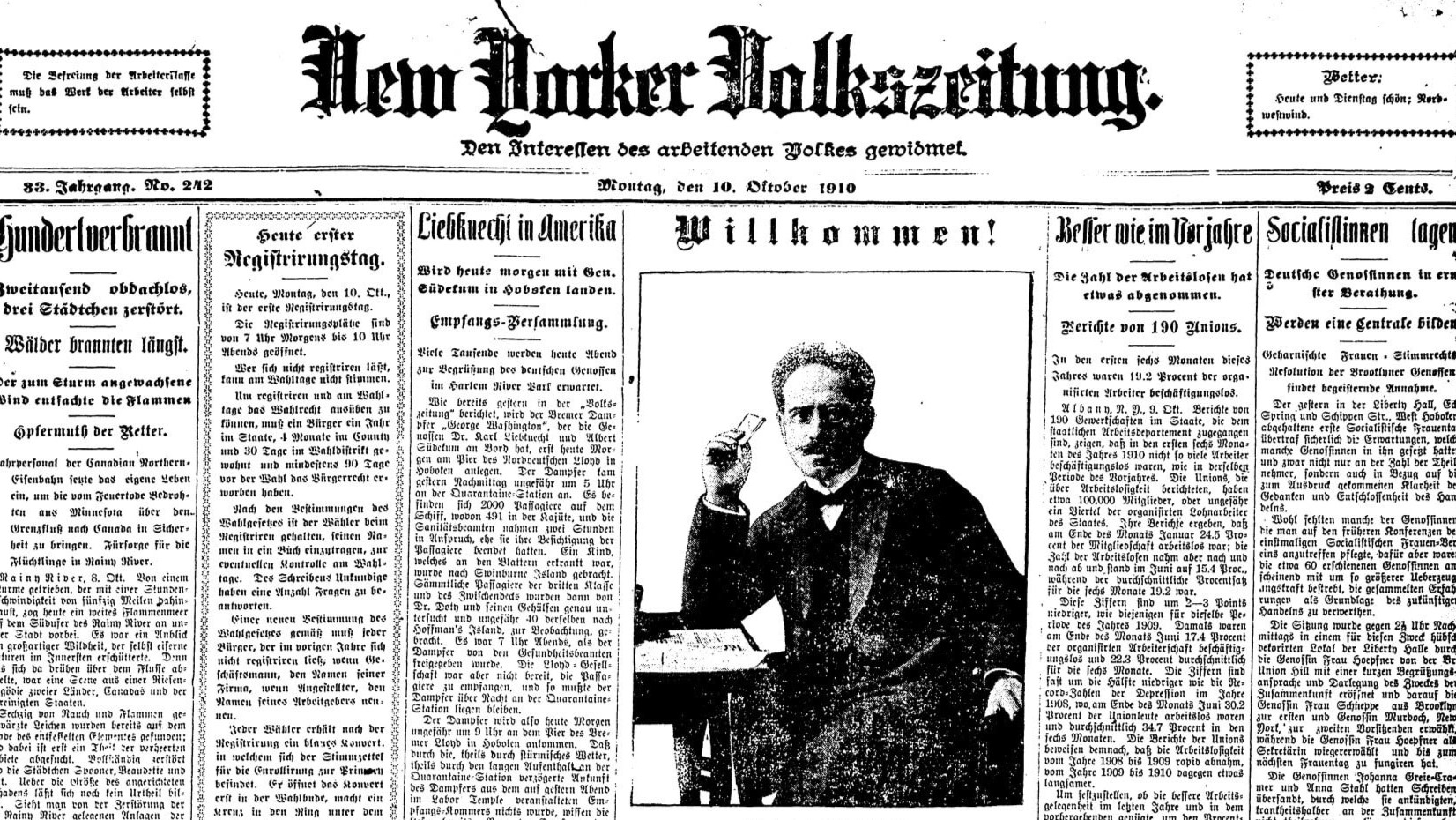
It says something about the movement in this country that what was, easily, the most important socialist newspaper in the country for decades was not in English, but the German-language New Yorker Volkszeitung. Founded in 1878, the venerable paper was already 33-years-old when Mailly, former S.P. National Secretary, wrote this history of it. It would continue for another 21 years under Ludwig Lore, finally closing publication in 1932, among the longest running in the history of the U.S. radical press.
‘The New Yorker Volkszeitung’ by William Mailly from The Coming Nation. Vol. 1 No. 19. January 21, 1911.
The history of the New York Volkszeitung dates from the inception of the modern phase of the working class movement in America. To write that history in full would be to record the development step by step of the German labor organizations in America to their present assured position of unquestioned power and substantial security, and to relate indirectly the origin and rise of the Socialist political movement itself.
The Volkszeitung is now thirty-three years old. It was born at a critical moment in the industrial life of the nation. For five years, following the panic of 1873, economic depression had lain heavily upon the land and working class conditions were ghastly and intolerable. The trades unions had been battered to pieces and their power rendered almost absolutely impotent. The German unions had suffered with the rest. The undisciplined spirit of discontent and revolt that conditions had gradually fostered among the workers had flamed out in the railroad strike centering at Pittsburg in 1877 and found manifold expression in industrial centers throughout the land.
That year ended disastrously for the workers. In New York a great strike of cigarmakers, ably conducted and supported with unexampled loyalty and endurance, failed miserably. The conviction began to gain ground that something more than industrial organization alone was needed, and that the attainment of political power was the chief means of betterment of working class conditions.
In 1871 the General Board of the old International was removed to New York and from then on the Social Democratic movement was represented always by one, sometimes by two German weekly papers, and at times by English weeklies. One of these German papers was The Voice of the Workers (Die Arbeiterstimme), which acted as the official organ of the Socialist Labor party in the United States, and of which Alexander Jonas was editor. This later became the Volkszeitung.
Meanwhile German daily papers sprang up elsewhere. The Forerunner (Der Vorbote) in Chicago was the most important, and later became Die Arbeiter Zeitung. Das Tageblatt appeared in Philadelphia, and the German workers of New York determined not to be left behind. They had extraordinary difficulties to contend with. The cost of publication was higher than elsewhere, the public expected a better quality of newspaper, and the New York Staats Zeitung, the capitalist daily, with its unlimited resources and a monopoly on the German reading public, left little to be looked for from advertisements. Another German daily of some standing had been forced to suspend because of the competition of the Staats Zeitung.
After much anxious deliberation as to ways and means, $2,000 was obtained in pledges, with $1,100 actual cash in hard. It was clear, even to the most uninitiated and enthusiastic, that with a weekly expense of about $900 as the cost of an edition of 5,000 copies, the total with which the Volkszeitung started, would last little more than a week. A reading public had to be guaranteed and to get this volunteer workers, numbering 278, undertook a house to house canvass of the city to secure subscribers. At last 4,000 subscribers were obtained and at a great meeting of Socialists, on motion of Jonas, it was decided that the first issue of the Volkszeitung should appear on January 28, 1878. And it was born on that date, with 5,500 copies as the first issue.
The scarcity of Socialists who were also journalists made it difficult to organize the editorial staff, which finally consisted of Alexander Jonas, editor-in-chief, Adolf Douai, associate editor, Robert Degen, city editor, who later became and still remains managing editor, and John Schaefer, labor reporter. A lot of young and inexperienced people acted as reporters and two professional writers, non-party members, received good salaries–on paper–and got whatever they could and were thankful for it. Sections New York and Brooklyn of the Socialist Labor party were the original owners of the Volkszeitung. Everything was decided by majority vote and the business of the paper was conducted by a board elected by then. Later, incorporation was effected under the name Socialistic Co-operative Publishing Association, and members of the sections were admitted by taking out a five dollar bond; afterward new members were voted upon by the association. Members of sections New York and Brooklyn of the Socialist Labor party are still admitted to membership under certain prescribed legal conditions. A constitutional provision. forbids any dividend on profits being declared but provides that all profits I shall be devoted to agitation.
The paper, as might be expected, had a stormy existence from the beginning. The finances were, of course, the source of the greatest trouble. The editorial and office force got what they could and that was very little, and the printers left 20, 25 and even 33 per cent of their wages standing to help along. Every worker that had a couple of dollars to spare loaned them and all sorts of fairs and concerts were given–and are still being given–but the Volkszeitung has cleared off all its debts, it is more prosperous than ever and its circulation, four times as great as at the start, has always, even in the worst times, kept a certain stability. The weekly issue, Die Vorwaerts, has a national circulation and the Sunday issue is noted for the excellence of its fiction and its musical, literary and dramatic reviews, as well as for its reports of the labor movements all over the world.
The Staats Zeitung fought the new paper bitterly, not through its columns, for after the first mention in two lines of the appearance of the Volkszeitung no word was printed about its rival, but through the distribution of the paper, and many conflicts were the result. At last the Staats Zeitung came to see that its tactics were useless and resigned itself to the inevitable.
From the beginning the value of the German Socialist daily was felt by the workers in New York of all nationalities and trades. Early in 1880 there was a lockout of the piano workers which was won and William Steinway, the leading employer, said that “the workers have in the Volkszeitung an organ with which we employers have nothing to compare.” Then followed an investigation into conditions in the New York breweries which resulted in the foundation of the present National Brewery Workers union by the formation of Brewers’ Union No. 1. The bosses who had been getting the brewers as they landed at Castle Garden, united in discharging the principal officers of the union. No strike was ordered at the union called for a boycott by the organized workers. Six days later the bosses capitulated, the discharged men were reinstated and all the union demands granted.
The Volkszeitung followed up this victory by exposing conditions in the bakeshops and Douai’s descriptions aroused the bakers to strike which took place on May first, 1881 and was surprisingly successful. The list of the bosses who settled filled a whole page of the Volkszeitung. An anti-rent agitation the same year prevented a threatened raise it rents and from then on there was a long series of strikes in which the Volkszeitung took part. Its first ten years were admittedly the most influential in its history, for through it dozens of unions were formed and inspired with the spirit of Socialism, thus laying the sure foundations of the powerful German labor movement, the movement which has always given so generously to Socialist propaganda and supported, morally and financially, every important, critical struggle involving working class interests.
No great crisis in the American labor movement but has felt the influence of this German labor movement and the Volkszeitung, the organ of the movement has been the chief instrument in furthering this influence. During the Haymarket affair in Chicago, the paper stood steadfastly by the condemned workingmen, and the American Railway union and coal strikes of 1894, the steel strike of 1901, the anthracite strike of 1902 and the Moyer-Haywood trial (to the expense of which the German and Jewish labor organizations of the country contributed more than any others) are but the most notable of the many industrial conflicts which the Volkszeitung has played a valuable part.
But the political education and organization of the working class has also received attention and the Volkszeitung has been a potent factor in its development. From 1877 to 1880 the Socialist Labor party had a strictly Socialist ticket in the field. From 1880 to 1886 tickets were only placed in the field in certain districts, the party being too weak to cover all districts. In 1880, however, the question of who should be supported in the presidential campaign came up. The troubles of 1887 had caused the capitalists to call for a government of the strong hand, and General Grant was expected to give such a government.
In order to unite the workers on an independent labor platform a convention of the Greenback party was held in Chicago to nominate a third presidential candidate. The Volkszeitung advocated the participation of Socialists in this convention on the ground that “there were some honorable elements in it striving for true working class politics and that Socialists do not make a group distinct from the fighting proletariat but should use every bona fide movement for their propaganda.”
This position caused differences among the various revolutionary elements, differences that had a decided influence upon succeeding events. But the Volkszeitung contended that this was the logical action to take at that time, as it served to introduce Socialism among the English speaking workers of the nation.
Then came the national eight hour movement which culminated at Haymarket Square in Chicago in May, 1886, to be followed by the orgies of blood which marked the frantic reaction in Milwaukee and other cities. In New York, a Judge Barrett sentenced participants in a union boycott on a music hall to prison for two and a half years. The Volkszeitung defied the judge and cried “On with the boycott The boycott went on and as a result more men were arrested and sentenced daily. A flood of rage was turned loose upon the Volkszeitung and its editor, Jonas. Judge Barrett declared himself in court that he had instructed the district attorney to bring criminal charges against both paper and editor. A great protest demonstration held in Cooper Union caused Barrett to become less belligerent and lighter sentences were imposed there after.
But this incident had a political significance not anticipated by politicians. The workers of New York were aroused to independent political action. The United Labor party came into existence. Then followed the famous campaign of Henry George for Mayor, supported by the Socialists. The Leader, an English daily paper was started on October 19, 1886, with Louis Post as editor. After George’s defeat, came the state convention at Syracuse at which the Socialists were rejected, the speedy collapse of the new party and the hanging of, Parsons, Spies, Fischer and Engel at Chicago on November 11, 1887. The Leader suspended publication at the same hour.
The Socialist Labor party resumed its independent political activity. In 1892 its first national ticket was placed in the field. In 1891 the Socialistic. Co-operative Publishing Association and the Socialist Labor party united in publishing The People, as the official organ of the party, with Lucien Sanial as editor to be later succeeded by Daniel De Leon. The People was really successor to The Workingmen’s Advocate, founded at New Haven, Conn., in 1883 and later moved to New York in 1889.
Differences between DeLeon and the Volkeszeitung over questions of policy and tactics culminated in what has been called the “revolution of July, 1899,” which split the S.L.P. and eventually led to the unity of the anti-De Leon faction with the Social Democratic party into the present Socialist party.
If the continued existence of the Volkszeitung has been due to the loyalty and devotion of its working class supporters, its influence has been due in great measure to the work of its editors. Some of the ablest German journalists have been members of its editorial staff during the past thirty-three years and it has never been without the best ability. Its first editor-in-chief, Alexander Jonas, is still an editorial writer, his service to the paper being interrupted only by trips abroad and illness. He is known as the veteran of the New York movement and he exhibits today a surprising mental and physical vigor for his 77 years. He is as eloquent a speaker as he is brilliant as a writer. His work has been sufficiently indicated in this article.
Herman Schlueter has been editor-in-chief since 1892. Schlueter was in prison two years in Germany for his Socialist activity, then was expelled from his native country, and later expelled from Switzerland, where he was on the editorial staff of the Social Democratic party organ. He came to America in 1889, and he cannot even yet return to Germany without risking imprisonment. He is the author of two authoritative works, “The Origin of the German Labor Movement in America” and “The Brewing Industry and the Brewery Workers Movement in America.”
Serge G. Schewitsch, the first editor of the Sunday Volkszeitung, returned to Europe years ago and he now resides in Munich. A striking personality, he was very popular while in New York, both as speaker and writer. His wife, who accompanied him here is known to fame as Helene Rackovicza, for whose sake Ferdinand LaSalle fell in a duel.
Until recently Julius Vahlteich, who was associated with LaSalle, in the founding of the German Socialist movement was Sunday editor of the Volkszeitung. He resigned to revisit Europe, where, as a Social Democratic veteran, he has received a warm welcome. He was succeeded by Ludwig Lore, who has brought youthful vigor, exceptional ability and much erudition to the work. Ludwig Jablinowski, one of the first reporters, is now city editor and Henry Stahl, formerly general secretary of the Workmen’s Sick and Death Benefit Society, is also a member of the staff.
The Woman’s department, under the editorship of Mrs. Meta L. Stern (Hebe) has for the past five years done a splendid work in educating the German working women.
Dr. Adolf Douai, first associate editor; Julius Grunzig, a brilliant musical and dramatic critic; Paul Lossau, a very able journalist, Jacob Franz, for years also editor of the Brewers Journal; Carl Schneppe, whose talented daughter Lore married two years ago; John Schaefer, the first labor editor–all these who contributed to the upbuilding of the Volkszeitung in the days of stress and struggle, have all passed on. The veterans are becoming fewer with the years. Among those remaining may be mentioned William Koenig and John Nagel, the latter having been president of the association for fifteen years. Frederick Krafft is the present business manager. The Co-operative Press, which does most of the printing for the Socialist and progressive labor organizations of New York, and the Socialist Literature company are offshoots of the association.
The Volkszeitung has had a momentous career, but its usefulness is by no means ended. That usefulness has really only begun in a certain sense for with the passing of the old generation there is the new generation to whom the Volkszeitung must address itself and in whom must be perpetuated that knowledge of Socialist principles and that indomitable Socialist spirit which made possible the beginnings of Socialism in America and gave initial impulse to the work of working class emancipation which we are now about to see bear full fruition.
The Coming Nation was a weekly publication by Appeal to Reason’s Julius Wayland and Fred D. Warren produced in Girard, Kansas. Edited by A.M. Simons and Charles Edward Russell, it was heavily illustrated with a decided focus on women and children.
PDF of full issue: https://www.marxists.org/history/usa/pubs/coming-nation/110121-comingnation-w019-volkszeitung.pdf
 Revolution's Newsstand