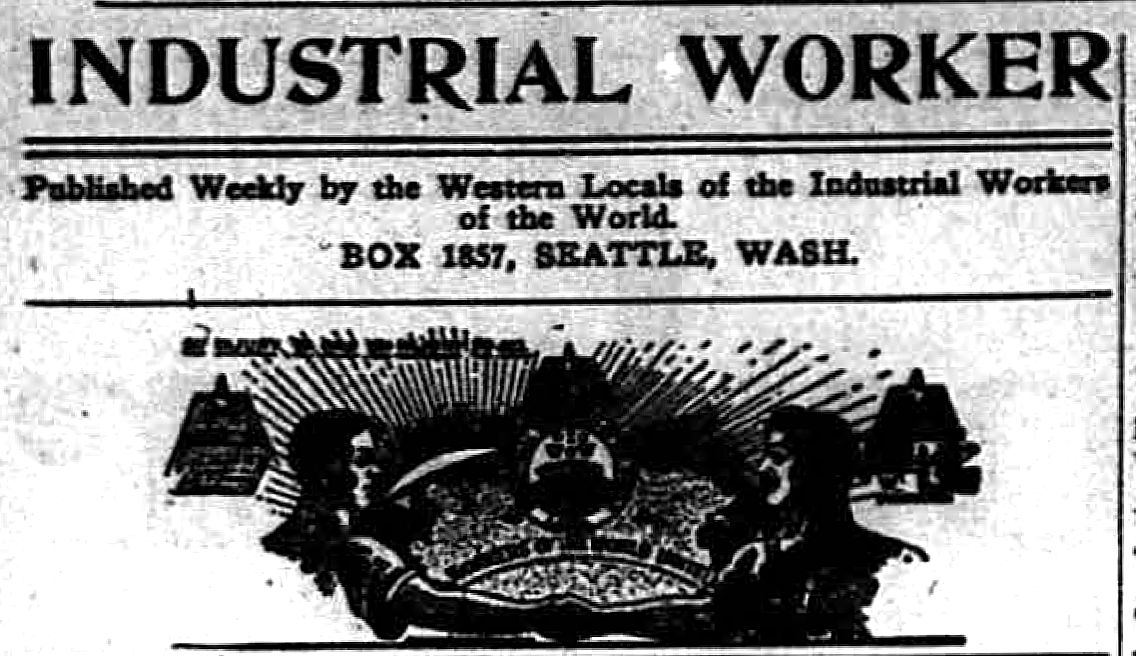
Charles Ashleigh welcomes the revival of ‘Industrial Worker’, paper of the western I.W.W. locals, published again after three years’ absence, this time from Seattle. Ashleigh, who as chief chronicler of the Everett Massacre and trials, would become one of the new paper’s highest profile authors, speaks of where the I.W.W. is at and the role of the revolutionary press.
‘Greetings!’ by Charles Ashleigh from Industrial Worker. Vol. 1 (new). No. 4. May 6, 1916.
I have just looked over the second number of the new Industrial Worker.
I was delighted to see a fighting paper started once more under the auspices of the rebels of the Pacific Coast. The makeup and contents of the paper are both excellent, and, if this standard is maintained. I think that the new Industrial Worker will equal, and–I hope–surpass the highest tide of popularity experienced by its old namesake.
It certainly recalled old times to look at the familiar titlehead on page one, and almost had the effect of making me “homesick” for the Coast, the scene of bygone exploits in which I participated.
There will, doubtless, be the usual number of croakers who will predict dire disaster for the Worker. It is true that revolutionary journalism is a fairly unstable thing at present, and that some forlorn hopes have failed. But that is absolutely no reason why we shouldn’t keep on going to it. The fact that we may have fallen down once will make us all the more determined to keep our feet this time. When the “wet blankets” blow in, just hint gently but firmly to them that there is plenty of voluntary work to be done in connection with the paper and that, if they don’t want to do it, they will oblige by taking a back seat, stifling their moans and leaving the field clear for those who are too busy plugging to knock.
Those who have stuck by the old I.W.W. ship for the past few years can see now some promise of the fulfillment of their desires. The organization is certainly beginning to reap the harvest of the widely sown seed of agitation. The work of Local 400, the A.W.O., in the harvest fields last year, and in the lumber camps; the organization of the lusty and rapidly growing Metal Workers and Smeltermen’s Industrial Union, Local 603, in the Webb City, Mo., district, and of 490 elsewhere in the same industry, the organization of the California A.W.O., 440, the organization of the hard-coal miners of Pennsylvania and the signs of movement and awakening among the Marine Transport Workers of both Coasts; all this points to a definite move in the direction of increased organization and the beginning of some substantial attainment of industrial control.
It is up to the membership to see that this impetus is not wasted but that what we have achieved be retained and more added to it. The spontaneous outbreaks of the unskilled workers in Bayonne, N.J., Youngstown, Ohio, and many other places show that there is a restlessness prevailing among the industrial slaves to which we should try to give intelligent direction along the lines of Industrial Unionism.
No greater weapon for these ends exists than that of a strong, vigorous, uncompromising proletarian press. The paper, the little silent missionary of the Revolution, carries the message of industrial freedom into a myriad places at once, breaking down the old, traditional conceptions of first this slave and then that, gradually and insidiously undermining the structure of the bosses’ society and preparing the way for the Grand House Cleaning. It keeps the isolated worker in touch with the striving of his class and cements the organization of those in the fight.
Revolutionary papers, however, like all others, cannot exist without a circulation and the membership must provide that. With the most enthusiastic and efficient editorial staff, with the most business-like and up-to-date circulation department, a paper’s existence still rests basically upon the efforts put forth by the membership to maintain it. This applies even more especially to a revolutionary paper that derives no income from advertising. Even in the days of my “prostitution,” when I eked out a more or less meager living purveying half-truths or whole lies for the capitalist press, I remember anxious periods when the failing circulation caused dyspepsia and corrugated brows among my bosses. How much oftener must such periods arrive for a paper that prints no advertising, carries no pimping paragraphs of “society” doings, licks no political party’s shoes for a subsidy, truckles neither to capital, state, law or “respectability,” and depends upon the awakened portion of the working class for its sole support?
Therefore, it’s up to the rebels! And, if the rebels fail, then I must be excused for having heavy doubts as to the reality of their rebellion!
But, who the hell’s going to talk of failure! We’re starting out with flags flying and the determination to succeed in building up strong husky organ of working class revolt that will contribute immeasurably to the destruction of scissorbilldom and the increased growth and success of the I.W.W. Now, all together!!!
The Industrial Union Bulletin, and the Industrial Worker were newspapers published by the Industrial Workers of the World (IWW) from 1907 until 1913. First printed in Joliet, Illinois, IUB incorporated The Voice of Labor, the newspaper of the American Labor Union which had joined the IWW, and another IWW affiliate, International Metal Worker.The Trautmann-DeLeon faction issued its weekly from March 1907. Soon after, De Leon would be expelled and Trautmann would continue IUB until March 1909. It was edited by A. S. Edwards. 1909, production moved to Spokane, Washington and became The Industrial Worker, “the voice of revolutionary industrial unionism and edited by James Wilson. Until the original’s 1913 demise it was mainly published from Spokane with editors generally alternating with National Conventions and including after James Wilson: F.R. Schleis, Frederick Heselwood, Walker C Smith, and John F. Leheney. Revived in April, 1916 and generally published out of Seattle the first new editor was J.A. MacDonald. In 1931 the paper moved to Chicago with the headquarters where it remains.
PDF of original issue: http://iw.applefritter.com/Industrial%20Worker/1916/1916%205%206%20IW.pdf
 Revolution's Newsstand