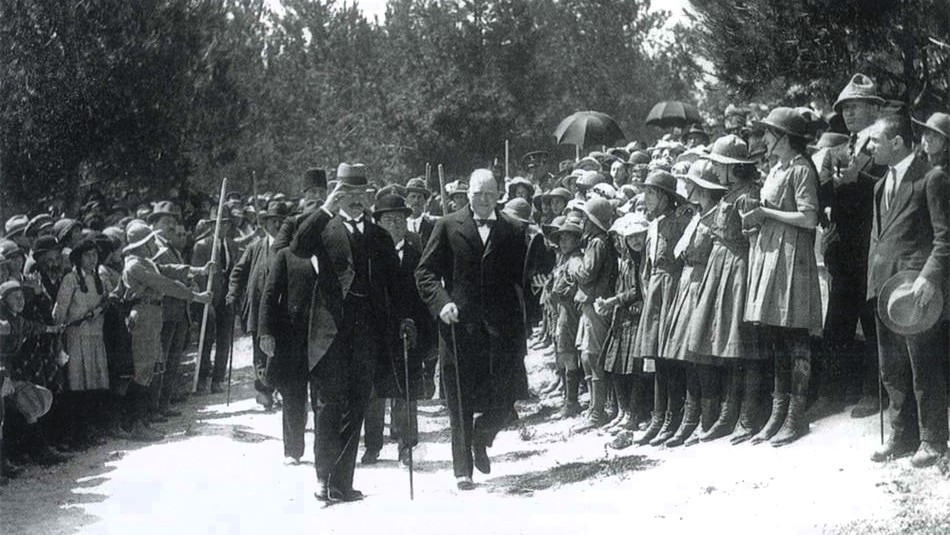
Bell on Churchill, newly made Colonial Secretary, as he visits His Majesty’s possessions with plans on their future division into states designed wholly in the interests of ‘the financial clique that runs the British Empire’.
‘Winston Churchill Visits the Middle East’ by Thomas Bell from Moscow. No. 4 March 28, 1921.
Through the name of Winston Churchill is synonymous in British politics with adventure, muddle, and bankruptcy that does not deter him from finding new scope for his swashbuckling career. The hero of Sidney Street, Antwerp, Gallipoli and Archangel–the secret compact with General Golovin and his White Guards will be fresh to everyone–has assumed a new role. He is now Colonial Secretary for Great Britain.
No sooner is he invested with the chains of office than he plans an excursion to the Middle East, presumably to see at first hand fresh fields for adventure. This man in the estimation of the heavily taxed middle class, may be mad but there is a grain of method in his madness. He is probably no more than a pliable tool in the hands of the financial clique that runs the British Empire. Of that we shall see presently.
The secret of his visit to the East has at last been given publicity and reveals the octopus of British Imperialism at work in no uncertain manner.
It is well known that since the Armistice strong feelings have existed between the British and American oil interests concerning Mesopotamian oil rights. The Yankees, apprehensive of a British monopoly, have protested against the machinations of the British Administration, alleging that it was sorting out the territory in its own interests.
With characteristic naivete the British reply is that such “development” as has already taken place has been purely for military and administrative purposes. With regard to oil, their interests they contend, have been limited to one well, to obtain a supply for military purposes, from a point nearer Baghdad than the Angio-Persian depot below Basrah. The ownership of the oil they say remains with the administrations now British, hereafter Arab which will not establish a monopoly though it may regulate the conditions of development.
They point out that the rights of exploitation conceded by Abdul Hamid were eventually leased early in 1911 to an Anglo-German body, the Turkish Petroleum Company, the German interests in which came during the war into British possession. These rights were transferred to France under the San Remo agreement in return for facilities for the construction of a pipe line to the Mediterranean through Syria.
Thus the Turkish Petroleum Company, now Anglo-French, has a vetoed interest in the oil of Mesopotamia. These interests, they argue against the Yankees, are not among the fruits of victory, since they were disposed of before the war. Such is the gist of the controversy.
Mr. Churchill has been to the East. It is now contemplated to run this pipeline as mentioned above from Mesopotamia to the Palestine port of Haido, a distance of over 700 miles. Obviously such a proposal cuts across the conflicting State interests of the small nationalities and has to be reconciled. This it is proposed by Churchill to do by “organizing a chain of native autonomous states federally related to Gt. Britain”. Thus Emir Feisul, the son of Hussein of the Hedjaz could rule Mesopotamia. The mountainous territory of Kurdistan, he suggests, should form an “autonomous province”. The country beyond Jordan is to be an independent state under Emir Abdullah. Palestine is to have a defence force composed of equal numbers of Jews and Arabs though the Arabs are said to number 85% of the population. King Hussein and the Imam of Genian (in Southern Arabia North of Aden) are to receive annual subsidies etc.
But supplementary to these arrangements, it is interesting to note that for present in the vicinity of this area, there no less than 112,000 armed forces. These are disposed of as follows: Constantinople 9,350, Egypt 18,030. Palestine 7,700, Mesopotamia 76,900. The cost of this army works out at L 37,267,600. Finally and this is probably the real secret of Churchill’s visit, it is proposed to establish an immense air station in Mesopotamia. This station to be a link between Gt. Britain, India and Australia. It is suggested that by such a station the route to Australia will be reduced to eight days.
Against the huge military expenditure Churchill promises curtailment since the “Royal Air Force” he says could then be the “paramount factor” and will police” the whole area.
The reduction and removal of the troops in the Middle East may be comforting to the natives who are promised “half determination”. They can hardly view with gratitude the prospects of a “Royal Air Force” that is to act as “Police” for the area, especially with such a man as Churchill at the head of affairs.
Moscow was the English-language newspapers of the Communist International’s Third Congress held in Moscow during 1921. Edited by T. L. Axelrod, the paper began on May 25, a month before the Congress, to July 12.
PDF of full issue: https://www.marxists.org/history/international/comintern/3rd-congress/moscow/Moscow%20issue%204.pdf
 Revolution's Newsstand