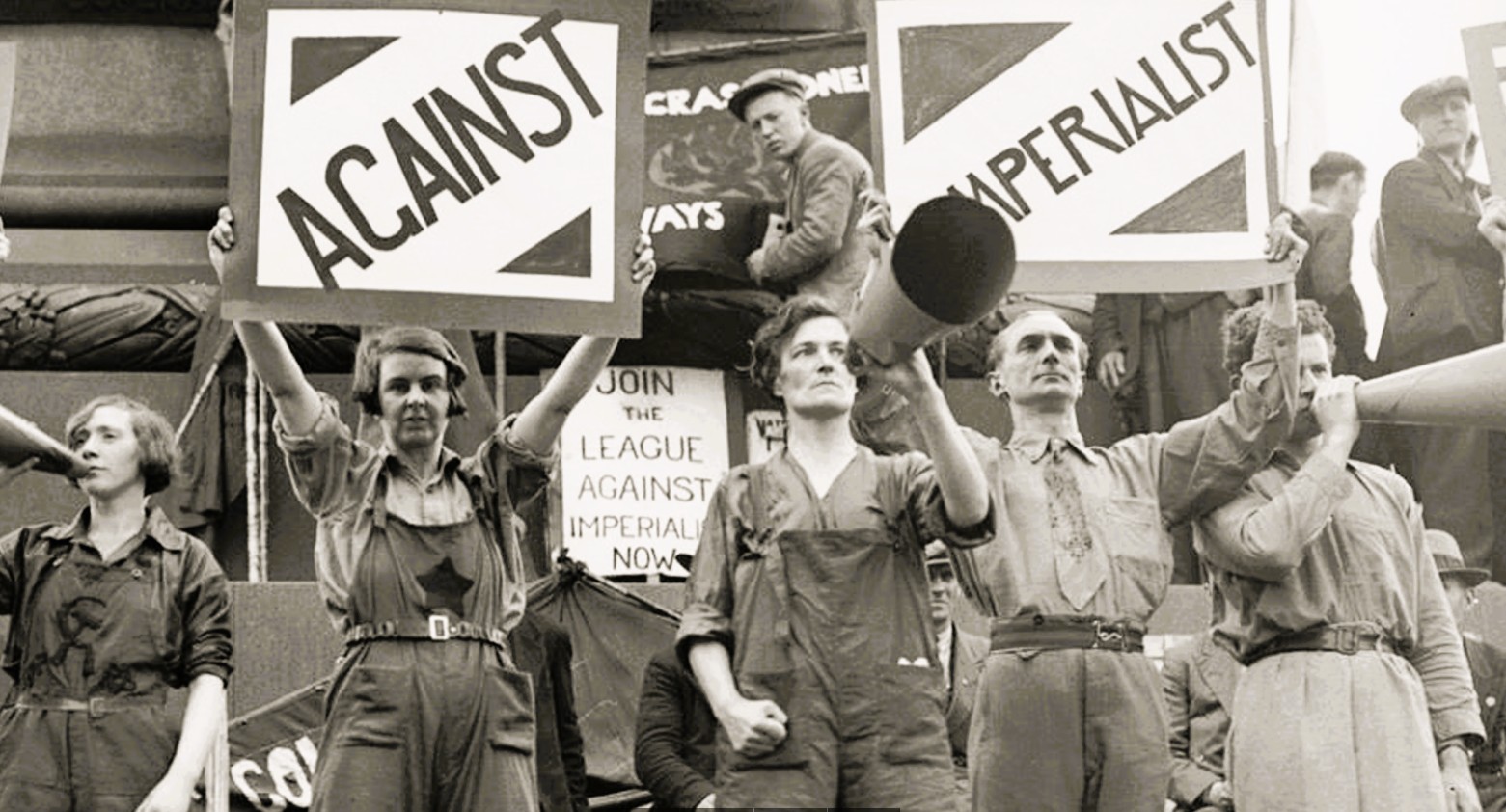
The General Secretary of the League Against Imperialism reports on the leadership meeting as the League was being transformed by events on the ground and the shift toward the politics of the Third Period by the Comintern. Gathering in preparation for the second International Conference would be held in Frankfort that summer the main topic was bringing trade unions specifically into the anti-imperialist struggle.
‘The Cologne Meeting of the League Against Imperialism’ by Willi Münzenberg from International Press Correspondence. Vol. 9 No. 5. January 25, 1929.
The meeting of the Executive of the “League Against Imperialism and for National Independence”, which took place a few days ago in Cologne, rightly aroused the attention and interest of broad proletarian circles and of the press.
The meeting was one of the most important held since the foundation congress of the League in Brussels. The Brussels Congress in 1927 was attended by two main groups: by the delegates of the national revolutionary movements and parties, and by a strong group of left-inclined intellectuals. The representatives of the proletarian organisations and trade unions constituted a small minority at the Brussels Congress. The leading organs of the League recognised this weakness in good time and have endeavoured to remove it. The Cologne conference has shown that these endeavours have not been in vain.
The most important item on the agenda was the question of the relations between the trade unions and the League. The delegates present showed in a most striking manner that the League has been strengthened on the proletarian and trade union side. From Great Britain there took part in the conference no less than nine men and women occupying prominent and leading positions in the English trade union movement. Of these we may mention A. Cook, secretary of the Miners Federation of Great Britain, S.O. Davies, Harry Pollitt, leaders of the Minority Movement, Alexander Gossip, Secretary of the National Amalgamated Furnishing Trades Association. There were also present: two representatives of the Trade union unity committee of Sweden, Baumgarten from the Basle trades council, Herclet from the C.G.T.U., Yue Fei, representative of the All-China Labour Federation, Ford from the American Negro Workers Congress, Soubri, the leader of the left-wing of the Arab national revolutionary movement, Fritz Heckert of the Red International of Labour Unions. As delegates from the trade unions of the Soviet Union here were present: Melnitchansky, Figatner and Josevitch.
Messages of greeting and expressing approval of the objects of the League were received from other trade union organisations, including the Finnish Trade Union Federation, the Peasants League and Trade Unions of the Philippines. During the meeting news was received that the Al-India Congress of Trade Unions had decided on collective affiliation to the League Against Imperialism. In addition to the big trade union organisations such as the trade unions of the U.S.S.R., the All-India Trades Union Congress, the Australian trade unions, the South African Trade union Congress, the Chinese Trade Union Federation, the English National Amalgamated Furnishing Trades Association, over one hundred trade union organisations and trades councils are collectively affiliated to the League. The League has thereby in the last few months greatly extended its influence among the workers and peasants and thus created a solid foundation on which it can proceed to carry out its international tasks.
The Cologne conference was the first occasion on which Russian representatives took part in a meeting of the League. The conference welcomed this fact by unanimously adopting an address of welcome which calls the attention of all organisations and friends of the League to the increasing danger of war against the U.S.S.R. and pledges them to prevent by every means the war against the U.S.S.R.
When dealing with the question of trade unions and the League, the two tendencies represented at the conference found sharp expression. One tendency, which was voiced by Cook, still cherishes the utopian idea of the possibility of convincing the reformists of the harmfulness of their actions and winning them for revolutionary work. Against this group the representative of the Russian trade unions, Comrade Melnitchansky. and Comrade Hecker put forward the programme of revolutionary class struggle and of fight against the conscious traitors in the labour movement. In his speech in reply. Cook at tempted to answer the attack and in so doing revealed a social-democratic point of view on certain points. Nevertheless Cook, as well as all the other non-Communists present, left no doubt whatever that he is ready to work with all energy for the League and for its fight against imperialism.
The resolution drawn up by Cook and Melnitchansky, and moved by the former, calls for a close co-operation of the anti-imperialist and national revolutionary movement: in particular the broad misses of the workers, especially the trade unions of the western countries, must take part in the work. The trade unions in the colonial and semi-colonial countries must be promoted without, however, the League interfering in the work of the trade unions. The resolution concludes with an appeal to all trade unions and workers to join the League.
It is clear that the differences of opinion between the two tendencies at the conference regarding tactics have not been removed with the unanimous adoption of this resolution. Comrade Melnitchansky rightly pointed out in his closing speech that the Russians will always fulfil their duty and call attention to all errors in the tactics of the workers’ organisations. It speaks, however, for the strength of the League Against Imperialism that it unites in its organisations representatives of national revolutionary parties along with intellectual Socialists and Communists and can carry on a discussion between representatives of different tendencies regarding tactics. The first attack on the League has been repelled by the British group under the leadership of Maxton, the chairman of the League. When Friedrich Adler, at the Brussels Congress of the II. International, called upon the Independent Labour Party of Great Britain to choose between the II. International and the League. Maxton declared a few days later at a mass meeting in Berlin that, faced with the alternative of going with Friedrich Adler against the League or of going without Friedrich Adler with the League, he would go without Friedrich Adler with the League a declaration which Maxton and the other members of the Independent Labour Party who appeared with him at the Cologne conference have emphasised.
In spite of the differences of opinion on the question of trade union tactics, the Cologne conference was united in conducting a revolutionary policy in the anti-imperialist struggle and unanimously demonstrated its readiness to exert all its forces against imperialist war.
This was clearly expressed in the speech by Saklatvala on the latest phase of the struggle for freedom in India and on the reactionary putsch in Afghanistan. In the decision adopted on this question the conference points out that the reactionary machinations in Afghanistan are to be attributed to the intrigues of England, and have as their object to disturb the peaceable relations of Afghanistan to the Soviet Union, to strengthen the influence of English imperialism and align Afghanistan in the war front against the Soviet Union.
It is quite understandable that the proceedings of the Cologne conference cannot give complete satisfaction when viewed from the severely critical standpoint of our Communist Party policy. The statements of some of the speakers betrayed illusions regarding the reformist leaders and their role in the proletarian class struggle and revealed a narrow outlook in regard to making use on an international scale of the experiences acquired in the proletarian class struggle.
It will be the task of the Communists in the League to continue the discussion of these questions which was commenced in Cologne. It would be a mistake, however, to restrict the work of Communists in the League or even to abandon the League on account of the existing differences of opinion. In the short period of its existence the League has proved that important sections and groups in the various countries are conducting a serious revolutionary fight against imperialism. Even if many leaders who made a big show at the Brussels Congress have gone over to the enemy, others have made great sacrifices for the anti-imperialist movement.
Others, such a Ghedli, the leader of the anti-imperialist movement in North Africa, have been condemned to long terms of imprisonment; Senghore and Mella have sealed with their lives their fidelity and devotion to the anti-imperialist movement.
The proletarian extension and growth of the League recorded at the Cologne conference is a further guarantee that the League has not got into opportunist channels, but, like its best sections in Mexico, in the Latin-American countries, in North Africa, in the Arabian territories and in India, is fighting with revolutionary and proletarian tactics for the correct anti-imperialist programme of the Brussels congress.
International Press Correspondence, widely known as”Inprecorr” was published by the Executive Committee of the Communist International (ECCI) regularly in German and English, occasionally in many other languages, beginning in 1921 and lasting in English until 1938. Inprecorr’s role was to supply translated articles to the English-speaking press of the International from the Comintern’s different sections, as well as news and statements from the ECCI. Many ‘Daily Worker’ and ‘Communist’ articles originated in Inprecorr, and it also published articles by American comrades for use in other countries. It was published at least weekly, and often thrice weekly.
PDF of full issue: https://www.marxists.org/history/international/comintern/inprecor/1929/v09n05-jan-25-1929-inprecor.pdf
 Revolution's Newsstand