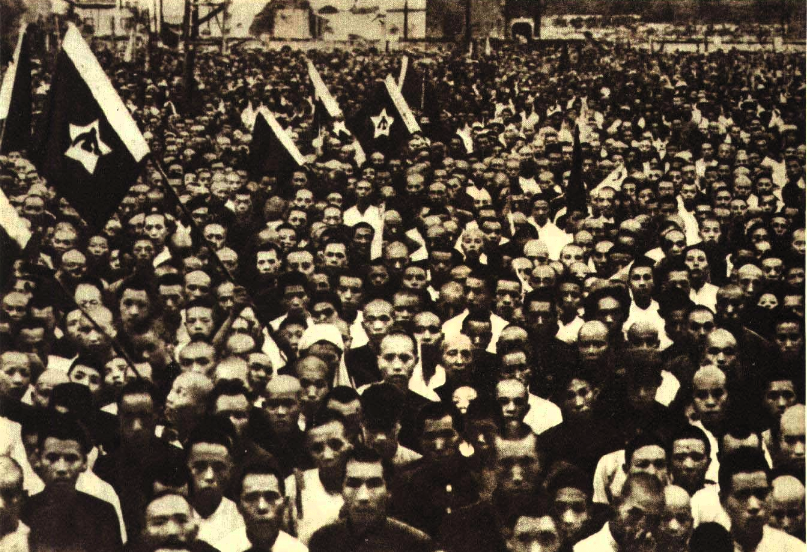
The Chinese Red Army begins setting up liberated areas as the First Civil War assumes its overall character; that of the Communists attempting to unite discontiguous zones of control while the Kuomintang attempted to encircle and eliminate isolated Soviet areas.
‘The Partisan Movement in China’ by A. Iwin from The Pan-Pacific Monthly. No. 37. June-July, 1930.
THE Red partisan movement in China assumes a more threatening character every day. It has already seized the whole of the Yangtse valley and the West river, has penetrated to the frontier of French Indo-China, is developing at a tremendously rapid rate in the province of Szechwan bordering on Tibet, is forcing its way through the province of Honan into the Yellow River valley, and having encircled the towns of Wuhan and Nanchang, is spreading eastward through the provinces of Anhwei and Chekiang to the chief industrial center of China; Shanghai, Nanking and Hanchow. The revolutionary village is attacking the chief strongholds of the Chinese reaction and is endeavoring at the same time to get into touch with the towns which are rapidly becoming revolutionary.
In the towns of Hankow and Wuchang (which with the town of Hanyang form the town of Wuhan), the influx of dignitaries and rich people who have fled from the surrounding districts to seek refuge in the town, has caused a serious housing crisis. A similar state of affairs prevails in the capital towns of other provinces and the great center of South and Central China, and to some extent also in North China.
Nevertheless, these dignitaries, in spite of all the discomfort and inconvenience, prefer to settle down in the capital town. But not in all of them. Nanchang for example, as we already mentioned, is encircled by the partisan movement and is even considered by the Kuomintang government of the province of Kiangsi to be endangered and the government is preparing to move to a safer place.
If even some of the provincial towns are regarded as so unsafe, what is to be said of the district towns? It suffices to reckon how many of these towns have been occupied only in the last two or three months by Red troops in order to obtain a fairly impressive picture. Meanwhile, it must be remembered that the number of towns occupied by the partisans is far less than the number of districts occupied by them.
Every district town which is recaptured by the regular troops from the partisans represents a blockaded island. Many of them even represent fortresses besieged by the inhabitants of the surrounding villages.
The victors of yesterday are today in a very unenviable situation. This applies to dozens of district towns in the provinces of Kiangsi, Fukien, Kwantung, Kwangsi, Hunan, Hupeh, etc. in which the partisan movement is growing and spreading.
The result is an extremely interesting situation. Districts, regions, whole provinces, are without “dignitaries,” “without authorities”: Who, then, is administering the country?
Let us have a look at the latest reports:
“In many villages in the frontier districts of the provinces of Fukien and Kwantung Soviet authorities have been set up. In one place a small arsenal has commenced working. The Soviet authorities have opened a number of propagandist schools. Men and women peasants are joining the Party in crowds.”
“Chuteh’s army has consolidated the Soviet Power in the West of the province of Fukien, where in spite of the blockade a Soviet government of West Fukien is functioning.”
“The government troops have discovered in the Pailulan mountains, a local Soviet government, various Soviet institutions, schools and such like.”
“The Soviet government has reorganized its troops and formed three new regiments. The staff of the Red Army is in Lunjank. In all the districts occupied by the Red troops, the State and private schools have been converted into Leninist schools in which Communism is taught.”
The above quotations suffice to show how, in place of the all-powerful gentry, the feudal big landowners and usurers; in place of the district administration of the Kuomintang, village and district Soviets are springing up. And this not in merely one province, but in the provinces of Kwangsi, Kwantung, Fukien, Honan, Hupeh, Szechwan, Anhwei, Kiangsi, Chekiang, and now also in Kiangsu.
Thus, in uninterrupted fights, revolutionary Soviet China is arising and growing. As we have already seen, this China, as regards its extent and population, is of incomparably greater importance than one might conclude judging merely from the number of district towns even though their number is by no means small-over which the red flag of the Soviets now proudly waves.
II
A few weeks ago the Kumintang press in Honan thought it was able to triumph. Thanks to a vile denunciation, the Honan authorities were enabled to arrest and execute the well-known partisan leader Ekweih.
Ekweih, who was born in Honan, was three years ago the vice president of the Peasants’ League in one of the district of Changsha. Later he organized a strong partisan detachment. Numerous punitive expeditions were fitted out and dispatched against him. A price of 2000 dollars was placed on his head. But all in vain.
A secret communication reached Changsha Ekweih was staying incognito in the town of Nansiang for the purpose of working out with the representatives of Holun, who is operating in West Honan, and with the representatives of the Communist detachment in the Hupeh border district of Tsiangli-Shishwo a plan for a simultaneous offensive with the Kiangsi 5th army corps under the command of Pen Tehu–as and the troops of Litchan in the South East of Hupeh.
“The arrest and execution of Ekweih,” declared the Kuomintang press full of indignation, “has not prevented the carrying out of the plan worked out.”
This is only one example of the coordinated actions of the Red troops in several provinces–in the given case of Hupeh, Honan and Kiangsi.
On the other hand, the imperialist press, especially the English, is repeatedly calling attention to the close contact maintained between the troops of the partisan armies operating in the provinces of Kiangsi, Fukien and Kwantung. Kiangsi thereby becomes a center, and the celebrated 4th corps of Chuteh, which is transferring its headquarters from one province to the other, becomes the main connecting link and, to a certain extent, the leading organ of the partisan movement.
Thus we see that, besides a rapid territorial extension of the partisan movement, which is embracing one district after another and one province after another, there is ever closer coordination of the, until recently, isolated actions of the workers’ and peasants’ army.
The Congress of representatives of the Soviet districts of China, convened by the CP of China, will be a further step in this direction. In addition, the Congress is confronted with an even more difficult task, namely, to establish the closest fighting connection between the partisan actions, the partisan war and the actions of the industrial proletariat.
Powerful as the partisan movement is already at present, the counter-revolution, which stands under the protection of the imperialists in the industrial and trading centers, cannot be finally crushed with the forces of the partisans of the Chinese village and of the small district towns alone. Without being burst from within, without the revolt of the industrial proletariat, which must have the hegemony of the revolutionary movement not only in the towns but also in the village, the main stronghold of the counter-revolution cannot be captured.
III
The red partisan armies have defeated regular troops more than once. In its fight which has already lasted more than two years, the 4th corps has disarmed more than one brigade. Even the bitterest enemies are compelled to pay tribute to the courage, the bravery and the strategy of the red partisans.
The improvised weapons, the primitive arsenals and the necessity to be very sparing with the munitions which have been obtained with so much difficulty, all these circumstances render it extremely difficult for the red troops to carry on an open and prolonged fight. Therefore the partisans, although they have dozens of times captured various district towns, have so far not succeeded in holding a town for long in the fight against strong punitive expeditions.
On the other hand, however, the regular troops are succeeding less and less in maintaining control on the other side of the city walls. Seized by the Sovietizing process, villages, districts and whole provinces, literally bristle with the lances of the insurgent peasants. In addition to the big troops of Chuteh, Ho-Lun, etc., there are arising numerous small detachments which serve to fill the gaps in the big formations and whose activity is frequently confined to the border of a district or even only to a village area.
The Chinese counter-revolution still manages to maintain its position in the towns, but it has already lost power over thousands of villages. And these thousands of villages are continually increasing. Chiang Kai-shek may boast as much as he likes that he has sufficient divisions at his disposal in order, without running the risk of weakening the front against his enemies in the North, to “establish order” in the Yangtse valley. But he will no more succeed in doing this than he succeeded in 1928 in “settling Communism in three months.”
It is true, Nanking has still numerous divisions at its disposal. But will it be able to rely upon these for long? Mutinies of the soldiers have for a long time been the order of the day. Desertions of soldiers from the regular armies over to the side of the red partisans are becoming more and more frequent. By means of energetic propaganda in the army, these desertions can assume a mass character, and in the coming insurrection of the industrial proletariat, this time supported by the red partisan army, can become the last thrust which will plunge the already doomed regime into the abyss.
The Pan-Pacific Monthly was the official organ of the Pan-Pacific Trade Union Secretariat (PPTUS), a subdivision of the Red International of Labor Unions, or Profitern. Established first in China in May 1927, the PPTUS had to move its offices, and the production of the Monthly to San Francisco after the fall of the Shanghai Commune in 1927. Earl Browder was an early Secretary of tge PPTUS, having been in China during its establishment. Harrison George was the editor of the Monthly. Constituents of the PPTUC included the Australian Council of Trade Unions, the All-China Federation of Trade Unions, the Indonesian Labor Federation, the Japanese Trade Union Council, the National Minority Movement (UK Colonies), the Confédération Générale du Travail Unitaire (French Colonies), the Korean Workers and Peasants Federation, the Philippine Labor Congress, the National Confederation of Farm Laborers and Tenants of the Philippines, the All-Union Central Council of Trade Unions of the Soviet Union, and the Trade Union Educational League of the U.S. With only two international conferences, the second in 1929, the PPTUS never took off as a force capable of coordinating trade union activity in the Pacific Basis, as was its charge. However, despite its short run, the Monthly is an invaluable English-language resource on a crucial period in the Communist movement in the Pacific, the beginnings of the ‘Third Period.’
PDF of full issue: fau.digital.flvc.org/islandora/object/fau%3A32140/datastream/OBJ/download/The_Pan-Pacific_Monthly_No__37.pdf
 Revolution's Newsstand