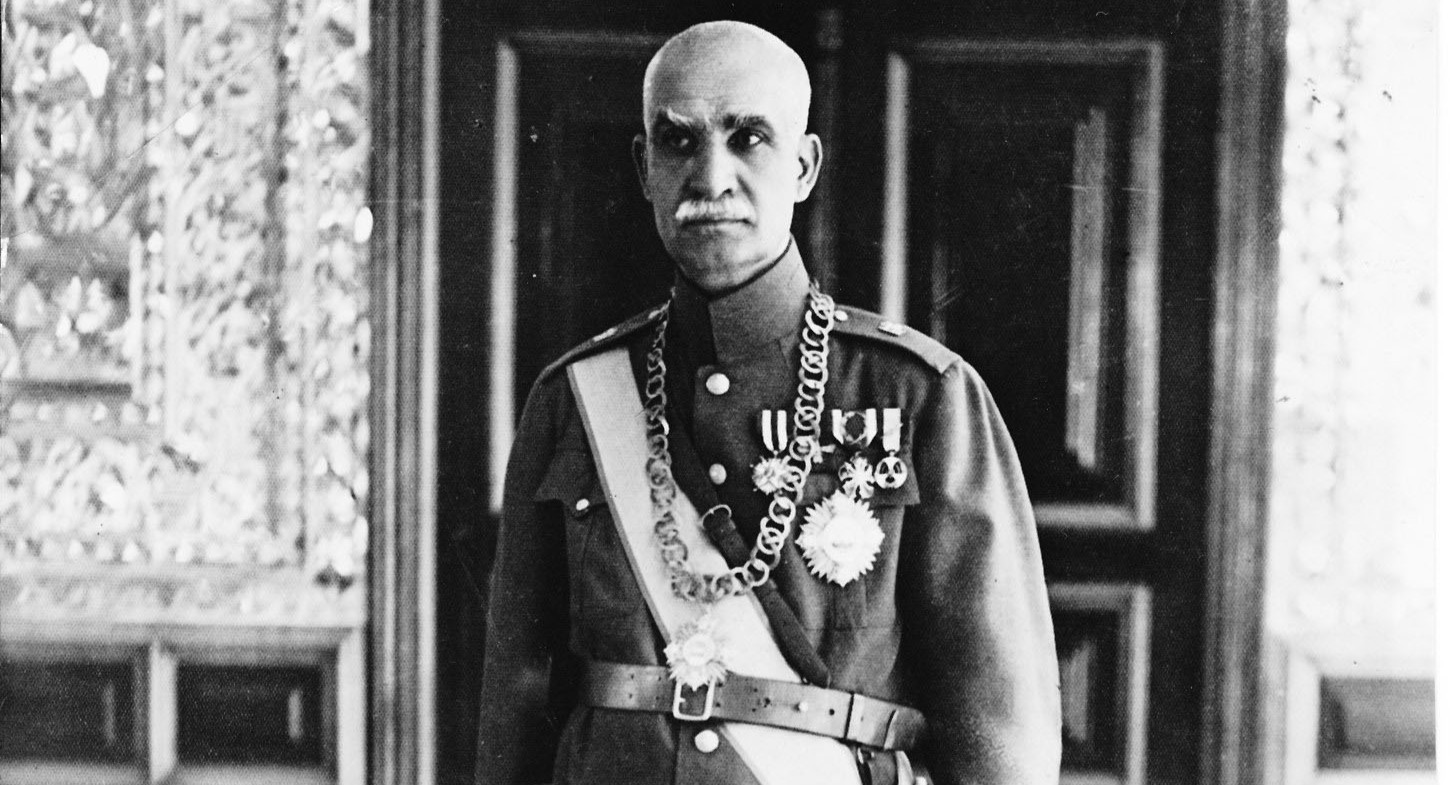
The story of the Pahlavi Dynasty’s coming to power in Iran with the regency of Reza Shah, grandfather of the current Pretender to the Throne.
‘The Struggle between the Monarchy and Republic and Change of Dynasty in Persia’ by Irandust from International Press Correspondence. Vol. 5 No. 79 & 89. November 5 & December 24, 1925.
The following article was written shortly before the overthrow of the Persian dynasty by the parliament which was reported on 31st of October. Ed.
The Monarchist demonstrations in Teheran, the capital of Persia, were followed shortly after by counter-demonstrations of a strong anti-monarchist movement. Whilst at the former the crowd mishandled members of parliament and abused the right of asylum of the Soviet Embassy, and at the same time demanded the return of the Shah who is at present residing abroad, the demonstrators in such big towns as Tabris and Ispahan are now protesting against the return of the Shah and are proclaiming a general strike to give force to their protest.
At the monarchist demonstrations the instigators of the movement did not venture to come forward openly, and had recourse to methods of provocation; at the anti-monarchist demonstrations the movement was led by the committees of the nationalists, who sent telegrams to the government and published appeals in the press. The monarchist movement did not extend beyond the main streets of Teheran and rapidly exhausted itself in a few riots; the great anti-monarchist movement, however, which has set in in the great trading cities of Northern and Southern Persia, seems likely to spread over the whole country.
There can be little doubt that the new outbreak of the anti-monarchist movement is attributable, to some extent, to the monarchist outbreak which immediately preceded it. These two outbreaks are symptomatic of those processes which commenced in the second half of the last century under the influence of the penetration into Persia of European capital, and which made unsuccessful attempts to find a solution in the Persian revolution of 1905-1909. These processes have, since the upheaval of 26th February 1921, assumed the form of a struggle of the semi-feudal monarchy with the bourgeois dictatorship of Resa Khan.
From the moment of the October Revolution in the Soviet Union, and, of course, especially from the moment of the conclusion of the Treaty between the Soviet Union and Persia of 26th February 1921, there arose those favourable conditions for the national emancipation movement in Persia which had formerly been lacking when Tsarist Russia had been the Northern neighbour of Persia. The national emancipation movement of Persia has now obtained a support.
But to the same extent as the military dictatorship grew stronger and Persia became modernised, the counter-actions of the Shah’s court against all progressive measures of Resa Khan also became stronger and more impudent. This led in October 1923 to a violent collision between Resa Khan and the Shah, as a result of which the Shah was compelled to leave Persia and Resa Khan, in addition to the armed forces, took over the control of all State affairs as Prime Minister. In the place of the Shah there remained in Persia the heir to the throne, who was bound by the pledge to refrain from any interference in the affairs of the State.
The bourgeoisie which had become stronger, saw in this the guarantee of its triumph over the old order, and in the Spring of 1924 raised the question of confirming its achievements by proclaiming the Republic. As is known, the Republican movement ended in a failure. The main reason for this failure was the ambiguous attitude of England who warned Resa Khan of the serious results for Persia this step would involve. English diplomacy recommended “lawful” means. It threatened with foreign intervention and the secession of Southern Persia, which prepared itself to become the place of refuge of the “lawful” power.
The question of the Republic was postponed, but its mere preparation had so terrified the Court, the upper clergy, the leading feudal landowners and also England, that the Autumn of 1924 they made an attempt to overthrow the military dictatorship. The only result of this insurrection was that Parliament placed Resa Khan in supreme command of all the armed forces of the country, and in this manner the power of the Shah was deprived of the fundamental privilege which was granted him in accordance with the Persian Constitution.
The government of Resa Khan which had sufficiently consolidated its position, undertook the carrying out of those most important reforms without which there can be no development of the productive forces in the backward countries of the East. Resa Khan submitted to parliament a number of bills regarding the reform of the system of taxation and the collection of taxes from the peasants.
Resa Khan, however, was intimidated by English diplomacy and, as a result, attempted in the Summer of 1925 to carry out the above-mentioned reforms by means of a temporary compromise with the Court and the clergy. An agreement was concluded with the leader of the groups opposed to him–with Moderres, a member of parliament. The main concessions of Resa Khan were: permission for the Shah to return to Persia, and acceptance into the Cabinet of three ministers to be nominated by Moderres, in return for this Moderres abandoned his struggle against Resa Khan and promised the support of his group for all bills introduced into parliament by Resa Khan,
By this agreement the question of the Republic was more or less buried. But this was only the case at the first glance. As a matter of fact, in entering into the agreement both sides reckoned upon obtaining certain advantages for themselves and strengthening their positions in the struggle. As regards Resa Khan, his aim in entering into this agreement was to enlarge the social basis of the regime set up by him and to facilitate the carrying out of the social reforms which he had in view. But at the very moment the agreement was concluded it was clear that something false was concealed in it and that the struggle between the two parties would be continued.
As a matter of fact only a few months had passed when Moderres, speculating upon the famine which had arisen as a result of a bad harvest, commenced a campaign against Resa Khan and in favour of the restoration of full powers to the Shah. This immediately aroused those circles who had supported Resa Khan and who did not wish any return to the old order. These circles rightly saw in the return of the Shah the beginning of the restoration and the loss of all the achievements of the years 1921-1925. It is precisely for this reason that in the great trading and industrial centres of Persia, the anti-monarchist movement has broken out afresh and strikes have been proclaimed under the slogan of prohibiting the return of the Shah to Persia.
The masses are warning their leaders. It is now quite obvious that Resa Khan made a mistake in entering into an agreement with Moderres and the Court, and it is probable that he will not fail to retrieve his error. For in spite of all its difficulties, another way must be sought for the solution of the tasks confronting the national government of Persia than that of compromise with reaction.
The Change of Dynasty in Persia.
The new Shah, Riza Shah Pahlawi, ascended the throne on 16th December. He has carried out in every form a definite stage in the development of the Persian State, for which the Dynasty of the Kadshars had in the last two decades been an actual corpse. The republican movement, which had repeatedly flared up in Persia in the last few years, was in its very nature an anti-dynastic movement and had put forward almost no economic and social demands. The lessons of the republican movement in Persia show that there did not exist in the country sufficient forces for a real bourgeois revolution, for a republican upheaval.
The real basis of the republican movement in Persia was the struggle for power between two hostile camps, between the old and the new Persia. In this struggle the slogans of the Republic were made use of as one of the tactical methods. This does not mean that the demand for the Republic does not now constitute a real programme for certain social groups in Persia. But up to the present these groups do not possess a sufficient political and social basis. The present political struggle in Persia has centred round the question of power and the struggle between the Shah’s court and Riza Khan.
The regime of the Kadshars was based upon the feudal traditions, and therefore condemned Persia to remain decentralised, with an almost complete independence on the part of the provinces, with anarchy in the sphere of administration, with a constant financial crisis and dependence upon foreigners, mainly upon the bank of England. Riza Khan, who first Khan, who first came upon the political scene in Persia in the year 1921, was at the head of the movement for centralisation, for the subjugation of the feudal lords, for the setting up of a strong state power in Persia. Thus an obstinate struggle between the two camps was unavoidable. The main forces of Riza Khan consisted in the army which had been reorganised by him, and his method of work was that of an almost undisguised military dictatorship. The energetic activity of Riza Khan in destroying all the remnants of feudalism, compelled all the forces of the old Order to rally together for the protection of the regime of the Kadshars.
The most important social forces of the camp of reaction consisted of the following groups: hereditary feudal lords leaders of tribes, and, connected with these leaders by bonds of political and economic privileges, the feudal land owners, nobles by birth, Court dignitaries and the higher clergy. The overthrow of the regime of the Kadshars meant for all these groups the end of their political power and privileges. The city bourgeoisie, the business people and craftsmen, the clerks and numerous officials joined the camp of Riza Khan. It was just here that the republican slogans corresponded with the demands of the most advanced sections of these groups. The main body of these groups, even if they were interested in the centralising work of Riza Khan, in the consolidation of the finances and in securing the safety of the commercial routes, feared, however, that on the other hand the further strengthening of the State power would impose heavy burdens upon the urban population, which endavoured with every possible means to escape the burden of taxation and of other financial obligations. For these groups the slogan of the Republic meant a hesitating commencement of a movement against a possible strengthening of the dictatorship of Riza Khan. The vacillating attitude of these groups in the Republican movement was one of the causes of this crisis.
The outbreak of the Republican movement in the early part of 1924 and in 1925 constituted, in its very nature, attempts on the part of the military dictator to overthrow the Kadshar dynasty, under the cloak of republican slogans. In this attempt he found no real support in those advanced sections of the Persian public whose interests are contrary to the regime of the Kadshars. The republican demonstrations revealed the extraordinary political and social wackness of these groups and their complete organisatory confusion.
On the other hand, the attempt at a Republican insurrection met with the strongest resistance of the combined forces of reaction, which succeeded in opposing to the military dictator a firmly-welded organisation, and bringing into movement against him all the forces of the feudal regime. Immediately after the republican movement of the year 1924, the whole of South Persia was involved in the revolt of the feudal lords against Riza Khan, under the slogan of the throne of the Shah and Islam. At the same time the influential leading section of the Persian clergy commenced a furious campaign against the heretical aspirations of the Persian reformer, thereby speculating upon the fanaticism of the masses, and did not even shrink from provoking the recent murder of the American Consul in Teheran. The result was that the diplomatic corps, with the English Ambassador at the head, expressed their lack of confidence in the political maturity of the regime of Riza Khan, while the clerical members of the Persian parliament brought forward an interpellation with regard to his bad foreign and domestic policy.
A similar situation arose in Persia in the Summer of 1925, when all the reactionary elements of the country not only brought about the defeat of the new wave of the republican movement, but even promoted the plan, according to which the Shah, who had spent the last two years in the pleasure resorts of Europe, should be brought back to Persia in order to subjugate, and afterwards to remove the dictator who was so dangerous to them.
It was in such circumstances that Riza Khan carried out in Teheran the October overthrow, by removing the Kadhsar dynasty without in any way determining the future form of government in Persia. It has now transpired that the overthrow was preceded by long negotiations of Riza Khan with individual groups in the camp opposed to him. Riza Khan, by intimidating the latter with the threat of a military putch and the growth of the republican movement, succeeded in getting some influential groups to come to a compromise, according to which he apparently undertook certain pledges regarding the latter being allowed to maintain their privileges.
All the circumstances of the October overthrow in Persia go to indicate that it was the result of a compromise between Riza Khan and the conservative camp. Riza Khan maintains that the form of government in Persia is without importance, provided real power remains in the hands of those who continue to lead Persia along the path of progress. Objectively considered, however, the situation is more complicated. The Pahlawi dynasty came to power by a compromise with the powers of the Past. This ties its hands in the sphere of economic and social reforms which young Persia requires.
The partial deflection to the Right of the social basis of the regime of Riza Khan renders probable the organising of the advanced elements of Persia outside the frame of the new regime, if the latter does not meet their demands. The events and the economic reforms of the last few years, which have given rise to fresh social sections, have already created the conditions for the further growth of new forces. The Republican movement in Persia has not only not come to an end, but it is only just commencing, and its further strengthening will proceed side by side with the economic development of Persia and the growth of the young Persian bourgeoisie.
International Press Correspondence, widely known as”Inprecor” was published by the Executive Committee of the Communist International (ECCI) regularly in German and English, occasionally in many other languages, beginning in 1921 and lasting in English until 1938. Inprecor’s role was to supply translated articles to the English-speaking press of the International from the Comintern’s different sections, as well as news and statements from the ECCI. Many ‘Daily Worker’ and ‘Communist’ articles originated in Inprecor, and it also published articles by American comrades for use in other countries. It was published at least weekly, and often thrice weekly. A major contributor to the Communist press in the U.S., Inprecor is an invaluable English-language source on the history of the Communist International and its sections.
PDF of full issue: https://www.marxists.org/history/international/comintern/inprecor/1925/v05n79-nov-05-1925-inprecor.pdf
PDF of full issue: https://www.marxists.org/history/international/comintern/inprecor/1925/v05n89-dec-24-1925-inprecor.pdf
 Revolution's Newsstand