
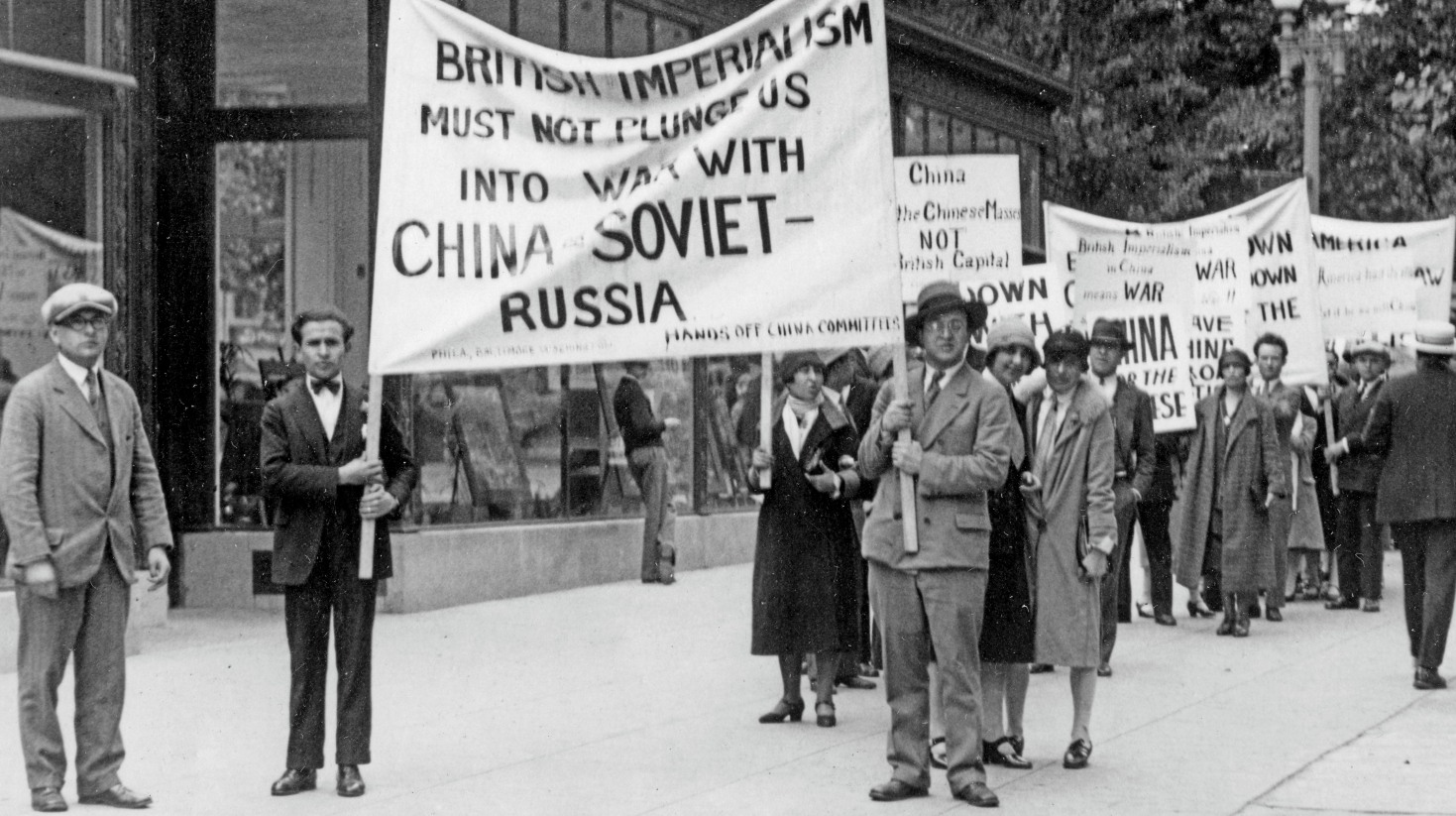
During the 1920s and 30s, August 1st, the anniversary of mobilization for the First World War in 1914, was set aside as Anti-War (sometimes Anti-Imperialist) Day to highlight current dangers around the world and tasks of the movement. Conflict began to heat-up in the late-1920s as WWI faded and U.S. power rose. 1927 saw, among many other events, a massive escalation of the wars in China and international interventions there, with the United States occupying Shanghai, as well as invading Nicaragua and expanding its intervention in Latin America, notably with threats against Mexico. All under the backdrop of the original Cold War as direct intervention against the Soviet Union was largely replaced by a global campaign of imperialist hostility, including blockade and economic sanctions. Below is the resolution of the Seventh Plenum of the Executive Committee of the Young Communist League held June, 1927 as preparation for August 1st were underway.
‘Young Communists and the Struggle Against Imperialist War’ from International Press Correspondence. Vol. 7 No. 45. August 4, 1927.
1. Imperialist War and the Youth.
The warnings of the C.I. and the Y.C.I. concerning the imperialist war menace are vindicated by recent events. The imperialist powers are already making war on the Chinese people which is fighting for its freedom. And now, after prolonged preparations, the attack on the fatherland of the workers of the world the Soviet Union, has also begun. Chang Tsolin’s raid in Peking was followed by the breaking off of relations with the Soviet Union by the Tory Government, which was a signal for the assassination in Warsaw and a number of criminal schemes carried out in the Soviet Union by counter-revolutionary-imperialist elements. Today the imperialists use against the Soviet Union the language of isolated assassinations and bombs; tomorrow armies and fleets will be put into motion against the first workers’ State. Although it is as yet impossible to predict exactly when it will come to a warlike attack on the Soviet Union, one should be certainly already prepared for the worst. We are at the beginning of a big imperialist war which has started in China, which is threatening now also the Soviet Union, and which will cause a conflagration throughout the world.
2. Struggle against Imperialist War and Militarism and Defence of the Russian and Chinese Revolution is therefore the Main Task of the Y. C. I. at the Present Juncture. This is so not only for general reasons, but also because the Youth play a very special role in this question. Today the Youth constitute the majority of the armies and of the mass liable to be called up for military service. It is the youth who will be the first to be called to the colours and who will be the most numerous war victims. But the mass of the present youth were not directly involved in the last imperialist war, and therefore do not know what an imperialist war really is. This makes them particularly amenable to the imperialist and militarist agitation of the bourgeoisie, which was never as strong as at present in the preparation of coming wars. The problem is made even more acute by the bourgeois military reforms, as a result of which compulsory military, or at least mass military training of the youth is introduced in an increasing number of countries. Liebknecht’s saying “Those who have the youth have the army” is more applicable today than ever before.
The Y.C.I. must do its utmost to get the working youth away from the influence of the bourgeoisie and to mobilise them for struggle against imperialist war and militarism, All Y.C.L. must fully and clearly realise that at the present juncture struggle against imperialist war and militarism is our main task. In accordance with this they must reorganise their entire work, adapting it to conditions prevailing in their respective countries.
3. On the eve and at the beginning of new big wars, the Y.C.I. declares together with all its Sections, that they will work with all their might for the slogan “war against war and transformation of the imperialist war into civil war” for the overthrow of capitalism, and that they will defend to the last drop of blood the Soviet Union and the Chinese Revolution. They will do their utmost to mobilise the mass of the working youth side by side with the adult workers, and to prevent by revolutionary mass actions, strikes, general strike, etc., further imperialist attacks on the Soviet Union and China, fighting at the same time energetically against any imperialist war menace, in the event of war, Young Communists will be for the defeat of their own imperialist governments, and at the same time they will work with the utmost energy for the victory of the revolutionary armies of the Soviet Union, of China and of the oppressed colonial peoples. They will carry into the ranks of the soldiers and sailors at the imperialist front the slogan of fraternisation and of siding with the armies of revolution. They will bring to the masses of young workers in the factories and in the fields of the rear and to the young workers in the belligerent armies the message of revolutionary class struggle against the bourgeoisie of their own country, the message of revolution for the purpose of putting an end to the detestable imperialist war and the domination of capitalism. The action of the Youth International, which has profited by its experiences and actions in 1914-18, will be repeated by the Y.C.I. with increased energy and on a larger scale.
Progress and Defects in the Anti-Militarist Work of the Y.C.I.
4. The anti-militarist work of the Y.C.I. has been considerably strengthened lately on an international scale and in a number of the most important countries. First and foremost in France, where our League has developed a complete system of activity in this sphere which is working admirably. Next comes Great Britain where our League, although not very strong, has carried on real Bolshevik anti-militarist work prior to and during the general strike, and also recently in the struggle against intervention in China. Moreover, the work has also been given an impetus on an international scale (as is witnessed, e.g. by the anti-militarist action during the visit of the British fleet in the Baltic). In the course of this activity, we have greatly improved and developed the methods of our anti-militarist work.
But in spite of its enormous importance, particularly just at present, the problem of struggle against militarism (work in the army) and imperialist war has hitherto been solved in a satisfactory manner only by a certain number of Y.C.I. sections, whereas it has been badly neglected by most Sections. Some Sections, and particularly those in Central Europe (Germany, Austria, Czechoslovakia) and part of the Scandinavian (Norway) Leagues have utterly underestimated the importance of this question. This is due partly to the fact that, quite erroneously, they did not think themselves closely affected by the war peril, and partly because of a certain “national limitation”, i.e. they showed themselves incapable to link up international events with the life and struggle of the working class of their respective countries. The work in Germany, however, has been improved since, and particularly so since the Congress of the League in Hamburg, and an active mass campaign has been launched against the war danger. Also in Sweden the League carried on among the masses a campaign against the menace of war and has utilised it well to strengthen its organisation. Some Leagues did not observe the international anti-war week (March 10th to 17th) because they had to attend to “more important” tasks in “their own” country. This caused the anti-war week to give in general no satisfactory results, except in Great Britain, France and Italy.
Other Leagues again limited themselves to general propaganda, but omitted the most important thing practical and regular work in the army and navy. This is a gross error which must be energetically remedied. Moreover, there is still a great confusion of ideas among the members of a good many Leagues an regard to our fundamental principles in the question of militarism and war, and this has led to a series of gross errors, particularly in the direction of pacifism.
In spite of the warnings of the last Enlarged Executive, the anti-war and anti-militarist activity of the Y.C.L. of America is still of a dangerous pacifist character. For the elections it issued the Social Democratic demand: “Reduction of armaments” and it also carried on its otherwise correct campaign against participation in the military training camps, in a purely pacifist tone; on the other hand, it does very little anti-militarist work, and its anti-imperialist work in the army and its struggle against the war in China is insufficient.
The Latvian League adopted in its agitation the same pacifist tone against the “soldiers murder” profession in general. Similar phraseology can be found in other Leagues. The dangerous and erroneous slogan put forward by certain comrades at the Czech Congress of the working youth: “Without us war is impossible and we refuse to go to war!” deserves strong condemnation. This slogan is contrary to the most elementary principles of Leninism that “the boycott of war is a senseless phrase”, that Communists and workers must participate in war in order to convert it into civil war. A similar attitude can be found also in various other Leagues.
Erroneous was also the slogan supported by the Y.C.L. of Austria for a democratic “peoples militia” embracing all classes. Some comrades accompanied this slogan with the declaration that it is essential to defend the Austrian democratic republic against any possible attacks on the part of Fascist Hungary and Italy. It is of the utmost importance to expose these sophisms circulated by the Social Democrats and to show that Austria, too, is only a factor in the game of the imperialist powers, and that the arming of the proletariat and the conquest of power by the proletariat in Austria represent the necessary guarantee against all attacks by the Fascist States.
An error of a different kind has been committed by some Italian comrades who foresee that the result of a war will be the collapse of Fascism and the ushering in of revolution, and who therefore do not want to stir a finger against the war preparations. Such fatalism is utterly incorrect. It is only by energetic resistance to imperialist war and militarism now in time of peace, through mass actions as well as through work in the army, and also during the war, that imperialist war can be converted into civil war and into victorious revolution. The Central Committee of the Italian League has energetically combatted such tendencies.
There is also confusion of ideas among Japanese comrades in regard to militarism and military training of the youth, and the Japanese League has neglected work in the army.
Side by side with the great enlightenment and mobilisation campaign which we have to carry on among the working youth, the Plenum declares that it is essential to carry on an intensive enlightenment and educational campaign on the principles and methods of our attitude on the question of War and militarism also in the ranks of our own members, in order to overcome all errors, particularly pacifist errors and in order to put an end to the underestimation of practical work in the army.
Y.C.L. Tasks.
5. The Plenum of the Y.C.I. identifies itself with the theses of the C.I. on war against the imperialist war adopted at the last Plenum of the E.C.C.I. These theses indicate also the general lines for the activity of the Y.C.I. against imperialist war and militarism and in defence of the Chinese and Russian Revolution.
6. The immediate task of the Y.C.L. is the development of a big and active solidarity campaign for the Soviet Union and the Chinese Revolution. This campaign should be carried on from day to day on the basis of concrete events, and it should be adapted to the situation prevailing in every country. In this campaign the Leagues in Poland and in the Border States play a particularly important role. The aim of the campaign should be:
a) Spreading enlightenment among the mass of the working youth and counteracting Social Democratic and bourgeois propaganda and sophisms (including explanation and popularisation of the character of the Red Army and of the national revolutionary Chinese Army).
b) Mobilising the mass of the working youth for active mass actions in conjunction with the adult workers: mass meetings, demonstrations, formation of committees of action, protest strikes, fraternisation with troops, prevention of the dispatch of troops and munition transports of the imperialist powers through strikes and other means, agitation and preparation for the general strike for the purpose of preventing further attacks, propaganda on the necessity of bringing about the defeat of one’s own imperialist bourgeoisie and of the transformation of the imperialist war into civil war.
c) Strengthening work among the armed forces of imperialism in the “metropolis” and in the colonies and China, bringing about fraternisation between the soldiers and sailors of the capitalist armies and the revolutionary soldiers and armies and at the right moment also the going over of the latter to the side of the revolution.
7. The Plenum pointed out that the most important task of Y.C. Leagues in the entire sphere of struggle against imperialist war and the defence of the Chinese and Russian Revolution is work in the army and navy. This work must be carried on systematically, and for this purpose a well-organised apparatus and an illegal organisation must be established within the army. One nucleus within an army section is more useful than many leaflets. Leagues which do not as yet possess an apparatus and an organisation for this work must consider it their foremost task after this Plenum to establish such an apparatus. Any delay and any negligence in regard to this question means an offence against our fundamental task in our struggle against war and would have serious consequences for our future practical work.
This work should cover the entire activity among the armed forces, from the military training of the youth, via the recruits to the standing army and navy and down to the demobilised soldiers and reservists, the gendarmerie and the police of the type of the “Schutzpolizei” and certain Fascist organisations (the Stahlhelm type). It should be carried out jointly by the Party and the Y.C.L.
Every League must have a programme of concrete partial demands for the members of the armed forces (army, navy, airfleet). This programme should contain demands in regard to the political and economic rights of soldiers, their juridical and economic position, and details of the military regime. It should also contain demands for the national minorities and colonial troops. Connected with these partial demands and the struggle for the soldiers’ trade union and political rights, is agitation for the formation and recognition of delegates and committees of soldiers, sailors and reservists (barrack committees, ship committees, etc.). The latter are, of course, something different from soldiers’ councils, which are to be formed only in connection with the formation of workers’ and peasants’ councils. The political basis of our work is: connecting the struggle for soldiers’ and sailors’ partial demands with our agitation for general slogans such as: fraternisation and the general political slogans of the Party and the Y.C.L. on the one hand, and of the struggle for soldiers’ demands and slogans in the army with the struggle of the working class outside the army on the other hand. Such is the basis for the disintegration of the imperialist army and its winning over for the revolution.
The Plenum of the C.I. adopted a special resolution for practical work among the armed forces which the Plenum of the Y.C.I. adopts on this question, and it puts forward that resolution as a direction for the work of the Leagues.
8. Y.C.L.s should carry on an energetic struggle against the introduction of obligatory military training of the youth. This struggle should begin already in school. But they should not approach this struggle from a pacifist standpoint, they should expose the class character of this measure and its role as a contributing factor to the armaments for imperialist war, setting against it voluntary military self-training of the workers (Red Jungsturm, Jeunes Gardes, Anti-Fascistes, etc.). Just such campaigns the Y.C.L. should carry on against the voluntary military training of the youth, taking at the same time steps to disintegrate it from within. Where military training of the youth is a compulsory part of the imperialist army system, our attitude to it and our work in it is analogous to our work in the army itself, i.e. we must go into it and learn the military profession. in order to utilise it in the service of the proletariat and to disintegrate and revolutionise this part of the army system. Just as in the army the Y.C.L. put forward partial demands for those doing obligatory military service, such as a better regime, continuation of pay, free Sundays, etc. Moreover, the military training of the youth gives us even wider opportunities for work than the army itself.
9. The application of the united front in the struggle against the imperialist war and in defence of the Russian and Chinese Revolution deserves special attention. The Young Socialist International as a fighting factor against imperialist war has suffered a complete fiasco even before the war had actually started. Whilst remaining inactive itself it has placed all the responsibility and the tasks in this sphere on the Second International. Politically, however, it shares with the latter its worst machinations for the ideological justification of the imperialist war and the attacks on the Soviet Union and China. This was particularly evident at its last year’s Congress in Amsterdam when Fascism, and Bolshevism were placed on a par. The policy of the leaders in the various countries is the same as the policy of the Social Democrats. The so-called “Left” sections, such as the British, Austrian, etc., which certainly expressed their sympathy for China and Soviet Russia in so many words, are mostly concerned about pacifist propaganda, and are thereby contributing to the disintegration of the working class, and are thus actually helping the bourgeoisie. Still it is precisely in the ranks of the Young Socialist Leagues that the treacherous policy of the Social Democrats in regard to war has called forth particular opposition, as for instance in France, Great Britain and Germany. The opposition groups work partly on revolutionary and partly still on pacifist lines. However, this confused idea of pacifism prevailing among the rank and file of the working youth (for instance of Guilds of Youth, of the British Independent Labour Party, which demand at the same time against war, the united front with the Y.C.L. and the Y.S.L. and individual refusal to do military service), which has its origin in the sincere desire to struggle against imperialist war, cannot be placed on a par with the conscious bourgeois pacifism of the Social Democratic leaders. The Y.C.L. must struggle against the pacifist illusions of the masses by patient work of enlightenment.
The situation demands more energetic application of united front tactics and at the same time more determined exposure of Social Democratic propaganda and of the sophism and pacifism of the leaders in regard to war. In practice this means that in view of the utter treachery of the Y.S.I. and its attitude to the united front with the Communists, we cannot reckon with an international united front between the Y.C.I. and this organisation. Moreover, we have to concentrate on the united front from below, whereas the united front with the leading organs on a national scale in connection with the question of war can only be contemplated on rare occasions, and even then for very limited tasks. But matters are different in regard to the opposition (local, district or national) organisations. In regard to them, united front tactics must be fully applied. At the same time the errors on the half-measures of the opposition, especially in the question of war and pacifism, must be combatted openly.
It appears now, in the light of the new situation, that the recent plenum solved in the right and proper manner also the questions of permanent unity committees, whose business it is to carry on the struggle of the working youth in general (whereas united front committees are formed only for limited tasks and for the duration of a definite campaign), namely that such permanent committees are to be formed only on a factory and local scale, on the basis of a mass movement occasionally on a district scale, and never on a central scale. United front with pacifist bourgeois organisations can be in contemplated only exceptional cases, for instance, in America on a local scale and for very definite tasks (for instance campaign against voluntary preliminary military training), care being taken that there should be complete dissociation from the pacifist standpoint and energetic struggle against it. Even this should take place only where such organisations embrace large numbers of workers. Otherwise and generally speaking, united front tactics with these organisations should not be applied.
10. It is essential to reorganise the organisations of the Y.C.L. in accordance with the outlined tasks. For instance, it is of the utmost importance to carry on special recruiting and organisation work, and to acquire and build up strong organisations in war industry centres and in ports. We must also be fully prepared for a more energetic offensive and persecutions on the part of the bourgeoisie, which will certainly endeavour to drive the Y.C.L. underground. Our Leagues must be prepared for this and should not delay reorganising themselves for this contingency. The plenum specially stresses this task.
11. Special importance attaches to systematic work in trade unions, particularly in those connected with heavy industry and transport, where our economic trade union and also our political work must be strengthened. The trade unions should maintain contact with their members who join the army through institutions as “sous des soldats” (Soldiers financial aid), etc.
Another particularly important branch of work is in the factories themselves.
The decisions of the Y.C.I. on the necessity of securing a firm footing in factories and on the reorganisation of our organisations on a factory group basis acquire particular importance in connection with the struggle against the imperialist war and the new situation which is being created. Therefore our Leagues must endeavour to put them into practice with the utmost energy and as soon as possible.
International Collaboration.
12. Closest international collaboration is essential for the struggle against the imperialist war menace and for work in the imperialist armies. This collaboration must be established between two or more Leagues affected by a conflict (Morocco, China, attack on the U.S.S.R., Italy, Yugo-Slavia), or by an imperialist movement (for instance, visits by fleets, expeditionary and occupation corps), and there should be establishment of direct connection and leadership through the Y.C.I. Joint work against imperialist war is also necessary between the Y.C.L. and the revolutionary organisations of the struggling colonial peoples and China, since only in this manner does the slogan of fraternisation get a real basis. In this sense the work of the Executive of the Y.C.I. itself must be directed primarily towards the struggle against the imperialist war.
International Press Correspondence, widely known as”Inprecorr” was published by the Executive Committee of the Communist International (ECCI) regularly in German and English, occasionally in many other languages, beginning in 1921 and lasting in English until 1938. Inprecorr’s role was to supply translated articles to the English-speaking press of the International from the Comintern’s different sections, as well as news and statements from the ECCI. Many ‘Daily Worker’ and ‘Communist’ articles originated in Inprecorr, and it also published articles by American comrades for use in other countries. It was published at least weekly, and often thrice weekly.
PDF of full issue: https://www.marxists.org/history/international/comintern/inprecor/1927/v07n45-aug-04-1927-inprecor-op.pdf
 Revolution's Newsstand