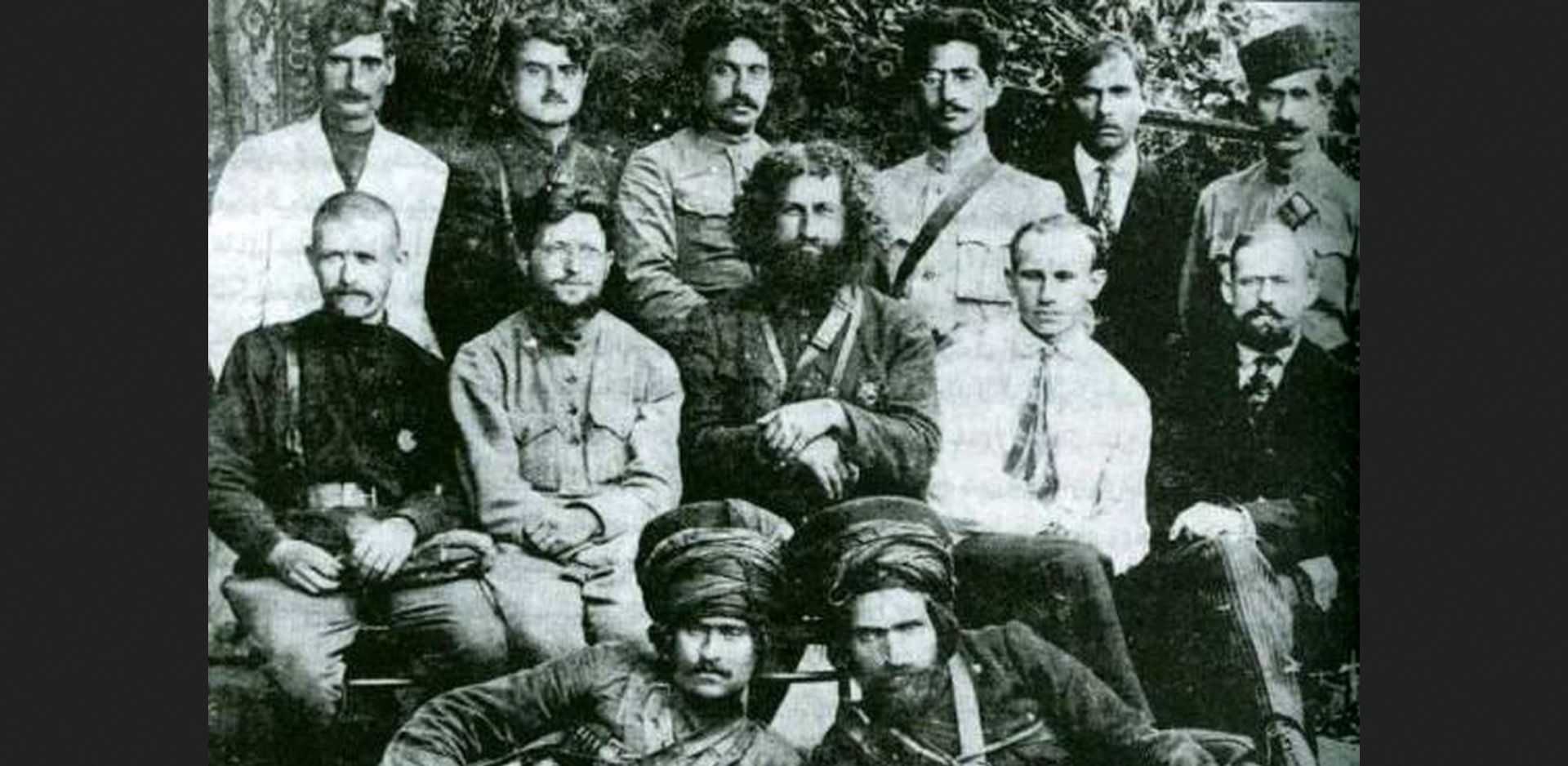
An early revolution inspired by the overthrow of Czarism sees the establishment of the short-lived Gilan Soviet Republic under the leadership Kuchuk-Khan and his Persian Red Army.
‘The Revolution in Persia’ by A. Leontiev from Soviet Russia (New York). Vol. 3 No. 11. September 11, 1920.
[An interview with Comrade Voznesensky, in charge of the Eastern Department of the Commissariat of Foreign Affairs, on the Revolution in Persia.]
Persia is on fire. A revolutionary Provisional Government has been formed in Resht. The entry of our troops into Enzeli seems to have given wings to the Persian revolutionists. They felt the proximity of fraternal support. In an interview with one of our collaborators regarding the significance of the Persian revolution for Soviet Russia the Director of the Eastern Department of the Commissariat for Foreign Affairs, Comrade A. Voznesensky, said:
“At the head of the revolutionary government is Kuchuk-Khan. He was one of the most active among the Persian revolutionists of 1908. He is a nationalist, and has a burning hatred for the enslavers of Persia, the English, and the Teheran government which sold itself to them. When Persia became a field for military activities after the outbreak of the world war in 1914, and was invaded by British, Russian and Turkish forces, Kuchuk-Khan formed his own detachments, which were named ‘forest brothers.’”
After the solemn declaration of Trotsky regarding the annulment of the former treaties, which was followed by the evacuation of our troops from Persia, Kuchuk-Khan inaugurated a definite orientation toward Soviet Russia, and began to act with more energy against the English. He captured Resht several times, and arrested the English consul. Strong forces were repeatedly sent against him, but they could never capture him, because he was hiding in the mountains and had the support of the broad masses of the people, who idolized him as a hero. The numerical strength of Kuchuk-Khan’s forces fluctuated between one thousand and eight thousand men, depending on the extent of the revolutionary activity. At present, before the capture of Teheran, Kuchuk considers the uniting of all the Persians as the most important task. When the capital city passes into the hands of the revolutionists, social reforms will be inaugurated, and first of all the land reform, since side by side with many large land owners Persia has an enormous mass of destitute agricultural laborers. Kuchuk’s program includes the nationalization of the banks and custom houses, and also the introduction of an income tax.
As early as the summer of 1918, Comrade Kolomeyzev was sent to Kuchuk-Khan with a special letter addressed to the Persian people. The letter did not reach Kuchuk. Kolomeyzev was captured by the English and shot. We nevertheless succeeded in establishing connections with Kuchuk. Besides Kuchuk, in Western Persia, in the district of Kusaan and Shyrvan, there is the insurrectionary activity of Dokhol-Khan, aiming at the liberation of the sacred city of Meshkhed, which the English are using as their base. This movement also became stronger after the meeting at Enzeli. It may lead to momentous results. For the revolution will undoubtedly pass from Western Persia into Sestan over the railway line that is now being built, and thence it will inevitably spread to Afghanistan and Beluchistan. And when Afghanistan is aflame, the fire will spread to northern India. Kuchuk’s insurrection thus acquires the importance of a world event.–Petrograd Krasnaya Gazeta, June 10.
Soviet Russia began in the summer of 1919, published by the Bureau of Information of Soviet Russia and replaced The Weekly Bulletin of the Bureau of Information of Soviet Russia. In lieu of an Embassy the Russian Soviet Government Bureau was the official voice of the Soviets in the US. Soviet Russia was published as the official organ of the RSGB until February 1922 when Soviet Russia became to the official organ of The Friends of Soviet Russia, becoming Soviet Russia Pictorial in 1923. There is no better US-published source for information on the Soviet state at this time, and includes official statements, articles by prominent Bolsheviks, data on the Soviet economy, weekly reports on the wars for survival the Soviets were engaged in, as well as efforts to in the US to lift the blockade and begin trade with the emerging Soviet Union.
PDF of full issue: https://www.marxists.org/history/usa/pubs/srp/v3n08-aug-21-1920-soviet-russia.pdf
 Revolution's Newsstand