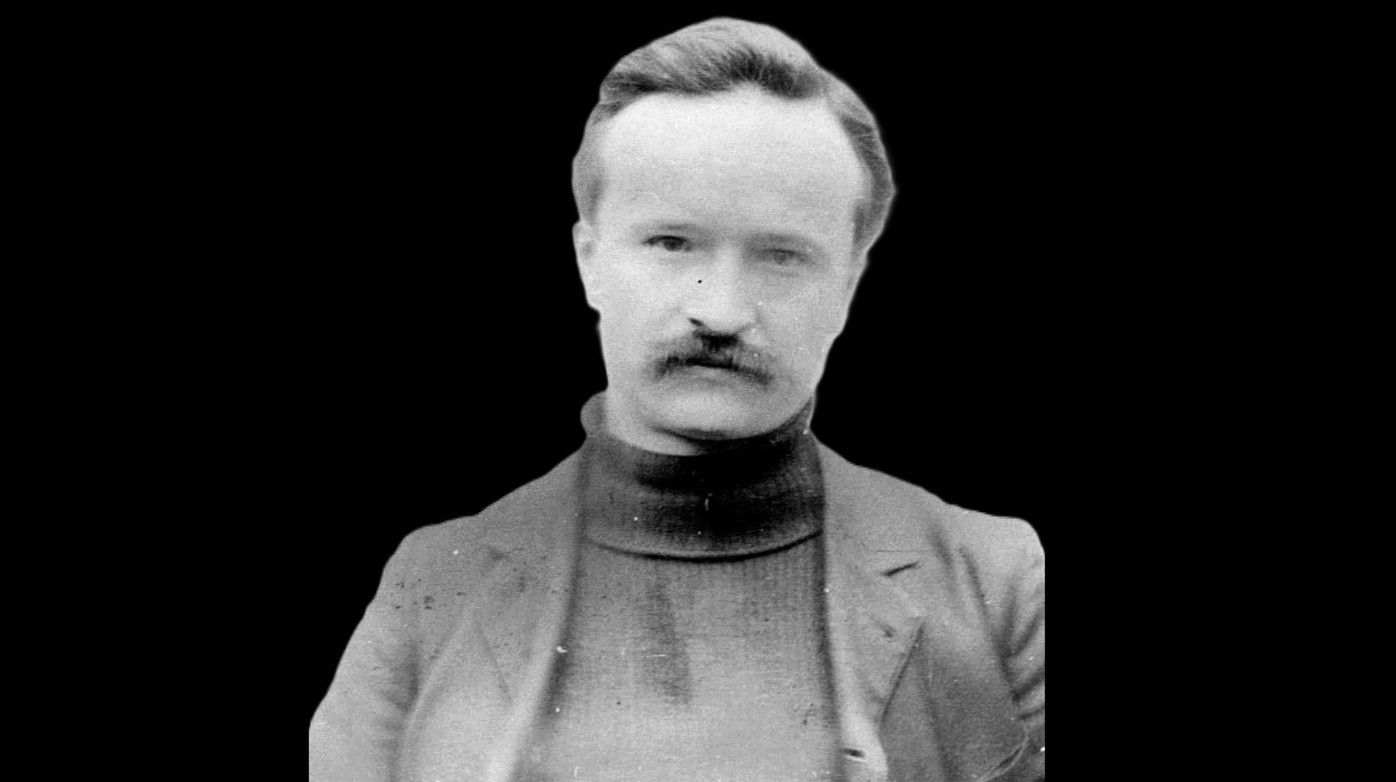
Leading French syndicalist resigns from his positions in the Confédération générale du travail over its support of French imperialism in the First World War. Monatte would be drafted and sent to the front, retaining his anti-war position and leading the revolutionary syndicalists at the end of the war.
‘Letter of Resignation’ by Pierre Monatte from Solidarity. Vol. 5 No. 262. January 16, 1915.
The following comes to Solidarity from Paris, in the form of a printed statement, in French. The author, Pierre Monatte, was the managing editor of “La Vie Ouvriere,” (Worker’s Life), a semi-monthly syndicalist review of considerable influence in France. He refused to submit to the censorship of his magazine, and suspended publication at the opening of the war. Monatte was also a member of the Confederal Committee (corresponding to a general executive board) of the C.G.T., representing the central or “departmental” unions of the Departments of Gard and Rhone, similar to the states of this country. Monatte’s statement is worthy of attention, as showing that the French syndicalists, including the much heralded militants were as completely swallowed up by the war wave as were the German social democrats:
WHY I RESIGN FROM THE CONFEDERAL COMMITTEE.
To the Departmental Unions of Gard and of Rhone:
Comrades: After the vote taken at its session of the 6th of December, by the Confederal Committee, I deem it my duty to surrender the credentials you have entrusted me with. Here are the reasons which have dictated my determination:
During the past five months, it is with stupor, with grief, that I have seen:
The Confederal Committee simply record the acceptance by its general secretary of an official commission from the government of the nation;
Some weeks later, the Confederal Committee despatched a message to Bordeaux consenting to make a circuit of (union) conferences to aid the government;
A number of militant syndicalists, officials of organizations, use the language of pure nationalists.
Today, the Confederal Committee reached the point of refusing its sympathy to efforts made in behalf of peace by the socialists of neutral countries.
According to the Confederal Committee, to speak of peace at the present moment, would constitute a sin, would be almost treason–a sort of complicity in a German maneuver–all the same as for the “Times” or for the government itself.
Under these conditions, it is impossible for me to remain longer in its ranks; for I believe, on the contrary, that to speak of peace is a duty incumbent, in these tragic hours, upon labor organizations conscious of their role.
Nov. 22nd, the confederal secretary made known to the committee an invitation to a conference of socialists of neutral countries organized by the Scandinavian Socialist parties, to meet in Copenhagen, Dec. 6 and 7.
In opposing its being referred to the order of the day, I made the following proposal:
That the C.G.T. reply assuring the Scandinavian socialists that even if it was impossible for us to send a delegate we would nevertheless follow their efforts in behalf of peace with the utmost sympathy and that we would make our vows for the success of the conference at Copenhagen.
At the Confederal Committee’s session, November 29, the Federation of Metal Workers deposited a resolution motived or inspired by the same spirit, which I supported with emphasis.
How and by whom was it opposed? By what arguments? It would take too much space to say here; but the minutes of the Confederal Committee–Nov. 22, Nov. 29 and Dec. 6–will doubtless inform you in the near future.
Dec. 6, the Confederal Committee faced three propositions: First, one from the Federation of the Building Trades, to the effect that the committee should make no response; second, one from Luquet, bearing some important restrictions and asking the accord of the C.G.T. and the Socialist Party upon a common text of reply; finally, that of the Metal Workers.
The Committee pronounced itself in favor of the proposition–prejudicial in character–of the Building Workers, adopting the same by 22 votes against 20, with 2 abstaining.
It is beyond doubt that the proposition of the Metal Workers would have been defeated, Dec. 6, by a strong majority.
Thus, once more, the appeals of socialists, in behalf of peace found no echo in the French central organization, nor in the labor press of the country, the latter even going so far as to refuse to reproduce them! Appeals and initiatives conforming, too, to the resolution of the international socialist congresses of Stuttgart, of Copenhagen, and of Basle, which declares:
“In case war breaks out nevertheless, it is their duty (of the working classes) to undertake to make it cease promptly, and with all their forces to make use of the economic and political crisis created by the war to stir the masses most profoundly and to hasten the downfall of the powers that be.”
That duty, Keir Hardie and the Independent Labour Party of England have endeavored recently to fulfill; also the two Russian socialist parties; likewise the Italian and Swiss socialists in their conference at Lugano, and the American Socialist Party by its initiative of an international socialist congress extraordinary.
It is the duty that Karl Liebknecht tried to discharge and with him a minority of the German social democracy–by his protest in the Reichstag, Dec. 2:
“What we must demand,” said he, “is rapid peace, humiliating no one, peace without conquest. All efforts directed to this end ought to be supported. Only the continuous, simultaneous affirmation of this wish in all the belligerent countries can stop the bloody massacre before the complete exhaustion of all the people’s interested. Only peace based upon the international solidarity of the working class and the liberty of all the peoples can be a durable peace. It is in this sense that the proletariats of all the countries, even in the midst of this war, ought to make a socialist effort for peace.”
It is comprehensible, in a certain measure, that the masses of the people, deceived and excited daily by the press by all the press should have accepted as articles of faith all the governmental declarations.
But that the militants of syndicalism should not have shown more insight; that they should not have brought more of the critical sense to the examination of these governmental declarations; that they should have let themselves be caught by the fever of national vanity; that they should have lost the remembrance of principles which hitherto have guided their action–that is the saddest spectacle!
When Poincare (it will be two years next month) ascended to the presidency of France, certain ones among us said: “We shall have war before the end of his term.”
We had it in less than two years after.
This war, foreseen, dreaded, by us; this war, desired, prepared, by our politicians of the national spirit–this it is that the majority of the Confederal Committee now looks upon as a war of liberation for Europe, a war capable of bringing liberty and the republic to Germany and ruin to universal militarism. What illusion!
This war, for which the “attentat of Sarajewo” (the assassination of the Austrian crown prince) was only a pretext, has its real sources in the Anglo-German economic duel in the Germano-Slav rivalry.
The Russian alliance, already the shame of the French Republic, has precipitated our country into the gulf. The Russian alliance and the Moroccan ambitions of our colonials.
The Kaiser was only able to advance the hour of the European conflagration. His responsibility for it is weightier than that of any other government; but that of the French, Russian and English governments is by no means light.
Moreover, it is not established that the French government did everything possible, in the last week of July. to safeguard peace. There is no doubt that secret diplomacy–whose misdeeds have so many times been denounced–played a considerable rile in the declaration of war.
The enlightened workers of the belligerent nations cannot accept the least responsibility for this war; it rests entirely, upon the shoulders of the rulers of their countries. And, far from the former discovering reasons for allying themselves with the latter, they can only reaffirm their hatred of capitalism and of the state.
It is necessary today, more necessary than ever, to conserve jealously our independence, to hold resolutely to those conceptions of ours, which are our “reasons for being.” If one thinks them false, what shall one say! Then only would one have the right to support nationalism in all its forms–nationalism political and economic.
But I fear very much, that our central organizations, in France as in Germany, C.G.T., as well as Socialist Party, Trade Union International as well as Socialist International, have only exhibited their failure.
They showed themselves too feeble to prevent the war, after so many years of organized propaganda. But one may say again. that the fault lies perhaps with the masses, who have remained separated from one another and who have not comprehended the duties of internationalism. This last glimmer of hope vanishes amidst the words of the militants of one country after another. It is at the center that the fire, that is the faith, has gone out.
If humanity is to know a day of peace and of liberty, in the confines of the United States of the World, only a socialism more real and more ardent, arising disillusioned from the present, baptized in the streams of the blood of today, can bring it into being.
It is not, in any case, the armies of the allies, any more than the old dishonored organization, which can do it.
It is because I believe, dear comrades or the Gard and of the Rhone, that the C.G.T. has dishonored itself by its vote of Dec. 6. that I renounce, not without sadness. the credentials you have entrusted to me.
PIERRE MONATTE, Titular Delegate of the Union of the Gard, Substitute Delegate of the Union of the Rhone.
PDF of full issue: https://www.marxists.org/history/usa/pubs/solidarity-iww/1915/v06-w262-jan-16-1915-solidarity.pdf
 Revolution's Newsstand