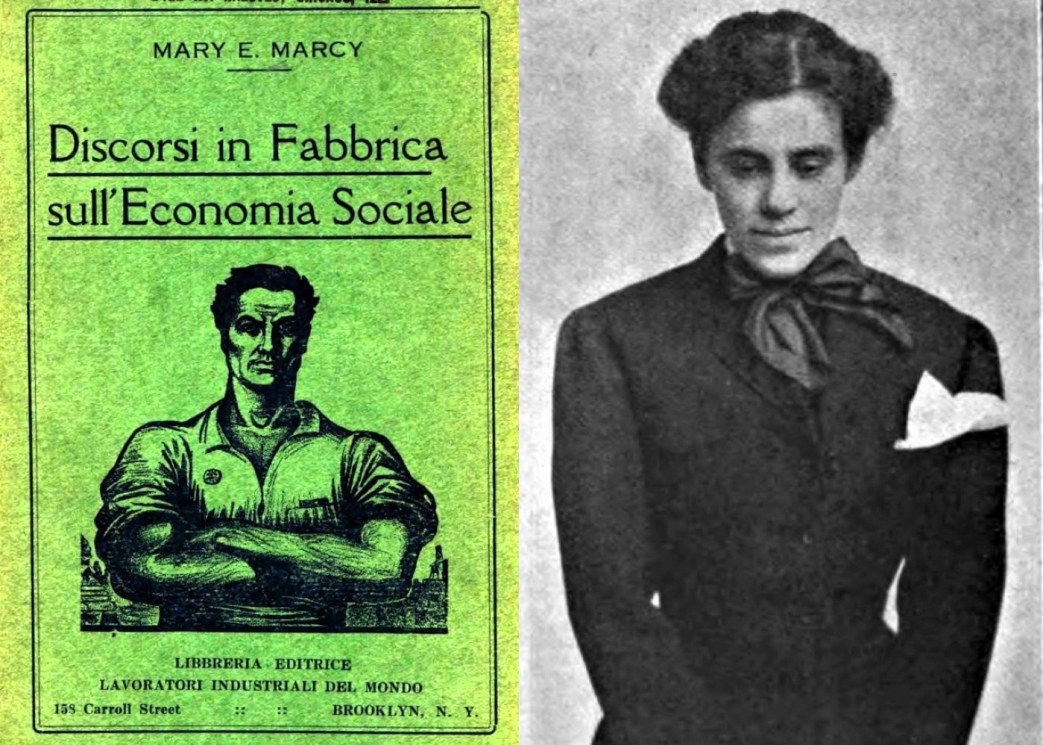
For well over a decade, as editor and writer, the International Socialist Review was Mary E. Marcy’s primary political and literary vehicle. After the magazine was effectively banned in the Federal repression that accompanied U.S. direct entry into World War One, Mary’s voice, which had helped to define the Industrial Socialist and Left Wing movements before the War, was quieted with only around a dozen substantial articles published from 1918 until her late 1922 death. A short-lived project was the Labor Scrapbook she put out with Charles H. Kerr immediately after ISR’s closing. From that magazine, which was largely an aggregating place for remaining labor and radical publications, come the article below in which Mary proposes a Socialist reconstruction for the coming crisis in the U.S. and international economy. Russia’s new revolution had opened wide vistas. And for Mary, as always, at the economic core of working-class liberation was the transformation of the labor process. Here, she proposes workers reconstructing the economy through the fundamental shift to production for use, not exchange, and the end of money with workers regulating circulation based on values for values and services for services. She also speaks to the then catastrophe facing the small farmer and how the coming revolutionary reconstruction will help them out of their crisis and exploitation.
‘The New Era’ by Mary E. Marcy from The Ohio Socialist. No. 22. June 11, 1918.
To an unprejudiced observer who might be looking upon the affairs of the world during the past century, it would seem that the inhabitants of this great, beautiful, fruitful, wonderful earth have managed things rather badly.
He would see, for example, that in spite of the fact that there is land enough for all, and to spare, in spite of the glorious tropical countries where food for mankind may be had for very little effort, in spite of the wide plains and fertile valleys, millions of people have long lived in a state of chronic hunger.
He would have witnessed children and sick folks dying for fresh air and sunshine in some portions of the world, and vast, wide, wind-swept, sun-flooded, health-promising hills and green valleys almost unpopulated, and poor folks freezing to death and suffering cold while millions of tons of coal lie under the ground waiting to be mined to bring comfort to them. And he would see men going hungry and begging for work in the face of a million things waiting and needing to be done.
He would see millions of acres untilled, undrained or parched for lack of the waters playing on shores a few miles distant and unused power rushing down the mountain sides, sufficient to perform the drudgery of the whole world on one hand, and men dying from overwork and disease breeding labor, on the other hand.
He would see vast empty grazing lands, and rivers teeming with fish and foods rotting upon the ground at one point and people begging for bread at other places.
And other things he would see: crime, prostitution, disease, great quarrelings and wars. And he would wonder why, in the midst of so great a plenty, in spaces so wide that there is room enough for all, men should not dwell together in happiness and love, making a garden spot for human kind on our own particular planet.
What’s Wrong?
In order to know what is wrong in the world today and how to secure a better place, a “decent place to live in,” you have to know something about how the things men need are produced and distributed–food, and clothing, and shelter, machinery, etc.
You can’t go out and settle down on a piece of land you may like and produce wheat and corn, for instance. If you want anything to eat, or to wear, or a place to sleep, you have to give somebody something for these things. And so you have to know about making things and what they will exchange for, and why for so many dollars, instead of more or less.
You have to understand when and on what terms, the workers are permitted to go to work on the farm or in the factory to make, or produce, things and you need to understand what they receive at the end of the week, or year, as payment. The worker who plants on another man’s land, or who works in another man’s factory does not own the things he produces. You will want to know just what he does receive. And then we will discuss what the class conscious worker wants, and ought, and is soon going to demand, and receive.
And so, first of all, we have to know what determines the value of commodities. We need to know this before we can intelligently consider what men ought to receive for so many pairs of shoes, or so many yards of cloth, or so many bushels of wheat, or machinery, etc., etc.
Now, a commodity is a product of human labor made to satisfy some human need or want, and made for sale or exchange. When a shoemaker makes a pair of shoes to wear himself, these shoes are not a commodity. When a farmer raises young onions to be eaten at his own table; these onions are not commodities. They are made for his own use and not for sale. It does not matter how he raised these onions or made those shoes so long as he intends to eat the onions, and to wear the shoes himself. But it is a different matter when he sells things to somebody else.
Then people always consider the value of the products and so it is very important that we should understand what determines the value of a commodity. Why, for example, a garden rake may sell for $1.00, and a suit of clothes sell (or exchange) for $25.00. Before we can really understand what is wrong in society, why the people who produce all the commodities in the whole world are usually poor people, while the people who own the factories, the mines, the railroads, the land, etc., etc., are usually rich people, we have to understand the value of commodities.
We think the wage-workers and the farmers, who work the farms, could give a better explanation of what makes value than any other class of men. Water is useful and uncleared land is useful and virgin forests are useful, but the only reason that owners of land or water rights can sell them is because they possess a monopoly of something the people have to use in order to sustain life. These are not commodities and they do not contain any real exchange value–because, as I suspect you have already guessed, they do not represent any necessary human labor.
Commodities have value because they are the product of human labor and because they satisfy some human need or want.
But there is one particular point in discussing the subject of value, that we need to make clear. The value of logs, for example, is not determined by the labor it takes to get them out of a marshy, isolated, difficult piece of timberland, nor is it determined by the labor represented in logs very accessible, easy to handle and get out. In other words, the value of pine, for instance, is not determined by the labor it takes to get pine out of the woods at one particular point, but by the necessary social labor represented in all the pine logs produced at a given time, the average labor it takes to produce pine logs.
Here is another example.
The value of a bushel of wheat from a small farm is not determined by the individual labor spent in producing it, nor is the value of the wheat produced on a capitalistic farm determined by the labor spent in raising it. Value is not determined by the individual labor, but by the necessary social labor represented in a commodity. If you think this over you will see that.
For example, if one of your neighbors asked you to pay $1.00 for a pound of sausage just because he and his wife had spent two or three hours making it in their own kitchen, you would laugh at him. You would probably see at once that he was asking you more than the value of the sausage.
You would tell your neighbor that: you couldn’t afford to pay a double or treble price for sausage just to give work to him and his wife, when you could buy the same sausage, or just as good sausage, at 25 cents a pound which had been ground up and mixed and stuffed by a man operating a machine.
If a one-horse tailor drove up to your door and tried to sell you a suit of clothing for fifty dollars, that you could duplicate at the store for thirty dollars, just because he had to make the whole thing by hand because he didn’t have any sewing machine, you would probably tell him you couldn’t afford to pay more than a suit was worth just because he happened to be broke.
The same conditions apply to all other branches of industry. In most fields there are thousands of people, companies and corporations, making the same things to sell. The people who make them by hand, or by small, old-fashioned machine, methods, put a lot more labor into every commodity than the workers for the big companies do, because the big companies can afford to install giant machines which cut down the necessary labor in a commodity.
The suit of clothing, the sausage, the wheat, produced by large capitalist enterprises, represent very little human labor. These great packing plants, and factories and capitalist farmers thus sell commodities containing very little value (or labor) when compared to the same product made by hand or by small farm methods, or even with the use of old-fashioned machinery.
Things are produced today not by an individual, for an individual, but by great social groups for a whole nation, and even for the world. Individual production has given place to social production. So that it is the socially necessary human labor which determines the value of wheat, or cloth, or machinery, or flour. The value of shoes is the average human labor it takes to produce shoes in a given state of society.
Now, wage-workers and employers meet each other as buyers and sellers of the commodity, labor-power. When the miner goes to the mine boss to get a job he does not sell electrical power, or steam power, but power to LABOR. He sells labor-power.
The factory boss, the capitalist farmer, the mill boss, anybody who hires men and women for wages, buys their strength and brains as a commodity. They regard the “hands,” or laboring power, and brains of the wage-worker as they regard machinery, coal, or lumber. And they buy the worker’s laboring power in just the same way, at the lowest possible price. And having ought labor-power, they want to see it on the job for the longest possible workday.
The wage-workers, having neither land, tools, nor money, are compelled to run around the country competing with others to get jobs–or to sell their laboring power, by the day or by the week. Because there are so many unemployed men the employers are usually able to buy this laboring power, or strength, at just about what is the value of any other commodity, labor necessary to reproduce it.
And so they pay wages which are just about high enough to feed and clothe and shelter the man and his family and enable him to get back on the job the next week.
Now, it only takes about two or three hours of social labor to produce enough to support a working-man and he gets this in wages. But he gives his employer eight, nine or ten hours labor. He receives wages and his boss appropriates his product. His wages represent two or three hours of social labor (value) and his products represent nine or ten hours of labor.
But all intelligent workers resent their laboring-power and brain-power being bought and sold like hogs and gasoline and tea kettles. They demand the social value of their products.
And when you stop to think of it–the working class has produced every useful and beautiful thing in the world that possesses any real exchange value.
The factory or mill owner buys the worker’s laboring power at–say $3.00 a day, while this worker produces chairs, hats, tables or tools worth ten or twelve dollars each day. Now, you can readily see that if the factory owner, or the mill owner, pays his wage-worker three dollars a day and the wage-worker makes a commodity representing eight hours of necessary social labor, or, say, $12, this factory owner could sell the product of his worker to the consumer for $12, at its value, and make a big profit.
As Karl Marx says the tendency is for these commodities to sell to the consumer at their value. This does not mean monopolies, nor highly centralized industries where millions of dollars are invested in fixed capital or machinery. Such industries are either out of the range of competition among capitalists or so inaccessible (because of the enormous amount of capital required) that their owners may be able to sell their commodities above their value.
But to return to the factory owner who pays his wage worker $3.00 a day and who keeps his $12 product. As stated above, this product may sell to the consumer at its value. But the employer is not able to put the whole $9.00 profits in his own pocket.
For instance: he may be a small silk manufacturer (originally) with little capital. Perhaps he had, when he started in business, just enough to buy his machines and hire a few wage-earners. He did not have enough to carry his silks in stock for long periods of time. But the wholesale silk merchant did have this capital. So the little silk manufacturer would sell his factory product to this wholesaler below the value of the silk–say at $6.00.
The retail merchant would have to get the average rate of profit on his money for carrying his stock; so the wholesale man would sell to him at $9.00 and the retailer would dispose of the silk to his customers at $12.00–the value of the silk (produced by the wage-worker for which he received only $3.00).
During these processes the wholesale merchant and the retail merchant and perhaps the factory owner might also have to pay out of this appropriated value, interest to the banker, rent, etc., etc.
Marx explains how the tendency is toward an average rate of profit, an average rate on the capital invested. Men having capital to invest seek those fields in which the rate of profit is above the average. Competition among these capitalists in the same fields reduces the rates until the average profit prevails.
Where one manufacturer is also a wholesale merchant who, in addition, maintains retail stores, he has a far greater capital invested than the man who manufactures only, and he expects to receive the average rate of profit on his money in every sphere. Otherwise he invests his money elsewhere.
The farmer is in the same position as the silk manufacturer. Unless he possesses sufficient capital to hold his crops, or merchant capital in addition to capital for working the farm, he is compelled to divide the value he produces (or his employes produce) with the buying associations or merchants. He is compelled to sell the products of his farm below their social value.
What We Are Driving At
Now, we are discussing the value of commodities; why we pay so much for one thing and more for another thing, or rather why commodities exchange for so much at a certain time, because we want to show why the present system causes poverty, unemployment, crime and misery and why we are trying to make the world, a “decent place to live in.”
We believe, along with Mr. Charles M. Schwab, and a few other big-visioned capitalists and workers, that Mr. Cahn is correct in his prediction that capitalism must fall, root and branch, if this war continues for another year.
Elsewhere in this little booklet we shall publish an editorial from the Mail and Breeze. Mr. McNeal believes that, with the collapse of the money system and capitalism itself, the world will go mad for awhile. There will probably be no money to hire anybody or buy things and production will cease; the city people will grow hungry and desperate, factories will be idle, homes will be cold and folks will begin to seek desperate remedies for desperate situations.
For this reason we are trying to analyze the contradictions in the present system and to suggest possible methods whereby the wheels will again begin to revolve and the period of transition from the old system of production for private profit into the production for use and happiness be made as painless, as smooth, as speedily as lies in our power. When the old system does collapse and money is outlawed and men have nothing with which to hire men or to buy things, shall we sit idle and allow ourselves to suffer and starve to death? What shall the workers do in this crisis?
We believe the Marxist has the only possible reply to this question. We do not believe that society will permit the lands and factories and railroads to lie idle merely because the private owners of these means of production and distribution have no money to hire folks to keep them going, but that the workers, themselves, should take the reins of production and distribution and save the world from chaos.
Class conscious wage-workers have long demanded that the working class receive the value of its products rather than that it be paid for its labor-power only. But the city workers need the co-operation of the workers on the farms just as the farmers need the products of the city workers. What have we got to offer the farmers for their co-operation in making smooth and easy the birth of the new society?
How the Small Farmer is Situated
We need to know how the small farmer is getting the worst of it in order to know what he may hope to receive under a new society. The farmer will want to know what we propose for him under this new regime. The day may soon come when the man who possesses food products, or shoes or clothing will be in an enviable position and the man who hoards outlawed money will have to go to work.
Because commodities tend to exchange (or sell) at their value or for other commodities representing an equal necessary amount of social labor, the farmer using old-fashioned machinery, or working his farm without the necessary machines, has been compelled to sell all his farm products below their individual value, while the capitalist farmer has always sold the products of his farm above their individual value. The mill man who buys from both and pays the same price for oats or wheat or corn to both, usually buys these commodities at their value. But, especially in America, the farmer very rarely sells his products direct to the consuming miller, who manufactures flour or breakfast foods, etc., etc. You do not ask how the chair was made, or how the cloth you are going to purchase, was Woven. You ask the price of these commodities. The same applies to the mill man or to the association buying farm products. They do not ask how many hours of labor a farmer put into the crops. They don’t expect to pay, and they don’t need to pay, any more for products from “hand” worked farms, or from farms equipped with poor machinery, than they do for crops from farms worked almost entirely by men operating machines.
So that, even when “free competition” prevailed in the sale of farm products, as it still prevails in many countries, the machineless farmer was forced, is forced, to work harder and longer hours for less reward than the farmer who possessed or possesses capital to buy machines. This is true today and will be true tomorrow and as long as capitalist society endures. There is neither equality of opportunity nor equality of reward when some men work to produce the necessary things of life without access to [word missing] and modern tools of production.
We believe that [missing word] when we say that if farmers using antiquated machines sell commodities representing [word missing] hours of labor, for money representing; and for which they can buy things representing, only five or six, or seven hundred hours of necessary social labor.
What We Propose
Now, when the present system of production for private profit collapses like a punctured balloon, we propose to build a new sort of society, the sort in which, as Mr. Schwab says, “we shall see an aristocracy of labor, of merit, in which the man who possesses no property, who works with his hands, shall control the affairs of the world.”
We shall refuse longer to sell our labor-power like men sell machinery and shall insist that the men who produce things receive the value of their products.
Today the productive workers receive about twenty per cent of this value while all the surplus (value) is appropriated by the parasites on the social body, the wholesalers, the “manufacturers,” the advertisers, lawyers, politicians, bankers, landlords, and retailers. Wherever the men in these groups perform no useful labor or service we shall propose that they go to work along with the productive workers and help us make two–or even three–good jobs out of one poor job, by cutting down the hours of labor. When there is no longer any need for allowing 80 per cent surplus value from which to support the non-productive workers and pay interest or profits on their money, every worker will receive ample VALUE for labor performed to enable him to live in comfort, with ample hours of leisure a as well as hours of labor.
We propose to abolish the private ownership of all the tools of production, the factories, lands, mines, mills and shops, and of the railroads, and to throw them open to the free use of those who wish to work to produce things, so that every man and woman will have opportunity to produce and to enjoy in full the fruits of his industry.
In short, we propose control by the working class. This does not mean that we shall prevent any man or woman from enjoying the good things at the world’s table, but rather, that we shall invite all to share in the world’s labor, or in the necessary service, if they wish also to share in the products of labor.
About the Farmer
When Karl Marx said commodities tend to exchange at their value, he did not, by any means mean that when a farmer sells a thousand bushels of wheat to one man, who in turn sells to a customer, who resells to someone else, who finally sells to a third or fourth buyer–Marx did not mean that all these perfectly useless individuals added any value to that wheat. But they sell it at a profit.
Now since these speculating purchasers have not added any value to the farmer’s wheat, either the first purchaser bought the wheat from the farmer below its value or the final purchaser paid for it at more than its value.
Now, unless they stored it in order to preserve it, or shipped it, these speculating purchasers have not added any value to the wheat. Take a case where the wheat is neither stored nor shipped. Then the man who originally bought the wheat from the farmer added no value to the wheat, nor did his customer, nor his customer’s customer, etc., etc., add any value to the wheat.
But the wheat may have sold finally at fifty cents a bushel more than the original purchaser paid for it. Now, price and value are not the ‘same. A sudden war, demand for a thing may cause it to sell (or exchange) far above its value. Or a sudden unexpected oversupply of a commodity or a sudden decrease in a demand, may cause it to sell below its value. Today this condition prevails in every field of industry.
But we are discussing the difference between the price the farmer sells his wheat for–to the buying associations–and the price at which they sell to the mill-consumers. There is a big difference.
We tried to explain to you a few pages back how brokers, wholesale merchants, middlemen, etc., etc., being, on the whole utterly unnecessary in society today, produce neither commodities nor any value.
But, where there are neither monopolies nor monopolistic tendencies, commodities, on the average, exchange at their value. That is, the consumer nearly always buys commodities at their value. He nearly always receives the value he pays for; he gives gold, or its equivalent, representing so many hours of necessary social labor, in exchange for commodities representing an equal amount of necessary social labor.
Wheat brokers and wheat and other grain speculators get their profits out of value either produced by the farmer who works his farm, or from value produced by farm tenants, or farm laborers, because these products are sold to these speculators below their value.
One speculator buys corn from a group of farmers at 40 cents and re-sells to another speculator at 48 cents, who disposes of it to a third for 55 cents, who finally sells it to the mill men (who use it as raw material from which, say, corn flakes are manufactured) at 60 cents.
On the average, these mill men buy the corn at its value; the various speculators, or associations, have never seen the corn, never moved the corn, have added not one hour of value to the corn.
The first speculator in this case bought the corn from the producing farmers at something like twenty cents below its value. This 20 cents, of which the producing farmers were exploited, is divided among the three speculators. Nobody is robbed but the actual producers of the corn.
In this country buyers’ associations are sometimes so powerful and so completely organized that they demand so great a share of the surplus value produced by the farm workers that the farm owner, or renter, or fruit grower, or truck gardener, is unable to appropriate any of this surplus value produced by his laborers and he ceases to use his farm in raising that particular product. Sometimes he labors along with his farm workers and finds when he has sold the products to the buying monopolies, that there is nothing left to pay for his own labor.
Now, we propose that no man or group of men be permitted to take the product of other men or a profit from the labor of other men, or to grow rich by owning the means of production and distribution.
We propose that the farmers shall receive the value of the things they produce and that wage-workers shall receive the value of their own products; that the basis of exchange shall be value for value, service for service.
The Ohio Socialist, published by the Left Wing-dominated Socialist Party of Ohio in Cleveland from January, 1917 to November, 1919. It was edited by Alfred Wagenknecht Wagenknecht spent most of 1918 in jail for “violation of the Conscription Act.” The paper grew from a monthly to a semi-monthly and then to a weekly in July, 1918 and eventually a press run of over 20,000. The Ohio Socialist Party’s endorsement of the Left Wing Manifesto led to it suspension at the undemocratic, packed Socialist Party Convention in 1919. As a recognized voice of the Left Wing, the paper carried the odd geographical subheading, “Official Organ of the Socialist Parties of Ohio and Kentucky, Virginia, West Virginia and New Mexico” by 1919’s start. In November of that year the paper changed to the “labor organ” of the Communist Labor Party and its offices moved to New York City and its name changed to The Toiler, a precursor to the Daily Worker. There the paper was edited by James P. Cannon for a time.
PDF of full issue: https://www.marxists.org/history/usa/pubs/ohio-socialist/022-jun-11-1918-ohio-soc.pdf
 Revolution's Newsstand