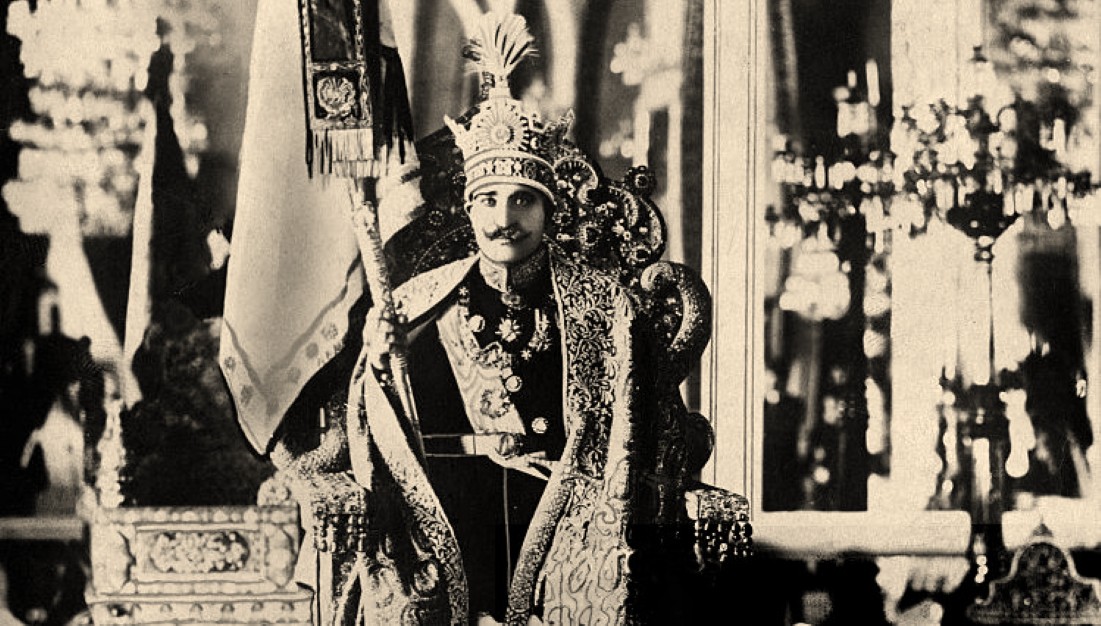
Reza Shah began his adventurer’s life as an illiterate private of the Shah’s elite, and Russian-controlled, Persian Cossack Brigade, who quickly rose through the ranks when the new British overlords purged the Russians after WWI. A counter-revolutionary White General under British tutelage who put down the country’s Soviet movement along the Caspian, a coup plotter against the monarch he swore to protect, then a civilian Iranian politician who declared himself the Shah and founded the Pahlavi dynasty in 1925. He faced his first large-scale crisis in 1929’s Tribal Rebellion in which took place in the backdrop of imperialist meddling, the collapse of an independent Afghanistan next door, and his failed attempt to balance feudal and capitalist interests, while crushing national, peasant, and worker demands at home. Below are two articles from the Comintern giving the context from the beginning and end of the rising.
‘The Situation in Persia’ by I.F. and W. Petrik from International Press Correspondence. Vol. 9 Nos. 33 & 65. July 12 & November 22, 1929.
The Situation in Persia by I.F.
The events in Afghanistan which led to the victory of reaction and to the complete disintegration of Afghanistan as a State, contain so many lessons that one must devote the most serious attention to the present happenings in Persia. The insurrections in the Southern part of Persia have extended still further. In Teheran, various prominent dignitaries have been arrested: the Minister for Finance, the leader of the gendarmerie, the governor general of the province of Fors, i.e. the province which is at present in a state of revolt. Among those arrested there are also numerous other officials occupying high positions.
These arrests have greatly excited Persian public opinion. On the other hand they are regarded in official circles as proof of a conspiracy against the government. The decision of the Persian government to proceed with the most drastic means against the revolt in the South appears perfectly natural having regard to the tense situation in the interior and the persons who have been arrested. The strained situation is due to the discontent prevailing among all sections of the population. The compromise upon which the present regime is based, embitters not only the broad masses of peasants and of the urban bourgeoisie, but also the clerical and feudalist groups who have been deprived of their former political privileges. The latter are endeavouring to influence the new monarchy in the interests of reaction. They are not content with having their representatives (as the former Finance Minister Firus) in the government. They want a thorough change in home and foreign policy. The government, on its part, which made various concessions to them, especially to the clergy, and for whose sake it abandoned comprehensive social reforms, is being pushed from behind. In its fight against the masses it is endeavouring to get the support of the Right groups, without, however, completely fulfilling the latter’s demands, and at the same time to carry out some reforms in order to satisfy the Left tendency. Objectively, however, the expedient and firm centralisation policy of the government, which means the driving out of the feudal lords and the elders of the tribes, has as an accompanying phenomenon encroachments on the part of the central administration. The population do not see any immediate positive results for themselves as a result of centralisation. The final result is a movement of the masses against the government, a movement which the reactionary groups are endeavouring to make use of in their own interests. Reliable evidence that those arrested in Teheran have or have not taken part in the insurrectionary movement is not at present to hand. That the arrested dignitaries, however, are among those persons who are extremely hostile towards the present regime and could, in the event of a further development of the events, take over the leadership of the movement against the government, there is no doubt.
Prominent among the arrested is the Minister for Finance Firus, who is closely connected with England through his former activity as statesman and is loyally devoted to the Kadshara dynasty. Firus is the best hated man in Persia. It was he who, in 1919, together with Wosuk ed Dowle and Sarem ed Dowle, bargained away Persia to England by concluding a shameful treaty which was annulled in 1921 under the government of Said Sia ed Dina. The English, in revenge for the rebuff they suffered, are now demanding the recognition as a State debt to England of the 160,000 pound sterling paid out to the above-named persons as a “reward” for the conclusion of the Treaty of 1919. Firus who had joined himself to Riza Shah before the overthrow of the Kadshara dynasty, became Finance Minister. But even in his new capacity he maintained the former connections with the English mission. He helped himself from the State treasury and continued his policy of blackmail and corruption, as well as his special policy towards the tribes in Southern Persia. His undermining work against the new regime was obvious. Riza Shah, who was quite aware of the activity of his Finance Minister, did not throw him overboard, as he valued the support of the groups led by Firus. What this support was worth is shown by the revolt in the Southern provinces of Persia.
The government is just as much responsible for the situation in Persia as is the clique of Firus and his consorts hitherto favoured by the government. It is possible that the court wishes, by the arrests which have been carried out, to allay the discontent in the country and win the confidence of the Left public opinion. It is also possible that the new monarchy is attempting to rally all the progressive forces in the country by holding up the spectre of a restoration of the old dynasty. Should however the government confine itself to making arrests, no one will believe in the seriousness of its intentions finally to settle accounts with the clerical and feudal groups. The discontent can be allayed only by social reforms in the interests of the peasants and of the urban bourgeoisie. The Persian public must receive the right to discuss State affairs freely. Supported by public opinion the government must take up a real fight against corruption and in general against all excrescences in the State organism of Persia. If the government decides on this course, then it will render difficult the work of the English agents who are preparing for Persia the same fate as Afghanistan. If it should not make this decision, it will thereby facilitate this work of the English agents.
Reaction is raising its head in Persia. Just as in Afghanistan the clergy are endeavouring to gain the leadership of the movement. They have already appealed to the population to overthrow the government and to revert to the old laws. It is the duty of advanced circles of Persia to prevent the reactionary groups from seizing the leadership of the movement.
The Situation in Persia by W. Petrik.
The insurrection in the South of Persia, beginning in the province of Fars in March, spreading to the North in the direction of Isfahan in June, and taking a very dangerous turn for the government when joined by the Bachtiyars in July, came to a standstill at the beginning of August. The government has succeeded in neutralising a number of the insurgent tribes by means of negotiations, and in driving the main Bachtiyar forces out of the Isfahan district. It may therefore be assumed that the rising is practically liquidated, and some conclusions may already be drawn.
The movement among the tribes in the South of Persia was undeniably of common origin, and was aroused by the serious dissatisfaction felt with regard to the political and Economic measures of the present Persian government. The policy of centralisation, of abolishing the autonomy of the tribes, of collecting taxes through the agency of special officials instead of by the chiefs of the tribes, the appointment of military governors, the introduction of military service with its resultant recruiting measures, and the simultaneous disarmament of the tribes all this aroused the discontent of the nomads. To this came the attacks upon and pillaging of the tribes by the military authorities entrusted with the execution of the measures.
It must, however, be remembered at the same time that during the last few years South Persia has been experiencing an agricultural and economic crisis, due to the reduction of the area under opium cultivation, to the stagnation in trade, and in part to the opening of the western transport route across the Persian Gulf, which inevitably undermined the importance of the southern provinces of Persia as a transit area. The government opium monopoly was a a severe blow to the decisive masses of the population in these provinces. Those who suffered were not only the peasants, but a large number of trading middlemen, besides the wholesale dealers in whose hands the export of Persian opium had hitherto been concentrated.
A further characteristic feature of the insurgent movement in South Persia is the fact that an essentially reactionary political programme was drawn up. The demands restricted themselves principally to the narrow interests of the individual tribes. The rebellion was led by reactionary elements anxious to make capital for themselves out of the dissatisfaction of the masses, and seeking to force the government, with the help of the masses, to restore feudal rights and privileges. The organising driving force was the clergy, who had lost much of their influence of late years. In the Southern states of Persia the clergy declared a “holy war” against the Teheran government. The clergy, though unable to arouse any comprehensive movement against the government, on the other hand, alienated from the movement the so-called “advanced” circles of Persia.
These advanced circles at first sympathised with the rising, in the hope that the government would be induced to grant reforms. As soon as they observed, however, that the feudal large landowners and the clergy were seizing upon the leadership, they sided with the government, fearing a repetition of events in Afghanistan. The passive attitude of the radical elements resulted in the political crisis in Persia taking a turn in favour of the representatives of the old regime.
As a matter of fact, the insurrection was liquidated by means of compromises with the old regime. The government reinstated into power the chiefs of the southern tribes. They sanctioned the return of Dowle to Shiraz, and restored administrative powers to the old khan of the Bachtiyars, Mofacham.
The line taken by the concessions of the government may be seen from the fact that in Teheran the women, who during the last eighteen months had the right to appear in public places accompanied by men, and to visit theatres, cinemas, etc., have on the pressure of the clergy, been deprived of these rights again. The sole economic measure which the government has seen fit to undertake under the influence of events in South Persia has been the reorganisation of the opium monopoly, which has been placed in the hands of a group of wholesale dealers.
The government believes that by this compromise with trade capital it will avoid the necessity of economic reforms. The press, apparently not without a hint from above, has opened a campaign against the abuse of official power by the tax officials. This is advanced as the reason for the dissatisfaction of the population with a taxation system good in itself.
From all this it may be seen that Persian government circles, whilst finding a loophole means for escape in these concessions to the clergy and the large landowners, are by no inclined to remove the causes forcing the broad masses into a struggle against the present regime.
The results of the rebellion in South Persia bear witness to the beginning of a counter-attack on the part of the feudal lords and the clergy who have exploited the rising to fortify their positions. This turn of events is doubtlessly extremely agreeable to the English imperialists. English imperialism, as the Persian press has maintained in opposition to the denials of the Reuter Agency, had its hand in the game, seeking to weaken and split up Persia. The movement in South Persia must be viewed in connection with the analogous happenings in Afghanistan and Kurdistan where the participation of English agents has been ascertained beyond all doubt. At the same time the internal driving forces of the Persian rising must be comprehended the more that Persia is in the midst of a serious economic crisis, a commercial stagnation, and its state budget shows a serious deficit. A further development of events in Persia is therefore well within the bounds of possibility. What direction it will take greatly depends, however, on the extent to which the present regime will draw the lessons from the insurrection.
International Press Correspondence, widely known as”Inprecor” was published by the Executive Committee of the Communist International (ECCI) regularly in German and English, occasionally in many other languages, beginning in 1921 and lasting in English until 1938. Inprecor’s role was to supply translated articles to the English-speaking press of the International from the Comintern’s different sections, as well as news and statements from the ECCI. Many ‘Daily Worker’ and ‘Communist’ articles originated in Inprecor, and it also published articles by American comrades for use in other countries. It was published at least weekly, and often thrice weekly.
PDF of full issue: https://www.marxists.org/history/international/comintern/inprecor/1929/v09n33-jul-12-1929-inprecor.pdf
PDF of full issue 2: https://www.marxists.org/history/international/comintern/inprecor/1929/v09n65-nov-22-1929-inprecor.pdf
 Revolution's Newsstand