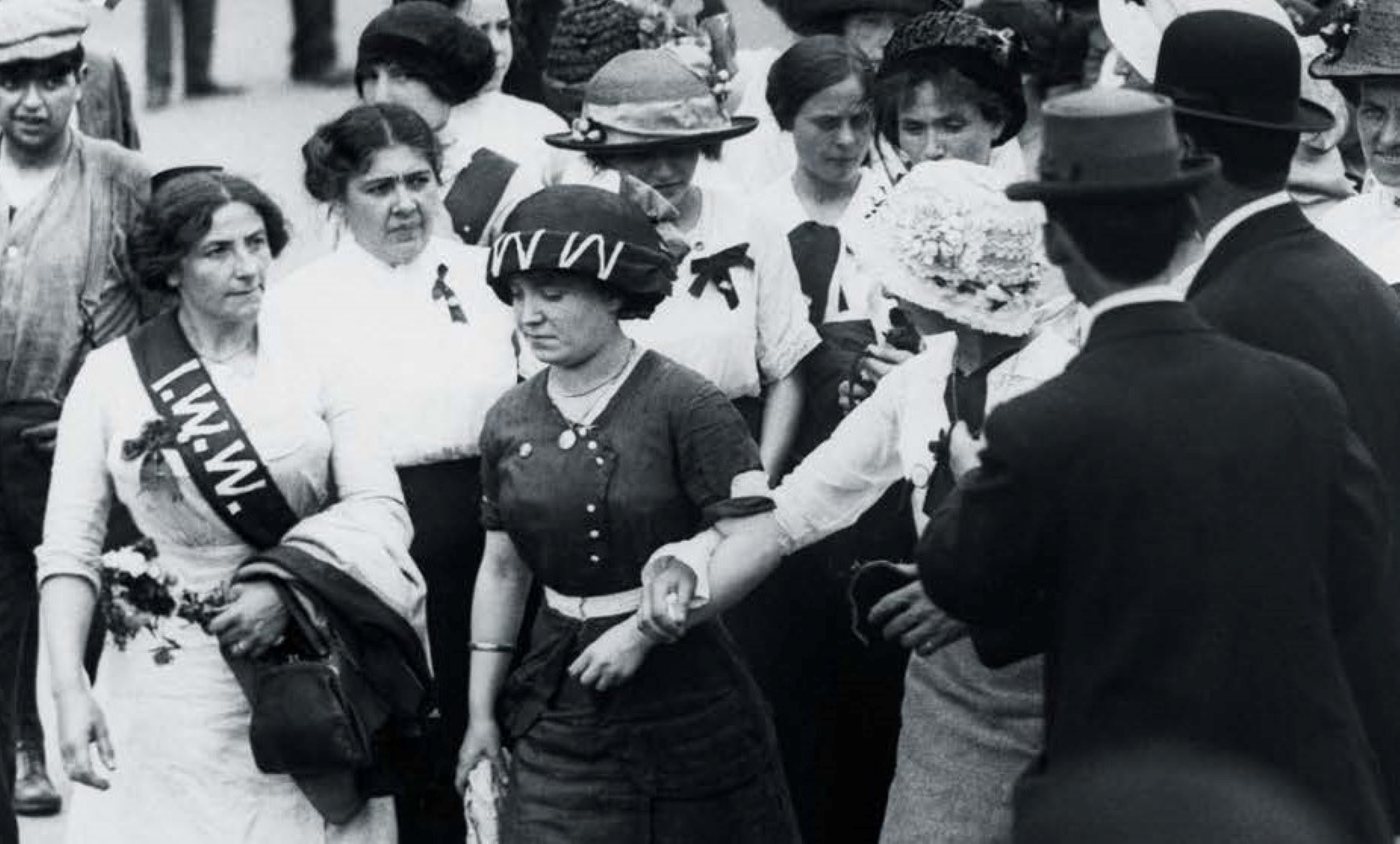
Flynn looks at the conditions, including pervasive sexual assault, faced by 15 girl strikers at one plant, the Bamford Ribbon Mill, during what was not only a high-point for I.W.W. organizing in the East, but what is still a byword for a the best of the U.S.’s radical labor tradition–the months-long general strike of Paterson, New Jersey’s multi-national, multi-lingual textile workers.
‘Contract Slavery in Paterson Silk Mills’ by Elizabeth Gurley Flynn from Solidarity. Vol. 4 No. 16. April 26, 1913.
When the general strike was called in Paterson, 15 girls from the Bamford Ribbon Mill answered the call. Mr. Bamford immediately threatened to confiscate large amounts of back wages belonging to the girls, but still in his possession. An investigation by a ribbon weavers’ committee repealed the fact that these girls, ranging in ages from 14 to 17, WERE VIRTUAL SLAVES UNDER AN ABOMINABLE CONTRACT SYSTEM.
The contract, drawn up by a prominent Paterson attorney, provides that from the wages of each girl 50 per cent is withheld for a period of one year. The other 50 per cent, MINUS FINES, is the girl’s pay envelope. One pay envelope calls for $6.50 wage. The cash contained was $2.80 mathematically peculiar 50 per cent. At the end of the year, the girl, if still in Bamford’s employ, receives the money WITHOUT INTEREST. But if the girl quits voluntarily, Mr. Bamford coolly POCKETS ALL THE MONEY HE HAS HELD BACK. And the entire policy of the business is to drive as many out as possible before the year is up.
One girl averaged $1.25 for a period of 42 weeks. Another averaged $1.85 for 32 weeks. The first girl manufactured 66,528 yards of ribbon for $64.45. If Mr. Bamford could sell his ribbon for but 2e a yard, he would still make $1,166.11 on this girl’s toil. Easy money for the man who has discovered a “pay streak” of labor–the children of Paterson! Kept in perpetual motion, a crowd working, a crowd quitting, and a crowd coming from school, his mill can profit as long as childhood lasts.
Ten hours a day these girls work, without rest or letup. Seats are not allowed. If a girl sits on the steam pipe she is summarily fired. Relaxation is impossible, for over these 15 girls are FIVE SLAVE DRIVERS to watch that their speedy labor is not neglected for a moment. Some of the girls at whom Mr. Bamford roars, “More work, more, more,” are so little they have to stand on a stool to reach the top of the loom. One of them said: “While I am on strike I go around to the school yard to watch the kids play, and sometimes I play with them myself.” Think of the tragic farce. fellow workers, a striker and playing with the children in the school playgrounds!
If the power stops, the girls must work overtime without pay to make up the lost time. They start three minutes before the regular hours and stop three minutes late, so Mr. Bamford gets2 minutes per girl free, or two hours and fifty minutes a day from the 15 girls. Saturday afternoon, when all other mills are closed, these little girls are kept in till usually 2 o’clock to clean up, including the floor upon which the masculine bosses have been spitting great wads of tobacco all week. When the year is up the girls are then compelled to work all the days they missed before they receive their money.
One little Italian girl, with a face like a flower, told how a wheel fell from the steam pipes and hurt her head so badly she was laid up for two months. She said, “The boss didn’t pay anything, but my old man had to pay the doctor’s bill. Then when I came back to work, Mr. Bamford told me I had to make j up those days before I’d get any of my money.”
They are paid 10 cents an hour for overtime, and once in awhile Mr. Bamford in a fit of generosity gives them a quarter for running out bad warps. But as the girls say, “Yes, he raises us 50 cents one week and docks us a dollar the next.”
Ventilation doesn’t exist in this industrial prison. If the girls open a window they are fined. In winter the steam isn’t turned on until it gets so cold they can’t work, and then only does Mr. Boss worry about their comfort. There are no dressing rooms. Men’s and women’s toilets are adjoining, and the partitions are so flimsy and have been so cut through that the girls are subjected to all sorts of indecent and obscene remarks from the other side. The floors are old and so split that the girls’ shoes are cut up walking to and fro at their looms. They eat their lunch on an old dirty stairway where the water comes through in rainy weather. The girls claim they have been sworn at, pushed and shoved around, and one boss in affectionate moods, between slave-driving ones, puts his arm around them indiscriminately.
As if all this were not bad enough, Mr. Bamford has worked out an elaborate fining system. The following are some of its applications enumerated by the girls: Sick one-half day, a girl was fined a day’s pay; buttoned shoes 5 minutes early, fined 50 cents; fined for talking together; for laughing at the boss; $1.50 for spilling some water down the elevator shaft; $1 for looking for another job; 25 cents for tying a big knot on a thread, etc. Scissors and hooks are sold to them, “lost” and sold over again, countless times.
Summing it all up, we may almost believe the girls were fortunate when they received their envelopes not to find therein a bill for what they owed Bamford!
The Paterson strike is a struggle for shorter hours and more wages. We want the fathers and mothers to earn enough money that they won’t need to send their 14-year-old daughters to work for $1.25 per week.
But we want to demand for the immediate future, (1) THE ABOLITION OF THIS OUTRAGEOUS CONTRACT SYSTEM; (2), that the little girls receive all their money from Bamford before the strike is over; (3), that a minimum wage be established there equal to what is paid for similar work in other ribbon mills; (4), that eight hours constitute a day’s work.
We want to make it impossible for girls who stand between childhood and womanhood, to have their health ruined by excessive and premature labor. We want to make it impossible for this “Christian gentleman” to say: “Bring your children to me; let me weave their soft bodies, their rosy cheeks, the light of their eyes, into cheap ribbon.”
Let us inscribe on our banner, that beautiful exhortation, “As ye do unto the least of these, ye do it unto me.”
Fellow workers, outside of Paterson, who want to help us in our fight against long hours, low wages, intensification of lab woman’s exploitation, child labor; who want to help us win o rights of free speech, free press, free assemblage, and the right to organize; who want to help us clean up and civilize such hell holes as Bamford’s–send your contributions to P.W. KIRCHBOUN, Fin. Sec’y Textile Workers Strike Committee, Paterson, N.J.
The most widely read of I.W.W. newspapers, Solidarity was published by the Industrial Workers of the World from 1909 until 1917. First produced in New Castle, Pennsylvania, and born during the McKees Rocks strike, Solidarity later moved to Cleveland, Ohio until 1917 then spent its last months in Chicago. With a circulation of around 12,000 and a readership many times that, Solidarity was instrumental in defining the Wobbly world-view at the height of their influence in the working class. It was edited over its life by A.M. Stirton, H.A. Goff, Ben H. Williams, Ralph Chaplin who also provided much of the paper’s color, and others. Like nearly all the left press it fell victim to federal repression in 1917.
PDF of full issue: https://www.marxists.org/history/usa/pubs/solidarity-iww/1913/v04n16-w172-apr-26-1913-solidarity.pdf
 Revolution's Newsstand