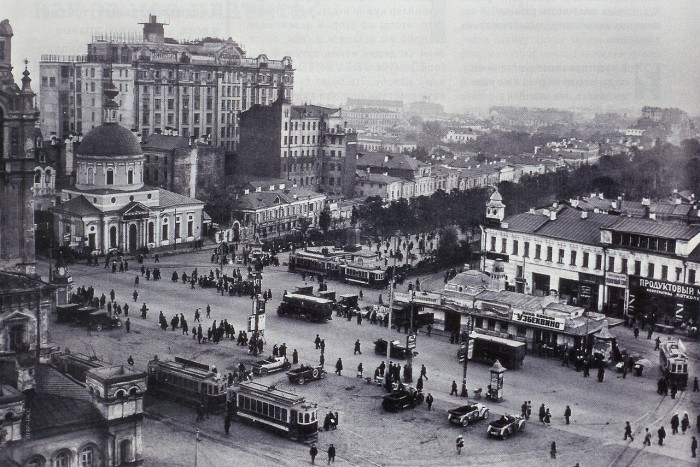
A packed penultimate chapter of Goldschmidt’s Moscow travel diary sees him describe a meeting with Radek at the offices of the Third International, prohibition in the city, the streets of the proletarian capital at night, profiteers and economic sabotage, remnants of the bourgeoisie, and the personality of Comrade Stunkel, organizer of the metal division of the Supreme Council of National Economy.
‘Moscow in 1920. Chapter VII’ by Dr. Alfons Goldschmidt from Soviet Russia (New York). Vol. 3 No. 20. November 13, 1920.
The Third Internationale
Its office is in the building formerly occupied by the German Legation. Deneshnyi 5. In a side street. The chairman of the Extraordinary Commission lives not far from there.
The day after my arrival in Moscow I spoke with Radek in the study of murdered Count Mirbach. Radek called my attention to it.
It is a beautiful building. An airy vestibule, hung with tapestries. The salon and reception room of the legation look as they did in Mirbach’s time. At least so I was told. They showed me the spot where Mirbach was struck by the bullet, and the line along which he staggered until he collapsed. They do not like to think of that horror. The Bolsheviki wanted to work with Mirbach, they regretted the murder in helpless wrath. So I was told in Moscow. They described the murder to me in detail, the auto, the flight of the murderers. It was a shameful and useless crime.
Klinger, the Secretary of the Third Internationale, has his office in a room on the ground floor, not far from Radek’s study. He is a slender man, with a great beard and many nerves. Not robust, and often bent with the weight of his office. A peculiar crowd swarms in and out. Here all the races come together, all those who have a longing for Moscow. From Asia, from Europe, from America they come. There is a twittering of languages, a map of heroic proportions. The history of the Third Internationale is perhaps the most interesting history in the world. It is a large scale political story, a story of sacrifices, a story of far-flung interest, almost like the history of Popedom.
I do not know how well this globe-embracing organization functions. Only a few people are working in the office. It is quiet here; but it is from here that red trumpets ring forth. Looked at architecturally it is a little Vatican. Perhaps its influence is no less than the influence of the Vatican upon the world. It is not an artificial influence, it is merely an organization center, a centralized organization of an existing force, a developing force. Revolutions, like religions, are not things of force, things to be grafted on, but they are matters of development and growth.
Behind the building there is a small park. It is sadly neglected.
The grass is tall and uneven, the fountain plays no more. Its statue is weather-beaten. While the Third Internationale is growing strong, the park is crumbling away.
Among Bourgeois
They live in an exclusive street in Moscow. In a good house, with an elevator in the vestibule. But elevators do not function in Moscow at present. Power must not be wasted, for fuel is scarce.
A great power distributing station is in operation near Moscow. It was built (in peace times) by a German firm. By Von Siemens, the A.E.G., and the porcelain factory of Rosenthal. A gigantic net spreads over the Moscow district from here. The power station operates, operates efficiently, but it does not supply as much power as one would like, for power must be saved.
Nor are the elevators in the government offices running. At least one pair of soles is used up in climbing to the top floor of the building of the Supreme Council of National Economy, for the elevator is not running. One arrives there with fagged-out lungs. But no matter, the elevator stands still. Blessed ration system.
In Moscow one never says a bourgeois, but burzhui or burzhoi. It is the modern attempt at botching verbalisms, the popular tampering with vocalization. There are many such modern verbal tamperings, such modern short cuts, modern perversions. For instance, spezi for specialist. By spezi, in Moscow, is meant not an expert; but the rebellious expert, the sabotaging expert, the lazy expert is so designated.
Burzhuis do not live in the sewer. Far from it They are not starved for air, forced to do without. I saw tables in their house, chairs, oil paintings, “real” oil paintings. I sat on a sofa covered with rep, and was invited to partake of the roast.
Mrs. Burzhui was wrapped in a negligee. Perhaps it was a kimona. I am no expert in such matters. I do not even know whether pajama is of the masculine or neuter gender. But it was a good piece of wearing apparel, undulating, and reaching down to a pair of light-colored house slippers. On her feet were silk stockings. I was asked to dinner.
In the third room stood a baby carriage, a bourgeois baby carriage, with a faithful soul beside it. It was a nurse. A real nurse, not a phantom nurse, a fourth dimensional apparition of a nurse, but a nurse of bone and breast. A nurse of the sort used by babies. Hence a vaulted nurse, not a shallow, flat one. It was a real nurse.
The magnificent Landa was with me at the Burzhuis. He is a Communist, and is entirely surrounded by a leather suit. The toes of his right foot, to be sure, cannot exactly be said to be surrounded. Or rather, they are surrounded by air, if I might say so. But it was warm Moscow air, summer air, quite harmless to the toes. Of course, it cannot be said that it was particularly cleansing, but it was warm.
In addition, the magnificent Landa wore an Everclean. Everclean is the perfect thing. Everclean is absolutely laundry-proof. One needs only one Everclean, one needs no more. The magnificent Landa washed his Everclean every morning with a little tea water. Then it flashed and burst into white glory in the warm rays of the Moscow sun.
A bit of lace over a right hand studded with diamonds was flirting across the table with Landa’s Everclean. Beside it stood a young lady—a young lady, not a girl—with silk stockings, and draped in a large striped swath of silk, with soft eyes and bitter complaints.
For now began a discussion of the system, of the problems. The Burzhuis were not satisfied with the regime. No one can blame them for that. For this regime certainly is no garden of Eden affair, not yet. It is rather like the management of a farm, of a rough piece of land, with a great many weeds, badly-hoed, and not even well-ploughed. There is no whole-hearted joy, no Burzhuis fun in sauntering along that ground. Silk stockings or silk-stocking souls do not feel at home there. It is no good for silk-stocking souls.
The lady with the silk-stocking soul was a Soviet employe. The kimona lady did no work at all. “I would like to serve the people,” she said feelingly, “but I cannot serve the people, I haven’t learned to do anything. Revolutions should only be allowed after every one is competent to serve the people.”
“What can I do,” she said. “I must sell my things, for I can’t do with less than 100,000 rubles a month. Too little bread, nothing to go with it. What can I do? I sell one thing after another. Unfortunately,” said she, “unfortunately I cannot serve the people.”
They doted on Lenin, but they complained about others. There is much to complain of in Moscow still. Every one actively engaged under the Soviet is far from being a paragon of unselfishness. Unfortunately many of them do not serve the people.
The little silk-stocking soul, wrapped in the swath of silk, complained too. Although she served the people in her way, she was not earning enough. The Soviet employes, whether male or female, really do not earn enough, with some exceptions. Neither in money nor in supplies. The Moscow government dinner (usually served in the government office building) is no luxury. It is not sufficient. The bread ration is likewise insufficient. It is mostly a matter of wage depreciation. The ruble depreciates with such rapidity that the wages and salaries simply never catch up.
But the little silk-stocking soul did not look starved in the least. She was no skeleton, she was a comfort to the eye. She was lively, trim, and her nails sparkled luxuriously. She was evidently living, and living well. Everyone complains in Moscow, and hundreds of thousands of people are living quite comfortably.
No bourgeois can really become a friend of the system, can really come to love it, that is. The Moscow bourgeois, in times of peace, was lavish in the enjoyment of his food, his drink and his bed. He cannot get used to the vexing frugality now. That goes without saying.
But he lives, though he may not be able to serve the people. He lives so long without serving the people until he has used up everything that makes his exemption from service possible. Then, of course, he is compelled to serve the people.
Complaints about bread, about meat, about meals, about clothes, about money. One hears them constantly. They are complaints over temporary conditions, over the present. There is no perspective, only a retro-perspective. That is natural, it is probably the same in other places, or will be.
The bourgeois are no Socialists, and certainly no Communists. They lost what Socialism gained. For this reason their complaints are justified, for they do not know that a gain for Socialism is their gain too.
I remarked upon the baby carriage, upon the baby with the vaulted nurse. I said: this baby will one day serve the people, and will cease complaining. He will not be a mere plaintive present conditionist, he will perhaps not even be a mere perspectivist, but may become a real human-being seeking his happiness in the present. The past will have become a museum for him.
Perhaps, said the kimona. Perhaps said the silk-stocking soul. But what good will that do us? It will do us no good whatever. We are present conditionists, and present conditions are not in a nice state, they are in a state, a state…
We did not accept the invitation to stay for the roast. Not because of a prejudice against roast. I longed for a Moscow roast, I reviled the roast-fed English Delegation. When I stopped in Narva on my return journey, I immediately ruined my digestion on a heaping dish of pork chops. That is how much I longed for roast meat.
But the bourgeois roast would have been a roast fought over and hedged about with principles. Therefore I went home, to a meal with kasha; to a meal served by Sasha, the Soviet cook, with her plump cheeks, her toothache, and her willingness to serve the people.
Profiteering and Sabotage
Moscow lives. Moscow is no starvation camp. The women of Moscow are balloon-cheeked. Their faces too. The children of Moscow are roundbottomed little ducks. Moscow men are far from anemic, far from being narrow, or spineless creatures.
Moscow lives. But Moscow lives only partly on the rationed products, only partly on the money it earns. A large part of Moscow lives by speculating. Actively and passively it speculates. It speculates, it buys and sells illegally, it speculates, and speculates, and speculates.
This illicit commerce is a necessary evil. For one cannot command the people: Live on your rations—when the rationed supplies are inadequate. That, in my estimation, is a matter of transition, but nevertheless it is an important phase of the Moscow psychology just at present.
There is speculation in everything in Moscow. From a pin to a cow, furniture, diamonds, cake, bread, meat, everything is traded secretly. The Sukharevka in Moscow is a speculator’s bazaar, an illicit trading-house. Now and then the police make a raid upon it. But the speculating is not cut down; it is a hydra-headed monster, which returns with a thousand heads.
Moscow has free market-places, a number of open markets, officially tolerated markets, supplementary markets, markets to fill out the inadequate rations. For instance, there is a supplementary market near the Theater Square. There are cucumbers, fish, hard-cake, eggs, vegetables of all kinds. There are great crowds on the long pavement. Booths are ranged along the edge of the sidewalks. Dealers are sitting around, are whispering from behind into ears of prospective buyers.
The price of a cucumber is 200 to 250 rubles, an egg is 125 to 150 rubles, and everything else in proportion. It is not much according to western exchange value, to say nothing of American exchange. At the time I was in Moscow a dollar was valued at a thousand Bolshevist rubles among exchange speculators. Some one told me of an American who changed 3,000 dollars into Bolshevist rubles. He received nine million Bolshevist rubles. Exchange speculation is not allowed, to make the money rate fluctuate and confuse the market—if one can speak of a standard rate. But there is speculation just the same. There is speculation in everything, in money too, of course.
Milk is being offered at every street corner by peasants. Good milk, not watered milk. This trade is allowed. It is not speculation, it is a legitimate relief and supplemental trade. But other things are speculated in. Every rationed product in the way of small goods is speculated in. But they speculate in bulk products, also. They speculate in fire wood, in clothing, in everything.
This speculating, this profiteering, this hoarding is a serious work preventer. Speculation is in the soul of the workers. They speculate while they work, they speculate when they should be working.
It is being fought against, but it has been impossible, so far, to overcome this mania for speculation. So far it has been impossible, naturally. This is war time, and there are not enough courageous ones in Moscow to take hold of things. It is a matter of development. I do not think it is a cardinal question.
The problem is well-known in Germany: Fixed prices and a ration system tempt people to break the law. But in Russia the underlying basis is different, the principles underlying arrest, the hypothesis upon which punishment is based are more radical and fundamental.
Moscow has always been a city of dealers. It was a political matter during the Revolution, and is one still. Moscow is still trading. The bourgeois trades, the Soviet employe trades, the worker trades. Moscow is the great port in Russia for illicit free trade. Often the trading is a mere process of exchange. I witnessed the following: One man, in high felt boots, stopped and spoke to another man in leather shoes. They ended by going behind a laurel bush. There they both pulled off their footwear, or leg-wear. Then the felt-boot man put on the shoes, and the leathershoe man the felt boots. It was a mere exchange, a corner trade, a trade behind the laurel bush, a simplified moneyless business transaction, so to speak.
The death penalty has been abolished in Russia. It is still in vogue at the front only. So I was told. The Extraordinary Commission is now fighting speculators and saboteurs. Speculation is considered a conscious interference with the rationing system, injurious to the common welfare. Sabotage, the direct or indirect refusal to work, is considered to be a rebellion against work, a hindrance to work, and welfare laziness.
The speculator is popular in Moscow, popular on posters, in the vaudeville theaters. He is not only being fought with every means, put behind the bars or forced to work, but he is also being made a laughing-stock. I saw one comedian who whacked a wooden doll to the tune of his refrain. Speculator, speculator, whizzed the song against the wooden cheek. The audience was in a frenzy of delight, and not one of them felt himself hit. Quite like us, quite like us, but still with a difference, looked at in the light of a problem.
There are small and large speculators, there is petty and great sabotage. Incredible horrors are still being perpetrated, crimes against the health of the people, storehouse speculation of colossal proportions. The punishment is in accordance. Such scoundrels should not be spared, scoundrels who steal the fuel from the freezing. Such scoundrels must be punished until the bones crack. I think they are still being treated much too mildly in Moscow.
Hard labor is supposed to be the chief punishment for laziness, as well as for speculation injurious to the public welfare. But it seems to me there is too little system connected with this hard labor. Every crime against the people should be paid with the sweat of the brow. Such trifling should be made good with production.
There are small disciplinary punishments for petty sabotage, lazy sabotage, rebellious sabotage. Certain administrative heads are vested with disciplinary powers, as for instance those of a captain in the former Prussian army. Jail up to two weeks. They are punishments by request. They are not given arbitrarily, but at the instance of the Extraordinary Commission.
Very little use is made of this power. Generally offenders are merely threatened. I experienced the following: A Soviet woman typist remained away from the office for weeks, without an excuse. She sent no doctor’s certificate, nor did she excuse her absence with a single line. The managing head was clearly justified in recommending punishment. At last she appeared at the office, wept, begged, and blandished. Perhaps the lovely spring weather had tempted her to a little spree. Finally the managing head relented, and let the matter drop with a good, strong warning.
On that account the offices are constantly short of help. On that account there is a lack of punctuality, there is slovenliness and flattery when punishment is about to befall. A firm hand is needed here. One must and does consider all the exigencies of life, but things must be handled with a firm hand. At least there must be a more definite punishment. Else there is danger of indifference. Perhaps it will be different when the war ends. There are not enough self-assertive administrative forces in Moscow. The majority are at the front.
But these things will change, for a reason which I cannot go into at present, for it is a matter of economic psychology, a matter of organization psychology, a scientific matter. This book is to be no heavy, weighty matter, but a gathering of anecdotes, a light diary, a recreation, and not a browsweating job.
The Streets at Night
I have already mentioned that there are no prostitutes prowling at night. Neither during the day nor at night. The streets of Moscow are free from prowling women even at night. One is not constantly baited, leered at, no one tempts you with fond reference to a waist line. This form of germ I did not notice in Moscow, either by day or at night.
The night is not dark in Moscow. It is not a white night as in Viatka, in Helsingfors, or among the crags of Finland. It is not even a dusk-like night. It is almost a rose-colored night.
Only a few lamps light the streets. The night glows in Moscow. Even the Bolshevist night. The glow of the Moscow night was not a product of the bourgeois light—the night is not revolutionary. It remains unconcerned about the system. It brings peace without bothering about the system.
After ten o’clock at night the theater, the concert halls, and the lecture halls begin to empty. But life is still throbbing in the social-gathering places, and the crowd on the boulevards is only just beginning to come to life. Toward one o’clock it is quiet on the dark green girdle encircling Moscow, and on the street.
In May, the Moscow sun went down about ten of an evening. An enrapturing sun, a rapturous sun. It glitters on all the golden domes, it frolics in a mirror with a thousand faces. It rainbows in all these golden mirrors as it sinks beyond the horizon. It is a gaily-colored sun, a sun which rises once more just before it sets, rises in the thousand domes of Moscow.
Then there is quiet. The watches are doubled. Those brown soldier watches in the door-ways, for the dead, and on the crossings. Men and women watches, with the gun shouldered upside down, or the gun held between the knees, or in the crook of an arm propped against a wall.
We were on our way from a visit to the German consul at three in the morning. The streets were quite still. They echoed almost like the streets in a small German town on a moonlit night. The watches were dozing. I said to my companion: What nonsense they write in the European press. If the people could only smell this peaceful quiet. If only they could wander through this stillness of the Moscow streets. He nodded, was about to answer. Suddenly a gun-shot only five paces away. It shattered the quiet, broke it into a thousand pieces, drove it away in all directions, hunted it, lashed it down the street.
What was it? People passed by and did not even look around at the watch who had fired the shot. We passed the watch and he shot again. What was the matter? We did not find out that night, and we were disturbed. Perhaps the Terror was not quite gone from the streets of Moscow.
The next day I was told that they were young militia men, greenhorns with a gun, men and women who like to pop a gun. They are forbidden to shoot and so they do it. It is a safety valve to discipline. A twitching finger on the trigger and the bullet is gone. It does not lodge in a wall, it misses a stray cat, or whizzes into the air between the houses.
Those free with their fingers are punished if they are reported. It is a waste of ammunition, it is insubordination, it is childish. Several times I heard this gun-popping during the following nights. Then there must have been a sudden blow-up. For the streets of Moscow became very quiet. The rifles slept. I think someone must have been locked up.
Any women may go through the streets of Moscow at night, unmolested. Miss Harrison, the courageous newspaper woman, went to the Foreign Bureau every night at eleven. About two in the morning, and even later, she returned. One noon hour she told us: “Once in Berim a monocled-being spoke to me. One of those who are exquisitely creased and pressed, including the brain, a hand-kissing, finger-tip-touching expert. At the Victory Arch I caused his defeat,” she said. “In Moscow I go about perfectly unmolested, even by looks.” That is what an American woman told me, who appreciates good manners. She wanted to tell that to the folks at home, especially the women-folks.
Without Alcohol
A relief device: I am tired of writing and must have a diversion. Otherwise I won’t write any more. Mrs. Snowden has just gotten some new, high, stout, yellow leather boots, so that she may have a look at Russia. And she has also gotten from her husband a splendid hat with wings of Hermes on it, so that her brain may not be disturbed by the Russian summer sun. But her boots, her high, stout, yellow leather boots and her splendid hat with its pinions have been of no avail. The hat did not defend Mrs. Snowden against the heat of summer, and in her boots she may have gone through Russian cities and over the Russian streets, but not through Russia. She certainly did talk a lot of nonsense in her article in the Vosische Zeitung. I tell you, she cooked together something that Karl Marx once said about Russia, in a way that shows her absolutely devoid of reason, shows that Mrs. Snowden not only did not see Russia, but never even saw Karl Marx. And she goes on to say something about Russian agriculture, which is absolutely wrong. And she talks about the cities, which she has never understood. She was led through Russia like so many others, without having grasped a single point of the essence of Soviet Russia. But she considers it her right to judge. She was taken around in an automobile and paid visits to exhibitions and homes, to cities and villages. But my dear high-booted, wing-hatted lady, you must work, and work hard, or else you will understand nothing of Russia. When Mrs. Snowden left Moscow, the soles of her high boots were still intact. People told me so. When our Delegation left Moscow all their soles, not to mention other things, were in pieces. That is the point, wing-hatted, high-booted, dearly-beloved innocent with your English energy and your glance—but I shall say nothing of your glance.
Not only Mrs. Snowden was without alcohol, without whiskey, without any stimulation in Moscow. I have seen many persons in Moscow that had spirit, but none with alcohol. Many were intoxicated and none so sober as Mrs. Snowden, but no one was drunk. Many were intoxicated with the Idea. They were not so immune to it as Mrs. Snowden who is not intoxicated with any idea because she sees none. She does not see the Soviet idea nor the Marx idea. She simply releases silly babble about children, future, humanity.
I saw no one drunk, not a single intoxicated man in Moscow. Inebriation was a social disease in Russia, a social disease that had to be eradicated. And damn it, it has been! I will not maintain that there is no such thing as a drunken man in Moscow. But alcoholism in Moscow is a thing of the past. There is no longer (relata refero) any alcoholism in the Russian army or in Russia as far as the system of the Soviet reaches.
Do you know the story of the Russian alcohol monopoly? It is a drunkard’s tale, a delirious tale, a tale of an idiotic way in which the state financed itself. It is a story of national intoxication, of national stupefaction, of murder by millions, of a low-down national assassination. The whole world raved and fumed against the Russian vodka monopoly, against this base whiskey treachery. The German press raged against it, the English press, the American press; every anti-rum paper in the world raged against it. Why do not these anti-rum papers now recognize this social deed, this deed of eradication, this tremendous sobering act, this health-giving act of the Soviet Government? You might at least recognize that! The elimination of prostitution and the driving out of the rum demon, you might at least recognize that. That is all we ask from you. Do you know the didactic story, the deterring story, the educational story of Tolstoi against the demon rum? He wrote it for the health of the peasants. The Moscow proletarian had to drink rum in peace times. He had to keep himself on his legs by means of rum, until his legs no longer kept him up, until he dropped and died in his tracks. The state required that he should drink rum. The rum monopoly dragged its 600,000,000 rubles every year out of peasant hearts, peasant livers, peasant brains and peasant kidneys. It dragged its 600,000,000 rubles everywhere out of the hearts, brains, livers and kidneys of the industrial proletariat. It made all Russia drunk, it made a pig-sty of Russia. You cannot deny that that was a base murder, a vile and general assassination, a universal poisoning without parallel.
I am not saying this with propagandist purposes. I am simply recording the narrative of a man whom I trust. This is what he said to me: White armies, aside from their other ailments, were soaked in alcohol. The Kolchak army was a staggering army. Prussian books of history tell of Russian soldiers in the Seven Years’ War licking up alcohol with their tongues. The Whites, I was told, did not only lick up alcohol, they ate it alive. This staggering army was fighting against a sober army, and the sober army was victorious. Sober armies will always be victorious; sobriety will always conquer. Not the sobriety of Mrs. Snowden, who knows no intoxication, but the abstinence from alcohol, from cocaine, from all stimulants.
Stunkel
When you come to Moscow do not forget to pay a visit to Stunkel. But make known your coming in advance for he is a dreadfully busy man. He works in Room 125 in the building of the Supreme Council of National Economy. He is the metalmaster of Russia, an organizer of the metal division of the Supreme Council of National Economy, which embraces the entire metal industry of Russia, or will embrace it. I shall not give you his private address, for Stunkel must remain undisturbed at night. He works from early in the morning until late at night.
You have surely not yet heard of Stunkel. You only hear of the Soviet stars, the Soviet celebrities. But I shall give you a tip: Politics is not as important as economic organizers. I have brought a number of things with me from Moscow, and one of them is a strong aversion for politicians. Politicians are stale, unproductive, officious, scribbling, orating, but not working. This staleness is something out of place in the modern age. The middle ages have just been overcome, the new time is dawning, and it is to be hoped it will be without politicians. The new era will not be made by politicians, but by workers of every stamp, it will be made by the machine workers, the garden workers, economic organizers, physicians, teachers, popular artists, technologists, workers of every kind, but not by politicians. There are politicians in Moscow who are workers, and there are workers who are politicians. Lenin, for instance, is a political worker and a working statesman. But even Lenins will not make the new era, important though they may be for the transition period. The new era will be created by other persons, and among them is Stunkel.
Stunkel is a Finn who was brought up in Germany. He is an engineer, one of the few Russian engineers who recognized the course of events rather early. He plays an important part in the Russian Society of Engineers, and that means a part in an important phase of the Russian Revolution. I cannot give you more information on this just now; I can only say that this society is very important for Russia, both in a negative and a positive way, for the Russian Revolution.
Stunkel is amiable, cool, and is equipped with organizing eyes. He can at once tell you whether things are not toll in Kolomna, one of Russia’s metal hearts. He sees the cycle of development, the path of evolution, the economic tendency, the errors and possibilities, and acts accordingly. He acts quickly, without much apparatus, without the red tape which is elsewhere so customary in Moscow, without the official awkwardness sometimes noticeable in Moscow, without long meditations, circuitous routes, and fruitless discussions. He is not a man of paper decrees, but a practical man. In short, a splendid fellow.
In his ante-room (125-A) you will find people who have been already satisfied, who know where they are at. They are sure that Stunkel will tell them something definite. It will be a positive statement, a plus or a minus, but it will be positive. He disposes of all these cases calmly, one after the other, no one mixes in with the other. Meanwhile he telephones, quickly and definitely, as it were with an amiable lash. He is a magnificent business man, a smooth, cool organizer, a briber with calm energy. Soviet Russia needs such people, and has all too few of them. Germany has such people, and so has America. Send them over to Soviet Russia, you will not regret it. Outside of the city, across the Moskva, in a garden shaded with cherry-trees and infested with Stunkel’s offspring, I worked with him until late at night (that is he worked with me). At tea, which was served by the amiable Mrs. Stiinkel, he told me things of which I had had no suspicion. On four evenings he delivered a course of lectures to me on the history of nationalization. I understand the necessities, the requirements for development, the distinctions. He took his drafting-board and drew for me, and thus illustrated the history of nationalization, simultaneously outlining it in the air with his fingers. I now grasped the present needs of economy, the chaos, the crying aloud for order; I saw people in this chaos, above this chaos; I saw money in this chaos, money that was fleeting and gone; I saw the accelerators and the retarders, the understanders and the non-understanding, the wanters and the resisters. All was as clear as a straight line to me now; a road; everything was disentangled and I breathed freely. It was Stunkel who provided me with this point of vantage, with the tower, the hill from which I could review the whole. I now understood the social economy of Russia; the social-psychological transformation which was driving for revolution. I understood the struggle of the officials and private employes against the workers, the struggle of the engineers against the workers, and the counter-struggle of the workers. For the first time I understood the new commercial geography, the new economic map of Russia, which Krzyzanowski later made concrete for me, just as once before Wermuth, now Mayor of Berlin, one of Prussia’s best officials, had explained to me with the aid of a map a matter that I had not previously understood.
In the little cherry garden, Stunkel gave me these points, these illuminations and I am grateful to him for them. I have rarely had such an instructive teacher.
Soviet Russia began in the summer of 1919, published by the Bureau of Information of Soviet Russia and replaced The Weekly Bulletin of the Bureau of Information of Soviet Russia. In lieu of an Embassy the Russian Soviet Government Bureau was the official voice of the Soviets in the US. Soviet Russia was published as the official organ of the RSGB until February 1922 when Soviet Russia became to the official organ of The Friends of Soviet Russia, becoming Soviet Russia Pictorial in 1923. There is no better US-published source for information on the Soviet state at this time, and includes official statements, articles by prominent Bolsheviks, data on the Soviet economy, weekly reports on the wars for survival the Soviets were engaged in, as well as efforts to in the US to lift the blockade and begin trade with the emerging Soviet Union.
PDF of full issue: https://www.marxists.org/history/usa/pubs/srp/v3n20-nov-13-1920-soviet-russia.pdf
 Revolution's Newsstand