A discussion piece by Haywood on methods of organizing Black workers against an expanding U.S. imperialism.
‘The Tasks of Revolutionary Workers in the Mobilization of the Negro Masses Against the War Danger’ by Harry Haywood from The Daily Worker. Vol. 8 No. 304. December 19, 1931.
SIMULTANEOUSLY with the deepening crisis and sharpening class struggles, there is taking place as unmistakable deepening of revolutionary ferment among the masses of Negro toilers. The militancy displayed by Negro workers in the struggles of the unemployed, the great mine strike, the fight of the Negro share croppers at Camp Hill and the vigorous mass response of the Negro toilers all over the country to the campaign of the Communist Party and other revolutionary organizations for the release of the nine innocent Scottsboro boys, can only be construed as an immediate forerunner of a great upsurge of Negro struggles for national liberation.
CONFRONTED with this rising militancy, the white liberal and Negro national reformist agents of the white ruling class have already sounded the alarm. Thus, Oscar de Priest, millionaire Negro congressman, as a result of “close observation” during “extensive travels all over the country” has “sensed serious and deep-seated dissatisfaction among all classes of Negroes in every section of the country.“
Howard H. Kester, southern secretary of the Fellowship of Reconciliation, after a recent tour of the South, warns his imperialist masters that “it is questionable whether they (the Negro masses) will continue to rely upon evolutionary methods in attempting to secure the rights and privileges guaranteed them by the Constitution; and that, unless they (the Negro masses) are convinced in no uncertain way that the evolutionary method is the best way, they will turn to violent methods.” (Our emphasis, H.H.).
Intensify Lynch Terror Against Negro Masses.
THE imperialist bourgeoisie is alarmed at these developments. In a desperate effort to quench this rising militancy of the Negro masses, it is rapidly discarding all vestiges of democratic pretense and is swiftly passing into direct, widespread violence and terror. Following directly upon the vicious Scottsboro frame-up, came the Camp Hill massacre. This was the brutal reply of the slave-driving landowners to the first organized expression of unrest among the pauperized Negro share-croppers, and marked the beginning of a new wave of lynch terror rivaling in ferocity the suppression after the Civil War Reconstruction Period (the period following the Hayes Tilden Agreement, 1877).
Notorious examples are the frame-ups of the disabled Negro war veteran, Willie Peterson in Birmingham, Ala.; the aged farm worker, Orphan Jones, in Maryland, and the young worker, Barney Lee Ross, in Texas. The frame-up of Peterson was used as a pretext for a campaign of savage repression against the Negro masses and their leader, the Communist Party, in Birmingham and vicinity. According to the report of Kester, this fresh onslaught has already resulted, since the middle of August, in the cold-blooded murder of 75 Negro workers. The latest outrage was the savage lynching of the Negro worker, Matthew Williams, in Maryland a few days ago.
Increase Efforts to Deceive Masses.
BUT American imperialism does not depend solely upon violence and terror to suppress the rising tide of Negro militancy; its chief bulwark in this emergency is Negro reformism. Thus, hand-in-hand with, and complementing this new wave of white chauvinist persecution, Negro reformist demagogy is becoming more and more cunning and desperate. The Negro national reformists are playing their historical role as the last reserve of imperialist Jim Crow reaction. Everywhere they are seeking to demoralize the growing movement and to dissipate its revolutionary energy. They are trying to distort and limit its aims. They are trying to confine it to Negro ghettos and preventing it from merging with the revolutionary labor movement. Their demagogy is glaringly apparent in the Scottsboro case. Here they are playing the role of assistant hangmen by pretending to defend the boys on the one hand while they viciously attack the real leaders of the Negro masses, the Communist Party, on the other. Faced with the burning indignation of the masses against the mounting wave of lynching, the Negro reformists together with their “enlightened white millionaire friends” in the NAACP, Inter-Racial Commission and Fellowship of Reconciliation, etc., have developed in the recent period a series of demagogic maneuvers intended to steer the rising mas energy into ineffectual, legalistic channels.
THIS is clearly exemplified in the following: The two million signature drive of the NAACP In support of the Dyer Anti-Lynch Bill; the report on the Southern Commission on Lynching which by ignoring the numerous lynchings that have taken place this year assert that lynching has decreased; and finally, the delegation headed by William Monroe Trotter raising the question of lynching before President Hoover. Supporting this demagogy on lynching, is the letter of the Rev. Mr. Harten, who in the name of the National Afro-Protective League warns the president “that if lynchings increase and the federal government fails to aid the lynched race may in desperation feel compelled to protect themselves.” (Our emphasis). The sum total of all these activities is to fool the Negro masses into believing something is finally being done, and thus disarm them in the face of the growing lynch terror. (But the Hoover Wall Street government stands fully exposed as a government of lynchers and Jim-Crowers of the Negro masses by the fact that Hoover in his message to Congress did not so much as mention the Negro question.)
War Danger Sharpens Attacks
A FURTHER explanation for the present ruthless attack on the Negro masses is in connection with the feverish war preparations of American Imperialism. In fact, the whole campaign of white chauvinist violence must be regarded as part and parcel of the war preparations of the Hoover government directed towards “pacifying” the Negro masses. The “home front” in the coming war for the repartition of China and military intervention against the Soviet Union must be prepared, and the Negro masses are an extremely important factor. Therefore, particularly at the present time, the Negro question must be formulated in the light of the accentuated war danger, i.e., in closest connection with the whole international situation. It must be remembered that war denotes a new and higher stage in the general crisis of imperialism, which brings an all-round sharpening of all capitalist contradictions and results in increased imperialist violence in the colonies and subjugated nations.
SINCE the last war, certain important changes have taken place within the Negro liberation movement, which are of far-reaching significance for the revolutionary movement in the United States. The post-war crisis which brought in its wake the most cruel sufferings for the Negro masses–widespread impoverishment of Negro farmers as a result of the agrarian crisis; in the industrial centers, mass unemployment lay-offs, and on top of this lynchings, “race” riots, etc.–witnessed the birth of the first great Negro movement. But due primarily to the weakness of the revolutionary labor movement and the immaturity of the Negro working class at that time, the leadership of this potentially revolutionary movement was seized by petty bourgeois intellectuals, represented by Marcus Garvey, who, to a considerable extent succeeded in steering it into reactionary, Utopian channels of “peaceful return to Africa.”
Rise of Negro Proletariat
THE period after the post-war crisis was marked by the further migration of Negroes into the industrial centers of the north and south as a result of the deepening agrarian crisis in the south and consequently a further development of class differentiation among the Negro peoples. The period since the post-war crisis has witnessed the emergence upon the political arena of a Negro proletariat as an independent class force in the Negro liberation movement.
This working class, in the crucible of the sharpening class struggle, is rapidly liberating itself from the influence of the Negro national reformists. This process has been accelerated by the present economic crisis, the growth of the revolutionary labor movement and the Communist Party with a real Bolshevik program on the Negro question. Thus the chief characteristic of the present stage of the Negro liberation movement is the rapid maturing of this most important driving force of Negro liberation, an industrial Negro working class. In close organic unity with the white workers and under the leadership of the Communist Party this industrial Negro working class is the only force capable of rallying the scattered and disorganized peasant and semi-proletarian Negro masses and leading them in revolutionary struggle against imperialism. The struggle for Negro liberation is now taking place under conditions of growing proletarian hegemony and Communist Party leadership. This process is a reflection of those changes that have taken place on a world scale in the revolutionary movement in the colonial and semi-colonial world in consequence of the post-war crisis in world imperialism.
Achilles’ Heel of U.S. Imperialism
All of the above circumstances have brought the Negro question sharply to the fore and greatly increased the actual significance of the Negro movement as a powerful factor in the intensification of the crisis of American imperialism. The Negro question at the present time constitutes the most dangerous sector in the American imperialist home front, a spot where revolutionary explosions are the most imminent. Such is the situation of the Negro movement on the eve of a new imperialist war.
TTHE American ruling classes are extremely sensitive to this “Achilles’ Heel” of Negro rebellion. This is reflected by the increasing alarmist utterances of its agents, such as Kester, who warns that “this year will be a year of testing. We are faced with a conflict situation, the proportions of which one cannot imagine without being in it.”
In this statement Kester expresses the apprehension of his Wall Street masters lest the Negro masses, under the leadership of the Communist Party, take advantage of this situation in order to strike a real blow for liberation. Precisely in this light must we regard the present savage reign of terror against the Negro masses. This situation throws light upon the motives of the U.S. War Department in liquidating four Negro regular army regiments–24th and 25th Infantry and the 9th and 10th Cavalry–disarming them and distributing them in the form of smaller units among the white troops. It is clear that the imperialists no longer consider Negro troops as reliable. This of course does not mean that the Wall Street government does not intend to use Negro troops as cannon fodder in the coming war. In this regard the imperialists undoubtedly have in mind a policy similar to that employed by the British in the utilization of colonial troops, i.e., to guard against possible mutiny by the sandwiching these troops in between more loyal white troops.
Favorable Conditions for Organization
ALL these circumstances, the sharpening crisis, the ruthless offensive of the white ruling class against the Negroes and the consequent growth of revolutionary ferment among the Negro masses, create the most favorable conditions at the present time for the organization of a powerful revolutionary mass movement among Negroes against the imperialist war and for the defense of the Soviet Union.
Under the circumstances it is necessary to carry out energetically the following tasks:
Tasks of Revolutionary Movement
1. As a component part of our general campaign, it is necessary to carry out the widest agitation and propaganda among the Negro masses against the war and for the defense of the Soviet Union. We must drive home concretely the implications of war for the Negro masses by explaining the imperialist war, which is for the purpose of maintaining and strengthening imperialist oppression, can only mean a further tightening of the yoke of slavery upon the Negro masses.
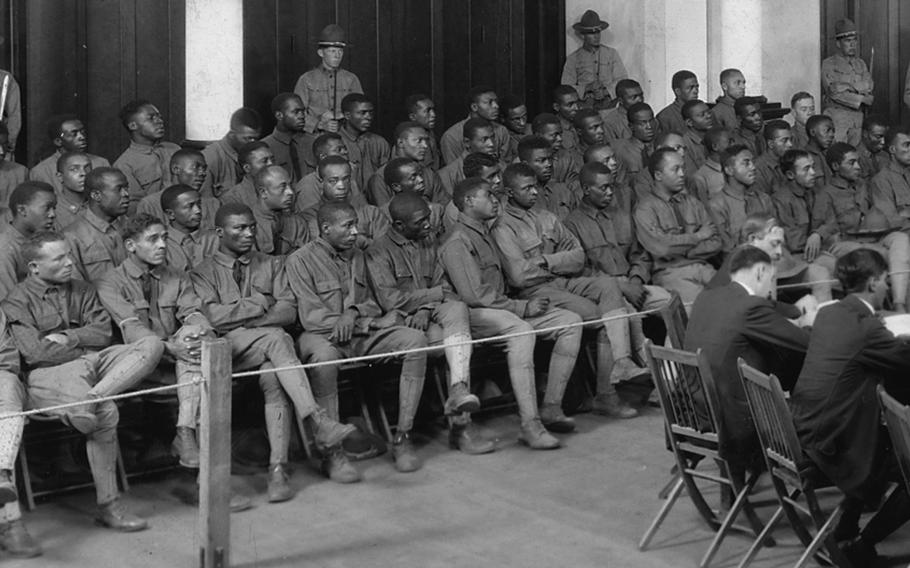
2. To accomplish this it is necessary in all agitation to draw sharply before the Negro masses the lessons of the last war–the persecution of Negro troops, segregation and Jim Crowism in the army, insults and gross mistreatment suffered by Negro troops at the hands of white ruling class officers, slavery in labor battalions, the needless slaughter of Negro troops by throwing them on the front without sufficient equipment or training (Argonne Forest), the massacre of Negroes as shock troops, the railroading of Negroes into the army regardless of their physical fitness or even if they had large families, the hanging of the members of the 24th Infantry during the imperialist war in connection with their mutiny against Jim Crow persecution, rape frame-ups of Negro’ soldiers in Camp Grant in 1918, the Jim Crowing of Negro troops in training camps and in hospitals, the mutinies and near mutinies of Negro troops in these camps as a result of inhuman treatment, etc., etc.
It is also necessary to bring out the vicious Jim Crowism practiced by the U.S. government against Negro war veterans after the war–“race” riots, wholesale lynchings of Negroes, including veterans in uniform, segregation in hospitals, discrimination in compensation, the humiliation of the Gold Star Mothers by the Jim Crow government at Washington, etc., etc.–all of this must receive the widest exposure.
3. The whole agitation against the war danger should be linked up with the exposure of the role of the Negro reformists in the last war as recruiting agents among Negroes for the imperialist war machine. In this connection it is necessary to expose such traitors as Dr. Robert Moton of Tuskegee, who was sent by the U.S. government to France for the purpose of curbing the growing dissatisfaction among Negro troops; DuBois, who wrote the treacherous editorial in The Crisis (organ of the N.A.A.C.P.)–“Close Ranks”–in which the Negro masses were called upon to forget lynching and Jim Crowism and help save Jim Crow imperialism.
In this connection DuBois wrote: “We, therefore, earnestly urge our colored fellow citizens to join heartily in the fight for eventual world liberation; we urge this despite our deep sympathy with the reasonable and deep-seated feeling of revolt among the Negroes at the present insult and discrimination to which they are subject and will be subject even when they do their patriotic duty” (emphasis ours, H.H.). Emmett Scott, who functioned as assistant secretary of war in 1918, must likewise be exposed. It is also necessary to expose the united front of Negro reformists and the Jim Crow government in the organization and maintenance of Jim Crow hospitals for Negro ex-servicemen.
4. This whole agitation should be developed in the form of sensational exposures centered around concrete cases. For example, such outstanding cases of imperialist persecution as the brutal hanging of the 13 members of the 24th Infantry by U.S. court martial at Houston, Texas, in connection with the mutiny against the outrageous attacks upon them by the civilian administration of that city: this whole case should be reviewed through establishing contact with THE FAMILIES of the victims and developing a mass campaign demanding reinvestigation of the whole affair, with the participation of representatives of working-class organizations on the investigation committee, the criminal prosecution of those responsible, and reparations to the families of the victims. Similarly the case of Willie Peterson, disabled veteran, framed-up at Birmingham, must be taken up and dramatized as a concrete example of the reward to be expected by Negroes for their services to the lynch government. This case must be utilized for the drawing of ex-servicemen into the struggle against lynching. The case of the Negro Gold Star Mothers who, as a reward for the slaughtering of their sons in the imperialist blood-fest, were subjected to the most humiliating Jim Crowism by the government, must be revived. In this case these mothers must be gotten in touch with and statements secured from them exposing their treatment. Campaigns should also be conducted around specific cases of discrimination against Negro veterans in connection with bonus, hospitalization and compensation.
5. Simultaneously it is necessary to immediately develop the partial demands of the Negro servicemen, regular army, National Guard, navy, on the basis of opposition to imperialist Jim Crow policy. It is our opinion that the Workers’ Ex-Servicemen’s League, as the working-class organization of war veterans, should also further work out the demands of the Negro war veterans in regard to discrimination in compensation, hospitalization, bonus, etc., etc., and assist in carrying on agitation among the Negro members of the American Legion and World War Veterans.
6. With the developing war situation and the growth of fascist reaction against the Negro masses, particularly in the South, the demand of the RIGHT OF SELF-DETERMINATION for the Negroes in the Black Belt acquires increasing vitality. Therefore, side by side with our fundamental slogans in regard to the war–convert the imperialist war into civil war; defeat the U.S. government, defend the U.S.S.R. and the Chinese Revolution–it is necessary to advocate among the Negro masses the necessity of turning the imperialist war into a revolutionary war for national liberation, equal rights and the right of self-determination in the Black Belt; for the confiscation of the land of the big land-owners and capitalists in the Black Belt in favor of the Negro toilers, etc.
7. Hand in hand with these fundamental slogans and subordinated to them it is necessary to advance in a more energetic fashion than heretofore the struggles for the partial demands of the Negro liberation movement: abolition of lynching and the organization of self-defense of Negro and white toilers for protection against mob violence and lynching, right of the Negro toilers to bear arms in self-defense, freedom of speech and press, abolition of Jim Crow laws and practices, equal pay for equal work, right to enter all occupations, unemployment relief without discrimination, etc., etc. For the South, in addition to these demands, the abolition of share cropping, debt slavery (peonage) and all transactions entailing bondage, abolition of chain gangs, vagrancy laws, convict labor, reduction and abolition of rent, reduction of taxes and refusal to pay taxes, relief for poor farmers at the expense of the government and big landowners, mass resistance to evictions from the land, etc., etc.
8. The mounting of lynch terror all over the country moves forward the struggle against lynching as a most vital partial demand of the Negro masses.
Struggle Against Lynch Terror.
Therefore the organization of a nationwide mass movement against lynching and for its prevention on the basis of initiating and linking up struggles around concrete cases of lynching and lynch-frame-ups, is a link which must be energetically grasped by the Party and revolutionary workers for raising the whole Negro liberation movement to a higher political plane.
In this respect it is necessary to remember that “even some relatively insignificant acts of the Ku Klux Klan bandits in the Black Belt can become the occasion for important political movements, provided the Communists are able to organize the resistance and indignation of the Negro masses.” (October Resolution of the C.I. on the Negro Question.)
9. All agitation and propaganda must proceed hand-in-hand with the more energetic championing of the everyday economic needs of the Negro toilers in the shops and factories, on the unemployment field and in the agrarian districts. This presupposes an all-around strengthening of the work of the Party, Y.C.L. and revolutionary organizations among the Negro masses. While strengthening and developing the work among the Negroes in the North, the South must now become the center of gravity in the work among the Negroes. It is necessary to carry through immediately the political orientation of all revolutionary organizations–trade unions, unemployed councils. United Farmers League, International Labor Defense, League of Struggle for Negro Rights, Workers International Relief, etc.–to the South, the development of a program of action for the Negro peasantry on the basis of revolutionary struggle against the landlords and their government, including the setting up of committees of poor farmers and unions of agricultural workers in the agrarian districts of the South.
Must Mobilize White Workers to Support Negro Masses
10. The utmost energy must be directed to rallying the broad masses of white toilers in support of the struggles of the Negro masses, including the conducting of propaganda among the white troops in the Army and Navy in defense of the Negroes.
11. The propaganda for the defense of the Soviet Union should be conducted along the following lines: Popularization of the role of the Soviet Union as the champion of the struggles of the color and subjugated nations against imperialism, in this connection to popularize the solution of the national question in the U.S.S.R. and the achievements of socialist construction and the Five Year Plan, in the industrial and cultural development of national minorities. It is necessary to bring before the Negro masses concrete illustrations of the attitude of the workers and peasants of the Soviet Union in regard to the Negro question: support given to the campaign for the release of the Scottsboro boys, the Stalingrad trial of white American engineers convicted by a Soviet workers’ court for a chauvinist attack upon the Negro worker Brown.
12. It is the duty of the revolutionary workers in the United States, especially the white workers, to assist in developing the campaign against war in the Negro colonies, particularly the West Indies; in the first place by the giving of moral and material support to the development of the revolutionary movement in these colonies: by carrying out the widest campaign among the mosses in the United States, including propaganda in the army and navy in defense of the emancipation movements in these colonies against the imperialist war, which is at the same time a war for the suppression of the colonial revolution. In this connection solidarity strikes, street demonstrations and other forms of mass action should be organized.
It is necessary to combat the reactionary influence of Garveyism by opposing to this anti-working class ideology the program of the C.I. on the Negro colonies–complete national independence, organization of independent republics, immediate withdrawal of armed forces of imperialism from these colonies, etc., etc.
IT is likewise necessary to expose the reactionary content of the ideas advocated by the Garveyites in regard to the present war, in which Japan is presented as the champion of the darker races against the white imperialists. Towards this end, it is necessary to expose the role of the Japanese imperialists in the rape of Manchuria, the brutal persecution of the Japanese toilers by Janese imperialists and the alliance of Japanese, European and American imperialists for the crushing of the Chinese and colonial revolution, and the military intervention against the U.S.S.R.
“Whether the rebellion of the Negroes is to be the outcome of a general revolutionary situation in the United States, whether it is to originate in a whirlpool of decisive fights for power by the working class for proletarian dictatorship, or whether on the contrary, the Negro rebellion will be the prelude to gigantic struggles for power by the American proletariat, it cannot be foretold now. But in either contingency it is essential for the Communist Party to make an energetic beginning now–at the present moment–with the organization of joint mass struggles of white and black workers against Negro oppression.”–(C.I. Res. on Negro Question, Oct., 1930.)
The Daily Worker began in 1924 and was published in New York City by the Communist Party US and its predecessor organizations. Among the most long-lasting and important left publications in US history, it had a circulation of 35,000 at its peak. The Daily Worker came from The Ohio Socialist, published by the Left Wing-dominated Socialist Party of Ohio in Cleveland from 1917 to November 1919, when it became became The Toiler, paper of the Communist Labor Party. In December 1921 the above-ground Workers Party of America merged the Toiler with the paper Workers Council to found The Worker, which became The Daily Worker beginning January 13, 1924. National and City (New York and environs) editions exist.
PDF of full issue: https://www.marxists.org/history/usa/pubs/dailyworker/1931/v08-n304-NY-dec-19-1931-DW-LOC.pdf
 Revolution's Newsstand