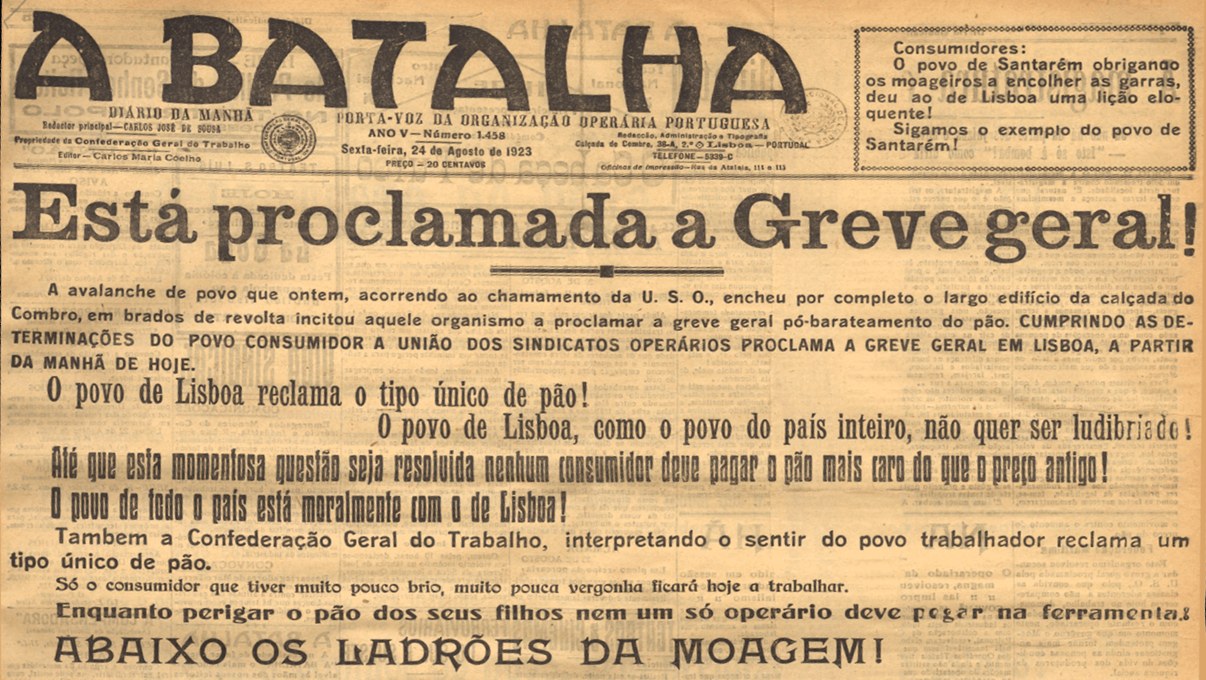
A letter home from Dos Passos traveling through sleepy Portugal where the syndicalists of A Battalha were waking the country with song.
‘In Portugal’ by John Dos Passos from The Liberator. Vol. 3 No. 4. April, 1920.
OPPOSITE me on the train to Lisbon sat a monarchist. He was very lean, had violet rings under his eyes, and a tightly stretched parchment face. He orated all night, bouncing up and down on his seat, and when he reached the climax of his eloquence, as he did frequently, his eyes flared in a most extraordinary way. As he kept handing me most tasty little patees which he took out of an inexhaustible paper bag, I felt excellently disposed towards him, and cheered in the pauses. He said that Portugal was a pequenha Russia, and that only a monarchy strongly supported from the outside, could keep the working people from taking control altogether. The place was not worked with soviets and with the infamous doctrines of Malatesta and Sorel.
Later, in Lisbon I heard much the same story from the paternal white-haired old gentleman who edited the leading “Liberal” newspaper. His cure was “a strong conservative government” with the usual work and reconstruction and no-strike tag. Portugal, he said must fulfill her obligations to her great ally. As I left I sprang something on him. How about the rumor that the royalists in the January revolt had landed in Oporto from an English vessel? The Duke of Palmella had been sheltered in the American Legation, hadn’t he? The paternal old gentleman went to the door and shut it hastily. Then he cleared his throat and said impressively, “Portugal will always look to England for help and advice. What we need is work and a strong conservative government.”
The republic, entirely in the hands of the bourgeoisie, receiving its orders as to foreign policy from Great Britain, having done nothing to free the country from domestic or foreign capital, has fulfilled none of its promises. Illiteracy remains over 75 per cent. Labor is worse paid than in any except the Balkan countries. The mineral wealth of the country is untouched, or else exploited by Great Britain. Portugal is a British colony without the advantages of British administration.
But in Portugal, as everywhere in the world, the giant stirs in his sleep. The story of Russia has spread among peasants and workmen. The first result was the November, 1917, peasant revolt in the province of Alemtejo, where the land is held in large estates. They proclaimed a communist republic, seized and divided the land and for weeks held out against the troops of Sidoneo Paes. The railway men in the southern part of Portugal struck in sympathy, and for a time it looked as if the revolution were at hand. The organization was insufficient, however. The centers in Lisbon were cut off, and Sidoneo Paes was able to deal with the rebellion with such severity and secrecy that not an echo was heard in the outside world.
Since that time syndicalist organization, on the model of the French C.G.T., has gone on vigorously, until now Lisbon and the south are excellently organized, while propaganda is making progress even with the clerical northern peasantry, who own their own land and form the most profoundly conservative force in the country. A Battalha, the organ of the C.G.T., is the best printed paper in Lisbon, and has now the third largest circulation. Of the editors Joaquin Cardoso is a typographer and Alexandre Vieira a college man and journalist. Cardoso told me that he personally had four separate trials pending, but he added, laughing, justice is less expensive in Portugal than in America.
A Battalha has in the eight months that it has existed. become the center of the syndicalist movement. I know of no paper that seems so rooted in people’s affection. A constant stream of people would pour through the office, asking advice, telling their troubles; old women would ask help for sons who were in prison; boys would take off their shirts to show on their backs the welts. raised by the sabres of civil guards, all with a trustful, burning enthusiasm that will go far some day. After talking a couple of hours with Lisbon workmen, the days of the politician and of the bourgeois seem numbered. And they might be over now if it weren’t for British Dreadnoughts.
If organize and wait is the motto of the C.G.T. shout and sing is the motto of the new tendency embodied in the Maximalist Federation whose organ the Red Flag, leads a lively and precarious existence. Their aim is to form the nucleus of a red guard which, while leaving all direction in the hands of the C.G.T. shall be ready from the first to fight the counter-revolution.
When I was talking to the editor of another “Liberal” newspaper, this one not fatherly but youngish, in a tight black silk vest, with a monocle in his eye, we heard singing in the street outside that sounded suspiciously like the Internationale. “It’s nothing,” he said. “They’ll be arrested soon. We need a strong conservative government to control this rabble. What Portugal needs is work and order so that we may fulfill our respons…”
But I knew what he was going to say. I left in a hurry. I found out that it was the Young Syndicalists protesting against the arrest of some members of the Maximalist Federation. The Young Syndicalists mostly boys between fifteen and twenty, were arrested too. In the prison they continued singing the Internationale. The Fire Department was sent for and the hose turned on them; they sang louder.
When I left Portugal about a week later, they were still in prison, and still singing. People could hear them from adjoining streets, which was demoralizing. But it’s hard to see what else syndicalists can do in Portugal but sing until something happens to the Dreadnoughts. Madrid, Dec. 14, 1919. JOHN DOS PASSOS.
The Liberator was published monthly from 1918, first established by Max Eastman and his sister Crystal Eastman continuing The Masses, was shut down by the US Government during World War One. Like The Masses, The Liberator contained some of the best radical journalism of its, or any, day. It combined political coverage with the arts, culture, and a commitment to revolutionary politics. Increasingly, The Liberator oriented to the Communist movement and by late 1922 was a de facto publication of the Party. Max Eastman would sell the paper to the Party and In 1924, The Liberator merged with Labor Herald and Soviet Russia Pictorial into Workers Monthly. An essential magazine of the US left.
PDF of full issue: https://www.marxists.org/history/usa/culture/pubs/liberator/1920/04/v3n04-w25-apr-1920-liberator-hr.pdf
 Revolution's Newsstand