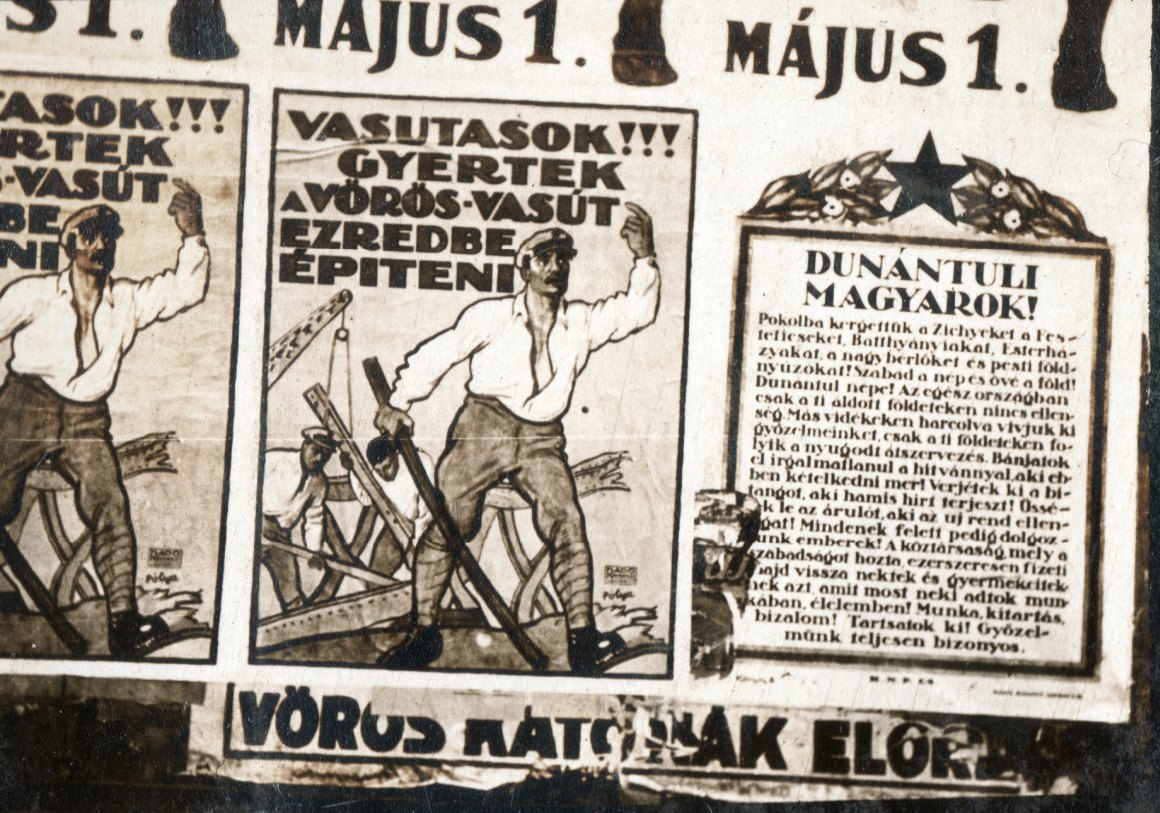
The economist writing as Commissar of Social Production on the unique circumstances which came together to bring Communists to power and their ambitions for the short-lived Hungarian Soviet Republic
‘Communist Hungary’ by Eugene Varga from Communist International. Vol. 1 No. 2. June, 1919.
Only six weeks ago no outsider would have believed it possible that Hungary could ever become a soviet republic. The Hungarian proletariat was divided into two parts. The one, incomparably superior in numbers, belonged to the social democratic party. The other, numerically much smaller, but in politics acting much more resolutely adhered to the communist party. An acute struggle seemed to go on between the two camps. The leaders of the communist party were even put under arrest and that by order of a government counting four social democrat ministers. Shortly after the arrest had taken place, the proletariat of Hungary took over the whole power in the country. The proletariat started from the principles of a soviet system and proclaimed the dictatorship of the proletariat. And now the leaders of the former social democrat party are working in full harmony with the communists at strengthening this dictatorship. Among the people’s commissaries are two former ministers who at the time had given their consent to the arrest of the leaders of the communist party. Today complete harmony reigns within the Hungarian proletariat. When the union came about only three of the former leaders of the social democrat party dissociated themselves. They were: Garami, intellectual socialist, formerly minister of commerce; Buchinger, secretary to the party and Peidl, minister without portfolio. They were not inclined to adopt the platform of dictatorship.
This peculiar change in the relations of the two parties was possible only because the Hungarian social democratic party was incomparably more radical than the Western parties. The Hungarian social democrats had kept themselves aloof from all social patriotism (some small transgressions excepted). No civil peace was established in Hungary during the war, the class struggle of the proletariat continued and frequently acquired an acute form even during the war. This furnished the general possibility for passing from the social democratic basis to communist policy.
However, the chief inducement for the marxistically schooled leaders of the social democrat party and, in particular, for the writer of these lines, to change their political principles lay in their realising that production could not be built up anow on a capitalistic basis in Hungary, nor, to all intents and purses, in any of the other countries. Militarism was so thoroughly eradicated by the first Hungarian revolution that the ruling classes were no longer able to use armed force against the proletariat. Thus disappeared one of the most indispensable props of all capitalistic production, armed power which, in cases of necessity, could force the proletariat to work. No intact military units remained that might have served as nucleus to all kinds of counter-revolutionary organizations, as was the case in Germany. Whatever new military organizations were formed after the first revolution were much more intimately connected with the proletariat, than with the bourgeoisie. It was therefore quite out of the question to user against the proletariat those new military units that had their own soldiers’ councils and delegates.
Under such conditions the capitalists had no choice but to grant the economic demands of the proletariat, for otherwise the workmen would have used force against the capitalists and their officials. However, high wages making production an unremunerative business, the capitalist withdrew from it and the whole capitalistic system came to a deadlock. As a matter of course prices had to be raised in accordance with the higher economic demands of the workmen. Thus production as a whole was moving in a circle, and it was clear that the demands of the workmen, no longer to be kept down by intact militarism, could not be granted within a capitalistic system, the more that the productive mechanism of Hungary had greatly suffered through the war, every reasonable marxist had to recognize that the preservation of the capitalistic system spelt absolute economic ruin to the country; that a reorganization of production would be possible only if all capitalistic obstacles were removed from economic development at one blow and the whole economic life subjected to the dictatorship of the proletariat.
The entering of the Hungarian proletariat into political power was facilitated by the Allied Imperialists dictating to Hungary conditions of peace which the coalition government, consisting of bourgeois and social democrats, would not accept, nor had the courage to refuse. The coalition cabinet chose the only way out and resigned, handing over entire government power, to the proletariat. The bourgeoisie thought that they were transferring the power to the social democratic party and were certainly rather disagreeably surprised when they became aware that they had really paved the way for proletarian dictatorship. The resignation of the bourgeois government enabled the proletariat to take the whole political power of the country into their hands at once, without any bloodshed whatsoever.
The union of the two parties having been accomplished and proletarian dictatorship proclaimed, activity immediately began with a view to carrying through the socialisation of production in the shortest possible period. The very first day of the now government being in power all banks were proclaimed state property, the deposits, securities and safes of the bourgeoisie were confiscated and the former owners permitted to draw not more than 2,000 crowns a month.
All the enterprises having over 20 workmen, were monopolized by the state without compensation the owners. All real estate exceeding in size the piece of land that could be worked by a single farmer and his family was taken from the owners and assigned for cultivation to the landless agricultural labourers. The land itself is state property; the tillers are paid labourers of the state organized on a cooperative basis. Cultivation on the large estates takes place under the control and guidance of trained agricultural officials; there is no dividing into lots at all. In the same way all houses neither acquired nor built, but merely inhabited by proletarians went over to the state without compensation to the owner.
Order is rapidly returning in economic life.
A central office is now being established for all raw materials and half-manufactured goods. The whole production of the most important branches of industry, such as coal, wood, Iron, sugar, machinery etc. is being concentrated in a central government office; the production of all the works is being reported to this office weekly. All the data on production flow into this central office. A superior council decides on the principles of distribution and further production. Moreover, an office for foreign trade has been formed that supervises and regulates the whole foreign trade, export as well as import. We thus see that the work of reconstruction is progressing much faster in Hungary than in Russia. The reasons for it are that for a whole month there was no counter-revolutionary movement, nor war in Hungary, that the country is small, which makes work much more easy than in a large country: and, lastly, that till now we had no sabotage, of intellectuals. On the contrary, engineers, chemists, state and private officials have placed themselves unconditionally at the disposal of the soviet government.
A severe impediment to peaceful work has arisen in the attack of the Rumanian boyars. In order to offer them effective resistance regular work had to be interrupted and the whole force of the proletariat turned towards the defence of the country. We earnestly hope to be able to repel the attack and to soon successfully finish the work we have begun.
The ECCI published the magazine ‘Communist International’ edited by Zinoviev and Karl Radek from 1919 until 1926 irregularly in German, French, Russian, and English. Restarting in 1927 until 1934. Unlike, Inprecorr, CI contained long-form articles by the leading figures of the International as well as proceedings, statements, and notices of the Comintern. No complete run of Communist International is available in English. Both were largely published outside of Soviet territory, with Communist International printed in London, to facilitate distribution and both were major contributors to the Communist press in the U.S. Communist International and Inprecorr are an invaluable English-language source on the history of the Communist International and its sections.
PDF of full issue: https://www.marxists.org/history/international/comintern/ci/old_series/v01-n02-jun-1919-CI-grn-goog-r2.pdf
 Revolution's Newsstand