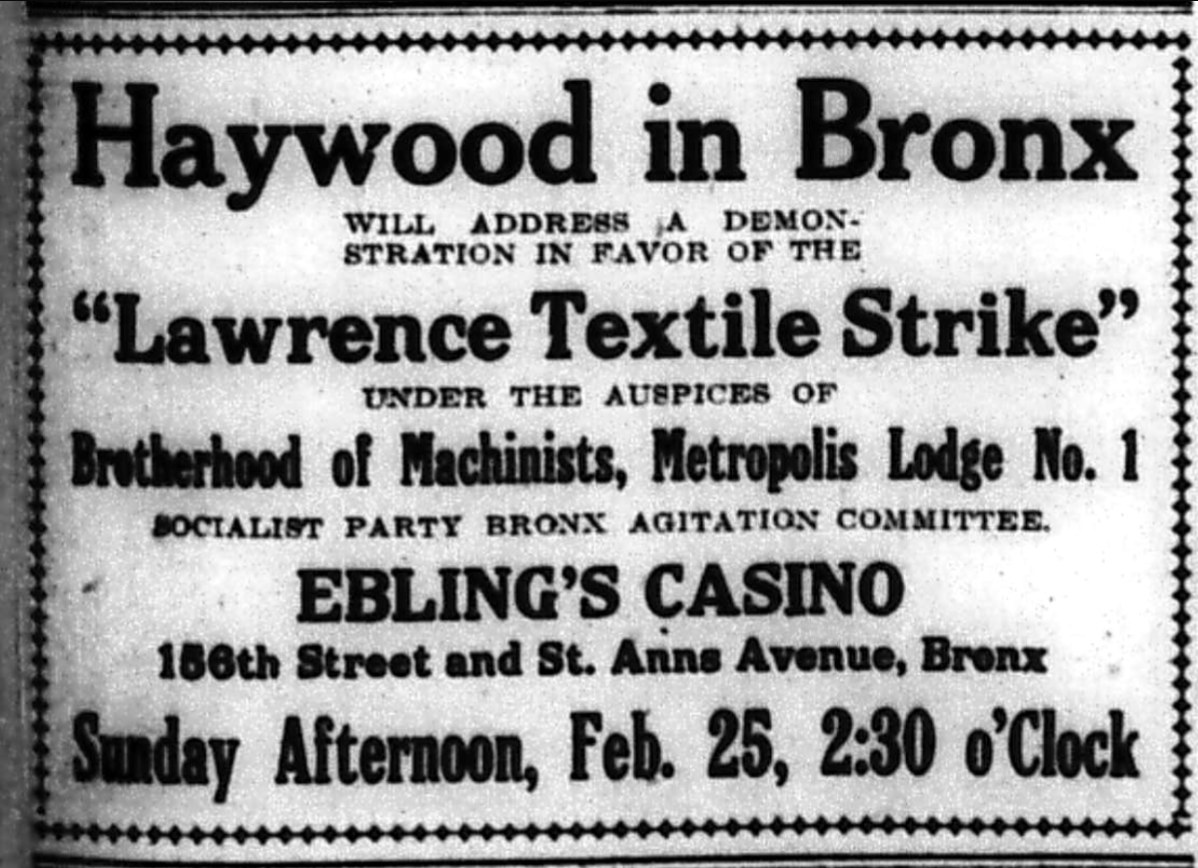
Haywood, speaking on the innovative and dramatic Lawrence strike for which he was a central organizing figure. Haywood had recently been elected to the Socialist Party’s national executive on a revolutionary platform, and saying such heresies as those below, in the heartland of the Party’s ‘politicals’ no less, would lead the reformist wing to pass Article II, Section 6 later that year and embark on Haywood’s recall from leadership, which succeeded the following February.
‘Haywood Tell of Fight in Lawrence’ from The New York Call. Vol. 5 No. 57. February 26, 1912.
Last Outrage Disgraces American History, He Says.
MEAN WAGE NOT $6
Says Gov. Foss Pays Women Slaves in Foundries Still Less.
Charging that conditions in Lawrence were a “disgrace to American history such as it has never been stained with before,” William D. Haywood spoke on the “Lawrence Textile Strike” yesterday afternoon to a large and wildly enthusiastic audience at Ebling’s Casino, 156th street and St. Anns Avenue, Bronx, under the auspices of the Metropolis Lodge, No. 1, of the Brotherhood of Machinists, and the Bronx Agitation Committee of the Socialist party.
In Introducing Haywood, Robert M. Lackey, the chairman, said that the time of the labor troubles in Colorado, with its bull pens and suspension of habeas corpus, it was said that such conditions could never happen in the East. The effort to keep the strikers’ children in the town he branded as the “most damnable capitalist anarchy.”
The class struggle, the social revolution, he said, could never be imprisoned in a two-by-four cell.
Haywood was given a great ovation rose to speak.
He spoke against the craft form of labor organization, each claiming autonomy, and the system whereby different contracts between the workers and their employers expire at different times.
Van Cleave, Parry, Post, couldn’t have conceived, he said, of a better plan to keep the workers from a united action.
The A. F. of L. in Lawrence, said Haywood, is trying to defeat the striking textile workers, and told of John P. Golden’s agreement with the mill owners, and his promise to scour the country for workers, to get strike-breakers if necessary.
He told how Golden went with a legation, headed by Judge Mahoney, to the Legislature to get their aid in defeating the strikers. The delegation, said Haywood, warned the Legislature that their action might result in the digging of their political graves. Labor officials, he said, lined up with Tammany Hall heelers, are a bane to the working class.
Haywood then told of the causes that had precipitated the strike. The Legislature passing the fifty-four hour law to benefit the women and children employed in the mills and the bosses’ speeding up of the machines until the workers were producing more cloth in the fifty-four hours than they had in the previous fifty-six. Not content, he said, with the saving in running the factories, the mill owners had put their fingers into the pay envelope and taken an average of 26 cents per week. For a worker receiving less than an average $6 per week the reduction of wages meant the difference between life and death, he said, taking away five or six loaves of bread from children who from very birth have suffered from malnutrition.
When the 22,000 textile workers, composed of eighteen different nationalities and forty dialects, found that raid had been made on their envelopes, they recognized that they had a common stomach and left the mills in rebellion.
Haywood retold of the scalding of the strikers at the Pacific Mills and the damage done by the outraged persons to the cars and to the mill machinery, the calling of the police by Bremen, and the arming of the “better material” found in the saloons. Governor Foss, who employs women in his foundries near Lawrence, at lower wages than those paid the male workers. Haywood continued, “the soldiers who came with murder in their hearts” resulting in the baptism of the glistening bayonet by piercing the lung of a boy. Then Haywood told of the shooting of the woman, the trial of Ettor and Giovannitti, and testimony of witnesses that a policeman had fired the shot. No warrant, he said, had been issued for the policeman.
The Lawrence strike, continued Haywood, has no leaders or executive committee, nobody that the mill owners can “see.” The strike committee, he said, is composed of 56 members representing the various nationalities. An auxiliary committee, three members for each of the strike committee, replaces members taken from the latter.
Relief Investigators, numbering 180, he said, call on the strikers to see they are not in want, and all applications are passed on by a relief committee. Relief is distributed from eleven different stations, each buying their supplies from the central station. Four dining halls feed the needy, the central station feeding from 11,000 to 18,000 each day. Including the aged, crippled and children, nearly 60,000 persons are being provided for by the relief corps.
After a collection was taken up, amounting to $67.87, Haywood continued. He said that the women, who constitute 40 per cent of the strikers recognize the Lawrence strike as their battle. They recognize it, he said. As a fight for the right to bear a healthy child, which right they have been deprived of.
When Haywood, mentioned the efforts of Hearst’s Boston American to start a campaign against the sending out of the Lawrence children, a long hiss arose. This is the “friend of the workingman,” said Haywood, who has locked out the miners at Lead City S. Dak., for two and one-half years in organizing.
Haywood then told of the outrage committed at the depot last Saturday, the clubbing of the women and children and of the children being prevented from leaving the town.
If ever he regretted being born on American soil, he said, it was when he saw a woman assaulted by American. “From this hour I forswear America.”
“Until this condition is changed I will never vote again,” said Hay wood.
He will fight, he said, for the one big union, the one that is being fought by the combined power of society, the press, the priests and preachers, all the city administration and the operatives of the Pinkerton, Burns and Calahan agencies.
Haywood then read off the wages paid the Lawrence workers. One envelope was marked $4.45; another $5.38; another, $6.05, $3.85. $4.75. one $1.36, for a week’s work. He compared these wages to those paid in other industries, wages which were larger for a day’s work of 8 hours–than the textile workers were receiving for 54 hours.
In speaking of the machinists, electricians, etc., who were working in the mills, Haywood said, he believed that no contract made by them was sacred enough to compel one worker to scab on another.
An additional collection was taken up which raised the sum to $92.93.
Fred Paulitsch, speaking as a member of the Socialist party, said while he agreed in organizing along industrial lines, he also believed that the powers of government must be captured. His contention, he said, is fully proven by the affair of Saturday. If the government, with its branches of police and military powers, had been in the hands of the working class, the outrage of Saturday would not have been possible There would have been no need, said, of calling a meeting to protest against such methods.
Protest by strikes, said Paulitsch, but also protest against the government on election day. The fight, he said, is an international battle against the capitalist class. Gary, said Paulitsch, compares the present condition of society to that preceding the French Revolution, a great upheaval which, after flaring up, returns to the capitalist class.
The great need, said Paulitsch, for the study of economic conditions, the organizing of the working class both practically and economically the use of both methods.
The party organization, he continued, is heart and soul in the Lawrence strike. He urged those press to take part in the work of the Socialist movement, to “make America the country of the working class.”
It was announced that the Brooklyn Federation of Labor, at its meeting yesterday, decided to appeal to canvas all unions affiliated with it for financial support in behalf of the Lawrence strikers, a committee of ten having been appointed to carry out the decision.
The New York Call was the first English-language Socialist daily paper in New York City and the second in the US after the Chicago Daily Socialist. The paper was the center of the Socialist Party and under the influence of Morris Hillquit, Charles Ervin, Julius Gerber, and William Butscher. The paper was opposed to World War One, and, unsurprising given the era’s fluidity, ambivalent on the Russian Revolution even after the expulsion of the SP’s Left Wing. The paper is an invaluable resource for information on the city’s workers movement and history and one of the most important papers in the history of US socialism. The paper ran from 1908 until 1923.
PDF of full issue: https://www.marxists.org/history/usa/pubs/the-new-york-call/1912/120226-newyorkcall-v05n057.pdf
 Revolution's Newsstand