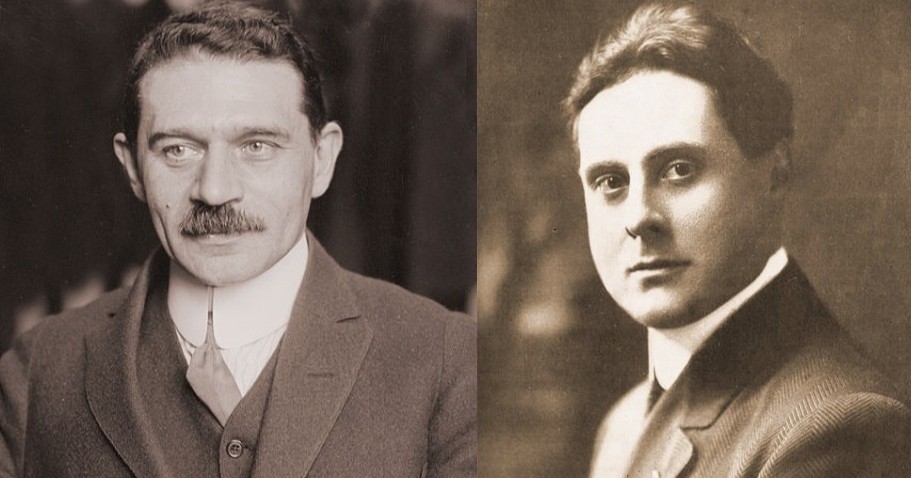
The U.S. Socialist Party delegate Morris Hillquit is alone at the International’s Stuttgart Congress in arguing for an anti-immigration position. Frank Bohn with a valuable report on the debate.
‘Immigration and Emigration at Stuttgart’ by Frank Bohn from The Weekly Worker. 17 No. 29. October 12, 1907.
In the history of humanity the movement of large masses of people has always been of vast importance. The story of every land begins with an account of the sources of its population. The ancestors of all white Americans came from Europe. Modern Europeans are composed of a mixture of peoples who came in successive waves from Asia. The Romans came from the Eastern part of the Mediterranean. Though migrations sometimes have political and religious phases, they are always fundamentally economic. People simply go where they can live most easily and most happily. The last four centuries, with immensely increasing populations in Europe, with the opening up of vast and undeveloped continents and the development of the means of transportation, have given rise to the greatest migrations in history. As a result we have new nations in the Americas, Australia and South Africa. The purpose of the European colonial systems was commercial gain. To the colonizing nations the development of independent societies has been an unlooked for and unwelcome by-product. This development has given rise to numberless “colonial problems,” colonial and international wars, and, last–from the point of view of the new countries, to the immigration “problem.” This “problem” is of practical interest, also, to the industrially more advanced countries, such as England Germany, which receive an influx of wage-workers from the poorer and less developed countries, such as Italy and Russia.
It is not my purpose in this discussion to enter into a consideration of statistics and conditions of immigration, shall merely state why the International Socialist Congress considered that the subject constitutes a problem and what the various positions assumed by the delegates were. For all clear-headed revolutionary militants, immigration presents a very small “problem.” In the first place, insofar as the worker is concerned, the national boundaries of the modern world are being rapidly swept away the development of world capitalism. Furthermore, even if capitalism were a national affair only, this would not be cause for the workers to similarly divide their forces. National exclusiveness, on the part of the working class, is prompted by the same narrow spirit of craft unionism. In either case, the more favored workers are in opposition to the less favored members of their class. Both attitudes paralyze the class spirit and, if persisted in, would make a revolutionary movement impossible. Recognizing this truth, the Amsterdam Congress (1904) defeated a resolution looking to restrict immigration.
When the Stuttgart Congress met, it was evident that another effort would be made to gain the support of the International Movement for a reactionary resolution. The resolution of the Socialist Party began with the following paragraph:
“Under a highly developed system of capitalism the migration of workingmen from country to country is unavoidable: the international mechanism of production and exchange presupposes an international market for labor.”
But this profound truth was followed, in paragraph No. 3, by the following unfortunate proposition:
(The Congress declares it to be the duty of Socialists, etc.) “To combat with all means at their command the willful importation of cheap foreign labor calculated to destroy labor organisations, to lower the standard of living of the working class, and to retard the ultimate realization of Socialism.”
Let us analyze this paragraph In. the first place our attention is attracted by that old one–“cheap foreign labor.” How many times, with tear-stained face, has the Republican campaign orator thrilled the working class with patriotism and the love of family and home, by expatiating upon the awfulness of importing and consuming commodities produced by “cheap foreign labor.” The resolution in question would have lacked some of its offensiveness had this phrase been omitted. Then, as to the import of the paragraph. Some of us are bold enough to claim the right, in searching for a master, to go to any part of world we please. The resolution introduced by the Socialist Labor Party simply declared that all efforts to restrict free emigration and immigration of workers were capitalistic and ought not be aided by Socialists. It is well known that in the modern world the capitalist and professional classes go where they please,–to the North Pole, to Tibet or Timbuctoo. But here we are to have legislation, as a result of Socialist sanction and initiative, discriminating against the working class, declaring the conditions upon which they may or may not travel about the world.
Some of us at once surmised that the resolution was afflicted by more sores than were at first visible. That we were right was perfectly evident as soon as the advocates of the thing held it up to public view. Delegate Hillquit declared that this part of the resolution was designed, if followed out in legislation, to prevent the importation of strike-breakers. A sentence in the preamble of the resolution, declared that the workers were compelled to resist the importation of unorganized and unorganizable foreign labor.” “Now,” said Hillquit, “oriental labor is unorganized and unorganizable.” All doubt vanished. The first part of the resolution and its preamble could be used to prove its revolutionary character. The part above quoted could be used on the Pacific Coast as bricks to hurl at the Chinese and Japanese. And the expression “cheap foreign labor” would come in handily while addressing exclusive, “aristocratic” American-born trade unionists.
In my remarks to the section on this resolution, I was fortunate in being preceded by Comrade Kato of Japan. This delegate, a man of exceptional insight and ability, spoke briefly and to the point in German. “Japan,” said he, has been thrust into the vortex of modern Capitalism.” Its capitalists were no less avaricious and its working people no less worthy of consideration than those of other countries. Observations made by the mover of the resolution inclined him to believe that the workers of the Orient were indicated by the veiled phrases of the resolution. Against this, as a Socialist, he protested. What would Marx think of such a proposition? His speech was received with applause. Following him, I observed that the resolution “was founded upon two antiquated and non-Socialist conceptions–(1) The capitalist political state, the frontier of which Socialists should ignore, and which were already being swept away by the streams of capitalist progress; and, (2) upon the Anglo-American craft union or job-trust, which made a practice of putting worker against worker, regardless of race, color or condition of servitude.
The preamble to the Hillquit resolution states that under a highly developed system of capitalism the migration of workingmen from country to country is unavoidable: the international mechanism of production and exchange presupposes an international market of labor. From the scope of this clear and excellent generalization how can we exclude, for instance, Japan? If Japan, why not Italy and Hungary. A great American textile manufacturer has lately said that Japanese concerns were paying 45% duty and still underselling American fabrics in the American market. Now what are the advocates of this resolution going to do about it? To be logical, they must join the party of high protection and thus save us from “cheap foreign labor.” If a Japanese Socialist Comrade Kato, here at my right, for instance, is exiled by the Mikado’s Government and sought refuge in America, would the mover of the resolution advocate his exclusion? (In answer Hillquit stated that, in his speech of the day before, he had not meant the Japanese at all, but the Chinese.) “It has been maintained that oriental labor in America is always contract labor and is used to break strikes. This I deny. But the Boot and Shoe Workers International Union of America, an organization which the mover of the resolution endorses and supports, signs contracts with the shoe manufacturers to import strike breakers in case the boot and shoe workers go on strike.”
I then read the S.P. California State Platform which pledged the candidates of the Party, if elected, to work for the exclusion of Oriental laborers. Then, after referring to articles in the “Oakland Voice,” I claimed that the California S.P. was moved to its action by a desire to please and gain votes from the A.F. of L. The advocates of the resolution had better set their house in order by abolishing the contract labor system in their own craft unions.” (At this point, after appeals from Hillquit, the chairman of the section asked me to talk to the subject).
After briefly outlining the history of immigration in America, I appealed to the section to assist the movement in America by aiding us in breaking down race and national barriers.
Compere-Morel, (a Herveist) of France, and Diner-Denes of Hungary spoke with telling force against race exclusion. The latter declared that the claim that the Chinese were unorganizable was as fallacious as to declare any other body of workers unorganizable.
The machine process made all races organizable. “If we oppose immigration because it depresses wages, why not oppose the introduction of machines which has the same effect?”
Valere of Italy protested against the chauvinistic spirit of American trade unions.
No one but Hillquit spoke for the resolution. And as he was absent when the vote was taken, it had not a single supporter.
Immediately before the adjournment of the section, an incident occurred which permitted me to further clarify the members upon the situation in America. A delegate who is active in the German Seamen’s Union (evidently having read and digested the report of the British S.L.P.), spoke with great feeling against those British, and American craft unions which excluded immigrants and thousands of their own countrymen, through high initiation fees. “This,” said he (almost literally quoting the British S.L.P. report),” is the cause of importation of scabs from England to the continental sea-ports.” He then introduced the paragraph dealing with this subject. (See below)
Speaking on this paragraph (the chairman not being moved to declare me out of order) I exposed the real nature of such organizations as the American Flint Glass Blowers’ Union, the Granite Cutters, etc., whose initiation fees, ranging up to $500.00, kept natives and immigrants alike out of the Union Movement. Great surprise was caused by the remarks, and I unable to secure enough I.W.W. and S.L.P. reports to satisfy the requests of delegates. The paragraph was inserted by unanimous vote and the chairman (Ellenbogen of Bohemia), in his report to the Congress attacked the system of high initiation fees as maintained among American craft unions.
The S.P. delegation, happily, voted solidly for the resolution as reported and thus, morally, at least, bound their party to a policy which accords with the principles and ideas of the Inte national Socialist Movement,
The resolution:
The Congress declares: Immigration and Emigration of workingmen are phenomena as inseparable from the substance of capitalism as unemployment, overproduction and underconsumption of the workingmen, they are frequently one of the means to reduce the share of the workingmen in the product of labor and at times they assume abnormal dimensions through political, religious and national persecutions.
The Congress does not consider exceptional measures of any kind, economic or political, the means for removing any danger which may arise to the working class from immigration and emigration since such measures are fruitless and reactionary; especially not the restriction of the freedom of migration and the exclusion of foreign nations and races.
At the same time the Congress declares it to be the duty of organized workingmen to protect themselves against the lowering of their standard of life which frequently results from the mass import of unorganized workingmen. The Congress declares it to be their duty to prevent the import and export of strikebreakers. The Congress recognizes the difficulties which in many cases confront the workingmen of the countries of a more advanced stage of capitalist development through the mass immigration of unorganized workingmen accustomed to a lower standard of life and coming from countries of prevalently agricultural and domestic civilization, and also the dangers which confront them from certain forms of immigration. But the Congress sees no proper solution of these difficulties in the exclusion of definite nations or races from immigration, a policy which is besides in conflict with the principle of proletarian solidarity.
The Congress, therefore, recommends the following measures: For the countries of Immigration:
1. Prohibition of the export and import of such workingmen who have entered into a contract which deprive them of the liberty to dispose of their labor power and wages.
2. Legislation shortening the work-day, fixing a minimum wage, regulating the sweating system and house industry and providing for strict supervision of sanitary and dwelling conditions.
3. Abolition of all restrictions which exclude definite nationalities or races from the right of sojourn in the country and from the political and economic rights of the natives or make the acquisition of these rights more difficult for them. It also demands the greatest latitude in the laws of naturalization.
4. For the trade unions of all countries the following principles shall have universal application in connection with it:
a. Unrestricted admission of immigrated workingmen to the trade unions of all countries.
b. Facilitating the admission of members by means of fixing reasonable admission fees.
c. Free transfer from the organizations of one country to those of the other upon the discharge of the membership obligations towards the former organization.
d. The making of international trade union agreements for the purpose of regulating these questions in a definite and proper manner and enabling the realization of these principles on an international scope.
5. Support of the trade unions of those countries from which the immigration is chiefly recruited.
II. For the countries of Emigration:
1. Active propaganda for trade unionism.
2. Enlightenment of the workingmen and the public at large on the true conditions of labor in the countries of immigration.
3. Concerted action on the part of the trade unions of all countries in all matters of labor immigration and emigration.
In view of the fact that emigration of workingmen is often artificially stimulated by railway and steamship companies, land speculators and other swindling concerns through false and lying promises to workingmen, the congress demands:
Control of the steamship agencies and emigration bureaus and legal and administrative measures against them in order to prevent that emigration be abused in the interest of such capitalist concerns.
III. Regulation of the system of transportation, especially on ships. Employment of inspectors with discretionary power who should be selected by the organized workingmen of the countries of emigration and immigration. Protection for the newly arrived immigrants, in order that they may not become the victims of capitalist exploiters.
In view of the fact that the transport of emigrants can only be regulated on an international basis, the Congress directs the International Socialist Bureau to prepare suggestions for the regulation of the question, which shall deal with the conditions, arrangements and supplies of the ships, the air space to be allowed for each passenger as a minimum, and shall lay special stress, that the individual emigrants contract for their passage directly with the transportation companies and without intervention of middlemen. These suggestions shall be communicated to the various socialist parties for the purpose of legislative application, and adaptation as well as for the purposes of propaganda.
New York Labor News Company was the publishing house of the Socialist Labor Party and their paper The People. The People was the official paper of the Socialist Labor Party of America (SLP), established in New York City in 1891 as a weekly. The New York SLP, and The People, were dominated Daniel De Leon and his supporters, the dominant ideological leader of the SLP from the 1890s until the time of his death. The People became a daily in 1900. It’s first editor was the French socialist Lucien Sanial who was quickly replaced by De Leon who held the position until his death in 1914. Morris Hillquit and Henry Slobodin, future leaders of the Socialist Party of America were writers before their split from the SLP in 1899. For a while there were two SLPs and two Peoples, requiring a legal case to determine ownership. Eventual the anti-De Leonist produced what would become the New York Call and became the Social Democratic, later Socialist, Party. The De Leonist The People continued publishing until 2008.
PDF of issue: https://www.marxists.org/history/usa/pubs/the-people-slp/071012-weeklypeople-v17n29.pdf
 Revolution's Newsstand