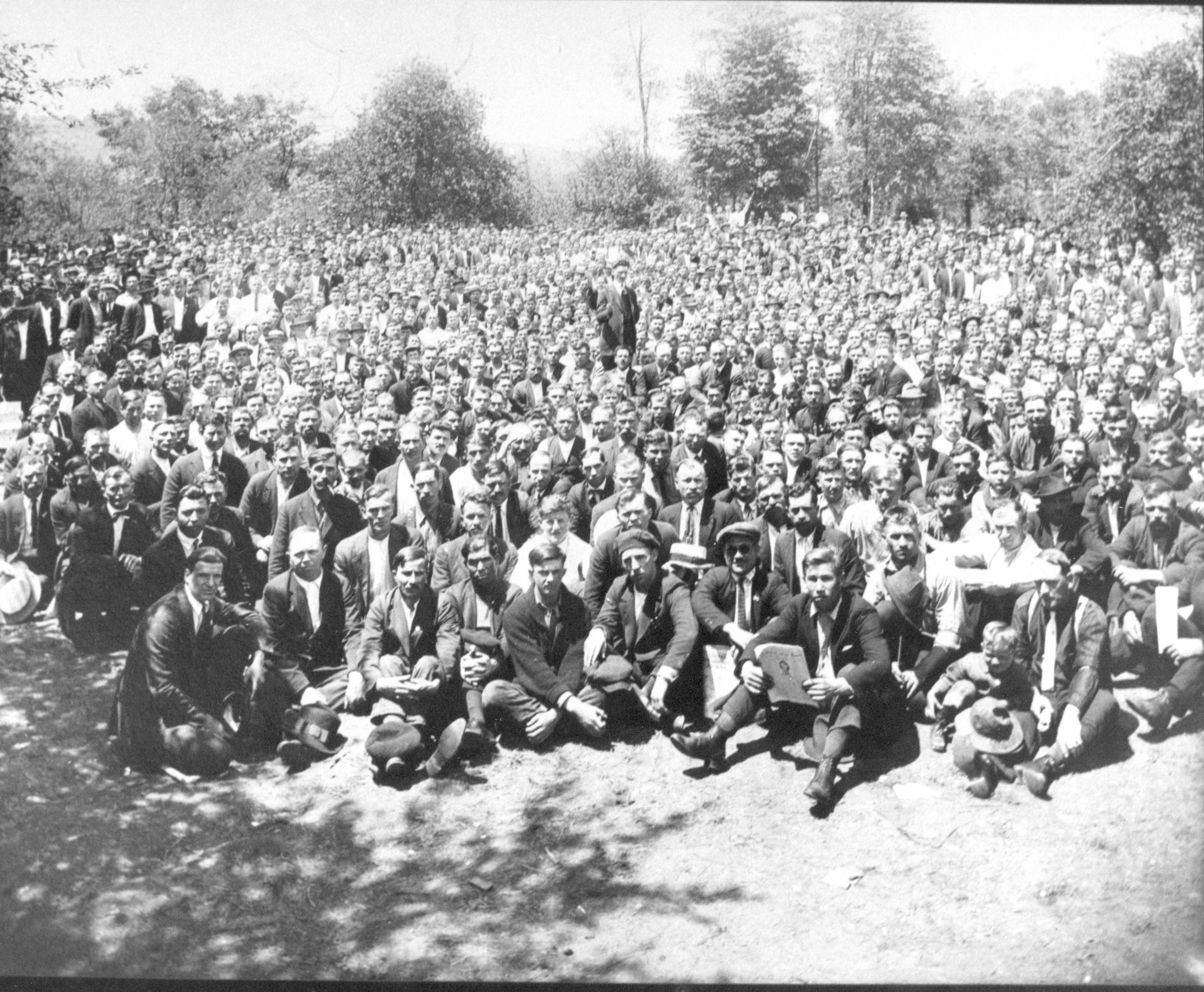
Art Shields notices a a generational shift as the U.S.-born children of immigrant parents, despite all efforts of the bosses, became labor militants. Shields was at the center of one of the great class battles in U.S. history as the national strike of half a million miners in 1922 against post-war retrenchment was also the last large fight of the.post-war strike wave. Many of those were non-union miners of western Pennsylvania walking out in solidarity and for a union themselves, only to be betrayed by the U.M.W.A. leadership and left out of the final contracts.
‘Miners’ Kids Surprise Bosses’ by Art Shields from New Majority (Chicago). Vol. 7 No. 18. May 6, 1922.
Windber, Pa. Five thousand newly unionized miners in the Berwind-White city of Windber, Somerset county, are still meeting in the open air, for the company has lease-control over every hall in town. But the strikers are no longer compelled to trudge the mile and a half to the Hoffman farm, for permission has been granted from three private owners to meet on their own lots.
As a substitute for the “pluck me” stores in which the men were formerly compelled to trade, the miners are hastily erecting a plank-board co-operative just outside the city limits, and till this is completed are dealing through two local merchants who are independent of the Berwind control.
E.J. Berwind, president, Berwind-White Coal Mining Co., has hastened from New York to try to solve the riddle of this astonishing strike in the city that was named after him, in reverse (Berwind-Windber). Few mining communities in the world have been freer from strikes and unionism than this town. Since Windber developed out of its sawmill stage in the nineties, when it was a center of lumbering operations in central Pennsylvania, the only labor revolt was the single struggle of 1906, when 250 raiding constabulary and an equal force of private gunmen slaughtered several strikers and crushed the rest of crushed the rest of the many-languaged workers back to their places in the famous Miller vein that supplies the bunkers of steamships and the power houses of the New York subway system with the highest grade of steam coal.
Following a long established coal baron policy the immigrant miners in the early days were parcelled out through the town in national sections–in Little Hungaries, Little Italies and so forth–and the natural solidarity of a mining community was rendered impossible.
And as the great American melting pot began to create a new type out of the children of the foreign born the far-seeing Berwind interests that controlled the town’s activities gave them something else to think about than their parents’ mining troubles. Many of the miners’ children, soon to be miners themselves, went through the local high school, and Windber became known far and wide as a premier athletic city of central Pennsylvania.
Patriotic movements were encouraged and the percentage of enlistments from Windber was very large. In fact more than 300 of the strikers there are A.E.F. men and many of them belong to the local American Legion post, which they virtually control.
As the educated young fellows went into the eleven mines of the community, they were further separated from their pick-swinging parents by getting the jobs of motorman, spragger (brakeman), etc., as far as possible. These positions are paid by the day, on a time rate, and not by the ton, hence the constant irritation, occasioned by the refusal of the company to allow check-weighmen to verify the weights by which the coal loaders were paid, did not affect them directly.
But the irony of the whole situation was that these very high school graduates, athletes and “company” men, as the day workers were called, were the ones who led the strike at Windber.
Today James Murray, high school graduate and star quarterback and captain of the Windber Juniors that won a central Pennsylvania championship, is president of the largest of the five Windber locals. His “buddy,” Steve Foster, of Hungarian extraction, who is now an active union organizer on tour through District No. 2, is the brilliant right tackle on the same team and the pitcher who has helped bring fame to the Windber baseball team and to a normal school nearby, where alumni patrons of the game got him a year’s tuition. And other young fellows of local note were almost equally active in the union movement.
So sure was the company of these men that it included the motormen and spraggers in the wage cut that was put through April 1 as part of the operators’ association’s policy to eliminate all wages higher than the new scales. Motormen who had been getting $7.90 a day for a nine-hour day (union day was eight hours) were cut to $5.40; spraggers to $5 a day, while the actual miners. were taken down from $1.28 to $1.01 for what the company called a ton of coal, but, which weighed far more in the opinion of the men who were driven off the tipple if they attempted to approach the weigh boss. Murray, Foster and the rest saw their opportunity. Their fellow motormen and spraggers were the natural means of communication to all the isolated working places of the underground labyrinths, and most of them were fluent in the language of their parents and in English as well. The message of strike and unionism was carried through the imines and passed on gladly by former union men from other camps working here and there underground.
A great meeting of the 300 motormen and spraggers was held April 5, on the public road late at night, and plans were laid. Next day, when the men assembled at the drift mouths, the drivers of the man traps gave the strike signal and Windber went out as one man.
To halt the strike the company offered checkweighmen rights and “company” men were offered pay for an extra hour, but the men regarded this as a ruse and refused to fall.
Strike enthusiasm is now so strong in Windber that the burgess, Blain Barefoot, who is also outside superintendent for the Berwind interests, is making no effort to interfere with meetings on private ground or with the entrance of organizers.
Even the Windber New Era, company-controlled local paper, is now admitting that there is a strike after two weeks’ silence. Its first reference to the situation was in the form of a statement from the Berwind-White Co. to the effect that British, Belgian and German miners would get the benefit of the steamship coal contracts the Berwind Co. would be obliged to transfer.
The New Majority was the paper of the Federated Farmer-Labor Party, founded in 1918 as the Minnesota Labor Party, and published weekly by the Chicago Federation of Labor beginning in 1919. Mostly edited by Robert Buck, as well as party and labor union activities the paper reported on the vibrant co-operative and workers’ education movements of the time. The Party was did not survive the 1923 attempt by the John Pepper-led Workers (Communist) Party to take over the F.L.P. The F.L.P. attracted many non-Communist leftists in the workers movement and the paper is a rich source on labor activity and union history those years.
Access to full issue: https://hdl.handle.net/2027/mdp.39015014129319
 Revolution's Newsstand