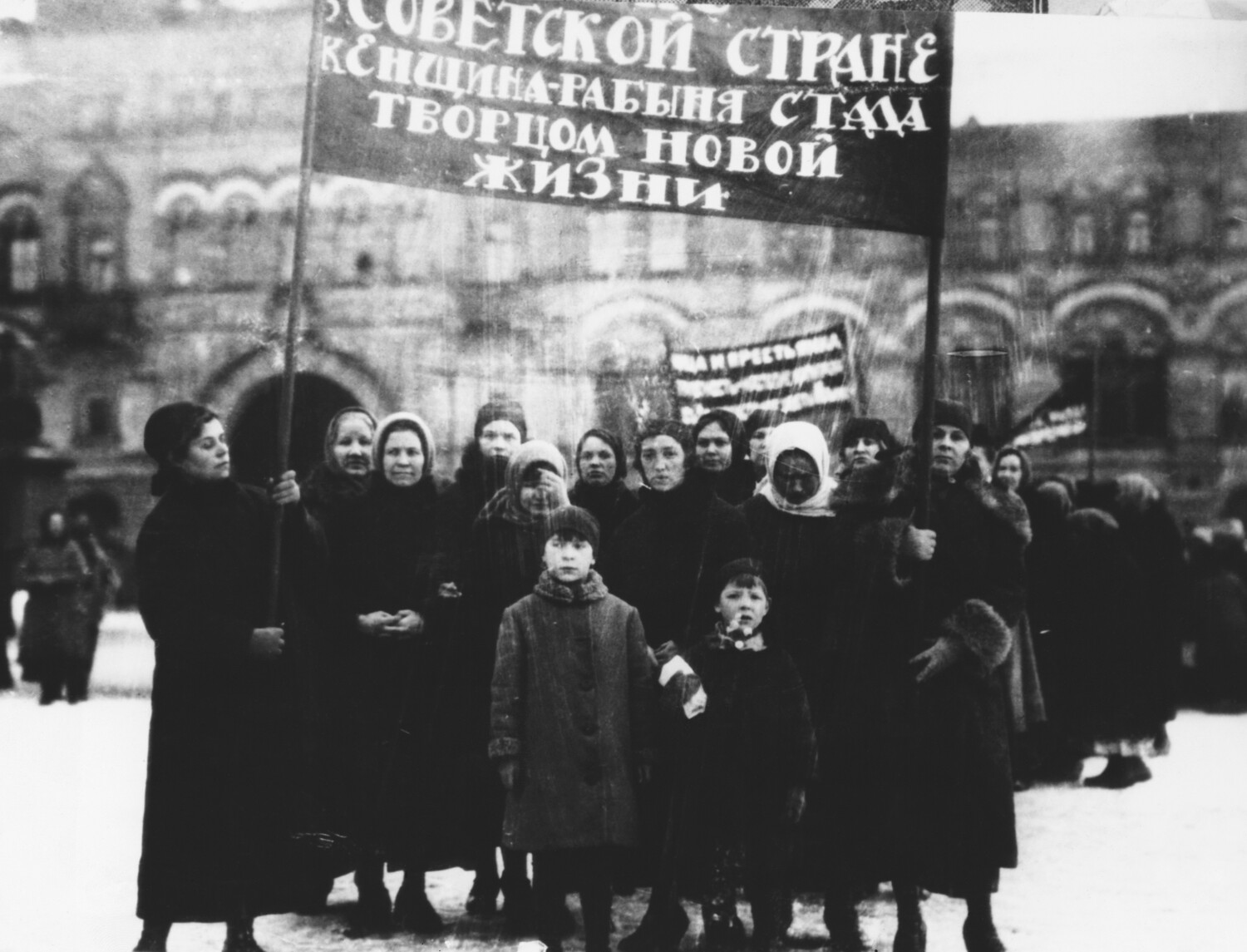
The Russian Revolution and Soviet reconstruction, in a few short years, transformed women’s legal, political, and economic position utterly. A look at those gains, and the ones still to be had, from 1926.
‘The Eighth of March in the Soviet Union’ by S. Hopner from International Press Correspondence. Vol. 6 No. 15. February 25, 1926.
Full of joyful expectations the woman worker of the U.S.S.R. is looking forward to her international fète day on March 8th.
It is not only the advanced women workers, the delegates, the Communists, who wish on this day to draw up a summary of their achievements and of the deficiencies which have come to light in their struggle, they are followed by the whole mass of women workers and wives of workers, and even the peasant women are joining them.
This year, March 8th will be in the truest sense of the word a general Labour day, a people’s fête, not only a women’s day.
The advanced workers know that Comrade Lenin regarded the victory of socialism as impossible unless the broadest masses of the workers were included in the work of socialist reconstruction. He attributed special importance to the participation of the broadest masses of women in the fight for liberty.
The progress of national economy and the improvement of the situation of the workers form the foundation for a mighty growth of the work of culture and education as well as for the increase of the activity of the broadest masses of workers.
The activity of the Soviets, the trade unions, the co-operatives, has received a strong impulse. A great influx of new members to the Communist party is also to be noticed.
Not only the workers and peasants but the women workers and the wives of workers and peasants are being employed to an increasing degree in public political life and in the work of political construction.
The following figures give us a picture of the increasing activity of the working women in the Soviet Union.
The total number of the women delegates (both female workers and peasant women), was 172,855 in 1923/24, of whom 51,344 were women workers and 121,500 peasants.
In the next year, 1924/25, the total number of women delegates had almost doubled and amounted to 314,000, among them 67,298 workers and 246,702 peasants.
By how many women were these 314,000 delegates elected? They are the representatives of a mighty army of working women, an army of 8,530,588 women.
If we include the number of women of the Soviet East, who have awakened to political life, the number will be still more gigantic.
At the end of 1925 there were in the East 57,578 women delegates of the working women. The number of female electors is not exactly established, but at any rate it is not less than half a million. If we add these two figures together, we may say that we have in the Soviet Union, in round figures, 10 million women who are striving for a new life.
The number of women electors to the Soviets and the trade unions has considerably increased. The number of female collaborators in the co-operatives and the relief-funds is also growing, though not in the same measure. In the same way their participation in voluntary associations is growing, the number of female correspondents for working women and for the country, the number of women taking a part in schools and circles, the number of books and papers published for women, finally the number of women joining the C.P. of the Soviet Union are increasing.
The way in which women participate in public political life has, however, greatly changed in character. The women who take part in discussions, congresses etc. no longer sit silent, no longer look on with indifference. At all the congresses and conferences of last year, women came forward with practical proposals, and consideration was given to their point of view.
Special emphasis deserves to be laid on the determined and conscious participation shown by the women delegates of the female workers and peasants at the Soviet elections and at the recent Soviet Congresses from the district Congresses up to the national congress of the Soviets.
These results are so successful that they cannot fail to strike every unprejudiced observer. Work enough still awaits us, however, in our great Soviet Republic.
There is a need for special attention to be devoted to the low technical level of the women workers. As long as the qualifications of the woman worker do not equal those of the male worker, she cannot be put on an equality with him as regards wages.
The 14th Congress of our Communist Party pointed out that in consequence of the growth of our industry, numerous young workers of both sexes from the villages have found their way into our factories and works. They are completely inexperienced in the organisation and participation in trade unions and are altogether still unaccustomed to organised procedures.
We must not forget that among these strata the women workers are the most backward. For this reason the work of education and training among them must be taken in hand with particular thoroughness.
The alliance between working and peasant women must be promoted in a still higher degree than hitherto, still more attention must be paid to rousing the peasant woman who plays so prominent a part in agriculture and who is of so great importance in the construction of new forms of life.
The women must be attracted more than ever into the co- operatives. Far too little attention has been given to gaining the interest of the women workers on the land in the trade union for agricultural workers and foresters.
The work of education must be intensified, illiteracy among the broad masses of women must be overcome. Ignorance and the low level of development are the reasons why so few women join the party. The work of political education must also be intensified,
The chief task however which we shall set ourselves on March 8th, is that of “interesting the working women more than ever in the work of socialist construction”.
We must see that on March 8th as many crèches, schools, public dining halls and wash houses, medical consultation centres etc. as possible are opened. In short, as many as possible of those institutions without great numbers of which woman will never cease to be a slave. Last year on this day, thanks to the self-activities of the women, a good piece of work was done, but we must never forget that in our vast country this is only a drop in the ocean.
Our working women are only a portion of the united front of the working women of all countries. Through the International Women’s Secretariat, the Comintern and the International Red Aid our women workers and peasants are most closely allied with their sisters and brothers in other countries and support them in their fights.
This year, on the 8th of March, the female workers and peasants of our Union must, in common with the working women of all countries, write on their banners:
“Long live the united front of the European proletariat, of the workers of our Union and of the oppressed peoples of the East against all imperialist conspiracies!”
“Down with imperialist war! Long live the U.S.S.R., the only pillar of peace for the workers of all countries!”
“Long live the fight and the victory of the Soviet Power in all bourgeois countries!”
“Down with the imperialist world robbers! Long live the liberation of the colonial peoples from foreign rule!”
“Long live the liberation of the women of the whole world from the letters of economic and political oppression, from oppression by their families!”
“Long live the International Women’s Day, the 8th of March!”
“Long live the Communist International!”
International Press Correspondence, widely known as”Inprecor” was published by the Executive Committee of the Communist International (ECCI) regularly in German and English, occasionally in many other languages, beginning in 1921 and lasting in English until 1938. Inprecor’s role was to supply translated articles to the English-speaking press of the International from the Comintern’s different sections, as well as news and statements from the ECCI. Many ‘Daily Worker’ and ‘Communist’ articles originated in Inprecorr, and it also published articles by American comrades for use in other countries. It was published at least weekly, and often thrice weekly.
PDF of full issue: https://www.marxists.org/history/international/comintern/inprecor/1926/v06n15-feb-25-1926-inprecor.pdf
 Revolution's Newsstand