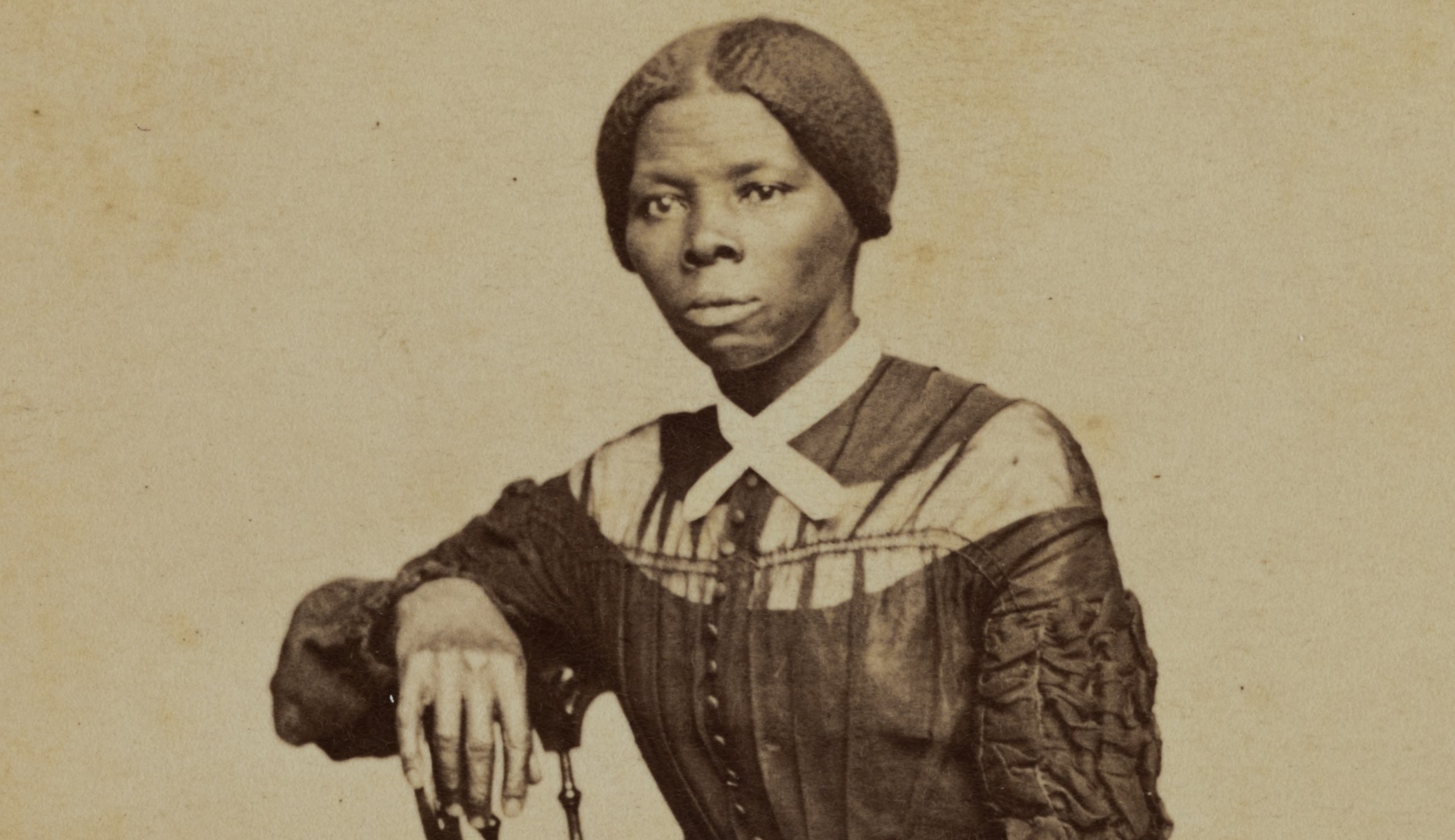
The section by Otto Hall, older brother of Harry Haywood, on Harriet Tubman from his ‘Revolutionary Traditions of the Negro People’ previewed in the Daily Worker.
‘A Woman ‘Moses’ of Slave Days’ by Otto Hall from The Daily Worker. Vol. 12 No. 58. March 8, 1935.
HEROIC REVOLUTIONARY FIGHTER FOR NEGRO LIBERATION
Harriet Tubman Led 300 to Freedom
From a forthcoming pamphlet, “Revolutionary Traditions of the Negro People”
Many Negro women were active in the fight against slavery. One of these was Harriet Tubman.
She was well known to the slaves on practically every plantation in the South. Songs were sung about her; she was the mysterious “Moses” who would take them out of “Egypt land.” The southern slave owners were anxious to find out who was depleting their plantations of some of its best “hands, but were unable to connect this mysterious “Moses,” of whom the slaves sang, with the lone black woman who was often seen in their community. Unlike the Moses of old, she did not go to the local “Pharoahs” and beg them “to let her people go,” but “went down into Egypt land” and took them. She was what was known as a conductor of the “Underground Railroad” system.
Daughter of Africans
This remarkable woman was born in Dorchester County, Maryland sometime between the years 1812 and 1820, the exact date not being known. She was one of a family of eleven children whose parents had been brought over as slaves from Africa when quite young. She was forced to work in the fields almost before she was able to walk, and knew nothing but a life of extreme hardship for many years. She received many beatings from her master.
When she was barely eleven years old, in a fit of anger, he threw a heavy iron weight at her, and hit her on the head. She was many years recovering from the effects from this blow.
She Runs Away
Soon, she ran away from this “hell hole,” as she described it, and escaped to Philadelphia where she was given refuge by a kindly Quaker family. She wanted to take her brothers with her but they backed out at the last moment and she went her way alone.
She covered the distance by foot, traveling at night and hiding away by day in potato holes (big holes dug in the fields for storing potatoes) or in the woods, until she reached her goal. Her friends helped her secure work in Philadelphia, and she managed to save a sum of money, which she used to carry out her plans. She was determined to get the rest of her family away from the plantation, and succeeded at last in rescuing every one of them, including her parents.
Before she left the plantation, she adopted a very ingenious method of bidding farewell to the rest of her family, and letting them know of her intention to leave. On that plantation, it was not advisable for the slaves to be seen talking too much with one another, even members of the same family. The masters were always afraid of an uprising. They were subject to severe beatings if caught.
Song of Departure
On the eve of her departure, she sang the following spiritual from cabin to cabin:
“When dat ole chariot comes,
I’m guine to lebe you,
I’m boun’ for the promised land.
Frien’s I’m a guine to lebe you.”
They sang back at her:
“We’ll be ready when dat great day comes, etc.” (Emphasis mine–O.H.)
She was not satisfied with getting her own family North. She made 19 trips back South, ranging from Maryland and Virginia to the Mississippi delta, and took away with her over 300 fugitive slaves, not a single one ever being recaptured.
In New York City during the time of the Fugitive Slave Law (passed in 1850) she snatched a manacled runaway right out of the hands of the marshals, who, together with his former master, were taking him back South.
These facts are verified by many eye witnesses of this event, who wrote about it later, Descendants of the slave she rescued are living in Washington, D.C. today.
A Rescue in Washington
A great crowd had gathered in front of the hotel at the time that this Negro, who could not be distinguished from a white man, had been captured. They were waiting for his captors to bring him out. His master, who, by the way, was his half-brother, both having had the same father, had offered a large reward for him, and his capture had created considerable interest. The crowd was sympathetic to the slave and expressed audible hope that someone would rescue him.
The marshals, because of the crowd, hesitated to take him out the front way, but there were as many people at the back as there were in front, so it was decided to go through with it in defiance of the crowd.
But Harriet was waiting for them when they came out, and snatched their captor right out of their hands, picking him up bodily in her arms, and ran off with him. The crowd got in the way of the marshals, preventing them from following her right away, and even though they Ared several shots at her, she succeeded in getting him safely away to Canada.
A Mysterious “Moses”
Nobody could keep track of her comings and goings. She would disappear and reappear in different cities mysteriously, and even her closest friends were sometimes puzzled and worried over her safety. But she would show up again just as mysteriously, with a new batch of slaves from Somewhere in “Egypt.” and the harassed planters would be posting rewards in every city. It was said that at one time there were rewards amounting to $20.000 out for this mysterious “Moses.”
She would suddenly appear some dark night at the door of a plantation cabin where a group of fugitives, forewarned of the time and place when “Moses” would come, would be anxiously waiting. She would then pilot them North. They would travel by night, scaling mountains, fording rivers, threading forests, lying concealed as their pursuers went past them, hiding out during the day. She would dope the babies up with paregoric, and lug them along in a basket. One time she carried, in this manner, a pair of twins who lived to remind her of this service many years later.
A Resolute Woman
The way was so toilsome over the rugged mountains that often the men who followed her would give out; footsore and bleeding, they would fall on the ground and lie there, protesting that they could go no further. But she was a resolute woman of quick action. She would snatch a pistol, which she always carried, out of her bosom, point it at their heads, and say: “Dead folks tell no tales. You pick up and come on, or die right here.” She showed remarkable shrewdness, while still engaged in rescuing the members of her family, in communicating with her brothers on the plantation. Up North, she had made the acquaintance of the son of a free Negro who had lived near the plantation where she used to be. She got this son to write a letter to his father containing a communication which would be given to her brothers, warning them to prepare for their escape.
In those days every free Negro was under suspicion and all mail received was read by the authorities before they were allowed to have it. She had the following message inserted in the letter, which was signed by the free Negro’s son. In it was written: “Read my letter to the old folks and give them my love, tell my brothers to be always watching, unto prayer, and when the good ship of Zion comes along. to be ready to step on board.”
Friend of John Brown
She was a devoted friend of John Brown, the fighting Abolitionist, and was one of his captains. He said of her at one time: “Moses (Harriet) is one of the best men I have in my whole band.” At the time of his “raid” and capture at Harpers Ferry, Virginia, she was on a mission for him in New York City, to recruit men and raise money for this venture. She was pretty well broken up at the news of his death, but lived to avenge him.
When the Civil War broke out shortly after, she gave her services to the Federal Government, and did scout work for the Union forces. She acted as spy behind the Confederate lines, gaining valuable information, and was the cause of many defeats suffered by the Confederate troops. No one was ever suspicious of the lone, old, black woman who wandered through the towns, with a shawl over her head, and a basket on her arm. She served all through the war and was never caught. She also would stir up the slaves on the plantations in the path of the Union army and prepare them to rise and desert.
In spite of the fact that her friends tried to get the Government to pension her for her services, the government showed its “gratitude” by refusing her any remuneration. She also lived to be over a hundred years old, and died in 1913, in Auburn, New York. Her life and activities give us another angle of how the spirituals were interpreted by the slaves. The common conception of spirituals, which is supported by bourgeois liberal philanthropists, is that the spirituals were merely sorrow songs of the slaves and merely expressed their desire for freedom which could only come to them after they were dead and went to heaven. But this was not altogether true. These spirituals were not mere sentimental longings; they expressed not only a desire for freedom, but were calls for action.
PDF of full issue: https://www.marxists.org/history/usa/pubs/dailyworker/1935/v12-n058-NAT-mar-08-1935-DW-Q.pdf
 Revolution's Newsstand