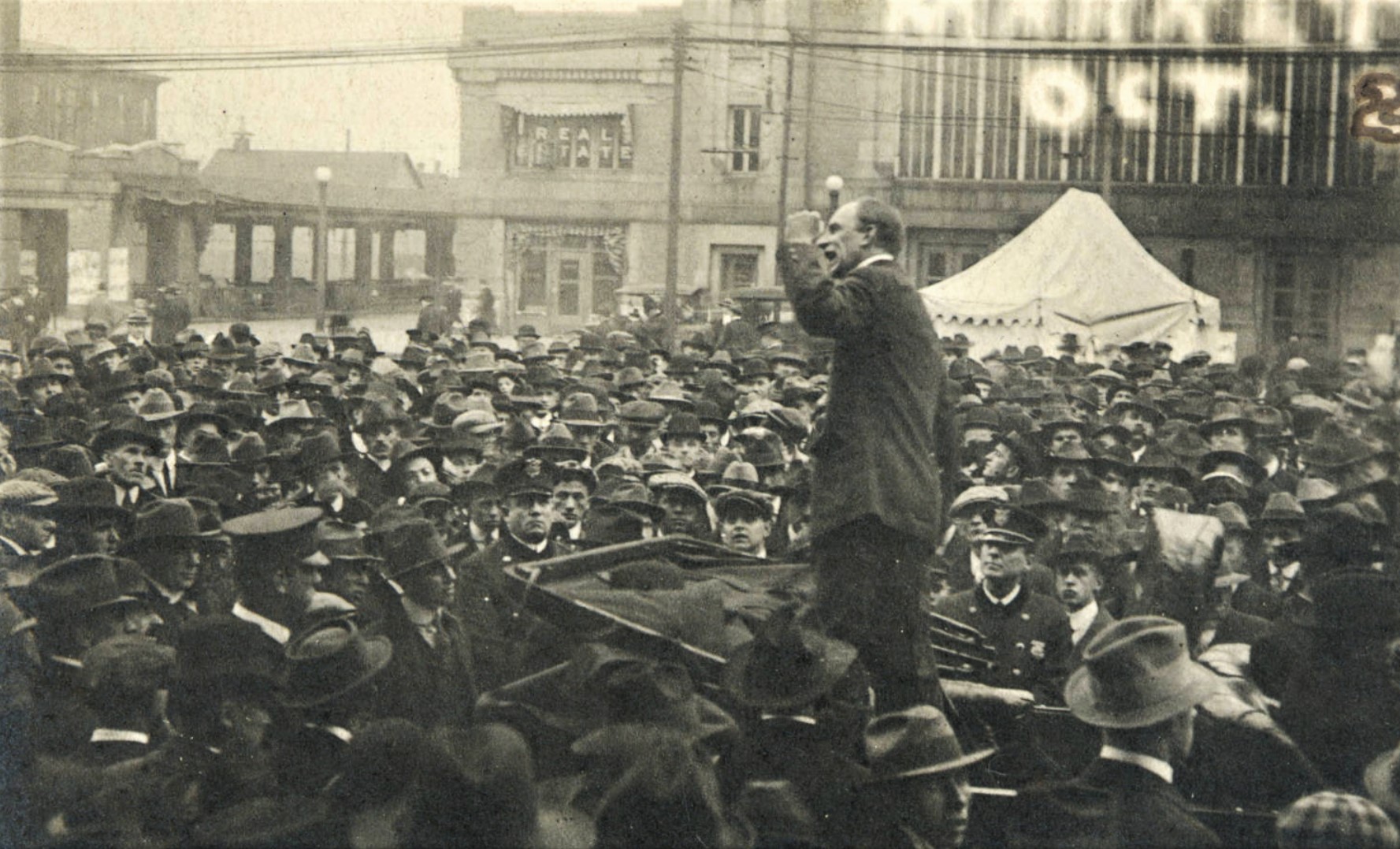
Cleveland, Ohio has a working class, radical tradition as long and as strong as any community in the country. The steel and Great Lakes shipping center was a place where a dozen left papers in a dozen languages, including the I.W.W.’s national ‘Solidarity’, were published. As a major center of the Socialist Party and its Left Wing, Cleveland was also the home of Charles E. Ruthenberg (“The Most Arrested Man in America”), Elmer T. Allison, Alfred Wagenknecht, and many other important figures in the emerging Communist movement. Of course, Cleveland’s working class radicals also faced the full force of the Palmer Raids and the Red Scare, with 1919’s deadly May Day anti-left riots by Legionnaires only one event of many.
‘White Terror in Cleveland’ from The Communist (C.P.A.). Vol. 1 No. 7. November 15, 1919.
SINCE the workers of Cleveland made their splendid demonstration on May Day, when forty thousand left the shops and factories, closing scores of them, to participate in the celebration of Labor’s International Holiday and demonstrate for freedom for Debs, freedom for Mooney and all other political and industrial prisoners, the capitalists of the city have been making a desperate effort to destroy the revolutionary working class movement.
For this purpose they organized the Loyal American League. This organization is an outgrowth of the American Protective League. It is financed by the local capitalists and maintains offices, attorneys and a host of agents for no other purpose than to fight the revolutionary movement.
The immediate result of the May Day Demonstration, which was attacked by the capitalist thugs and the police, was the railroading of about a hundred comrades to prison on terms running from thirty days to a year and the indictment of C.E. Ruthenberg, Tom Clifford and Julius Fried for “assault with intent to kill”, on two policemen injured during the struggle in the streets. It was charged that Fried committed one of the assaults and that Ruthenberg and Clifford inspired them through speeches they had made prior to the May Day Demonstration. In addition a general policy of suppression was adopted against the branches of the local movement, which had endorsed the Left Wing position.
When the bomb frame-up was staged (the house of the mayor of Cleveland was slightly damaged by one of the “bombs”), this was immediately used as a reason for a new attack upon the movement. Raids were conducted nightly and all the members found at branch meeting loaded into patrol wagons and locked up, sometimes for three or four days. The Russian branch was particularly under attack, three raids being made on its headquarters in one week. In one of these raids the members were found quietly studying the parts of an automobile. The machine parts were heralded the next morning as having some sinister significance, although the comrades arrested were merely a class in machine practice, studying to train themselves for greater service to Soviet Russia when they returned there. When the local advertised that it would [sentence missing] -tire press of the city at once began a campaign of provocation and intimidation. One day it was announced that the police had been furnished with new ammunition to prepare for the Bolsheviki on the Fourth, the next day two thousand clubs had been distributed to beat up the Bolsheviki, etc.
But the picnic was held, although every worker who attended had to run the gauntlet of two squads of police stationed at the end of the city car line and at the city limits, who searched every one going in the direction of the picnic grounds.
The fact that several thousand workers attended the picnic in spite of the campaign of provocation and intimidation aroused the Loyal American League to new action. A few days later the party headquarters were raided and all the literature found carted to police headquarters. C.E. Ruthenberg, then secretary, and his assistant Carl Hacker, were arrested and charged with violating the Criminal Syndicalism law through “displaying” literature on the bookstand at the headquarters. Among the literature cited as violating the law was the “Revolutionary Age”, “The New York Communist”, “The Liberator”, “The Messenger” and thirty other pamphlets and publications.
On July 19, C.E. Ruthenberg was again arrested for violating the Criminal Syndicalism law, when an effort was made to break the ban against meetings and he delivered a speech in Royal Hall.
Comrades who were caught distributing literature were regularly arrested and held as “suspicious persons”. On a single day five comrades were arrested on this charge.
The Criminal Syndicalism law was also brought into play to prevent the party branches from securing meeting places and to frighten hall owners from renting their halls to the party for mass meetings. Two comrades of the Russian branch who heldthe lease of the hall in which this branch met were arrested under the provisions of the law making it punishable by a year in prison and $1,000 fine to rent a hall for a meeting to teach or advocate Criminal Syndicalism.
John Dequer who spoke at a picnic held Labor Day was arrested under the same law and has since been indicted.
Since the local has affiliated with the Communist Party the terroristic campaign has been redoubled. Recently ten members of the Second Ward Branch met at the home of a comrade for some organization work, when the police marched in the front and back door with loaded revolvers in their hands and arrested all those present. Nothing was said or done at the meeting which violated any law, but the mere possession of a number of copies of the pamphlet containing the Manifesto, Program and Constitution of the Communist Party was sufficient to bind them over to the grand jury. A similar raid was conducted at Acme Hall in which a committee of the German Branch and the Executive Committee of the Russian Branch were arrested because they had Communist Party membership cards in their possession.
These raids are being linked up with the arrest of alleged bomb makers, for the purpose of arousing public sentiment against the Communists.
Twenty-six cases are now pending in the courts of Cleveland, four of them being charges of “assault with intent to kill” and twenty-two for violation of the Criminal Syndicalism law.
At the present time no Communist Branch can hold even a business meeting in Cleveland. In the eyes of the police and the paid spy organization of the capitalists the Communist Party is an illegal organization.
In spite of this oppression and white terrorism the Communist Party is distributing more of its propaganda leaflets in Cleveland than in any other city of the country. The party is adjusting itself to the circumstances and the capitalists will have to deal with an underground organization in the future. No matter what the action of the capitalists the work of building the Communist Movement in Cleveland will go on.
On Trial
Comrade C. E. Ruthenberg, Executive Secretary of the Communist Party, is now before the court in Cleveland. He will be tried successively on two charges of “assault with intent to kill” and two charges of violating the Criminal Syndicalism law. In all, the charges involve FIFTY YEARS in prison. This is one of the results of the “white terror” in Cleveland.
Emulating the Bolsheviks who changed the name of their party in 1918 to the Communist Party, there were up to a dozen papers in the US named ‘The Communist’ in the splintered landscape of the US Left as it responded to World War One and the Russian Revolution. This ‘The Communist’ began in September 1919 combining Louis Fraina’s New York-based ‘Revolutionary Age’ with the Detroit-Chicago based ‘The Communist’ edited by future Proletarian Party leader Dennis Batt. The new ‘The Communist’ became the official organ of the first Communist Party of America with Louis Fraina placed as editor. The publication was forced underground in the post-War reaction and its editorial offices moved from Chicago to New York City. In May, 1920 CE Ruthenberg became editor before splitting briefly to edit his own ‘The Communist’. This ‘The Communist’ ended in the spring of 1921 at the time of the formation of a new unified CPA and a new ‘The Communist’, again with Ruthenberg as editor.
PDF of full issue: https://www.marxists.org/history/usa/pubs/thecommunist/thecommunist3/v1n07-nov-15-1919.pdf
 Revolution's Newsstand