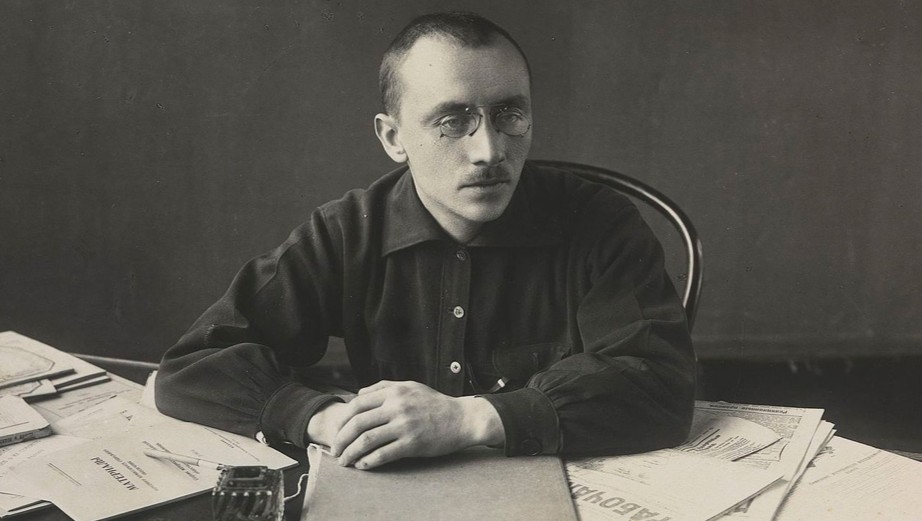
An illuminating treatise from Nikolay Milyutin on the contradictory and ‘intermediary’ role of agricultural cooperatives in the ‘collectivization of the village’ and socialization of agricultural production. Milyutin was a Bolshevik trade unionist, architect, and soldier who, literally, stormed the Winter Palace in October, 1917. After the revolution he was engaged almost entirely in planning and economy, being the Commissar for Finances for much of the 1920s, a city planner during the Five Year Plans and then as an academic of architecture.
‘Agricultural Cooperation’ by Nikolay Milyutin from Soviet Russia (New York). Vol. 3 No. 4. July 24, 1920.
AGRICULTURAL artels (cooperative teams) must be considered the oldest form of agricultural cooperation. The artels have behind them a history of more than one century, and many works have been devoted to their theoretical analysis and interpretation.
Information of hunting and fishing artels goes as far back as the 13th century. One of the latest investigators of the artels, Sergey Jlaslov, writes: “Artel forms of toil in agriculture go far back into the past. The peasants worked in artels for men called into military service, for monasteries and churches, and during the period of serfdom, on jobs for landowners. We find agricultural artels’ labor even in the pre-reform period. At this time it manifests itself in common tilling, in work for the clergy, in so-called ‘nest exploitation’ which was described by N.V. Shelgunov, in artels of scythemen who were tramping every year to the far off steppes of the Don and Kuban.”
In the period of serfdom, we find also instances of “artel” experiments by the landed proprietors, which were quite characteristic although not very numerous. There are detailed descriptions of such artels, as, for instance, by Stremuhov, Yilkins, Zhukov, and others.
After the sixties (of the nineteenth century, that is, after the liberation of the peasant), the artels developed independently and became the refuge of the narodniki, who were seeking in them the realization of new forms of social life.
But despite the long history of the agricultural artels they have always been very few in number and very weak. Coming into existence with the object of practicing cooperative economy, cooperative tilling, the artels would speedily disintegrate under the pressure of the slightest economic changes. As soon as the economic situation would improve the artel would fall apart.
Usually the artels consisted of a few members. An artel would have only from ten to twelve men, heads of families. There was no internal economic bond in the artels; the petty bourgeois aspirations and delusions would not die out; they had absolutely no technical equipment, and they, therefore naturally could not develop into an important social movement.
The following at bottom deadly characterization of artels was written by the same Sergey Maslov, who is a narodniki, a Right Socialist Revolutionist, but whose characterization, in our opinion, nevertheless correctly interprets the nature of the artel movement:
“Summing up the characterization of the Russian agricultural artels as a type, we will say that the impression of the extreme weakness and primitiveness of our artels remain upon closer examination. There is not the slightest indication in them of broad social tasks; there is no adequate technical equipment; the productivity of labor is low in true Bussian fashion; all the inter-relations are extremely reduced and simplified; there are absolutely no written forms; and the artels have no common fund of finances and resources. The Russian artel is very weak in membership, very weakly organized and probably disintegrates easily.”
As a narodnik, Sergey Maslov is trying to soften his verdict on the artels, but it is, nevertheless, deadly.
Thus, as attempts of small owners to organize cooperative production, the artels were a failure and never had a serious social significance or interest from the economic or any other standpoint.
Of much greater extent and importance were the new cooperative forms in the domain of agriculture, which are an independent movement and the product of the new period—the end of the 19th and the beginning of the 20th century.
Agricultural cooperation spread to many phases of agriculture and succeeded in becoming so large that it has even formed the basis for the origin of new theoretical Utopias, or the possibility of creating an ideal cooperative system by the exclusive means of economic changes, by uniting millions of small owners, or for the peaceful and painless attainment of the Socialist system.
***
The basic forms of agricultural cooperation until recent days were: (1) credit cooperatives, (2) buying and selling cooperatives, (3) some special associations, such as control unions, insurance associations, etc., and (4) artels, of which we have already spoken.
The consumers’ associations, which are very strong in the villages, ordinarily do not belong to the forms of agricultural cooperation, since they are not directly connected with agricultural production, but are, on the contrary, connected with urban industry.
Cooperation in Russia in general, and in agriculture in particular, began to develop and reached serious dimensions only after 1905. During ten years all the forms of cooperation made great advances.
The War of 1914-1918 not only did not weaken the cooperative movement, but on the contrary hastened its development. On January 1, 1918, there were 54,400 local cooperatives in Russia. They were distributed in different groups as follows:
1. Credit cooperatives 16,500
2. Consumers’ associations 25,000
3. Agricultural associations 6,000
4. Agricultural corporations 2,400
5. Dairy artels 3,000
6. Artisan and home manufacturing and other cooperatives 1,500
Total: 54,400
From these data we can form an opinion of the relative development and spread of one or another form of cooperation. We see that, with the exception of the consumers’ cooperatives, the credit cooperatives have the greatest development and popularity.
The agricultural cooperatives are united into several large central organizations. At their head at the present time is the “Selskosoyuz,” which is analogous in its functions to the “Centrosoyuz,” the central organ of the consumers’ cooperatives. An important part in the agricultural cooperatives belongs also to such organizations as the “Central Association of Flax Producers” and the unions of Butter Producing Artels of Vologda and Siberia. But what place can be taken by the agricultural cooperatives under the new social conditions, and what is their future?
This question is of great importance for our work of socialist construction.
Heretofore we have had interpretations of the socialist cooperatives only from the standpoint of the cooperators themselves, who adhere firmly to the basis of private economy.
In the capitalist system the cooperatives are not only of great economic but also of great social importance. The different kind and forms of cooperatives not only bring definite economic advantages to their members as well as to non-members, but they also wage a struggle—both economic and ideologic—against the capitalist forms. To be sure, this struggle is first of all conditioned by the competition inherent in the capitalist system. Under the capitalist system a struggle prevails of each against all and all against each.
In their economic life and activity the cooperative organizations, inasmuch as they desired to exist, naturally and inevitably were forced to wage this struggle, and frequently not only against the capitalists, but also against each other.
But besides this struggle, which arose on the basis of competition—a struggle for existence, the cooperative organizations, uniting those who were oppressed by large capital became united in the struggle against the capitalist system, and in the workers’ cooperatives as class organizations,—these elements appeared stronger and clearer. In the other cooperatives, the civic and agricultural, that are essentially petty bourgeois, this appeared much weaker. The last kinds of cooperative organizations have almost never risen to a consciousness of the political struggle—the necessity of overthrowing the yoke of capitalism. The sphere of their struggle was confined to the aspirations to improve their economic organizations, the position of their members, or to the purely ideologic propaganda of their cooperative principles and their cooperative virtues. Many have tried to define the nature of the cooperatives. Among the well-known definitions are those of Tugan-Baranovsky, Nikolayev, Prokopovich, Semen Maslov, and other cooperators. As a typical definition, we will cite the following of Semen Maslov:
“The cooperatives are first of all organizations or unions of toilers. This union consists in the creation by the collective effort of the toilers of special economic enterprises or economic organizations. The aim of the cooperative organizations is the removal of those losses and hardships which are inflicted on the toilers by the power of modern capitalism in its various manifestations. The cooperatives are thus a voluntarily organized economic activity of the toilers the aim of which is to raise the income from the toil of its members and, as much as possible, to liberate them from the tribute which the toilers are forced to pay to the owners of capital.”
In this, quite precise, definition we see the boundaries which limited the activity of the cooperatives in general and of the agricultural cooperatives in particular. This economic organization aims to raise the income, to improve the conditions of living, but it is not concerned with questions of changing the basis of the social and political system.
This nature of the cooperatives in the profiteering capitalist system and their opposition to capitalist principles appealed to many. But in the present conditions of Soviet Russia, when the power, the whole power, both economic and political, passed into the hands of the toilers,—all these features of the cooperatives lose all their meaning. There is no more room for competition. The world of competition and speculation is dying out, being replaced exclusively by organized and social forms of economic activity.
Opposition to the power of the state loses its significance, for opposition to the Soviet power, to the power of the toilers, inevitably turns into its very opposite, becoming reactionary. Inasmuch as the cooperative organizations tried to take this path (as, for instance, in Siberia and in the Urals) they inevitably became counter-revolutionary organizations, helping the power of the capitalists and landed proprietors.
Thus, from the standpoint of the development of new social forms, there was no reason why the cooperatives should set themselves up in opposition to the new Soviet state forms.
The existence of private social organizations of toilers (and not of those who frequently hide behind this flag) side by side with the Soviet state organizations of the toilers, both in the cities and villages, is an absolutely superfluous parallelism which, if anything, can be only harmful.
Only those who cannot go forward, who value the old division of society into separate groups, who grasp at the old and dying, would advocate the continuation and the safeguarding of this separate existence of two social organizations. There are many such groups among the millions of small owners and particularly among the petty bourgeois ideologists.
Behind this, of course, is a definite reason. To make it clearer, the aspiration to save the bourgeois property forms of social relations. However, since the elemental forms of social development are being replaced by the consciously regulated, the harmful remnants of the past, also in this domain, which are hindering the unity of social development must be broken and replaced by new forms in harmony with the Socialist content of the social development.
Under the Soviets the private organizations must be included in the unified network of Soviet organizations. Life has taken this path with regard to the consumers and credit cooperatives, and the agricultural cooperatives must also follow the same path.
This becomes particularly clear when we consider the economic tasks of the agricultural cooperatives under the conditions of the economic developments of the Soviet system.
In distinction from the agricultural artels whose activity consisted mainly of agricultural production, the agricultural cooperatives have had as the center of their activity intermediary operations. The agricultural cooperatives stand between the city and the village, and are engaged, on the one hand, in collecting manufactured products which they sell in the villages and, on the other hand, in gathering raw materials, flax, butter, grain, etc., and selling these in the cities or abroad. Few people have paid attention to this circumstance, and yet precisely in this consists the essential nature of the agricultural cooperatives.
Indeed, the strongest cooperative organizations, such as the butter producing union, the associations of flax producers and others, are important as intermediary and not as producing organizations. Production remains in the hands of individual peasants, while the cooperative organizations direct their activity to collecting the products of individual small producers.
In this respect the agricultural cooperatives play the part of a large buyer of raw materials, which they do not use themselves for manufacturing purposes, but sell to others. Of course, there are exceptions, but they have no important, determining significance for the character of the cooperatives. Again, the role of the associations for the purchase of agricultural machinery is merely of an intermediary nature, just as is the role of the credit associations. Only in Russia they do not act as large buyers, but, on the contrary, as wholesale sellers.
However, precisely in this activity of the agricultural cooperatives lies the secret of their stability, of their capacity for development and entrenchment which they have manifested in the capitalist society, differing in this respect from the agricultural artels, which had but a pitiful existence.
The intermediary activity of the agricultural cooperatives was a response to the vital and necessary needs of the peasants. This quite justified their existence and this economic activity furnished the soil on which alone they could live and develop.
The significance of the agricultural cooperatives can be fully expressed in the word intermediary.
However, inasmuch as the agricultural cooperatives precisely by this activity grew strong and won the sympathies of the broad social groups in the bourgeois society, growing economically strong, in so much do they become weak in the socialist system, when the very basis for such activity between the city and the village becomes unnecessary and superfluous. Indeed, of what use is the private intermediary activity under the conditions of a food monopoly, of a monopoly on flax, of state distribution, of agricultural machinery, when state collecting and distributing organs come into existence? Of course they are of no use!
Furthermore, against whom would the cooperative organizations fight and compete when the class of landed proprietors has disappeared as a class and the capitalist enterprises have been nationalized? With the Soviet institutions? But this would be useless and harmful. If the cooperatives would undertake such activity they would be the first to suffer. Thus, the agricultural cooperatives lose under the Soviet system their most vital and practical function—the intermediary function, which passes to the state organs organizing the whole society. We, who advocate a united coordinated national economy, do not need to prove the necessity of such a transition.
If we desire the development and strengthening of the industry, if we desire to raise the national economy to higher stages we must concentrate in the hands of the state organs the collecting of raw materials and the distribution of these to our factories and workshops, and only then can we be sure that no private or group interests will hinder the development of the national economy, particularly in its most advanced parts.
For this purpose Soviet organs have been created during the first two years of the existence of Soviet Russia for the purchasing of flax, wool, leather, etc.
Hence, from the standpoint of the collectivization of the village, the agricultural cooperatives have played only an auxiliary part. They were necessary and useful both from the standpoint of economics and education only in the capitalist system. In the Soviet Socialist system they become useless, at least, as an independent private organization.
Of course, the process of the dying out of the old forms proceeds slowly. It will probably take a good deal of time before the cooperative organizations will change from private or group organizations into Soviet state organizations, into real social institutions.
But the development towards these results is irresistible.
The collectivization of the village must proceed, but not through the agricultural cooperatives. They lack the necessary qualifications for this purpose. First, as we have seen, their direct connection with agricultural toil and, in general, with the productive processes is extremely weak. Secondly, they are organizations of separate groups of peasants, and their interests will therefore always be opposed to the general interests and to the interests of the national economy as a whole. Thirdly, their intermediary activity is passing to the state organs. Fourthly, their educational activity, in the presence of the extensive educational efforts of the Soviets, is losing its importance.
From all this we must conclude that the process of the collectivization of the village must not be expressed in the old forms, even if they have a respectable past. It must be expressed in new forms in harmony only with the demands of the national economy, and such forms are only the agricultural communes and the Soviet economy. We regard with respect the role of the cooperatives in the past, we do not refuse to take advantage of their present useful functions, but we respectfully tell them: “give way to new forms of life and change yourself into these, if you can.” — Narodnoye Khozyaistvo, September-October, 1919
Soviet Russia began in the summer of 1919, published by the Bureau of Information of Soviet Russia and replaced The Weekly Bulletin of the Bureau of Information of Soviet Russia. In lieu of an Embassy the Russian Soviet Government Bureau was the official voice of the Soviets in the US. Soviet Russia was published as the official organ of the RSGB until February 1922 when Soviet Russia became to the official organ of The Friends of Soviet Russia, becoming Soviet Russia Pictorial in 1923. There is no better US-published source for information on the Soviet state at this time, and includes official statements, articles by prominent Bolsheviks, data on the Soviet economy, weekly reports on the wars for survival the Soviets were engaged in, as well as efforts to in the US to lift the blockade and begin trade with the emerging Soviet Union.
PDF of full issue: https://www.marxists.org/history/usa/pubs/srp/v3n04-jul-24-1920-soviet-russia.pdf
 Revolution's Newsstand