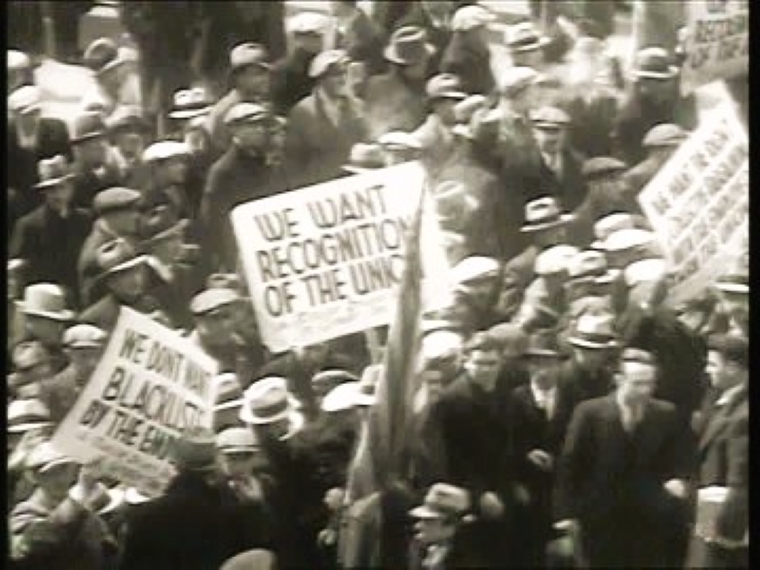
Tens of thousands of New York City hacks strike for a union and against starvation wages. Joseph North with the local color.
‘The Taxi Strike’ by Joseph North from New Masses. Vol. 11 No. 1. April 3, 1934.
So you ride the streets all day long and at five o’clock you look at the meter and what do you see? A soldier. [$1–Ed.] “Good Christ,” you say, “you gotta make three bucks more before. you turn in.” So you cruise the streets round and round and finally you get desperate and you open the door and say, “Come on in. Anybody.” And who should walk in? A ghost. So you say to the ghost, “Where to?” And the ghost says, “Drive me around Central Park.” So you drive the ghost around Central Park till the meter hits four bucks. Then you ask him for the dough. Then the ghost tells you he’s broke. So you t’row him out and you go back to the garage. You shell out t’ree bucks of your own so you don’t get the air. When you get home, the wife says, “Where’s the dough?” Then you tell her, “Today I gave it to the company to keep the job.” So she says, “Keep your job hell. You’re keeping the company. Well, pick. Who’s it you gonna ‘keep? Me or the company?” So you gotta pick. Who you gonna keep, men, the wife or the company?
-Hackie’s Fable.
MEN WHO ply the streets for their livelihood develop a characteristic attitude: the highways belong to them. When they go on strike, be they taxi-cab drivers, or traction employees, the authorities may well expect the major pyrotechnics of revolt. The police nightstick can flail from day to night, it cannot dislodge the idea. The Mayor may cajole and storm in turn from dawn to dusk but the men of the streets stay on the streets. The streets are theirs not only the gutters. As the New York cabbies say in their juicy lingo that springs partly from their slum derivations, partly from their enforced association with the night-life characters of a big city, and partly from the peculiar conditions of their trade: “What? Them weasels tell us to get off the streets? Spit on them! Push me off, rat!”
The strike of the New York cabmen stands unique in American labor history: it is, to date, the biggest in the industry and possesses connotations of great importance to all American workingmen. Forty thousand cabmen abandoned their wheels for the sake of an independent union, and against the strait-jacket of a company union. They symbolize most spectacularly the rebellion of the American workers–700,000 of whom have been weaseled into company unionism under the pressure of finance capitalism and the N.R.A.–against the flumdummery of “employee-representation” organizations.
The major engagement–at the moment–against company unionism is being fought in New York City. Good warriors always seek allies. First they gauge the strength of their opponent, and then they must, perforce, achieve all possible aid.
The taxi drivers learned early in this strike the lineup of their enemy. Briefly, it is this: 1. The N.R.A. and its concomitants: the Regional Labor Board as represented by Mrs. Elinore Herrick, that shrewish, class-purblind matron; Ben Golden, weasel-worded and smiling, “I’m something of a Marxist myself”; the rest of the Blue Eagle officialdom from William Allen, Deputy N.R.A. administrator, up to Roosevelt himself, termed by one of the dubious leaders of the taxi men as “that Great Humanitarian in Washington who won’t let us suffer injustice.”
2. Mayor Fiorello LaGuardia, the Hackies’ Friend. Fiorello’s promises at election time won the support of the 60,000 cabbies who claim the control of a quarter million votes (their families and friends, etc.) “He give us the runaround the first strike,” the strikers say puzzled. “And the way we run around getting him the vote.” The entire city apparatus, particularly Bernard Deutsch, president of the Board of Aldermen, who was thrust forward by Fiorello in this strike as an “impartial arbitrator.” But the cabbies called the mayor’s bluff. “Once fooled, twice cautious,” strike leader Sam Orner said.
3. The Socialist Party, which includes former Judge Jacob Panken, whose tactics during the last strike left him in somewhat bad odor but who continues to jockey for leadership and edge in one way or another. The New Leader sabotaged the United Front Conference of New York workers supporting the taxi strikers with an editorial which read: “Many strong and sympathetic unions affiliated with the A. F. of L. have indicated they will not be represented because Communist organizations have also been invited…”
4. The company union and their outstanding representative, Mr. Irving “Rat” Robbins.
5. The New York commercial press. It has been many a moon since the local papers have so revealed themselves in their class nakedness–liars, accepters of bribes in the form of “paid advertisements,” tirelessly working to swing “public opinion” against the cabmen.
6. The police department and gangsters, both those imported from Chicago where they were organized several years ago in the Yellow Cab war and the local varieties recruited by the Sherwood Detective Agency.
7. And, behind the scenes, the vast strength of the General Motors Corporation.
The allies of the strikers, and these developed very early in the strike are of course:
1. The inchoate, but non-the-less palpable weight of the masses–particularly the millions of New Yorkers on C.W.A. hunger rations, the thousands of other strikers.
2. The left wing unions of the Trade Union Unity Council of Greater New York and the Communist Party and its allied organizations. The Communist Daily Worker, which alone of all the dailies in the city told the truth about the strike.
3. The cabbies’ erstwhile “enemies,” the Negro cabbies of Harlem, who were previously jimcrowed even by the white cabbies.
This, briefly, was the local lineup of forces, in the contemporary American war of capital against labor, particularly as it effects the question of unionism.
The trio of policemen bivouacked across the street and dawn found them cracking slats to heap on the fire. Three ruddy faced cops–“mugs”–pretended to ignore the hackies picketing the Parmelee garage at 23rd Street and Eleventh Avenue. One patrolman picked a carrot from the gutter and fed a blanketed horse, deliberately turning his massive blue-coated back on the strikers. Across the street this hackie, Leo Chazner, strike placards flapping against his chest and back, eyed him obliquely. “I been in the racket seventeen years,” he told me. “I never seen a strike like this one. The beauty part of it is, kid, we’re making history for the whole woild. The eyes of the woild is on us–the New York hackies.”
He marched up and back, hackman’s cap and worn overcoat. Every time he passed the garage entry he peeped inside. “What a sight! Look at them, kid, look at them! Two hundred and fifty of ’em crowding the walls.” Within, shiny cabs, row on row, stretched a full block to the next wall–phalanxes of beautiful cars–eerily silent, something uncanny about them like all machines when the human factor is extracted. He boasted of the Parmelee cab. “Wonderful engine. Hums like a boid. Don’t know you’re riding. No bumps.” We had tramped all over lower Manhattan that morning from garage to garage, picketing and checking up on the turnout. Radio police cars swept up and down West Street. Across the boulevard, ocean liners trumpeted in from the harbor. The first trucks lumbered their route, but no taxis rolled. “Look at the avenoo,” Cabby Chazner gloated. “Clean as a whistle.”
That was Saturday morning. The previous night the strikers had swirled across Broadway, leaving a wake of wreckage which plunged the iron deep in the Parmelee, Radio and Terminal fleet operators. Cabs lay on their sides, the wheels grotesquely whirling; here and there they burst into flames, scabs fled down the street pursued by strikers, while mounted police picked their way through the streets at the fore and rear of the demonstrations. The cabbies’ “Educational Committee” was on the job. Parmelee, Radio and Terminal fleet owners spent thousands of dollars for full paid advertisements in the commercial press moaning “Vandals!” and calling for the military. “Take the scabs off the street and there won’t be no violence,” the hackies responded. “Who’s driving them cabs? Chicago gunmen wit’ soft hats: say, did you ever see a hackie on duty wit’ a soft hat? That’s the Parmelee Chicago gunmen…”
The next day when the strikers took a night off, I heard a detail of mounted police at Fifteenth Street and Irving Place taunt a crowd of hackies, “Well, well, them Chicago boys got you on the run now, ain’t they?” The strikers retorted, “Say, mug, look, look–there goes Dillinger! See if you can catch Dillinger.”
Forty-five hundred drivers of the Parmelee System, Inc. (a General Motors unit), left their wheels March 9 on strike against the formation of the company union and the discharge of their shop steward, Samuel Jaffe. Declaration of war at the 155th Street and Bradhurst garage spread to all the Parmelee garages in Manhattan, Bronx, Harlem and Brooklyn by night. Leadership of the strike was in the hands of the newly formed Taxi Drivers Union of Greater New York.
The strike committee of nine, three from each borough, dispatched pickets to the garages. “Stop all cabs trying to roll.” A list of twelve demands were put on paper: these included reinstatement of all discharged men for union activities; abolition of the spotter system; two weeks’ vacation with pay for all regular drivers; uniform caps to be supplied by the company, no discrimination against Negroes. And foremost, union recognition.
In brief, the strikers seek the right to form a strong independent union of their own choice. They have rebelled against the stool-pigeon dominated company-union, the Brotherhood, which signifies this much to the men: a continuance of blacklist, subservience to the company and to lower-than-subsistence level wage. ($8 to $12 a week for a 16 hour day.)
The New York hackie is a man in whom revolt has been festering for many years. Every policeman has the right to commandeer his cab at any moment without compensation–for police duty. The city officialdom has raised his tax, his license fee, forced him to plaster his photo in the cab in a sort of Bertillon system, libeling him a semi-underworld man. Pugnacious and independent by nature, he has resented the need to live off the tip, which always carries with it a smack of mendicancy. He found redress nowhere; neither the press which he has learned belongs to those who “give him the woiks”; nor the government, for who but they elected Fiorello, the self-announced hackies’ “friend,” they ask. The hackies are bad men when riled. Like all long-enduring workers, they are not finicky about scabs or company property. They have developed a technique in this strike: the Education Committee–(“Better teachers than Yale professors”)–which is a guerilla picket line well adapted to the needs of a big city strike of this sort.
Scab drivers halted by a red light often find the committee of “professors” waiting on them. To the epithet “Rat!” or “Mouse!” or “Weasel!” the scab finds his car doorless or even in flames–a lit match flicked into the engine beneath the hood does the trick.
Enter Mrs. Elinore Herrick, chairman of the NRA Regional board and her retinue: Mr. Ben Golden, Mr. William Allen, et al. The hackies have not forgotten Mrs. Herrick’s apoplectic outburst in the first strike when she screamed, “If I had my own way I’d throw the Committee of 13 out of the window.” The N.R.A. representatives offered the men a poll to choose between the company union or the Taxi Drivers’ Union of Greater New York, the same offer with variations repeated by La Guardia, Deutsch, the fleet operators. But what has brought the men out on general strike if not the hated company union? They have already voted by taking strike action–skirmishing with police and gangsters, by facing nightstick and bullet. When Mrs. Herrick proposed that the men go back to work and then hold the plebiscite, the union officials telegraphed they had learned a lesson from the Weirton and Fifth Avenue Bus Co., plebiscites. The fleet owners then drew Mr. Irving “Rat” Robbins from their proverbial silk hat. Mr. Robbins, Stool Pigeon and head of the Drivers Brotherhood, the Parmelee Company union, grew lyrical. “The Parmelee system is the swellest company in the world. We haven’t got a single kick.” Then he grew lyrical over the police department which “is doing a swell job. For the first two days of the strike there was a lot of rough stuff. But the police are now on the job every minute.” He promised all scabs this excellent police service. Then he topped it by announcing a telegram to Bill Green, requesting admittance in the A.F. of L. “Birds of a feather sure are flocking together,” Joe Gilbert, outstanding strike leader, commented.
The taximen discovered the extent of their allies’ strength when a conference of all unions and working class organizations backing the strikers overflowed at Manhattan Lyceum, March 18, and moved on to Webster Hall. One hundred ninety trade unions, the great majority from the Trade Union Unity Council of Greater New York and left wing organizations were represented. “Today we feel we are not alone in the struggle against the company union,” Organizer Gilbert said.
The Communist Party sent fraternal greetings, publicly announced its support and proffered a contribution of $50 to the strike fund. By Monday, March 19, the Parmelee strike had grown into a general strike: 27,000 men were out. Scarcely a taxi wheel turned in New York. The tide of victory headed their way. A number of small fleets, totaling 5,000 cabs, settled.
Then followed a weary round of deliberations at City Hall with Fiorello cooing and roaring in turn while his policemen consistently cracked the heads of strikers. Despite the operators’ vow never to sit “at the same table” and confer with the hackies, on Saturday, March 24, they huddled, glowering across the room at Orner, Gilbert, and the taxi leaders. The overlords of the taxi fleets swallowed their patrician aestheticism: the cabbies’ ultra-plebian behavior (resulting in a loss of $250,000 to the fleet owners) brought the big shots down from Park Avenue and the Grand Concourse. Fiorello thereupon presented the following proposition: hold a plebiscite, but only those on the payroll of the three big companies January 30 and 31 be permitted the ballot. Such a plan includes only 5,000 cabs and eliminates half the drivers. The strikers turned the proposition down cold, the next day, at St. Nicholas Arena. Since that time plan and counter-plan has been tendered: General Motors, through its president, Alfred P. Sloan has directly lent a hand to shove the company union into pre-eminence on the basis of Roosevelt’s Detroit “pioneer effort in human engineering.”
How race hatred melts in the crucible of class struggle was poignantly evidenced when a Negro hackie from the Harlem detachment of strikers addressed the strikers at Germania. Hall. “Boys,” he said, “when you say you’re with us, mean it. Mean it from the bottom of your hearts! We been gypped ever since 1861 and we’re from Missouri. If you show the boys up in Harlem you mean what you say, then you’re getting the sweetest little bunch of fighters in the world: for them spades driving the Blue and Black taxis up there can do one thing–and that’s fight!” The hats began to fly in the air. He gestured for silence. “And when we fights together, us black and white, man, they ain’t nobody can stop us!” The ovation he received from these recently politically-uneducated workers was tremendous; it signified to me how deeply-inured prejudices and hatreds fostered among the proletariat can vanish overnight when solidarity is needed in common struggle.
Returning to strike headquarters after the meeting (it was necessary to run a gauntlet of files of bluecoats, mounted horsemen, radio cars, and riot trucks), Hackie Chezar clapped his hand to his forehead. “Oh, for a couple hours of shut-eye,” he groaned. “I been up three days straight now.” At leaflet-littered strike headquarters on 42nd Street I read the placard in rude hand-printed letters, “Watch Out for These Cars: Yellow Cab Large Sedan Penna Plates; Terminal Cab 021- 644; Couple N. Y. Plates I-T-5469.” Chezar watched me. “Gangsters and dicks riding them cabs,” he commented.
A massive youth, pugnosed and Irish, they called him Pondsie, was recounting the demonstration the delegation of cabbies received at the Communist district convention in the Coliseum the other night. “We walks in and the Communists go crazy. They stand up, about a million of ’em, and start singing. We go up on the platform and they give us the spotlight.” The crowd about him listened. intently. “Then when they come to the chorus of the song they’re singing they give us the Communist salute.” His left fist–a huge affair–goes up in a sort of short uppercut. “Know what their salute is?” he asks, looking around the room, “The left hook.” And he demonstrates it again and again. The others in the room watching him, try the salute, too. I notice a youth with a palm cross on his lapel, giving the left hook. (It was Palm Sunday.) “And then,” Pondsie finishes his story, “they have a collection. Man, they raked the coin in wit’ dishes on broomsticks. ‘Bout three hundred bucks them Communists give us.”
The lad with the palm cross on his lapel raises his eyebrows. “Three hundred bucks!” He shoots a few left hooks in the air. “If them Communists are wit’ us, I’m wit’ them. Left hook!” he shouts. The others chorus, “Left hook…left hook…”
As we go to press, the fleet owners, through their company unions are demanding the arrest of Orner and Gilbert on charges of inciting to riot. Threats on their life have been made and the entire 40,000 cabbies have volunteered as their bodyguards. One hundred
strikers have been arrested; many beaten to unconsciousness; others are in hospitals. Police inspectors ride decoy taxis. Cabs filled with beefy plainclothes men scour the streets, provoking attack by the pickets. Parmelee gunmen “wit’ the soft hats” go round and round the city looking for “customers”–their lead pipes and revolvers in the side pockets.
More than that: at 41st Street and 7th Avenue a radio police car ran down Jack Stacher, of 1525 West Farms Road, a striker, injuring him so seriously he may die. The license number of the police car was jotted down by a striker; it is 4N-4744; and the badge of one of the policemen inside is No. 13197. At Roosevelt Hospital one of the doctors taunted Stacher: “Well, now what do you think about demonstrating and picketing?”
The newspapers continue to run full page advertisements ridiculous in their patent falsity–raising the red scare, calling for still greater violence by the police.
It is open class warfare in the streets of this city of seven million. The humble cabbies, smarting with the indignities heaped on them for years–the butts of the traffic police, the victims of the night-life gangsters, chained to the wheel for sixteen hours daily by the fleet owners–(and behind them General Motors)–evolve into heroes. If they defeat all forces arrayed against them and achieve the independent, rank-and-file union, this will prove a tremendous stimulant to the millions of American workers watching them. Hence, the bitterness with which General Motors is waging this fight. The hackies firmly believe “the beauty is, this strike is making history all over the woild.”
The New Masses was the continuation of Workers Monthly which began publishing in 1924 as a merger of the ‘Liberator’, the Trade Union Educational League magazine ‘Labor Herald’, and Friends of Soviet Russia’s monthly ‘Soviet Russia Pictorial’ as an explicitly Communist Party publication, but drawing in a wide range of contributors and sympathizers. In 1927 Workers Monthly ceased and The New Masses began. A major left cultural magazine of the late 1920s and early 1940s, the early editors of The New Masses included Hugo Gellert, John F. Sloan, Max Eastman, Mike Gold, and Joseph Freeman. Writers included William Carlos Williams, Theodore Dreiser, John Dos Passos, Upton Sinclair, Richard Wright, Ralph Ellison, Dorothy Parker, Dorothy Day, John Breecher, Langston Hughes, Eugene O’Neill, Rex Stout and Ernest Hemingway. Artists included Hugo Gellert, Stuart Davis, Boardman Robinson, Wanda Gag, William Gropper and Otto Soglow. Over time, the New Masses became narrower politically and the articles more commentary than comment. However, particularly in it first years, New Masses was the epitome of the era’s finest revolutionary cultural and artistic traditions.
PDF of full issue: https://www.marxists.org/history/usa/pubs/new-masses/1934/v11n01-apr-03-1934-NM.pdf
 Revolution's Newsstand