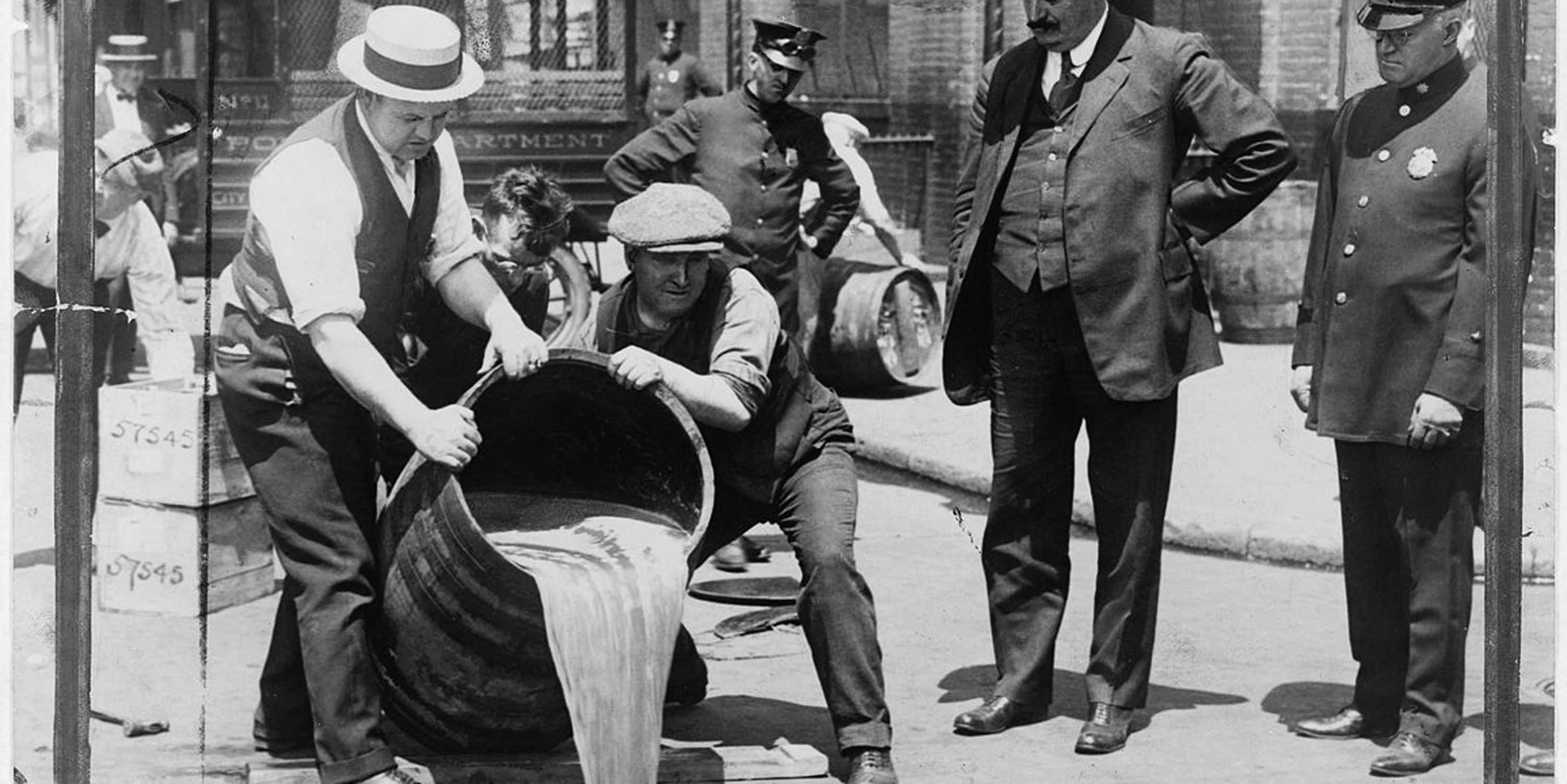
The prohibition on alcohol and ‘war’ against its illegal production, distribution and use was a colossal, and bloody, failure. With its notoriously corrupt and violent city politics, and place as an international Great Lakes and U.S. transportation hub, Chicago was also home to the largest, best protected, and most lethal criminal syndicates, which included much of its police force.
‘The Rum War In Chicago’ by Thomas J. O’Flaherty from The Worker. Vol. 4 No. 296. October 13, 1923.
Pitched battles are being fought in the streets of Chicago between rival gangs of bootleggers or “beer runners” as they are now called. Within the past two weeks three men engaged in the business of violating the Volstead Act have passed on to the great unknown as the result of the attentions of gunmen alleged to have been employed by their competitors.
A deputy sheriff is arrested charged with the murder of one beer runner. The other two were killed at one of the busiest crossings in the city but their murderers cannot be identified. The gunmen of both camps strut about the city, call on the mayor and the chief of police, ask what the shouting is about and grant interviews to the newspapers. Seemingly they have nothing to worry about. Why?
Walter O’Donnell, one of a family of gangsters, as well known to the police as Charlie Chaplin is to the movie fans, declared that if he told all that he knew, the city would blow up and half the police department would stand on its head. A judges said that he suspected the same percentage of the police force was implicated in the bootlegging business. The office of the District Attorney is fussing like a squirrel in front of a sand pile and raising as much dust without accomplishing anything. The gunmen laugh at them and say that they dare not do anything.
During the recent mayoralty election we told the workers that capitalist politicians looked on the city of Chicago as a good place to loot. Rival groups of grafters compete for the privilege of raking in all the money they can lay hands on through the machinery at City Hall. It is a well-known fact that the best political workers are the gangsters and they must be taken care of after the smoke of battle clears away and a new mayor is installed in office.
The gangsters who were part of Thompson’s political machine had to give way to the “boys” who won their place in the sun as a result of Dever’s victory. And the sun of prosperity never shone with more splendor than since Volstead jacked the liquor business from comparative obscurity up to a prominence rivalling the manufacture of automobiles. There was a lot of money in running beer. Everybody it seems, got a divvy out of it. As long as the liquor dealers “did the right things with the boys back of the administration,” nothing happened. But then the shooting started and those who were left out in the cold began to express considerable moral indignation and learned that the “people” were getting nervous. Something must be done.
The mayor got busy. He called the chief of police. The latter called in his captains. The captains called in the patrolmen and the latter went out, arrested some soft drink parlor proprietors and their customers, and the merry war in on. But the average citizen is cynical. He believes it is all bluff and the cause of the rumpus is the refusal of the rum dealers to come across. When you see a drunk come out of a corner saloon followed by a policeman equally drunk and when you see the same policeman go right back for another load–well, when you pick up the paper and read that Chicago is now as dry as the Sahara desert your skepticism is not diminished.
The fact is, according to seasoned political veterans that the political bosses of this glorious city are up to their necks in the rum graft. The police are afraid to tell what they know, as is everybody else. This bubble will burst and the amber fluid will flow again. It is capitalists’ politics. Nothing is sacred but graft. “Get the coin,” is the slogan. That is the great incentive. Civic pride, civic purity–that is all bunk to be peddled to the fellow who has nothing between the ears. There is money to be made by selling beer and as long as there is the political hacks of both the Democratic and Republican parties will share in the spoils of the preservation of order will be only a side line for the police department.
The present administration is in a rather ugly predicament. Its friends must be protected. And there is no doubt but that back of the scenes secret diplomacy is working to square things between the “boys” so that the ends of justice can be attained by silence and “business as usual” again becomes the order of the day.
The Daily Worker began in 1924 and was published in New York City by the Communist Party US and its predecessor organizations. Among the most long-lasting and important left publications in US history, it had a circulation of 35,000 at its peak. The Daily Worker came from The Ohio Socialist, published by the Left Wing-dominated Socialist Party of Ohio in Cleveland from 1917 to November 1919, when it became became The Toiler, paper of the Communist Labor Party. In December 1921 the above-ground Workers Party of America merged the Toiler with the paper Workers Council to found The Worker, which became The Daily Worker beginning January 13, 1924.
PDF of full issue: https://www.marxists.org/history/usa/pubs/theworker/v4n296-oct-13-1923-Worker.pdf
 Revolution's Newsstand