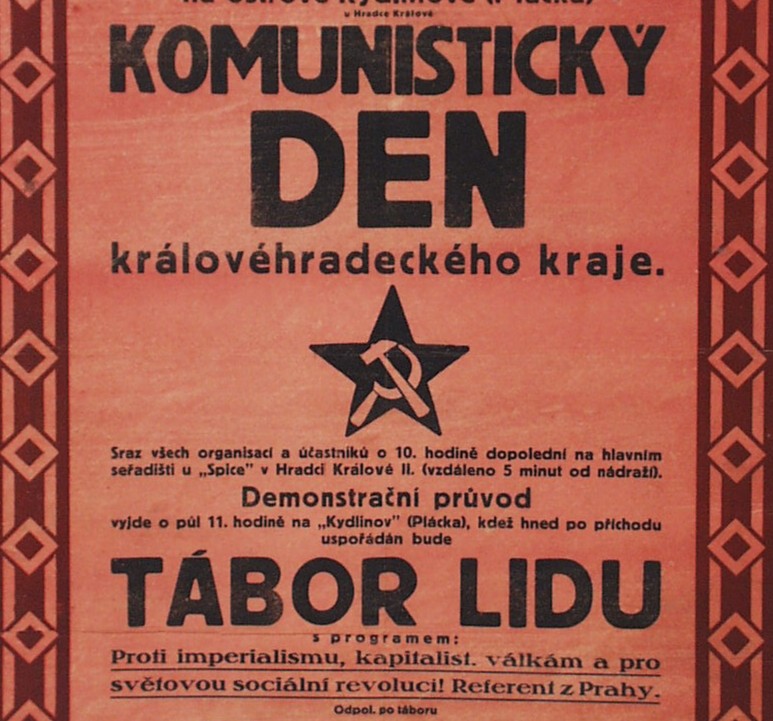
With over 100,000 members in 1922, the Czecho-Slovakian and German parties were the largest Comintern sections outside of the Soviet Federation and as such, the turn to the united front by the Comintern was particularly applicable there. Below the thesis passed by a special conference of the Party on building the united front in one of the countries emerging from the Austro-Hungarian Empire.
‘The United Front in Czecho-Slovakia’ from International Press Correspondence. Vol. 2 No. 31. April 28, 1922.
The National Conference of the Communist Party of Czecho-Slovakia met in session in Prag-Karolinenthal during the Easter holidays. The problem of the united front was the leitmotif of all the various problems treated at this National Conference. A special session was devoted to the united front and its deliberations were condensed into the following theses:
1. The international labor movement is passing through a transition period which was characterized as follows by the Third Congress of the Communist International. The crisis in capitalist world economy is intensifying, unemployment is increasing and capital is systematically attacking wages and labor’s standing of living. The immediate and most important tasks of the Communist Parties consist of shortening this period of capitalist decay by interesting the masses of non-organized workers in certain practical partial demands. This interest must little by little be transformed into a determination to struggle which must as rapidly as possibly be intensified into a mass-attack on capitalist society. This perception was in August last coined into the short slogan: “Approach the masses!”
2. By granting both social and political reforms, the bourgeoisie succeeded immediately after the collapse in 1918 in diverting the masses from decisive action. This course separated the class-conscious workers from those sections of labor which were still of the opinion that the interests of its class could be realized by means of democracy. Having, however, consolidated the capitalist state, the bourgeoisie is endeavoring to rebuild its system at the expense of the working class and, having accomplished this, to deprive labor of all its economic and political gains. This common front of capital does away with all illusions as to peace among the classes, and creates the preliminary condition for a united front of the class struggle.
3. The slogan of a united front does not only mean a general appeal to the masses, but also an appeal to the reformist parties for the purpose of joint action for the immediate common aims of the entire proletariat. Such an appeal can, however, only be issued after it has been definitely ascertained that the indifferent masses and the workers organized in the reformist parties are willing to fight for everyday demands. For the first time since the war the masses are manifesting their desire to fight. This is of great and world-wide importance. And though the masses have for the time being no intention of fighting for ours, the Communist aims, but for their present everyday demands, they have at least understood that these demands cannot be attained without a struggle. Hence they–the masses–are not only prepared for, but even urgently demand the joint struggle of all labor parties against the capitalists. And though their faith in reformism is not yet utterly destroyed it has, nevertheless, been seriously shaken. Seeing that the proletarian class is bent upon fight, it goes without saying that it is the duty of the Communists to prove immediately that they are ready for joint struggle. This duty is all the greater, because the proletariat is everywhere in a situation of unparalleled difficulty and is, irrespective of what party it might belong to, entitled to the full support of the class-party of the proletariat, the Communist Party, which is all the more in duty bound to lead these struggles, because it knows full well that every demand for a greater piece of bread, no matter how modest, will become a revolutionary demand, because at present it cannot be agreed to by the capitalists; and furthermore, that every fight for a higher wage or, as often happens for the retention of the present wage, will develop into a rebellion against the present system of society. In consideration of these facts, it can be said that the slogan for a united front becomes a revolutionary mobilization order.
4. The reports of all delegations to the February Conference of the Enlarged Executive Committee of the Communist International were all agreed on the point that during the last months the worldwide economic crisis has gained in intensity and that this fact has more or less reacted upon and shaken the political consolidation of the bourgeoisie. The spontaneous strike of the German railwaymen who a year ago were looked upon as reliable pillars of the German bourgeoisie, which broke out prior to the February Conference, provides an impressive illustration for the truth of these reports. This “wild” strike was supported by members of the notorious of the notorious “Sipo” that Security Police Corps which in March 1921 proceeded in such a brutal manner against striking workers. At the same time, the teachers in Czecho-Slovakia who a few short months ago were considered a mainstay of the bourgeoisie in that country gave unmistakable signs of their sympathy, with the striking miners and the cause of labor. From the reports of all delegations it could be gathered that for the first time during the whole revolutionary period the subjective and the objective conditions are gradually but undoubtedly assuming a revolutionary form. Only in such a situation is it possible to give the appeal to the masses a concrete form–the slogan for a united front.
5. This slogan is of far-reaching importance in Czecho-Slovakia where the world-wide economic crisis is gradually assuming the marked forms of a crisis of overproduction. Six months ago the reformist parties promised labor that, if they only could again participate in a coalition government, they would overcome these difficulties. Now, however, when they are again participating in the Government, these parties declare that, having no political character, the economic demands of labor can only be forced through by the trade-unions. But the workers organized in the reformist parties have come to understand that every economic demand is also a political demand which cannot be attained without simultaneously and uncompromisingly fighting the capitalist class in its capacity as the ruling class. At the same time labor is gradually grasping the fact that in the trade-unions, too, the reformist leaders are not willing to combine the defensive struggles of the various trade-unions into one general strike. Labor sees that in the present economic situation isolated strikes are welcomed by the employers, because they are really mere voluntary lock-outs. Influenced by all these considerations, the Social-Democratic and nationalist workers are giving their Communist fellow-workers to understand in so many words that they expect our party to take the initiative in the common struggle against the capitalist class. Our party must not allow itself to underestimate the importance of those sections of labor so far organized in the reformist trade-unions, and though the Czech Social-Democratic workers are few in members, they belong to key industries which are of great importance in a social revolution (metal workers, railwaymen, miners, etc.) To the same trades belongs a large part of the workers so far organized in the National Socialist party. Half of the organized German workers in this state belong to the German Social-Democratic Party, a fact which we must also pay due attention to. If the Communist Party takes the initiative for the proletarian united front, all these masses will be drawn up in one battle front and will during the struggle soon grasp the truth that it is impossible to attain even the most modest aims without first conquering political power by means of a revolution.
6. To explain this state of affairs to the masses of the proletariat, the manual and intellectual laborers, to prove to them that their power is great if only they are conscious of it, to make the see that it is the task of all proletarians in Czecho-Slovakia to form a united front against the bourgeoisie, to rouse, in short, the decisive majority of the proletariat to revolutionary class-consciousness–that constitutes the immediate task of the Communist Party of Czecho-Slovakia which, without in doing so abandoning its principles or methods, puts itself at the head of the action for the united front of the proletarians of all parties, as long as this front is really directed against capitalism and the bourgeoisie. All the energies of the party must be exerted in a propaganda for such a united front. All our papers and periodicals should be edited in the same spirit. Our slogan is: “Down with the shameful coalition with the bourgeoisie and capital! Long live the joint struggle of all workers in the united and uniform proletarian battle front!”
7. With regard to the way to be travelled to the united front, we declare the following:
The pure proletarian character of the Communist Party renders it necessary that we first of all appeal to the masses and exert all our energies in an attempt at building the united front upon the wish of the laborers in shop, mine and mill. We know, however, that the formation of the proletarian united front would progress more speedily, if it were not sabotaged by the officials of various parties and organizations. We are not even adverse to carrying on direct negotiations with the leaders of these organizations so long as such negotiations do not leave the platform of anti-capitalist struggle.
8. The Communist International has followed the suggestion that representatives of the three Internationals meet in joint conference and manifest their earnest determination to fight for the interests of labor. The Berlin Conference represents the first step in this direction. The social-patriot parties of Czecho-Slovakia have, however, refused to abide by the decisions of the joint conference of the three Internationals. But the Communist Party will not be deterred by this first failure; it will continue to work for concerted action and will repeat its proposal at a suitable moment.
9. The united front does not mean a new organization of labor or an organizational superstructure, but merely the united struggle of all labor parties and organizations and the indifferent workers for the imperative demands of the day, as for instance, against wage reductions, lengthening of working hours, etc., etc. The only preliminary for the united front is the honest determination to defend labor’s interests. If the other parties are animated by this spirit, the united front will be easily accomplished.
10. We know that a number of reformist leaders are not honestly enough determined to defend labor’s interests and prefer to safeguard state and other interests instead; we know, however, just as well that such leaders have a large following of proletarians who are interested in protecting their own existence and are ready to fight with that end in view. Hence the united front has its most solid basis in the shops and on the fields, in labor itself. We must not allow ourselves to forget that the unity of the proletariat can only be achieved if the Communist Party is organizationally prepared and ready for action in a manner to enable it in the coming struggle for social demands to imbue the workers with enthusiasm for its leadership by its example. The members of the Party must therefore do everything in their power in the action for the creation of the united front; they should, however, consider the united front merely as a means for intensifying the struggle for the emancipation of the proletariat.
International Press Correspondence, widely known as”Inprecor” was published by the Executive Committee of the Communist International (ECCI) regularly in German and English, occasionally in many other languages, beginning in 1921 and lasting in English until 1938. Inprecor’s role was to supply translated articles to the English-speaking press of the International from the Comintern’s different sections, as well as news and statements from the ECCI. Many ‘Daily Worker’ and ‘Communist’ articles originated in Inprecor, and it also published articles by American comrades for use in other countries. It was published at least weekly, and often thrice weekly. The ECCI also published the magazine ‘Communist International’ edited by Zinoviev and Karl Radek from 1919 until 1926 monthly in German, French, Russian, and English. Unlike, Inprecor, CI contained long-form articles by the leading figures of the International as well as proceedings, statements, and notices of the Comintern. No complete run of Communist International is available in English. Both were largely published outside of Soviet territory, with Communist International printed in London, to facilitate distribution and both were major contributors to the Communist press in the U.S. Communist International and Inprecor are an invaluable English-language source on the history of the Communist International and its sections.
PDF of full issue:https://www.marxists.org/history/international/comintern/inprecor/1922/v02n031-apr-28-1922.pdf
 Revolution's Newsstand