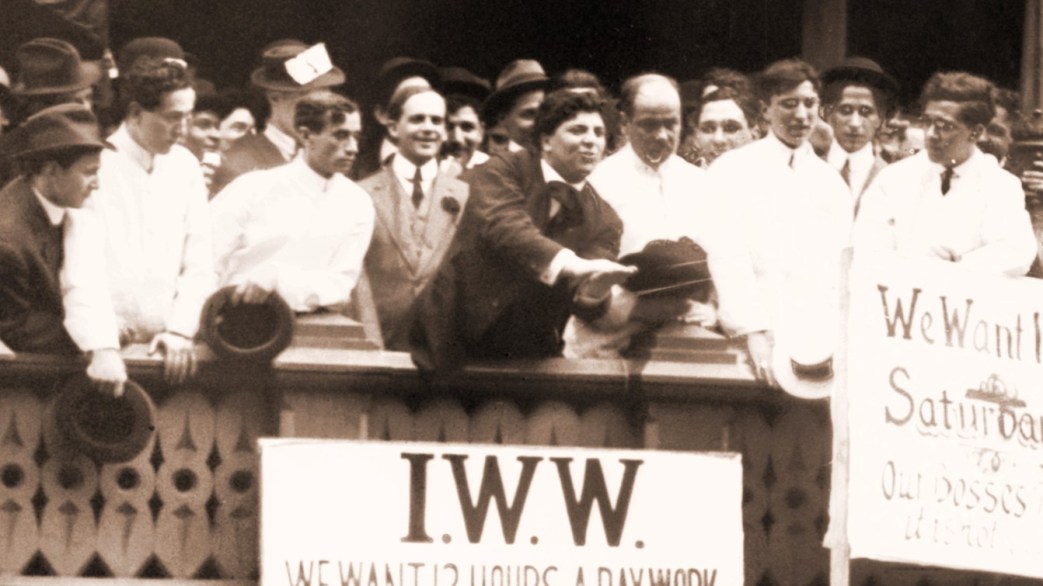
There from the start, a major figure of the early I.W.W. looks back at a decade of activity.
‘A Retrospect On Ten Years Of The I.W.W.’ by Joseph J. Ettor from Solidarity. Vol. 6 No. 293. August 21, 1915.
Marx and Engels over fifty years ago penned in the immortal Manifesto: “The history of all hitherto existing society is the history of class struggles.”
In the city of Chicago in 1904 representatives of labor organizations and radical thought gathered together and wrote the Industrial Union manifesto, starting out with “Social relations and groupings only reflect mechanical and industrial conditions.” The Communist Manifesto wound up its statement to the workers of the world with: “In place of the old bourgeois society with its classes and class antagonism we shall have an association in which the free development of each is the condition for the free development of all.” The Industrial Unionists in Chicago closed their appeal to the many times betrayed and defeated wage workers of America: “A labor organization to correctly represent the working class must combine the wage workers in such a way that it can most successfully fight the battles and protect the interests of the working people of today in their struggle for fewer hours, more wages and better conditions, offering a final solution of the labor problem, build an organization whose growth and development will be the structure of an industrial democracy of workers, a workers’ co-operative republic, which must finally burst the shell of capitalist government and be the agency by which the working people will operate the industries and appropriate the products to themselves.”
In July, 1905, men of various thought gathered at what William D. Haywood then fittingly called “The Continental Congress of the Working Class,” to “confederate the workers of the country into a working class movement that shall have for its purpose the emancipation of the working class from the slave bondage of capitalism.”
The men and women gathered there represented various views, yet most of them builded better than they knew. They launched forth into a world of struggles the labor organization that they little thought would in the short period of 10 years create so much concern and so much opposition on the part of the employers.
As Marx and Engels wrote in 1847: “A spectre is haunting Europe–the spectre of communism. All the powers of Old Europe have entered into a holy alliance to exorcise this spectre. Pope and Czar, Matternich and Guizot, French radicals and German police spies,” so can we write now: A spectre is haunting America–the spectre of revolutionary unionism. All the powers of established institutions have entered into a holy alliance to exorcise this spectre: Presidents, Cardinals, political economists, employers, radicals, politicians of all shades and agents provocateurs.
To the accusation brought by our enemies that in ten years we have been unable to unite the workers of this land into one association we can well reply that at least the fear of our ideas permeating the workers has been sufficient to unite strange elements into one bond in opposition to the revolutionary unionists of this country: Berger, with Morgan, Hillquit with Rockefeller, Gompers with Carnegie, William Wood with Golden, Roosevelt with Taft, each in their place and in their way, offering either balm or silver to the plug uglies and thugs of California, the copper collared spies of Montana, the State Constabulary of Pennsylvania, to the courts of New York and Massachusetts.
Men, who for reasons of their own in other matters of public interest show great opposition to one another, stand as one in their opposition to the I.W.W.
The I.W.W. is a menace and we can well reply to these gentlemen of various thoughts and colors that not only is the I.W.W. movement a menace but that we are working hard to make the working class become a menace to the pelf and the place that are enjoyed and held by the men and women who represent and speak for the various established institutions. If our opponents have any illusions about the ways of the world, long and bitter experience has taught the revolutionary unionists of America many a lesson. The one lesson most important of all that we have learned is the stern fact that the struggle of the working people for industrial freedom is the most serious undertaking that any class in history ever set out to accomplish. Bitter experience has also taught us that we are dealing with opponents who will leave no stone unturned; who will contest every inch of the ground by all means and methods at their command. They have no illusions about justice or right or morals; they place their faith in their ability to accomplish the purpose they set out for by whatever means are necessary. There is neither set principle nor set method in the way they carry on their fight. “Any and all means to accomplish our purpose in exploiting labor” is their motto. To establish the rule of the workers or, as the Germans would put it, “to conquer a place in the sun for ourselves,” the workers must organize their industrial power and the capacity to produce for the purpose of accomplishing whatever purpose they wish and to succeed they must have no illusions. They must use any and all effective means, take every advantage of the employers’ weakness to make the strength of the workers prevail. The question of right and just must only be measured by the question of necessity for the workers to accomplish their purpose.
The Revolutionary Industrial Unionists have not failed. Those who say that we have, fail to understand that the Industrial Workers of the World is not merely a labor union whose scope is limited to getting men and women, irrespective of whether they have any desire to change the world, and grouping them into associations, whose only greatness is number, whose only efficiency is dues collecting, and whose greatest accomplishments are to sign contracts and protocols with employers and thus put the moral as well as the physical links about the wrists of the workers, binding them to their employers.
The Industrial Workers of the World is an organization that proposes to teach the workers the necessity of organization for the purpose of conducting the struggle against the employers and at the same time train themselves for the time when they shall cease to be an army to invade the bosses’ rights and profits and shall become the industrial army of occupation and production.
The capitalists do not fear the I.W.W. because the I.W.W., to accomplish its purpose, every day, seeks shorter hours and more wages; the capitalists fear and fight the Industrial Workers of the World because the Industrial Workers of the World teach the workers, every day, in the shop, the necessity and the advisability of the workers becoming the controllers of the particular industry in which they are employed. The employer may say that Socialism is a dream, that it will come in some distant future, or in the language of the French King’s arrogant reply: “After me, the deluge”–philosophically expressed: “I should worry!” But in the Industrial Unionists he sees immediate danger, danger that is neither in the future nor problematical, but a question of today. Therefore he concludes to fight the menace.
The I.W.W. is not the first menace in history. All movements that started in the depths of humanity against those who were on top were a menace. The black robed gentlemen, who sanctimoniously warn the employers and society of the I.W.W. menace can well turn to history and be reminded that the “hobo agitator of Nazareth” and his outcast and tramp followers were a menace to the Roman Empire and to its civilization, to its religion and its patriotism. The socialist leaders may read the early history of the movement and find in it against themselves the same expressions, the same kind epithets, they now use against “the bums,” “the tramps” of the I.W.W., and so can all men and women who are opposed to us.
If we had been willing in all of these past ten years to subvert our ideas, to make peace with the employing class and their institutions, to sign protocols and contracts and wink at outrages committed upon the workers because the employers collected the union dues, can there be any question that the I.W.W. would have been a “success”? But we have refused. In the language of the Manifesto by Marx we “disdain to conceal our views and aims, we openly declare that our ends can be attained only by the forcible overthrow of all existing conditions.”
We appreciate that the struggle between the employers and the workers is a struggle for the industries of the nation. Neither Boards of Arbitration nor Committees of Conciliation can breach the chasm that divides the two classes. Small questions may be settled in a way and for a time, but questions of this magnitude cannot be settled in any such way. All efforts in the past have only been a temporary success, if success at all. In most cases they have been so many frauds perpetrated on the workers and so many advantages gained by the employers. The employers and their moral friends ask the workers to settle the dispute with their employers through Boards of Arbitration, Committees of Conciliation and through the process of adding “one social law” to another. We have only to look to Europe to see that the ruling classes of each country, in economic struggles that affect the ruling class of the respective countries, have refused to leave even their great God to act as arbitrator for them. On the eve of battle the priests and the parsons of each country prayed to their God to give strength and right to their respective armed hosts. They did not leave it to the wisdom and the judgment and the impartiality of the Great Jehovah. They well know what they don’t want us to know, and what we are learning in spite of them; that an oppressed class can only obtain its freedom through its own exertions and neither Popes nor Guizots, Caesars nor Politicians can free them. The Great God of Battle will only give victory to the most numerous and best equipped battalions.
The most widely read of I.W.W. newspapers, Solidarity was published by the Industrial Workers of the World from 1909 until 1917. First produced in New Castle, Pennsylvania, and born during the McKees Rocks strike, Solidarity later moved to Cleveland, Ohio until 1917 then spent its last months in Chicago. With a circulation of around 12,000 and a readership many times that, Solidarity was instrumental in defining the Wobbly world-view at the height of their influence in the working class. It was edited over its life by A.M. Stirton, H.A. Goff, Ben H. Williams, Ralph Chaplin who also provided much of the paper’s color, and others. Like nearly all the left press it fell victim to federal repression in 1917.
PDF of full issue: https://www.marxists.org/history/usa/pubs/solidarity-iww/1915/v06-w293-aug-21-1915-solidarity.pdf
 Revolution's Newsstand