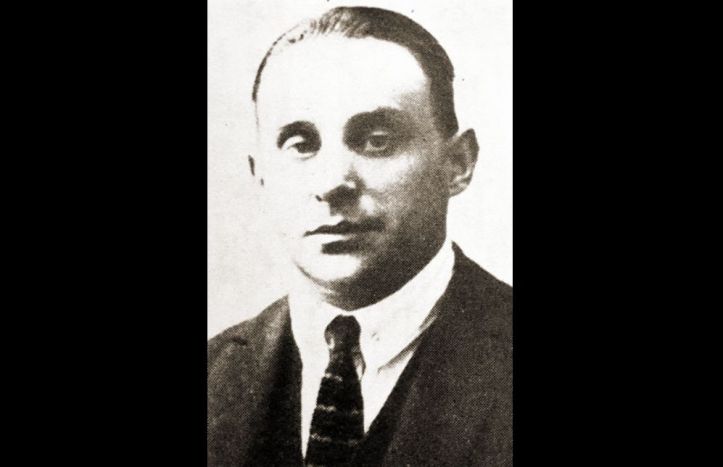
Domski’s early 1920s articles from the new Polish state are an essential Communist record of those years. Henryk Domski was a veteran of Rosa Luxemburg’s and Leo Jogiches’ SDKPiL. Arrested after the 1905 Revolution and exiled to Siberia, Domski escaped to Paris in 1908. Returning to Warsaw during the war, Domski, who knew Lenin in their exile, was an early supporter of the Bolsheviks and founder of the Polish C.P. Considered a ‘Leftist’ for having Luxemburg’s position on Polish independence and being critical of the United Front, Domski was also critical of the Red Army’s invasion of Poland in 1920. A Comintern delegate, on its Executive, and representative to Germany, Domski was also the Polish correspondent for Inprecor. In 1925, with the Left of the Party, Domski briefly lead the Polish Party before falling, supporting Zinoviev in the Comintern and Russian debate, with Stalin’s supporter, Lenski, instead became the central figure of the Polish party. Living in Moscow, he was an Oppositionist in 1927, also following Zinoviev in soon recanting and being readmitted to the Party in 1930. Domsky again worked as a Comintern journalist until, like many former Oppositionists, he became a victim of the purges and was expelled, again, after Kirov’s murder; arrested in November, 1936 and Henryk Domski was shot on October 26, 1937.
‘The Second Congress of the Free Trade Unions of Poland’ by L. Domski from International Press Correspondence. Vol. 2 No. 54. June 28, 1922.
On the 25th and 26th of May, the Second Congress of the “free” trade unions (the so-called “class trade unions”) of the Polish republic was held. The congress was noteworthy in so far as there took part in it for the first time the representatives of the Jewish trade unions who applied for and obtained affiliation to the Polish Trade Union Federation in the previous year. Even if this connection is very loose and is limited to the coordination of the head organizations of the trade unions (with regard to which a word must be said later), yet this common conference of the Polish and Jewish workers is an event which will not be without results.
This change in the composition of the trade unions was also echoed in the character of the congress debates. Whilst at all previous trade union congresses, the opposition to the nationalist policy of the P.P.S. leaders only came from the Communist delegates, this time it was upon many questions reinforced by all the representatives of the Jewish trade unions, among whom there were also three definitely “red” delegates. Of the total number of delegates, 225, the Polish social patriots could this time absolutely rely upon only 155; the remainder often voted against their proposals and of these 34 delegates were united into a “red fraction”.
The 34 “reds” may appear to be an insignificant few compared with the 160 social patriots; in reality however, they testify to an almost unexpected strength of the Communists within the trade unions. One must call to mind how the Communists are persecuted in Poland, how trade union executives at all “tainted” with Communism are “cleared up” out by the police on the basis of information furnished by the P.P.S., in order to be able to appreciate properly the importance of this total of 34. The delegates were nominated by the trade union executives which, in consequence of the methods above cited are almost throughout in the hands of the P.P.S. If the Central Committee of a trade union is “red” as in the case of the Building Trades, the Wood Workers’, the Shoemakers’, the Bakers’ and the Warsaw Municipal Workers’ Unions and in the entire Posen District Federation, it only exists where there are not sufficient social patriots in the whole trade union to scrape together to form some sort of a presentable trade union staff. This, with the exception of Posen, is unfortunately only the case in the smaller trade unions. In the larger unions, as in the Miners’ Union, the Textile Workers’ Union, and in part in the Agricultural Workers’ Union, the social patriots still compel the oppositional-minded majority of the union to accept a reformist leadership.
How such a trade union congress is arranged in Poland is shown to us by the following statements of the Pilsudski paper, (the Kuryer Polski) which is favorable to the P.P.S.: “It was known beforehand that this majority would be formed through the appointment of delegates by the Executives of the largest trade unions…The reason for this regrettable fact is the tactics of the Communists…Political control of the trade unions is only possible in the form of a dictatorship…The guilt does not lie with the P.P.S. which adopts the only possible defensive tactics: the Communists are guilty…This (the return to a non-partizan policy), will only be possible when the Communists have disappeared from Polish territory…”
Thus the social patriotic majority at the Trade Union Congress was formed. The P.P.S. took full advantage of their majority regardless of everything. Thus it was “decided” not to permit the reading of the declaration of the “red” fraction and the message of greeting sent the Congress by the Communist Party of Poland. The majority also refused the Communist deputy, Comrade Lancutzki, entrance to the congress. To their greatest regret the social patriots were unable to silence the “red” delegates whose speakers, Rybacki, Mirski, Dutlinger, Golendzinovski, Podniesinski and others, gave the managers of the Congress many unpleasant moments.
It is to be noted that the legal Polish Independent Socialist Party, which expects to act as the heir of Communism, was not represented by a single delegate at the Congress. This good party has clearly one little fault: its existence has not yet been proved. As for the strength of the trade union organizations, they have, according to the report of Zulavski, 48 centralized unions with 1,116 branches and 492,962 members. Referring to the total of 253,456 members which the Trade Union Federation had on January 1st, 1920, Zulavski deduced from this a praiseworthy increase of about 93 per cent in membership. This statement was unfortunately misleading, for at that time the Railway Workers’ Union, the Posen District Federation and the Jewish trade unions were still outside the Trade Union Federation. The membership of these four organizations together was in January, 1920, 441,695. No doubt an increase can be recorded since the middle of 1921, when a wholesale exodus from the trade unions was everywhere taking place.
This slow process of development of the trade union organizations, which is the more striking as the number of active industrial concerns in Poland has greatly increased since 1920, (thus the number of workers in the textile industry was at the beginning of 1920 26.2% and in the middle of 1922 63% of the pre-war total) is all in consequence of the trade union tactics of the social patriots. If the trade union leaders sabotage every serious trade union struggle, if they crush the whole trade union movement merely in order to be rid of the Communist majority, the consequences cannot be otherwise.
The debates were very lengthy. The agenda was as follows:
1-Report of the Central Committee and discussion.
2-Trade union tactics and the united front.
3-Militarism and war.
4-Organization problems.
5-Social legislation.
6-Miscellaneous.
Upon all these questions (with the exception of point 5) the debate was merely a conflict between the P.P.S. and the Communists in which the Jewish trade unions–who in the great majority were Bundists (members of the Bund) alternatively supported this or that party.
On the question of the united front the Bundists were on the side of the “red” fraction. It is true that they did not fail to launch attacks against Communism (the Jewish Bund in Poland is not a government party only on account of lack of opportunity), but they took up on this question the position of the Vienna International. The P.P.S. men naturally raved against the united front. Their leader, Zulavski, declared at united front with the Communists, who brand him (Zulavski) ag a traitor, to be impossible. Both the Communist and the Bundist resolutions on the united front were rejected by a large majority.
On the question of the fight against militarism the Bundists likewise went partly with the “red” fraction. The resolution of the social patriots was directed naturally against the “capitalist states” generally and against Soviet Russia whom they charged with provoking war. On the other hand they directly defended Polish militarism in recognising national defense and not holding Pilsudski responsible for war propaganda.
Whilst the speaker for the “red” fraction, Mirski, refuted the mendacious attacks against Bolshevik militarism, the representative of the Bund stood up against the Francophile tendencies of Poland and the P.P.S. At this juncture Jouhaux, who was present as a guest, sprang into the breach, after whose “stir- ring” speech the reformist resolution was accepted by a vote of 131 to 64.
The debates on the problems of organization were interesting. The Communists stood as advocates of a real unity between the Polish and Jewish trade unions; they advocated amalgamation in place of the existing loose federation and fusion of the Executives. This point of view was energetically opposed by the P.P.S men, who then together with the Bundists voted for the resolution previously referred to. In the same way the proposals of the “reds” for the amalgamation of the existing craft organisations into great industrial organizations were rejected. In the final vote the “reds” were overwhelmingly defeated by the united votes of the P.P.S. and Bundists.
In the debate on social legislation the Minister for Labor, Darowski, the creature of the industrial capitalists, who was present as a guest, stood up and attempted to persuade the Congress of the great advantages of Polish social legislation. The declarations of the Minister did not even convince the P.P.S. crowd.
The new election of the Central Committee was no surprise after the Bundists had supported the vote of confidence in the old Central Committee. In spite of this the new Central Committee could not be kept quite free of Communists. The influence of the Communists in the trade union organizations is already too powerful for this.
Taken all in all, the Congress shows once more that the Communists do not give up the struggle even in the most difficult circumstances, and that the beginning advance of the trade union movement in Poland is beginning to break through the social patriotic crust in which the legal labor movement has been cramped.
International Press Correspondence, widely known as”Inprecorr” was published by the Executive Committee of the Communist International (ECCI) regularly in German and English, occasionally in many other languages, beginning in 1921 and lasting in English until 1938. Inprecorr’s role was to supply translated articles to the English-speaking press of the International from the Comintern’s different sections, as well as news and statements from the ECCI. Many ‘Daily Worker’ and ‘Communist’ articles originated in Inprecorr, and it also published articles by American comrades for use in other countries. It was published at least weekly, and often thrice weekly.
PDF of full issue: https://www.marxists.org/history/international/comintern/inprecor/1922/v02n054-jun-28-1922-Inprecor.pdf
 Revolution's Newsstand