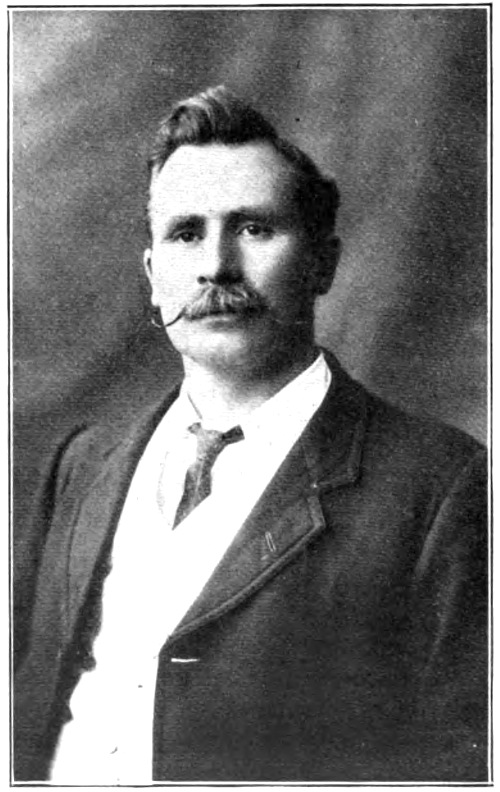
Soon after the shift in direction of The Review, personified by the letting go of editor A.M. Simons and the hiring of Mary E. Marcy, the magazine embraced the industrial union movement. Already with a veteran’s authority in 1908, Tom Mann with a primer on the subject in an ‘Open Letter to Trades Unionists on Methods of Industrial Organization.’
‘The Way to Win’ by Tom Mann from The International Socialist Review. Vol. 10 No. 3. September, 1909.
AN OPEN LETTER TO TRADES UNIONISTS ON METHODS OF INDUSTRIAL ORGANIZATION
Comrades: The great crisis is drawing nigh when the supreme effort must be made by the workers to take entire responsibility for the management of all industry and commerce; the existing system of society must of necessity give place to some other system that will adequately provide for the requirements of all. The nature of the newer order will depend in considerable measure on the standard of intelligence possessed by the workers, and their courage to apply sound principles that will ensure social and economic equality.
The object I have in writing this letter is not to enlarge upon principles or ideals, but to direct attention to the machinery that is necessary to enable us to achieve our object.
THE PRELIMINARY ESSENTIAL CONDITION IS WORKING-CLASS SOLIDARITY.
Without this solidarity, i.e., without the power and the disposition to act in concert as the working-class against the dominating plutocratic class, there is no hope.
At present we have not got this solidarity, either industrially or politically.
The weakness of our industrial organization lies less in the fact that only on-e-fourth of the workers are organized, than in the much more serious fact that those who are organized are not prepared to make common cause with each other.
Hitherto we have been content with trades unions—meaning unions of skilled workers, supplemented by unions of unskilled workers. But each of these unions has for the most part initiated and as far as possible carried out a policy for itself alone; more recently broadened out somewhat by joining trade and labor federations to secure something in the nature of general help in time of trouble or warfare.
Still, the basis of unionism of to-day is distinctly sectional and narrow, instead of cosmopolitan and broad-based.
In Australia, more particularly, resort to Arbitration Courts and Wages Boards for the settlement of industrial disputes has resulted in settlements being arrived at and agreements entered into by the various unions, binding them not to become actively engaged in any dispute during the period covered by the agreement.
Such agreements in themselves absolutely destroy the possibility of class solidarity.
Agreements entered into between unions and employers directly—i.e., without the intervention of Arbitration Courts or Wages Boards—are equally detrimental to, and in dead opposition to working-class solidarity. They, therefore, must be classed as amongst the chief obstructive agencies to general working-class progress.
Thus it is clear that to continue entering into binding’ agreements with employers is to render the unionist movement impotent for achieving our economic freedom.
Therefore, no more agreements must be entered into for lengthy periods. Of course, temporary adjustments must be made, but they must be for the hour only, leaving the workers free for concerted action with their fellows.
The form of capitalist industry has changed during the past 50 years. It has passed through the stages of individual ownership of shop or factory, the employer taking part in the business and competing with all other employers in the same business, then to limited liability and joint stock companies, which removed the individual employer—whose place is taken by a manager—and reduced competition between the capitalist firms. From this it has now gone to trusts and combines, inter-State, and even international in their operation.
A corresponding progress must take place with the workers’ organization. Sectionalism must disappear, and the industrial organizations must be equal to State, national and international action; not in theory only, but in actual fact.
Another influence tending strongly towards discord and not towards solidarity is the stipulating in some unions that a man who joins an industrial organization by that act pledges himself to vote in a certain way politically.
I have, in days gone by, argued strongly that the industrial organizations should be the special places where economic knowledge should be imparted and adequate scope for discussion afforded. I hold so still, but I am thoroughly satisfied that it is a source of serious discord to couple the political with the industrial in the sense of demanding that a man must vote as the industrial organization declares.
It is not difficult to understand why this should be so. It is because in the unions or industrial organizations we are (or should be) prepared to enroll every person who works, irrespective or his or her intelligence, or opinions held upon political or other subjects.
Take the case of an organizer, who finds himself in a center of industry where there is practically no organization. He soon discovers that the usual orthodox bodies are there, theological and political. He finds out the composition of the local governing bodies and the type of politician who received the votes at last election. From this he concludes that there are resident there the usual percentage of reactionaries, Liberals, Laborites and Socialists, and each of these parties finds its adherents chiefly in the ranks of the workers.
That ought not to interfere with industrial organization, in which they should be enrolled entirely irrespective of political faith; and, becoming members of the industrial body, it is here these workers should get their education in industrial and social economics, and this would prove the true guide to political action.
To insist upon them voting solidly politically before they have received instruction in matters economic, is to add to the difficulties of organization.
Notwithstanding what has been done and is now being done by the Australian Workers’ Union, it is abundantly clear that we shall have to separate the industrial from the political, and so afford scope for growing activities with the least amount of friction.
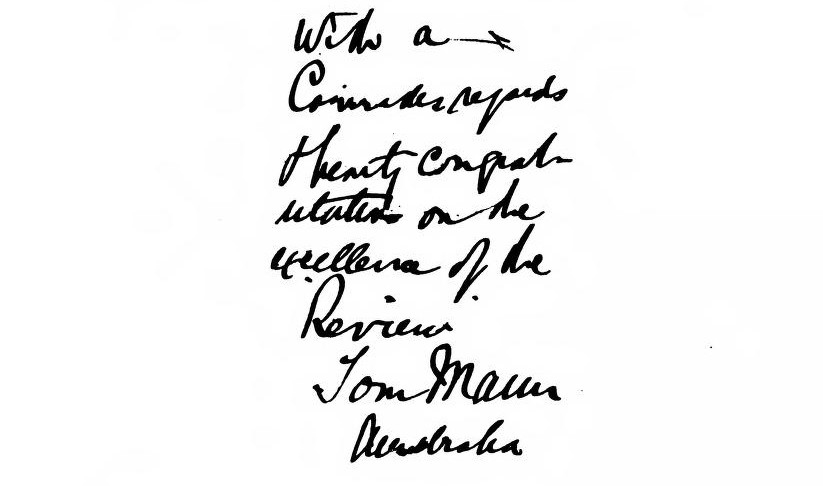
I am not wishful to deprecate political action, but it is necessary to say that during recent years, in Australia, undue importance has been attached to political action; and although the actual membership in industrial organizations may be as large, or even larger than in former years, there is not held by the typical unionist a proper understanding of the fundamental and vital importance of economic or industrial organization. Indeed, to listen to the speeches of the typical Labor politician, it is clear that he is surfeited with the idea that that which is of paramount importance is the return to the legislative bodies of an additional number of Labor men, and that all else is secondary and relatively trifling.
In absolute fact, the very opposite is the case. Experience in all countries shows most conclusively that industrial organization, intelligently conducted, is of much more moment than political action, for entirely irrespective as to which school of politicians is in power, capable and courageous industrial activity forces from the politicians proportionate concessions.
It is an entirely mistaken notion to suppose that the return of Labor men or Socialists to Parliament can bring about deep-seated economic changes, unless the people themselves intelligently desire these changes, and those who do so desire to know the value of economic organization. During the past few years the representative men of France, Germany, Italy and other countries have urged upon the workers of the world to give increased attention to industrial organization, and they are acting accordingly.
Indeed, it is obvious that a growing proportion of the intelligent pioneers of economic changes are expressing more and more dissatisfaction with Parliament and all its works, and look forward to the time when Parliaments, as we know them, will be superseded by the people managing their own affairs by means of the Initiative and the Referendum.
However, I am not an anti-Parliamentarian. I am chiefly concerned that we should attend to the first job in the right order, and thus make it the easier to do whatever else may be necessary.
It is encouraging to see the practical turn of affairs in Port Pirie, S.A. There the Combined Unions’ Committee have already sent out a circular letter to the unions of South Australia, in which they say:
“During the present struggle with the Broken Hill Proprietary Company, we have had ample opportunity of ascertaining in what manner industrial organization might be made more effective in resisting the tyrannical encroachments of modern capitalism, and securing to the worker a larger share of the product of his labor. My committee have come to a definite and unanimous conclusion that craft unionism has outlived its usefulness, and that 20th century industrial development demands on the part of the workers a more perfect system of organization. With this end in view, we urge, as a preliminary step, the holding of a Trades’ Union Congress in Adelaide during the month of July next. We sincerely hope that this proposition will meet with the earnest and energetic support of your members, and that immediate action will be taken.”
This is a significant sign of the times, and an encouraging one, too, to those who lament the sectionalism of the present unionism movement.
Such a conference could well discuss and carry such resolutions as follow:
“That the present system of sectional trades unionism is incapable of combating effectively the capitalist system under which the civilized world is now suffering, and such modifications and alterations should be made in the existing unions as will admit of a genuine Federation of all organizations, with power to act unitedly for industrial purposes.”
“That this conference urgently advises all trade societies, unions and associations to speedily make such changes in their rules as may be necessary to separate the funds subscribed for purposes usually provided by Friendly Societies from the funds subscribed for economic or industrial purposes, and proceed to at once form district Federations of all unions as distinct from trade or craft Federations.”
“That a Provisional Committee, or Council, be formed in each State (or, if need be, in each industrial district), to direct organizing activities, until the movement attains such dimensions as will warrant the holding of an Interstate Congress, at which Congress all details as to objects and methods can be definitely decided upon. The members composing such provisional councils or committees to be drawn from members of unions agreeing to the previous proposals.”
“That no dispute be entered upon and no encouragement given o any section to formulate grievances (unless a impelled by the action of employers), until the movement shall have attained a high standard of organization, approved by the proposed Interstate Congress.”
“That in order to guard against dissension, it be declared from the outset that this movement is neither anti-political nor pro-political, but industrial and economic, and that members may belong to what political organization they please providing they do not oppose the expressed objects and ideals yet to be agreed upon at the Inter-State Congress, and at present set forth in the previous proposals.” If the unions of the Barrier agree to take such action as suggested in the foregoing proposals, I believe there could be, in a short time, a far more powerful organization than anything of the kind known to modern times.
Beyond any question, the industrialists of Australia are prepared to carefully consider any well thought-out proposals submitted to them by the comrades of Broken Hill and Port Pirie.
The time is particularly opportune also, because for some two years past much discussion has been indulged in as to the merits of industrial unionism, and the minds of many are prepared to co-operate in such effort as here set forth.
Many of the unions in New South Wales and Victoria have already given much attention to the subject, and are well disposed thereto.
To remain in the present forcibly feeble condition characteristic of present-day unionism would be to stamp ourselves as incapables; and would admit of an indefinite prolongation of capitalist tyranny.
On all sides we see hysterical efforts being made by the plutocratic governments of the different countries to prepare for war on an unprecedented scale, as a relief from glutted markets. Such is the condition of the peoples in Europe and America that deaths by starvation and deaths from diseases arising out of ill-nourished and unsanitary conditions are so appallingly large that the modern system stands condemned in the eyes of all intelligent citizens.
Through the ages men have died by millions before the naturally allotted span of life, because they have not been able to produce life’s requirements in the necessary abundance ; but never before did the anomaly we now witness obtain, viz., that people die of hunger because they have produced so much as to glut the markets and fill the warehouses, and are then deprived of the opportunity of work, therefore of incomes. Hence, poverty, destitution and misery.
These conditions cannot last. In spite of colossal ignorance, there is already too much intelligence and genuine courage to acquiesce in such class dominancy and exploitation as brings such results in its train.
Therefore, comrades, get to work like men of intelligence and courage, count it a privilege to be permitted to share in the great work of social and economic emancipation; for, indeed, there is no higher, no worthier, no holier work than can engage the energies of man.
The International Socialist Review (ISR) was published monthly in Chicago from 1900 until 1918 by Charles H. Kerr and critically loyal to the Socialist Party of America. It is one of the essential publications in U.S. left history. During the editorship of A.M. Simons it was largely theoretical and moderate. In 1908, Charles H. Kerr took over as editor with strong influence from Mary E Marcy. The magazine became the foremost proponent of the SP’s left wing growing to tens of thousands of subscribers. It remained revolutionary in outlook and anti-militarist during World War One. It liberally used photographs and images, with news, theory, arts and organizing in its pages. It articles, reports and essays are an invaluable record of the U.S. class struggle and the development of Marxism in the decades before the Soviet experience. It was closed down in government repression in 1918.
PDF of full issue: https://www.marxists.org/history/usa/pubs/isr/v10n03-sep-1909-ISR-gog-EP-cov.pdf
 Revolution's Newsstand