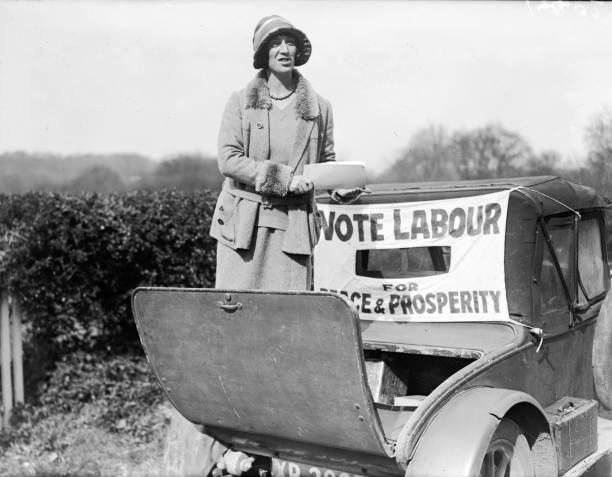
The organizations during the momentous year of The General Strike of working class women in the British labor movement, particularly through the Women’s Section of the Labour Party.
‘Work in the Mass Organisations of Women in England’ by A.E. Scott from International Press Correspondence. Vol. 6 No. 44. May 27, 1926.
In England we have two main mass organisations of working women, the Women’s Sections of the Labour Party and the Women’s Co-operative Guilds. There are other organisations such as the Railway Women’s Guilds, but the method of work is the same, and if we deal in the main with the work in the Women’s Sections of the Labour Party it will make clear the general conduct of the work of Communist women in the big non-Party organisations.
In the Labour Party all individual members are members of the ward committees, (all Parliamentary Constituencies are divided into wards) and pay their subscriptions to the Party through the wards, but also, the individual members are organised into men’s and women’s sections. These sections meet separately, and elect an equal number of delegates to the governing body of the local Labour Party, the General Committee, on which the affiliated Trade Unions in the locality are also represented.
The Women’s Sections have their own officers, President, Secretary etc. and hold their own National Conference once a year. There are no separate subscriptions to the Women’s Sections, the expenses are met from the general Party funds. The Women’s Sections have the right of affiliation to other bodies, and often the Sections are affiliated to the local Trades Council.
The women members of the Party are organised in their Party fractions, which work in the same way as the Party fractions in other organisations. The work is carried out under the control of the women’s propaganda conmmittee of the local, working in close touch with the Local Party Committee, and the comrade in charge of the work in the Labour Party and Trades Councils.
In the Women’s Sections there is a speaker for nearly every weekly meeting, and it is possible for our Party women to obtain Party or left wing speakers on subjects of interest. Further, the discussion arising out of the address gives our comrades a very good opportunity for making clear the difference in outlook of the Communist Party. For instance nearly every women’ section has had a speaker from the No More War Movement, and on this occasion, by means of questions and taking part in discussion, it is possible to counteract a good deal of the pacifist propaganda which appeals directly to the women.
There are always a number of conferences to which a Women’s Section is invited to send a delegate, called by the Labour Parties, the I.L.P., the Women’s International League, the Communist Party etc. It is very useful to go as a delegate to some of these conferences, and then to make a report on the proceedings of the conference at the next meeting of the section. The fraction should also consider if it is possible to send a left wing sympathiser also to the conference, so that they will get a better understanding of the position of the organisations concerned. In this way, the bourgeois character of the Women’s International League was made clear to some of the members oi one Women’s Section.
In connection with the National Conference of Labour Women held in May of each year, the Central Women’s Propaganda Committee always sends to the local committee, resolutions to be put forward on to the Agenda, with some brief speakers’ notes on the importance of these resolutions. Then, after the resolutions put forward for the agenda are discussed, there comes the question of the election of delegates to the conference, and the instructions to be given to the delegates on the resolutions which appear on the agenda. Here again, our comrades have a big opportunity to discuss clear and concrete working class issues which are of special interest for women.
Some of the local and district women’s propaganda committees have called delegate meetings in their localities and these have proved very successful on the whole.
The Party has issued an invitation to all organisations in the locality which have working women as members–Labour Parties, Co-operative Guilds, Independent Labour Party branches or women’s sections, women’s Trade Union branches, the Trades Council, Railway Women’s Guilds, etc. The meeting is called on some definite issue of importance to the workers. The first delegate meetings were called just before July 1925, when the question of the miners’ lockout was the burning question and the delegate meetings were called to consider what part the women could play in the struggle.
The campaign for the release of the prisoners was also used for the calling of delegate meetings.
At these meetings resolutions were passed in support of the Party’s position, and on a number of occasions a Women’s Council of Action was set up for the purpose of coordinating the activities of the working women in the locality. The majority of the members of the Councils would not be Party women, but the councils would act under the leadership of the Party. Some of the Councils of Action which were set up in July and during the Release the Prisoners campaign out of the delegate meetings, took an active part in the organisation of International Women’s Day.
The calling of delegate meetings has proved very valuable from the point of view of breaking down the prejudices which exist against the Party and of showing to the women workers the serious purpose of the Party. The meetings are held definitely under Party auspices with our own speakers and resolutions which enables us to make clear to all the organised women in the locality exactly the position of the Party.
Even though we have not yet been able to get women from the factories to our delegate meetings, they have been extremely useful in increasing the influence of our Party and making clear our policy to working women.
On March 21st in Mansfield a very successful delegate meeting was held to prepare the work of the women in the industrial crisis. At this delegate meeting 300 delegates were present representing 55 organisations.
After the Liverpool Conference of the Labour Party when again it was decided to turn the Communists out of the Labour Party, it was decided that it was necessary to form a Left Wing in the Labour Party. In the Women’s Sections our comrades were active in bringing the question forward, and in getting a speaker from the Left Wing Committee to speak on this, and then later to get delegates sent to the Left Wing conferences which were held all over the country, and to affiliate to the Left Wing Committee.
The arrest and imprisonment of the Communist leaders, and the miners of South Wales brought tremendous sympathy for the Party, and on this question the working women went wholeheartedly with us, and worked well in raising funds for the Defence and Maintenance fund and the organising of the petition. Women also were very prominent in the demonstrations which were held for the release of the prisoners.
The Party organ is always on sale at the meetings of the Women’s Sections, even where it has been forbidden, as in that case it is sold outside the meeting instead of inside. Also when we have our woman’s paper coming out regularly, it is in or ganisations such as the women’s sections of the Labour Party that we can work up a good circulation.
The work is very much the same in the Co-operative Guilds. Special issues also come up in the Guilds. as for example, the question of the attitude of the Co-operative Societies if there was a miners’ strike or lockout; the point of view that there should be no politics in the Guilds; affiliation to the Minority Movement; questions arising from the Co-operative stores themselves. their prices and the dividends they pay etc.
The work outlined above is preliminary work, so to speak, gradually breaking down the prejudices of working women against the Party, and gradually drawing them towards the Party. This work has to go on all the time, but it is not enough. Very definite efforts must be made to get the women actually to join the Party, and this has been done slowly but steadily. Very often it will be found that women feel that they are too ignorant to join up with the Party and want to know more about politics before they do so. And here it has been found very useful to form a discussion circle with some of the Left Wing sympathisers, to discuss matters of importance in the Section or Guild, and also to have general political discussions. In this way we can keep in close touch with our sympathisers, and at the same time bring them nearer to the Party and give them some insight into political questions.
There is a great field of activity in these organisations of working women, and it is important that they should be taken up seriously. In England, our forces are very small, but the effect of the work that had been done in the women’s sections of the Labour Party was made clear at the last Labour Women’s Conference, where, although we had only 10 delegates, the support that was obtained for the point of view put forward by our delegates, and for cur resolutions was far beyond what our numbers would lead us to expect. In the conference this year (which at the moment has been postponed owing to the general strike to get the Communists out of the Party, we have 7 delegates to the Conference, and all our resolutions are on the agenda. The work is very difficult, and very slow in showing results, and the more successful it is the greater is the opposition you have to face from the right wing elements. But nevertheless, the work presents the best opportunities for increasing the influence of the Party over the organised women of the working class.
International Press Correspondence, widely known as”Inprecorr” was published by the Executive Committee of the Communist International (ECCI) regularly in German and English, occasionally in many other languages, beginning in 1921 and lasting in English until 1938. Inprecorr’s role was to supply translated articles to the English-speaking press of the International from the Comintern’s different sections, as well as news and statements from the ECCI. Many ‘Daily Worker’ and ‘Communist’ articles originated in Inprecorr, and it also published articles by American comrades for use in other countries. It was published at least weekly, and often thrice weekly.
PDF of full issue: https://www.marxists.org/history/international/comintern/inprecor/1926/v06n44-may-27-1926-Inprecor.pdf
 Revolution's Newsstand