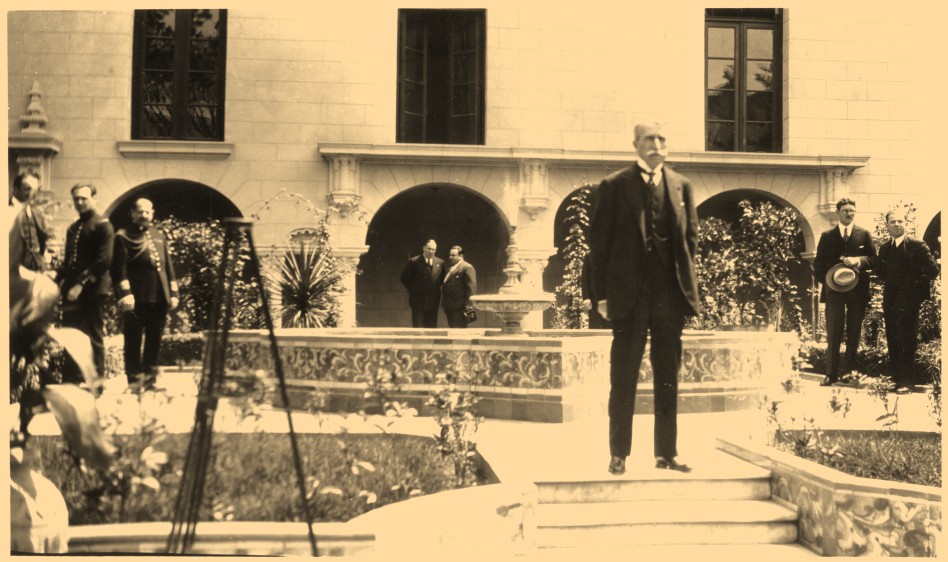
The story of how U.S. imperialism supplanted the British in Peru, their bloody relationship with Augusto B. Leguia, facilitating the extortion and robbery of the Peruvian people by Standard Oil and National City Bank.
‘Peru Dictator is Vassal of U.S. Bankers’ by Manuel Gomez from The Daily Worker. Vol. 3 No. 78. April 13, 1926.
Imperialists Rule with Iron Hand.
Peru and Chile are contesting the ownership of the Tacna-Arica territory, with the United States government playing the role of “Impartial arbiter,” ably represented by Generals Pershing and Lassiter, numerous United States military aides, United States marines, a United States war ship and United States civil administrators.
Tacna.
The tragi-comedy of the Arica plebiscite now approaches its denouement amid the discomforture of both Peruvians and Chileans and the complete hegemony of U.S. imperialism, the “impartial arbiter,” over the disputed territory.
Simultaneously news began to leak out of the ubiquitous “impartial arbiter” in Peru and Chile themselves. This news is not printed in the American capitalist press. Yet it is indisputably authentic news, from unimpeachable sources, dealing with facts easy to verify. Its suppression here is due, no doubt, to a deep concern for the delicate sensibilities of American imperialism. The facts recount such a barbaric tale of naked aggression on the part of Wall Street and Washington that it is probably believed the American stomach cannot stand them.
Daily Assault on Workers.
Newspapers from Chile report daily assaults against the workers in the nitrate fields of Tarapaca and Antofagasta, under the inspiration of the American nitrate interests. However, it is in Peru that American imperialism is showing itself in all its ferocity. The All-America Anti-Imperialist League has received direct information from the Lima Federation of Printing Trades Workers, smuggled thru the censorship, which carries the appeal of an entire people, American imperialism (whose government is too moral to recognize governments emanating from the people) has bribed Augusto B. Leguia, one of the most vicious tyrants in Latin-American history, to beat the Peruvian people into unqualified submission to it. The Peruvian nation has been delivered over to imperialism for exploitation. Forced labor, long ago solemnly banished from “civilized” society, has been revived in Peru by American imperialism, just as it was revived in Santo Domingo where the natives have been conscripted to work in chain gangs on the hot roads. But in Peru the entire working class is conscripted by law to produce profits for a private American company, the Foundation Company of New York!
Conscription of Labor.
That is the law. Actual conscription has not been possible of realization on a national scale in Peru because of the heroic resistance of the workers and peasants. In the province of Arequipa” the peasants engaged in open conflict with the soldiers who tried to conscript them.
In Lima the Federation of Printing Trades Workers has gone on strike and a general strike of all workers is threatened. The students have also been drawn into the struggle; a united anti-imperialist front against President Leguia and his imperialist masters has been created.
Terrorize Workers.
Leguia answers with deportation, imprisonment, murder. “The laws of Peru must be maintained!” says this dictator who has done nothing but violate law since he seized power for the first time, eighteen years ago.
How is it that this particular law has become sacred to Leguia? How is it, in the first place, that American imperialist interests have been able to get such a stranglehold on the Peruvian nation as to secure the passage of a law that conscripts every Peruvian who cannot buy his exemption to work twelve days a year without pay for the Foundation Company? These questions have already been answered in the news reports sent out by the All-America Anti-Imperialist League, which show the actual state of affairs in Perú. However, the news reports deal only with recent happenings. The original contract between the Peruvian government and the Foundation Company was reported in the Wall Street Journal two years ago. The gradual subordination of Peru to American imperialism has been taking place over a period of years-along with the advancing march of American imperialism throughout Latin America. The present excesses only show how far the process has gone, and dramatize the fact that Peru has long ceased to be a free country.
$100,000,000 Investment.
Wall Street has $100,000,000 invested in Peru, and there are millions more, waiting for “the proper conditions” to fertilize Peru’s great wealth of copper, silver, oil and other raw materials into monopoly profits for American capitalists.
Peru is a great copper country. The Cerro de Pasco copper company, linked up with the Morgan interests, and the American Smelting and Refining Company (Guggenheim interests) control practically the entire output of copper, as well as the silver. Cerro de Pasco alone controls some 730 mineral claims comprising 5,900,000 acres. Besides owning the greatest mine in Peru it owns a railroad, other mines, 7,000 acres of ranch property, water rights and 108 coal mining claims. The Cerro de Pasco properties are operated as private territorial domains, with private police standing guard over the supreme rights of the company. Under these ideal conditions the workers, with no place else to go, can be hired by the Cerro de Pasco outfit so cheap that the company is able to turn out copper at a net cost of 212 cents a pound. Copper is selling in the world market at 14 cents a pound. Is it any wonder that workers in the copper mines of the United States, whose jobs and standard of living are threatened by the competition of this cheap semi-colonial labor, should be opposed to the imperialist system that makes such exploitation possible?
Standard Oil Rules.
Peru is fast becoming an oil country. A few years ago the output of Peruvian oil was negligible but today it is already the largest item in Peru’s exports. Standard Oil dominates the Peruvian oil situation, camouflaged as the International Petroleum company. This was stated openly in the advertising of Peruvian bonds in connection with the latest loan by American bankers.
Other American concerns that are powers in Peru are the Vanadium corporation, W.R. Grace and Company and our old friend the Foundation Company–not forgetting the ever-present National City Bank of New York.
Foundation Company.
The Foundation Company has executed several construction contracts with the obliging Peruvian government and now has a contract for paving, roadbuilding and sanitation work for some 32 cities, as well as other public works, involving a total governmental expenditure of some $50,000,000.
The $7,000,000 loan floated in the United States in 1924 (out of which, incidentally, the bankers made a scandalous profit) was largely for payments to be made to this company.
As the latest news from Peru indicates, the Foundation company is doing even better than Cerro de Pasco in the matter of securing cheap labor for its undertakings. The Foundation Company gets labor power for nothing at all. President Leguia was simply made a stockholder in the Foundation Company and conscription of workers was made the law of the land. There is nothing like a little imperialism, say the capitalists, to solve the “labor problem” at home!
British-American Imperialists Clash.
American imperialism has not had a clear field of it in Peru. British interests are still very great there, and the British capital invested is perhaps still greater than the American. But although much of the old investment remains in British hands, British influence in Peru is already a thing of the past. Wall Street has supplemented economics penetration with political, to such good effect that she is now undisputed master in the land of the Incas.
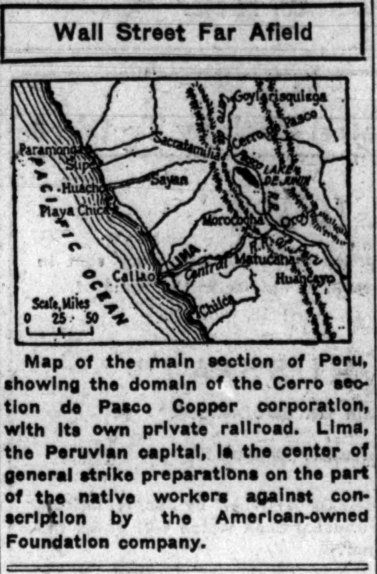
Since November, 1921, Dr. Wilson Cumberland, appointed by the president of the United States, has been resident at Lima as financial advisor” of the Peruvian government.
He is superintendent of the customs and a director of the national reserve bank. Acting on his “advice,” an entirely new customs tariff has been enacted, favorable to American interests.
American Collects Taxes.
Tax collection is now a function of Mr. Cumberland’s national reserve bank, which sends out notices 80 to 60 days before taxes are due. If they are not paid within 15 days after due date the property becomes lien and is sold for payment of the public debt. Thus Mr. Cumberland is able to dispossess every little Peruvian taxpayer to guarantee interest payments on the loans put thru by the Peruvian government and the foreign bankers.
“In the past,” says the Financial World, “it was not so. This explains why the Peruvian government has sometimes hitherto been late in payment of interest and sinking fund and provides assurance that this will not be the case in the future.”
That was only the opening wedge. Then followed the impressive visit of the American naval mission to Peru. American diplomacy at Lima became more and more dictatorial. The dictator was dictated to. Finally he was drawn into the imperialist system of Wall Street and Washington, with the result that Peru is now practically semi-colony.
Coolie System.
American bourgeois liberal ladies have been aghast at the coolie system maintained by British, French and Dutch imperialism in Asia and Africa But the coolie system is civilization itself as compared with the “American plan” of indentured slavery as exemplified in Peru and Santo Domingo!
With Central America and the inlands of the Caribbean in its grasp, American imperialism has been steadily feeling its way along the Pacific coast of South America. It is no accident that the Tacna-Arica episode goes hand in hand with imperialist encroachments in Chile and Peru. Similar developments are at work in Venezuela, Ecuador and Bolivia, though Peru stands out as the savage, dramatic example.
Imperialism Threatens Workers.
The workers of Peru have appealed thru the All-America Anti-Imperialist League to the workers of the United States to join the united anti-imperialist front against Wall Street. The American workers cannot afford to ignore this appeal. American imperialism stands like a mighty insatiable monster, with its “big stick” threatening all the exploited of the world.
The Daily Worker began in 1924 and was published in New York City by the Communist Party US and its predecessor organizations. Among the most long-lasting and important left publications in US history, it had a circulation of 35,000 at its peak. The Daily Worker came from The Ohio Socialist, published by the Left Wing-dominated Socialist Party of Ohio in Cleveland from 1917 to November 1919, when it became became The Toiler, paper of the Communist Labor Party. In December 1921 the above-ground Workers Party of America merged the Toiler with the paper Workers Council to found The Worker, which became The Daily Worker beginning January 13, 1924.
PDF of full issue: https://www.marxists.org/history/usa/pubs/dailyworker/1926/1926-ny/v03-n078-NY-apr-13-1926-DW-LOC.pdf
 Revolution's Newsstand