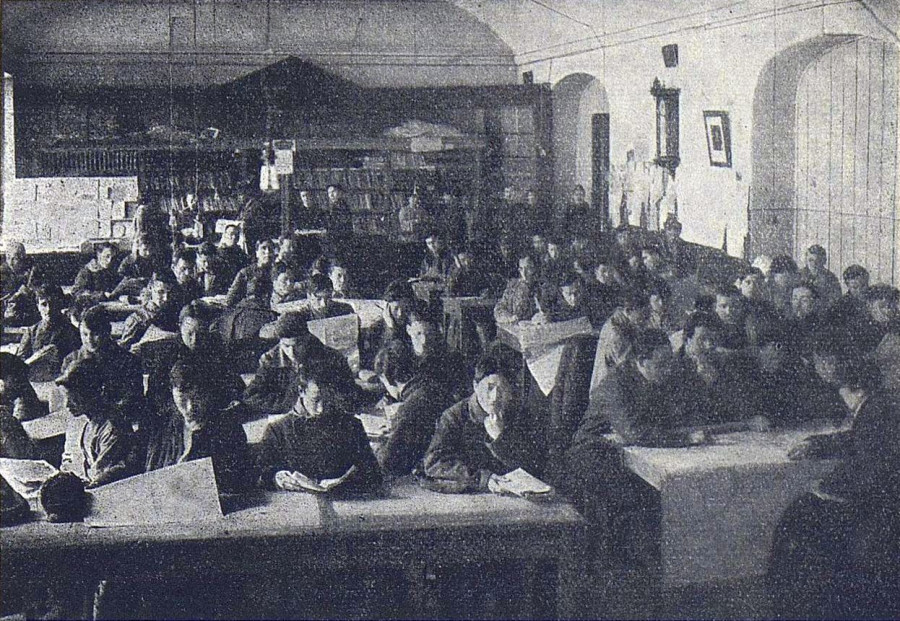
A central figure in its founding speaks to the ‘University of the East’ established by the Soviets. Always interested in the national question, Pavlovitch organized the Congress of the Peoples of the East in 1920, worked in the People’s Commissariat for Nationalities, and began the Moscow Institute of Oriental Studies, editing New East and Marxist History magazines until his 1927 death from cancer.
‘The Communist University for Eastern Workers’ by Mikhail Pavlovitch from Moscow. No. 6. May 31, 1921.
The strengthening of the Soviet’s Eastern policy is best proved by those steps for which have been taken by Soviet Russia in educating the Eastern peoples both of those states which are under its influence and of those which are parts of list the R.S.F.S.R. The first step taken by the Soviet Government towards activity and propaganda amongst the Eastern peoples was undertaken in Baku where six-weeks courses were organised, at which lectures are read in Eastern languages on Geography, the origin of the earth and man, political economy, the Soviet system, etc., etc. These courses were only a weak attempt, which, however, had great significance, to show our desire to forward the spiritual emancipation of the downtrodden Eastern peoples, without which it would be impossible to fight that terrible economic and oppression which burdens the whole of the Eastern races.
Today another tremendous stride in direction is being undertaken. By a decree of the All-Russian Executive Committee, in Moscow, a Communist University for Eastern workers is to be founded under the authority of the Commissary for Nationalities. The Collegiate of the Commissariat for Nationalities has made Com. Broilo, member of the Collegiate, the Head of this university. The University will be able to accept 2,000 students immediately, amongst whom will be included workers from all those nationalities and tribes which were the Eastern border-provinces of Russia.
The University has already its pro- 0-gramme of work under the following language sections:
1. One (English) for Chinese, Japanese, Indian and other emigrants.
2. One (in Russian) serving the Burats, Yalhoots, Maru, Mordvi, Votiaki, Korels and Koreans.
3. A Tuscoman group for the Tartars, Yabeks, Khirgiz, Turcmen and some Caucasian tribes which speak the Turcoman language.
4. A Persian group for the Buharts, Hivintai, Azerbeidjanians and Persians.
5. A Mongolian group for the Kalmuks and Burats.
6. An Armenian group.
7. A Georgian group.
8. An Upper Daghestan group in six languages for the Ossetins, Ingushes, Chechentai, Karachiaevtsi, Kastkyenuks.
The small number of intellectual forces does not allow a long stay for university students in Moscow. For the border peoples sent to Moscow their most capable youth which they wish to see started on practical work as soon as possible in their own districts. Hence the first University course will only last for a period of six months. The University curriculum is split into two courses, a theoretical one for 4 months and a practical one for 2 months.
The syllabus for the theoretical course consists of 1) natural science, 2) outlines of the evolution of organic and inorganic nature, 3) the theory and development of capitalism, 5) the history of the Russian Revolution and the Russian Communist Party, 6) the programme and constitution of the Russian Communist Party, 7) the economic geography of the world and particularly of Russia, 8) the national and colonial question, 9) the study of the Orient and the history of the revolutionary and national movements of Eastern countries (Central Asia, Persia, Turkey, China and Japan).
This course extends over a period of 4 months with 6 working hours a day. The two-months practical course sends all the students into the special spheres of Soviet and Party structures, namely, sections of industrial, commercial, agricultural, co-operative, educational, agitational, party organisation, labour and trade union movements.
The news of the opening of this university in Moscow was received with the greatest joy in all Eastern and autonomous districts of the R.S.F.S.R. The whole of the Eastern peoples will fittingly observe the significance of this fact and will again be convinced of the vast difference between the policy of the proletariat on the one hand and that of the bourgeoisie on the other in their attitude towards backward colonial countries. Whilst “civilised” Republican France is fighting with all its strength against the spreading of education in its Mussulman colonies of Algiers, Tunis and Morocco, whilst “constitutional”, “freedom-loving” England is holding down its hundreds of millions of Indian slaves in the mire of ignorance, Soviet Russia, starving, worn out and bleeding, is giving away its last in order to educate hundreds of representatives of the East. This one fact alone proves that Soviet Russia is not striving to conquer the Eastern peoples by the strength of the sword, nor desirous of exploiting them as do the imperialist states, but, on the contrary, it is doing everything possible to hasten the national and revolutionary development of the Eastern peoples. Our attempts, up to the present in this direction, truly weak, but due to no fault of ours, are the best arguments in the circles of the educated elements of Persia, India, Turkey, etc., to prove and illustrate the fact and truth that Soviet Russia’s policy in approaching backward peoples is diametrically opposed to that of imperialist states; that Soviet Russia is the true friend of backward nations and is not striving to conquer them but to free them from all forms of exploitation.
The opening of the University for Eastern peoples is to be celebrated in the proceedings of the Comintern.
M. Pavlovitch.
Moscow was the English-language newspapers of the Communist International’s Third Congress held in Moscow during 1921. Edited by T. L. Axelrod, the paper began on May 25, a month before the Congress, to July 12.
PDF of full issue: https://www.marxists.org/history/international/comintern/3rd-congress/moscow/Moscow%20issue%2017.pdf
 Revolution's Newsstand