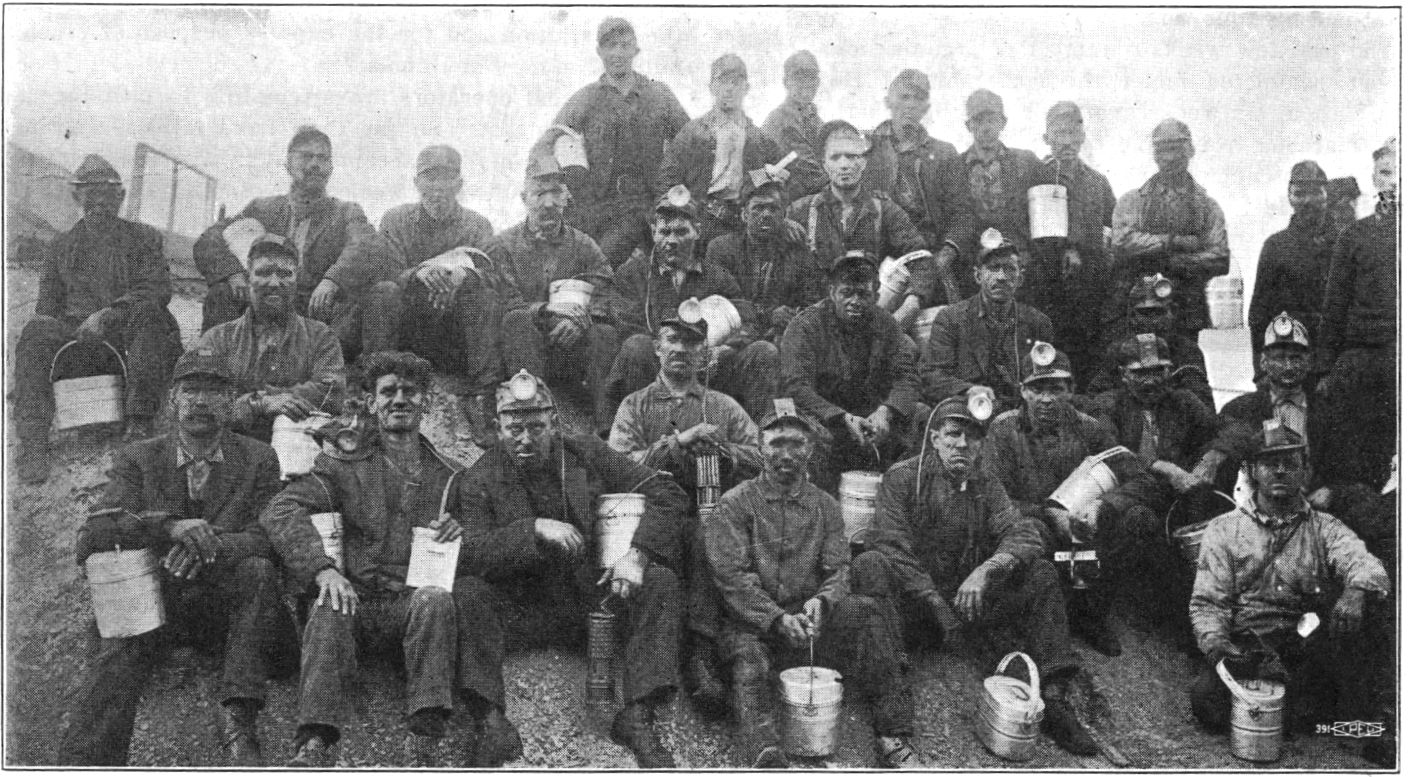
A summary of the complex situation in the U.M.W.A., the largest and most important working class organization in the country, in the mid-1920s as the Progressive Miners faced off against the ‘rule or ruin’ policies of the John L. Lewis faction that sought to bring all of the union’s districts under their control.
‘The Martyrdom of the Coal Miners’ by J.W. Johnstone from Workers Monthly. Vol. 4 No. 8. June, 1925.
SPIRITS were high among the progressive miners when the results of the last miners’ national election were made known. John L. Lewis was swamped with 66,000 left wing votes, it was announced. Perhaps our candidates were elected–at least they received many thousands of votes not counted by the Lewis administration.
We are crowding the fakers! A little more energy, more education, intensified activities and organization, and the long battle against reaction will be won.
These were the thoughts expressed on all sides.
That George Voyzey defeated John L. Lewis cannot be proven, at least, not without access to the official records. But this thought, expressed first more or less as a wish, has more merit to it than that of merely propaganda. It finds confirmation in the present tactics of the Lewis-Farrington machine, notably in their refusal for the first time to tabulate the votes cast in the election in accordance with Article 9, Section 36, of the International Constitution, which reads as follows:
Sec. 36.–The votes of each District shall be tabulated separately and consecutively, and the votes of each Local Union within each District shall be tabulated separately and consecutively, the entire total given and the complete report printed and sent out to the Local Unions by the International Teller not later than January 15th of each election year.
It is also shown in the brutally frank manner in which they have now set out to destroy the most militant and progressive sections of the U.M.W. of A., such as Districts 12, 14, 18 and 26.
Lewis cannot tabulate the votes, he says, because the finances of the union are low. This work would cost at the utmost $2,000. Lewis wants the miners to believe that he is altruistic and is worrying very much over the financial condition of the organization, forgetting for the purpose that there is over $1,000,000 in the treasury. “If you insist on a report on the election returns we shall have to place an assessment on each miner,” says Lewis, again forgetting for the occasion that an assessment of $2 per member was collected during the months of January and February, 1925, yielding nearly $1,000,000, and that an assessment of one cent per member would more than pay the cost of tabulating the election returns.
“The financial condition of the union is bad,” declares Lewis. “The financial situation of the U.M.W. of A. is very satisfactory,” said Wm. Green at the convention of District 12. There was no thought of economy when Phil Murray spent $3,000 of the union’s money on a pleasure trip to Europe, but the tabulation of the votes cast in the last election is something very different.
“You stole the election,” affirm the progressive miners to Lewis.
The plain truth is that Lewis dare not publish the tabulated election returns. The avalanche of votes cast for the progressive miners’ candidates was so great and Lewis’ vote stealing to retain his official position so brazen, that it would be impossible to hide it if the returns were sent to the locals. Impeachment proceedings would immediately be started against his administration.
So, Lewis, who has spent the union’s money like a drunken fool in smashing district after district, because they did not bow to his autocratic rule, suddenly becomes economical.
“We have only a million dollars in the treasury, so we can’t afford to tabulate the votes.”
To say that the 66,000 votes admitted to have been cast for the progressive candidates have thrown the Lewis administration into a panic is wrong. To work from this conception would be ruinous. People who are panic-stricken are easily defeated. The Lewis-Farrington machine is not in that state of mind. That they realize their desperate position is self-evident in the utter abandonment of any pretense of “constitutionality” in their attack upon the progressive miners, and their complete disregard of the welfare of the miners and the union. They realize full well that the only way they can control the coming convention is to remove from office and expel from the union all remaining leading opposition forces and to destroy completely the mining centers that will not submit to their traitorous and terroristic tactics.
The miners in Districts 12, 14, 18 and 26 will not yield to Lewis’ collaboration scheme, so they are slated for destruction. The pretense of assisting the Nova Scotia strikers and organizing the West Virginia miners, is merely shadow boxing and camouflage to take attention away from the real job of destroying the mining centers that are determined to replace the Lewis machine with a militant progressive leadership.
The Regime of John L. Lewis.
Under John L. Lewis’ short but disastrous leadership, the miners have been led into one betrayal after another. Few men have been granted the opportunity of John L. Lewis. He was made president of the U.M.W. of A. at a time when objective conditions were ideal for organizing the industry 100 per cent for the enforcing of the 6-hour day, nationalization of the mines, the installation of safety appliances, advancement if not actual enforcement of many other political demands of the miners, and the raising of the political level of the entire working class. With a real militant group of nationally-known fighters–such as Alex Howat, Duncan McDonald, Jim McLachlan–and with district and local leaders of the type of Freeman Thompson, John Watt, Tom Myerscough and many others, the pendulum was swinging in favor of the miners, and a victorious struggle at this period would have strongly entrenched the miners and would have eliminated at least 40 per cent of the present unemployment.
But Lewis failed to produce anything but compromises, defeats, and downright betrayals, until today the miners’ organization is in process of disintegration and is in very serious danger of being completely demolished.
In 1919 the situation was exceedingly favorable for the miners. The miners were keyed up to the highest point.
The six-hour day from bank to bank, which would have meant a five-hour workday at the face, with a national agreement covering the entire country–these demands, if not others, at least would have been won. But a word from the late President Wilson gave Lewis the excuse to betray the miners under the cowardly plea that “They could not fight the Government.”
In 1922, although the objective conditions were not as favorable as in 1919, the morale of the miners was splendid. They were ready, yes, eagerly awaiting the strike call. And, much to the surprise of John L. Lewis and the coal operators, the non-union miners struck 100 per cent and stood solidly side by side with the organized miners for five months in the most complete general strike in the history of the American labor movement.
Victory was within the miners’ grasp. Defeat seemed impossible. Yet, defeat and not victory was the dose handed out to them. The compromise settlement entered into by Lewis which left the miners stunned, the almost unbelievable betrayal of the Fayette County miners, following upon Lewis’ cowardly attitude in failing to go through with the strike in 1919, will go down in American labor history as equalling in disastrous effect the British miners’ “Black Friday.”
Two Fakers Expose Each Other.
The saying is that “when thieves fall out, honest men get their dues.” At least we can say that when labor fakers fall out, the rank and file gets an earful. We will let Lewis and Farrington tell the WORKERS MONTHLY readers some of the things that were happening behind the scenes before and during this strike.
Lewis and Farrington were close friends and associates, but they fell out–over what, is no matter; it is what they said during this period of hostility that gives some idea of why the miners were betrayed and why the organization is in danger of destruction. Lewis and Farrington are now good friends. They have combined their forces in order to save each other from destruction. Their common enemy is not the coal operator, but the 66,000 miners and the militant leaders who challenge their despotic rule. But, let us see what they had to say about each other in 1922 and 1923.
At the meeting of the International Executive Board of the U.M.W. of A., held Oct. 9th to 20th, 1922, inclusive, Lewis accused President Farrington and Vice-President Fishwick, of the Illinois District, of having received money to allow the Lester Strip Mine (Herrin, Ill.), to run during the strike. Executive Board Member Dobbins reported the story to Farrington, who demanded a retraction. Lewis refused to retract.
In a letter to Lewis dated November 22, 1922, among other things, Farrington had this to say:
“An influential operator with whom I happen to know you had dinner during the month of December told me that you had told him during the month of December that you believed the mine workers of the country were going to be obliged to take a reduction of wages after the first of April, and that you implied that in order to enable you to escape responsibility for the reduction a strike was to be called on the first of April and was to continue until the government intervened and settled the strike, even on the basis of reduction of wages, and considering the fact that you were continuing parleying with government authorities during the strike, I have just as much right to believe his statement is true as you have to believe the story about me concerning the Lester mine.
“I heard that you and other officers of our union collected $100,000 from the operators in Kentucky for allowing them to operate during the strike…
“I heard that instead of borrowing $100,000 from the Harriman Bank of New York, as publicly stated, that you received $750,000 from this bank and three members of the directorate of the bank are operating NON-UNION MINES IN THE PENNSYLVANIA FIELD and that the extra $650,000 which the public never heard anything about, was given to you and your associates with the understanding that the support of the International Union would be withdrawn from the striking mine workers in the non-union fields of Pennsylvania.”
In the light of these accusations, one gets a clear understanding of why the miners were betrayed, why the membership has dwindled down to about half of its former strength, why over 50 per cent of bituminous coal is mined under non-union conditions, why 75 per cent of the union miners are unemployed or working only a few days a month, why a state of complete demoralization and chaos now exists in the U.M.W. of A.
This hostile relationship between Lewis and Farrington could not continue. It meant the exposing of one of the methods used by the corrupt labor bureaucrats in advancing their personal fortune, and showed the crude basis upon which class collaboration is built. It also meant suicide for both of these well-paid tools of the coal operators.
So, the hatchet was buried, but not before Lewis and Farrington had convicted themselves as traitors and grafters before the many thousands of members who read these incriminating letters. Undoubtedly the coal operators had a hand in forcing a reconciliation. To allow this exposure to continue meant the destruction of the Lewis and Farrington machines and the turning of the organization over to a more progressive if not a revolutionary leadership. This would not suit the coal operators at all.
In spite of the fact that Lewis and Farrington detest one another, their own personal safety compelled them to make peace.
The move was easier for Lewis to make than for Farrington. Farrington, in his desperate attempt to step into Lewis’ shoes, had flirted with the progressive miners, and for a time even pretended to lead the fight for the reinstatement of Alex Howat. However, if any progressive miners were fooled by Farrington’s pretensions, they were few and far between. Farrington is not any more treacherous than Lewis, but he is a much cruder artist.
On May 5, 1923, in answer to an inquiry about the standing of the Progressive Miners’ Committee, he had this to say. We quote two paragraphs from the letter:
“I am returning herewith the circular letter which accompanied your letter of May 3rd. I do not think THAT THE MEN WHO ARE BEHIND THE SO-CALLED PROGRESSIVE MOVEMENT HAVE ANY INTENSIONS WHATSOEVER OF ESTABLISHING A DUAL ORGANIZATION OF MINE WORKERS, instead their activities, I think, are due entirely to their determination to clean up some of the corruption that is going on in our union…
“Alex Howat has repeatedly declared that he will have nothing to do with the establishing of a dual organization of mine workers and I am satisfied that he meant just what he said. I do think, however, that Howat has much reason for complaint and will no doubt identify himself with this element in our union because he believes that is the only way he can secure justice for himself and the Kansas miners.”
In the early part of June, 1923, the peace pact was completed and on June 29th, Farrington officially deserted Howat. We quote the following three paragraphs:
“In reply to your letter of recent date, I advise that I assume the recent case of Alexander Howat will be an issue in our next National Convention and that a decision will be rendered by that body. I have done everything in my power to get him reinstated to membership in our union, as a matter of fact, I led his fight from the very beginning and I not only gave him my moral support, but recommended that he be given the financial support of District 12 and financial support was given him and the Kansas miners without stint…
“It is a great disappointment to me to learn that Alex has lined up with the enemies of our union. (Progressive Miners.–Ed.). He surely could not do his own cause any good by following that course while on the other hand he has done himself irreparable harm.
“I shall continue to do everything I can for the Kansas miners, but now that Alex Howat has joined forces with the enemies of our union he will have to make his own fight in his own way.”
Rule or Ruin Tactics.
Since the signing of the Jacksonville Agreement, Lewis and Farrington have been openly co-operating with the coal operators to crush the rebellious spirit of the miners, even to the destruction of districts and the throwing out of the industry of 200,000 “surplus” union miners.
District 18 (Alberta, Canada) is a classic example of how Lewis destroys a district that is opposed to his rule. The Alberta miners could not be won over to Lewis so their district had to be destroyed. In 1923, there were 11,000 organized miners there. Today it is doubtful if there are 3,000.
The strike of 1924, lasting nearly eight months, was deliberately sabotaged by Lewis and his lieutenant, District President Sherman. The miners were starved into submission. The militants were driven from the mining fields. In Crow’s Nest Pass, always a center of progressive activities the seven local unions have been completely demolished In five mining fields, only company unions exist, and in the other two they have not even gone to the trouble to form that kind of company protection.
In the northern fields the situation is not much better Demoralized, disorganized and deserted by Lewis and his gang, the miners were compelled to accept a 121⁄2 per cent reduction in wages. Lewis breathes a little easier–an op position force has been destroyed. What matter the sympathies of the miners and their wives and families?
For over two months the 12,000 Nova Scotia miners have been on strike against the British Empire Steel Corporation This district, in spite of all attempts by Lewis to disrupt it still remains 100 per cent organized. However, dissension is rife among the miners; many having become disgusted with the ruinous tactics of Lewis and his lieutenants, have quit the organization and joined the O.B.U. This is a step in the direction of complete destruction, the thing that Lewis is consciously working for. District 26 is an irreconcilable enemy of the corrupt Lewis administration. Going to the O.B.U. suits Lewis–he does not care whether miners go over to the O.B.U. or form a company union, just as long as they are eliminated as a factor in his struggle to retain autocratic control of the U.M.W. of A.
While other unions are contributing to the relief fund, the Mine Workers’ Official Journal, up to the writing of this article, has not even published a single word about the strike in Nova Scotia. Lewis paid a visit to the strike zone but did not have the courage to address a single strike meeting. He felt much safer in the office and more comfortable in the company of the BESCO officials.
The financial assistance given the 12,000 strikers by the Lewis administration is $15,000, in spite of the fact that approximately $1,000,000 was collected during the month of January and February by a special $2 assessment. A dollar and a quarter per family for two months, or less than three cents per day per family, is John L. Lewis’ idea of strike benefits.
Following the deposal of Jim MacLachlan and the other district officials in District 26 because of their sympathetic strike with the steel workers in 1923, Lewis has paid special attention to the disruption of this fighting district. The commission set up by Lewis, with the approval of Lewis and with his promise of financial support, called a strike in January, 1924, running the district into debt to the tune of $104,000. This debt Lewis repudiated in the hope that it would break up the district.
The miners, in spite of the fact that their average monthly earnings during the year 1924 averaged only $37 a month, paid off this huge debt by monthly assessments. Twice, the official organ of the Nova Scotia miners, the Maritime Labor Herald, has been burned to the ground. The last time was just a few days ago, leaving the strikers without a strike organ.
The situation in Nova Scotia is indeed critical. While the R.I.L.U. shows its sympathy and common interest with the Nova Scotia miners by donating $5,000 from its meager treasury, the Lewis administration which owes this district $104,000 has just collected a million-dollar assessment, insults the strikers by giving them $15,000.
Shall District 26 be numbered among Lewis’ many victims? Up to date he has failed in this. Will he finally succeed? That will depend upon the support given the strikers by the militants throughout the industry. They must force the Lewis administration to disgorge a goodly part of the million dollars collected for strike purposes.
The strike must be strengthened at all points. The district officials must stiffen up. They must not allow them selves to be influenced by the “liberal” bourgeois atmosphere that surrounds the Relief Committee, or by fake promises of. aid by Lewis.
The miners and their families must get sufficient food to keep them on strike.
But this alone will not win the strike. A militant fighting picket-line is needed. Not one stroke of work must be allowed in the mines during the period of the strike.
The Kansas District.
Kansas is another district that incurred the enmity of Lewis. Howat, the fighting president, could not be bought over by the coal operators nor by Lewis. The miners of Kansas supported their fighting leader. It was these miners, under the leadership of Howat, who defeated the Kansas Industrial Court Law. Their going to jail rather than knuckle down to this law was a major political victory, which resulted not only in defeating the industrial court in Kansas, but in preventing the establishment of similar courts throughout the country by federal law.
In 1921, prior to the removal of Howat, the district was 100 per cent organized. There were 10,000 organized miners in Kansas. Today there are not more than 6,000. At the last election Howat was endorsed by 90 per cent of the miners of the district, but was arbitrarily ruled off the ballot. Nevertheless the Lewis lickspittles were completely repudiated. Matt Walters, first president of the Knights of Labor in that district, was elected president by the support of Howat and his followers.
In the past few weeks a number of organizational drives have been conducted under the leadership of Howat and Walters. About six weeks ago, 3,000 men, led by Howat and Walters, marched from mine to mine and succeeded in pulling back into the union many of those who had quit the organization, disgusted by Lewis’ disruptive tactics. And the next convention will see a fighting delegation from this district to help smash the corrupt Lewis administration.
Farrington’s Tactics in Illinois.
District 12, Illinois, is the largest district in the U.M.W. of A. It is 100 per cent organized, with approximately 100,000 members. Here we see the Lewis forces, under the leadership of Farrington, making a desperate effort to demoralize if not completely destroy the district. Farrington is now in office by virtue of stealing the election. It is a well-known fact that the miners of Illinois almost solidly supported Voyzey as against Lewis for International President. That is why Lewis dare not tabulate the votes and send them, as per the constitution, to the local unions. His fraud would immediately be discovered if this was done.
Statements such as this might seem extreme, but keep in mind the letters exchanged between Lewis and Farrington from November, 1922, to May, 1923, and you have some idea of the unscrupulous character of these men who grow rich upon the sufferings of the miners and their families. In the Labor Herald of August, 1924, I showed how Lewis became International President by a circuitous route and by the aid of one Hamilton, a scab coal operator who openly boasted in 1916 that he would make Lewis the next miners’ president. This was accomplished by the year 1919. Strange as it may seem, Lewis never was elected to any international official position in the miners’ union, including his present position; but with the election machinery in his control he has been able to retain his control over the union.
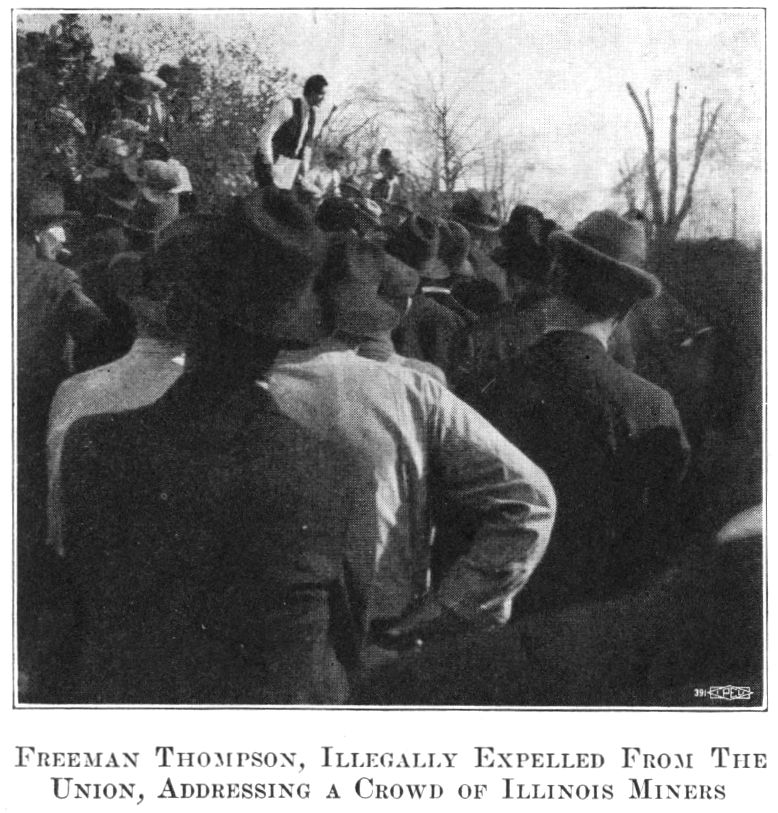
In Illinois, Farrington is carrying on a reign of terror–expulsions and arbitrary removal from office, the outlawing of meetings held to discuss the unemployed situation and to assist the starving miners’ families, mark his course. He has removed from office Freeman Thompson and John Watt, the fighting president and secretary of the Springfield sub-district, expelling Watt from the union as well as removing him from office. Duncan McDonald has been expelled from the union. All of these acts were carried out in violation of the constitution and for the express purpose of crushing the militant miners of Illinois.
The coal operators are attempting to introduce the yellow-dog contract. So far they have failed. Farrington is urging the miners to accept a cut in wages amounting to 12 cents a ton. Several weeks ago the Old Ben Coal Co., the largest coal company in southern Illinois, closed down and refused to open its mines unless the miners would accept a cut in wages and allow them to hire expert shot-firers. This would eventually mean the reducing of the miners to mere coal shovelers, and in time no state examination for miners would be necessary. With the shot-firers as company men, the crushing of any revolt would be that much easier.
Farrington, at a meeting held in Johnston City, Illinois, urged the miners to accept whatever arrangements he could make with the company for operating the Old Ben Coal Company mines. But the miners refused to give Farrington power to make any settlement.
These four districts have incurred the undying enmity of the Lewis-Farrington machine. They cannot be won over to the class collaboration policy, so their destruction is being systematically carried out. Unemployment, and its attendant starvation on the one hand, and sabotage and betrayal of the miners’ interests by their officials on the other is the method being used to accomplish this end.
Will the miners’ union survive this double attack? Through bitter struggle the miners have learned how to fight the coal operators. But they cannot put up a successful battle when their leaders are the tools of the mine owners.
The miners’ union will be saved by a mass revolt of the rank and file against their miserable conditions and against betrayal by their officials. In every mining town the progressives must organize mine committees to carry on the struggle.
They must prepare for the coming convention. Impeachment proceedings should be started against the Lewis-Farrington wrecking machine. The miners must take their union out of the control of the coal operators and place at its head officers who will lead the miners into struggle. With a real fighting leader in place of the present wet-rag, the miners can retrieve their lost position, build up and strengthen their union, and go on to new and greater victories.
The Workers Monthly began publishing in 1924 as a merger of the ‘Liberator’, the Trade Union Educational League magazine ‘Labor Herald’, and Friends of Soviet Russia’s monthly ‘Soviet Russia Pictorial’ as an explicitly Party publication. In 1927 Workers Monthly ceased and the Communist Party began publishing The Communist as its theoretical magazine. Editors included Earl Browder and Max Bedacht as the magazine continued the Liberator’s use of graphics and art.
PDF of full issue: https://www.marxists.org/history/usa/culture/pubs/wm/1925/v4n08-jun-1925.pdf
 Revolution's Newsstand