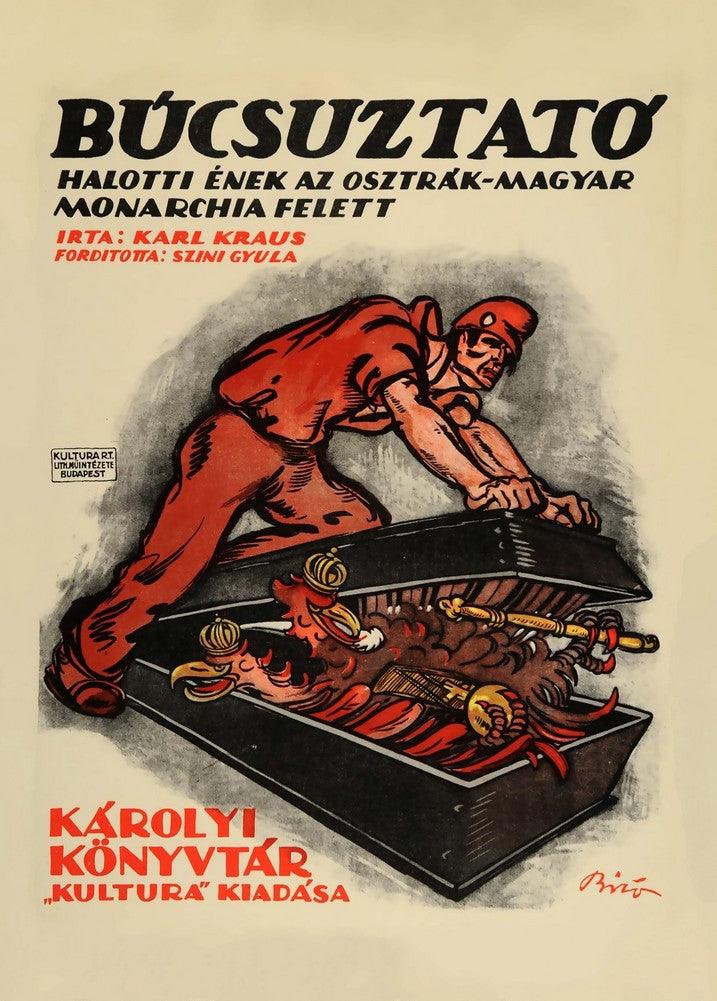
The tremendous ambition of the brief Hungarian Soviet from its then Commissar of Social Production.
‘Economic Revolution in Hungary: From Capitalistic to Socialistic Production’ by Julius Hevesi from Communist International. Vol. 1 No. 3. July, 1919.
The most important problem, the nucleus of dissent between communists and social democrats, is the question, whether conditions are ripe enough for leaving the basis of capitalistic and going over to communistic production. The ways and means of solving this problem is in all Countries of the world the main point at issue between the Marxists, standing on the ground of class war and the Scheidemannists, who have lost themselves in a warren of bourgeois ideology.
In the carrying into effect of the socialization of production in Hungary we see a clear and decisive solution of the question.
Within four weeks all the means of production, that is more than 27,000 factories and works, from the biggest to the smallest, all commercial concerns and shops equally from the biggest to the smallest, were not only in theory but practically withdrawn from under private ownership and turned into the property and possession of the proletariat without such a change causing the slightest interruption in the continuity of production. This furnishes us indisputable proof of the fact that the transition to communistic production is not a mechanical problem at all, but solely a question of politics of might. Political struggle must merely loosen the bands of law that bound the bourgeoisie to the means of production. The further technical and economic round of production may remain absolutely untouched, but all the scientific and technical presuppositions of further communistic change are assured.
The great change, in fact, consists only in the most rational utilisation, as far as that is possible, of various and certain technical and scientific possibilities in the sphere of production. That is why I never thought an intermediary stage, a transition phase in the socialization of production necessary. Thus everywhere, where political resistance is out of the question, socialization can be carried into effect without by gradation, in all spheres of industry at once, from mining works, through works producing semi-manufactured goods down to the factories producing the ready commodity.
In consequence of the united action of the proletariat, the bourgeoisie in Hungary lost all means of economic power, and grew completely impotent to resist politically and to disturb the progress of production. That fact furnishes a clear proof of the correctness of my supposition.
Immediately after putting into effect dictatorship, the places of the capitalist in every work, every mine, even in every building enterprise, was taken by workers’ councils of the work in question and as everybody, who really did work, stayed where he was, production nowhere suffered interruption.
The complete revolution of the economic basis of production thus was effected smoothly. The immediate cause of this smooth revolution lies in the fact, that the ground for such political change was well prepared. Further reasons of the shockless change lie in the attitude of the engineers and employees, who had taken part in the process without resistance or sabotage, and who even had powerfully helped in the work of preparation. The chief reason however, was that the bourgeoisie was completely powerless against the united advance of the proletariat and could offer no resistance to socialization.
The proletariat, united in resolve and action, can speed along the path of socialization without meeting any obstacles of a technical quality. The concrete cases we saw were in Hungary in a very brief period of hardly a few weeks, unconditionally corroborate this assertion.
After taking over the materials and instruments of production, we proceeded at once to the centralized building-up of production. The execution of this task belongs to the People’s Commissariat for Social Production, now carrying out the organization of the Economic Councils as well. Within the People’s Commissariat we have erected special sections for all branches of industry, and the of industry, and the majority of these already embrace the enterprises of their respective branches. Not only a general survey has been realised, but the rational cooperation of the several enterprises of the same branch as well. In this sense centralization has been carried into effect by us in the mill, leather, and timber industries. In the textile branch, concentration of all working stock into the best-equipped and economically best-returning factories has partly been, partly is being, achieved. The same is the case in the chemical industry. In the latter we have practically realized the publication of manufacturing secrets and general mutual exchange of such between the several surprises. Nationalisation of the Iron and metal industries, as well as of the concerns manufacturing agricultural machines is proceeding. We have begun to organize joint offices for machine-building and designing, many small works were liquidated and their working stock turned over to large enterprises.
The entire mining Industry of the country is under central control. The centralization of all Budapest power works is going on and the centre for the production of electric energy is undergoing a change in the sense of unition. We have commenced the preparatory work of electrifying several steam railroads, a measure necessitated by the colossal difficulties of coal import.
Although we originally had no intention of socializing the small industries, this happened, as it were, automatically. The small craftsmen and tradesmen in crowds offer to deliver their instruments and stock of their free will and take work as workmen in the great socialized workshops. They have, it is true, no other choice, as they no longer can get working material. Thus we have constituted parallel to the socialization of living-houses central repairing workshops and offices for houses, which unite the mechanics and craftsmen formerly occupied in house repairs. The management of the special sections is such that the Supreme Council of Public Economy can be constituted immediately out of these sections. Besides politically reliable highly skilled specialists, the special sections contain representatives of the trade unions and of the largest enterprises. By thus putting the management of the special sections into the hands of those immediately concerned in production, we have prevented the formation of a hearsay central bureaucracy. The specialists we employ are not paid any special premiums, they earn no more than the average well-paid skilled labourer, yet they work with great ambition. In the individual enterprises the central organ of production is represented by an Industrial Commissary, appointed by the People’s Commissariat, whose duty it is to carry into effect the decrees of the People’s Commissariat, and in general to safeguard the interests of the proletariat The Industrial Commissary has to send a weekly report to the People’s Commissariat on the conditions of work in his particular factory, on the stock of raw materials, and manufactured produce, and on all experiences that in his opinion may prove useful for other enterprises. In coordination to him is a Workers’ Controlling Council, at present consisting of workers of the same factory. These councils, however, we intend shortly to transform on the Russian model, so that the majority of the members should be delegates of other factories and of the trade unions respectively. The economic management is superintended by Finance Controllers, delegated by the People’s Commissariat for Finance to all socialised factories. Each socialised factory is expected to keep its books like any independent concern. The elaboration of a uniform system of bookkeeping is proceeding.
We began the erection of an organization for taking stock of and distributing materials. The first step in this direction was an inventory of all factories and shops in the country. More than 90% of all concerns sent in their inventories, all of which at the present day are gotten through to the last.
Twenty-seven thousand inventories were sent in by manufacturers; this number, of course, comprises many small concerns as well. Thus we got an idea of the quantity of stock at our disposition, that in its turn enabled us to establish a rational husbandry of materials. A central office for the distribution of materials, constituted in the spirit of the sovsystem, is being erected. The materials needed to keen enterprises up can only ho furnished on application to tots office. The demands for materials is endorsed by the respective special section of the People’s Commissariat, the demand is deemed justified. Similarly orders are rationally divided among the several factories by a central office.
Foreign trade is concentrated in the Central Office for Foreign Trade. The winding-up of all business obligations contracted with foreign firms by private trade has been taken over for settlement by this office. At present only exchange deals can of course be settled on a basis of recompensation.
In the country socialisation, of course, proceeds at a slower pace than in Budapest. The larger enterprises are all included in the sphere of action of our special sections, but the organisation of the smaller ones is yet in the making. We sent District Industrial Commissaries into the larger country towns for the purpose of carrying socialisation into effect. The constitution of industrial councils in the larger communities is proceeding. These latter are subordinate to the District Industrial Councils in Industrial Councils in the larger towns. The industrial, agricultural and general supply Councils together form the so-called communal and economic councils. The congress of the latter as a Supreme Council of Public Economy is to be summoned after the first Soviet Congress.
We are thus on the best way to the realization of the socialistic system of production in the entire territory of production and economic life in general. Our most imminent task, however is the fitting out of our troops now taking the field against the Allied bourgeoisie with the necessary ammunition and other indispensable supplies. We are unfortunately not in the position by far owing to the great shortage of raw materials to supply all the proletarian multitudes who want to go to the front with the greatest enthusiasm and readiness, with the materials of war. We set our hopes on the speedy assistance of our Russian comrades, for if we could obtain immediate connection with Russia, we could easily, by help of imported raw materials, fit out a mighty proletarian army in our factories, at present lying still.
We owe our Russian brothers who have signally lightened and simplified our task with their pioneer work, the greatest homage and gratitude.
Julius Hevesi.
The ECCI published the magazine ‘Communist International’ edited by Zinoviev and Karl Radek from 1919 until 1926 irregularly in German, French, Russian, and English. Restarting in 1927 until 1934. Unlike, Inprecorr, CI contained long-form articles by the leading figures of the International as well as proceedings, statements, and notices of the Comintern. No complete run of Communist International is available in English. Both were largely published outside of Soviet territory, with Communist International printed in London, to facilitate distribution and both were major contributors to the Communist press in the U.S. Communist International and Inprecorr are an invaluable English-language source on the history of the Communist International and its sections.
PDF of full issue: https://www.marxists.org/history/international/comintern/ci/old_series/v01-n02-jun-1919-CI-grn-goog-r2.pdf
 Revolution's Newsstand