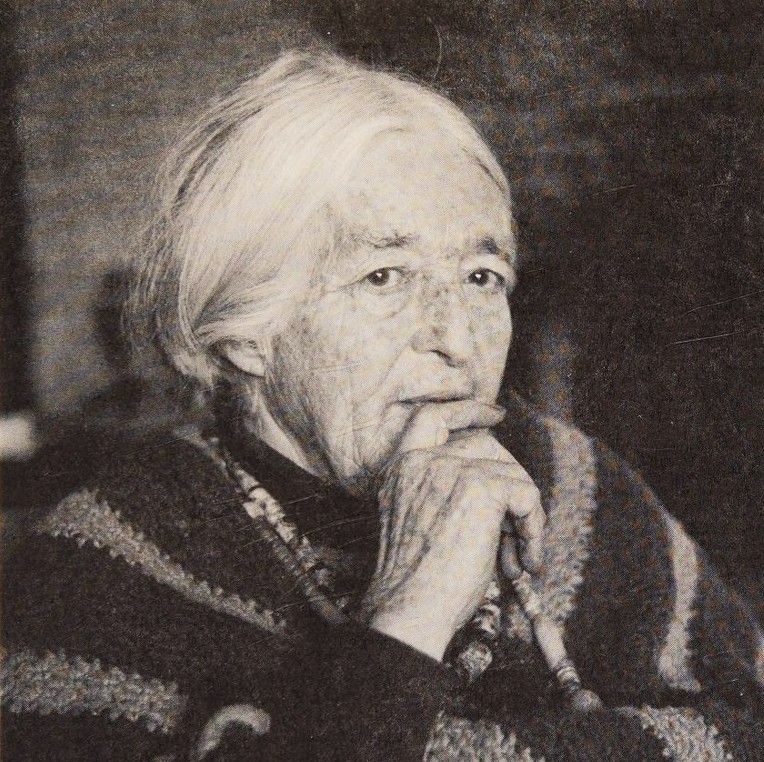
Meridel Le Sueur’s contribution to the A.W.C.’s founding collection was this wonderful essay which, for this Ohio-raised comrade, is the illumination of a recognizable portrait of the place, people, and politics. The Midwest as ‘rust belt’ is, in fact, a process that began generations before today as the boom and bust of capitalist accumulation ravaged many of its original towns as regional lumber mills and family farms, and small towns collapsed in the 1880s-90s. The American Writers Congress was held in 1935, and began as a ‘popular front’ era replacement for the John Reed Clubs as a vehicle for Communist Party arts work.
‘Proletarian Literature in the Middle West’ by Meridel Le Sueur from The American Writers Congress. International Publishers, New York, 1935.
THE PRAIRIE of the Middle West is very large. Nothing has ever been rooted there. Now it is blowing away because nothing has been rooted there to hold the soil into the earth. The rooted things have been torn up by the greed for lumber, coal, iron, railroads, and wheat. Man has not been rooted in it either.
Coming here I came slowly through Pennsylvania and New York, and there is a deep way that the houses are rooted in the soil. In the Middle West I have never seen such houses. Out there you look down the road and you see a house going down the road. Some one has decided to move with their house. It is a common sight. At the present time you can see whole villages of farmers being moved from one part of the country to the other. My family for two generations have moved from place to place, something better farther on, something opening up. All the itching feet, renegades, and banshees from the East came to the Middle West and we have been howling to the moon ever since, wanting something. The hills where the great wheat and railroad kings live have been built with thousands of lives of workers. Nowhere in America are the ravages of laissez faire colonization so apparent as in the Middle West. Banks, watered stock, trick practices, have driven the worker and the petty bourgeoisie over the prairies like sheep going from one town to another, going from industry to the farm, and from the farm to industry, and being milked dry. Whole villages have been incorporated by shysters, immigrants brought from the old country and the village then bankrupted, and the people wandering on to be fleeced in a better climate.
This has been going on not only since the depression, but for seventy-five years. We have always been depressed. My grandfather surveyed half of Illinois and became so ill at the sharp practices of the government in getting worker immigrants for cheap labor and swift fleecing, that he got drunk and sat in a corn field in Iowa for two years without speaking. He was buried with a picture of Ingersoll on his coffin and left a note book which said that Jeffersonian democracy was a failure and it wasn’t going to turn out that every man would have land and the vote.
In the Middle West there are entire villages ravaged since the passing of the lumber industry. There are thousands of families, men who were the fellers, whistle punks, who have been sitting in a waste land since the last of the lumber barons passed, as a most awful testimonial to one of the worst and swiftest exploitations that the world has ever known, when the Middle West, a rich fertile sleeping valley, was, in the space of practically fifty years, laid waste. The wealth that was thus accumulated in so piratical a fashion has not even supported a culture, or maintained for itself an American clown, or painter, writer or poet. Our wealthy houses are full of phoney paintings by Rembrandt, Titian and obscure painters with long Italian names. The furniture is of the court of Louis, and only English novels are bought to this day. This wealthy class of robbers has not even supported the pretense of a native culture.
There is only one class that has begun to produce a mid-Western culture, and that is the growing yeast of the revolutionary working class arising on the Mesaba range, the wheat belt, the coal fields of Illinois, the blown and ravaged land of the Dakotas, the flour mills, the granaries. In these places the first unity of action, and of communal expression, is being made between the farmer and the industrial worker on the militant front of struggle.
It is from the working class that the use and function of native language is slowly being built in such books as those of James Farrell with the composition and the colloquialism of the streets of Chicago; of Jack Conroy with his worker heroes going from the automobile industry in Detroit to the coal fields; of Nelson Algren, and of the worker-writers in the Farmers’ Weekly, in the Western Worker.
This is not something in the Middle West that has suddenly grown up, or that is merely a concomitant of a passing depression. This is something that has been bred in our bones for two generations, that has cut the jawbone a little sharper. This is the slow beginning of a culture, the slow and wonderful accumulation of an experience that has hitherto been unspoken, that has been a gigantic movement of labor, the swingdown of the pick, the ax that has made no sound but now is being heard.
I remember when I was about twelve years old I lived in a scorched town in Kansas and I went to Kansas City to spend the summer. I was reading Hawthorne, Emerson, Poe and they seemed pretty strange and alien to the prairie horizon. But there I saw something that was not so alien. I saw a little handful of men sitting in a room and I had never seen so much smoke and talk and such faces. They had just come in from the wheat fields and they were going to talk and study all winter. They were IWW’s–they were Earl Browder and Bill Browder, a little man with a mustache and a cane whose name was Charles Ashleigh, and Billy Williams and others, many others; they came and they went and they talked. This was a beginning for many of us. This was like a seed that was being planted in the dark in many separate places and now it is here coming into growth.
In the Middle West I think we try not to forget the IWW’s. They spoke an American language, not an English. Many of them were anarchists, many of them were only haters of the machine, but they started something. Like Johnny Appleseed who scattered the seed for countless orchards in the Middle West, the IWW’s brought countless thumbed copies of Marx.
In the Middle West an important nucleus for the worker-writer is grouped around the Anvil. There are other groups. Last winter a hundred and fifty women from factory and farm wrote down their great proletarian experience under slight guidance. This was not only a terrific and gigantic experience of an exploited and dispossessed class, it was also, fragmentary perhaps, literature.
Writing is nearer experience than a trade. This is a new and buried body of experience the skilled writer can help draw up and refresh his own knowing at the same time. The emphasis must not be simply on skill and technique, but on a new experience, a communal relationship and revolutionary ideology.
Criticism is of incalculable value of course, but there are varying pressures of criticisms–a time to hoe, a time to cut down and a time to wait for rain. Critical judgment like everything else in a transitional period must be swift before the happening, and volatile, and at the same time stern. In the present critical temperature it seems to me there is danger of intellectual ossification before there has been a complete full and warm statement of chaos. You have to have a rich and powerful chaos for a strong and fertile order.
At this time a new literature is being formed by a subtle event of birth. We are now in the composition of a new event. At the moment of hatching what is needed is heat. Some enthusiastic critics may have the best intentions, but they are like the elephant who felt tender toward the wren’s egg that had been left in the sun and sat on it. We need besides criticism, also love and enthusiasm, so that our literature will not be a dissected corpse before it is hatched.
We have never, in the Middle West, had ease or an indigenous culture. We have been starved since our birth. The exploiting class has not even made a culture for itself. Revolution can spring up from the windy prairie as naturally as the wheat.
We have never been burdened with the old tradition in literature from the old world. Every writer in the Middle West has had to work alone as far as connection with other writers is concerned, therefore he has been in closer contact with the American experience. An integral part of the Middle Western immediate experience is a quick adjustment, during danger, between the farmer, the industrial worker, the brain worker, the writer, the artist. They are forming a steady and quick phalange on the prairie. Now we know where to put down our roots, that have never been put down, that have been waiting through a bad season.
The idealistic duality of the New England culture never did us much good. The event of the rape of America was not to be so subtly obscured in mid-America. We never took very seriously the function of the bourgeois writer to muffle the percussions of an exploitive and continuously more barbarous capitalism.
We, of the petty bourgeoisie and the working class, have been dissenters, individual madmen, anarchists against the machine; but now the Middle Western mind is finding a place, sensing a new and vigorous interrelation between himself and others, which at last will give him the free association from the factual bourgeois and decaying reality to the true subjective image of the communal artist, which already is real in Russia: not the spurious subjectivity of the bourgeois artist of personal defeat, subterfuge and apology, but the subjectivity of the communal root image of a rising class that has no reason for entrenchment and subterfuge, and links him further and deeper to all.
In the Middle West, the center of the reformist demagogy, it is only this united cultural front that can save us from falling into the last hypocrisy of the ruling classes–fascism.
 Revolution's Newsstand