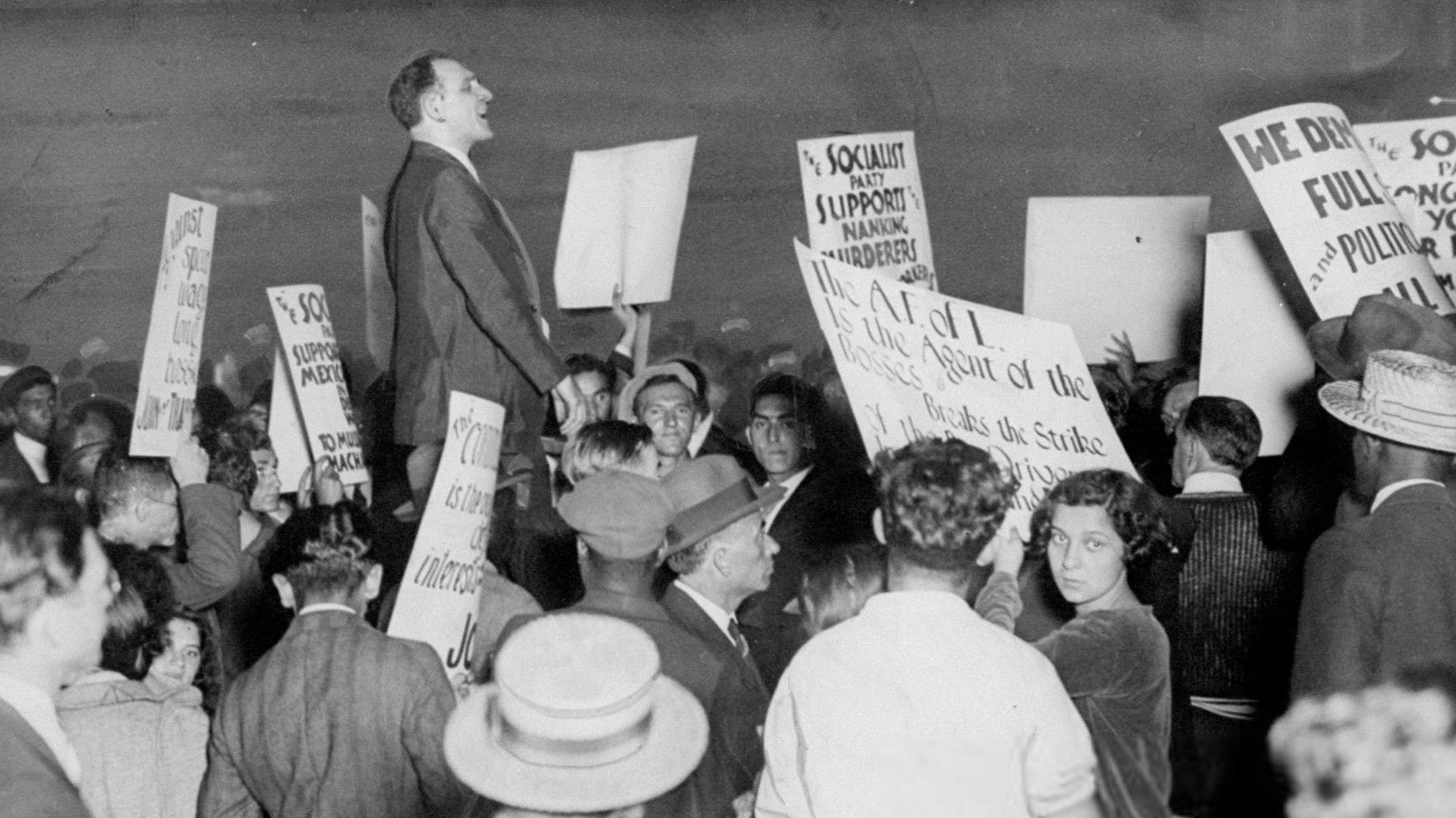
A leading figure of the old C.P.A. on the what the application of the Comintern’s United Front policy might look like in the conditions of the United States.
‘The United Labor Front’ by William W. Weinstone from The Worker. Vol. 5 No. 214. March 18, 1922.
The Communist International was constituted from the “Left Wing” groups of the reformist Socialist Parties of the Second International and developed by splitting these parties.
Communist Parties were formed in the countries of Europe and America and the Labor Movement of the world was divided into Communists and Yellow Socialists.
The Communist International declared merciless war upon the traitors to the working class—the Scheidemanns, Hendersons, Thomases, and Gomperses—the heroes of the rotten Second International. The hostility to these Social Chauvinists and out and out Bourgeois Reformers was unconcealed.
It said emphatically to the working class that as long as they follow these Judases of the Labor Movement, they are doomed to crucifixion by the Capitalist class.
There is but one thing to do with these traitors—to drive them out of the Labor Movement as discredited bourgeois lackeys.
In its first appeal issued in January 1919 to the Communists of the world, the Third International stated that a fight without mercy must be put up against the social traitors and the Centrists must be criticized relentlessly and unmasked as phrase-mongers and lip revolutionists.
The Third International successfully conducted this policy. The sections of the CI exposed the bourgeois ideology of these lieutenants of Capital. They denounced them for their support of the Bourgeois Dictatorship and their unwillingness to fight for the Dictatorship of the Proletariat.
During the first year, the fight against these opportunists was limited, however, to propaganda alone. To defeat the reformists and to expose their true character to the workers, it was decided that propaganda alone was insufficient.
It was necessary to demonstrate to the workers on the basis of their own experiences, in the practical, everyday struggle, that their leaders were unwilling to fight for their interests. The working class of Europe would have to go through the period of disillusionment, similar to that experienced by the Russian workers under Kerensky, before they discovered that the Scheidemanns were serving only the Bourgeoisie.
Participation in Class Struggle.
The Second Congress of the Communist International therefore declared that it was the task of the Communists not simply to agitate for the Dictatorship of the Proletariat on the basis of the theory alone, nor limit their fight against the leaders of the Second International to bitter denunciation.
It was the duty of the Communists to participate in the daily struggles of the workers and by close and constant association with the masses, by fighting side by side with them for their immediate needs, to expose the cowardice, incompetence, and treachery of the Bureaucracy.
For Immediate Needs of Workers.
The Communists alone are willing or able to fight for the immediate interests of the proletariat. The Bureaucrats are unable to do anything but to demoralize the workers and to surrender to the capitalists without a struggle.
This policy of fighting for the immediate interests of the workers appeared to some groups in the International as a concession to opportunism.
The duty of Communists, they proclaimed, was to agitate for the Dictatorship of the Proletariat and not advocate anything less than that.
However, it was evident that not only must the Communists engage in the struggle of the workers but if they are really an advance guard, they must lead the workers in these struggles. In these struggles they could a thousand times more effectively expose the labor charlatans as bourgeois agents masking as leaders than could be done in any number of polemics on Dictatorship versus Democracy.
The policy of conducting the fight on the basis of immediate demands, while pointing out the limitations of these demands, would have the additional value of further disturbing the equilibrium of Capitalist production.
It would hasten the development of the intensive class struggle leading to the final conquest for power; the immediate struggles inevitably growing more general, sharper, and taking in greater numbers.
Strategy to Expose Reformists.
The Second Congress not only laid down the general principle of participation in the daily struggles but also directed the Communist parties to operate in the working class organizations of whatever political color, and advised the British Communist Party to enter the reformist Labour Party in order to better expose the reformists from within.
Lenin went even further in this policy and counseled the British Communists to support Henderson in the coming election so that the workers might see with their own eyes and feel through their own experiences the futility of reforms and reformers to free them from the hell of Capitalism.
Soon after the Congress, the German Communists issued their now famous Open Letter proposing to unite with the Social Democrats and Independents on a program of immediate demands for a common struggle against the Bourgeoisie, while maintaining their independent organizations and full right of criticism.
The Third International itself invited the Yellow Amsterdam International to cooperate for aid to Russia and help to the Spanish workers suffering from the brutal persecutions of the White Terror.
In each of these proposals there was the strategy of unmasking the reformists as false leaders unwilling to fight for the simple, elementary needs of the workers; of being the real split-makers dividing the workers for their bureaucratic interests. And the results show that this strategy was successful.
United Front of Labor.
The Third Congress endorsed the Open Letter policy and invited the Communist parties of the world to follow the example of the German Communists.
It did not, however, as yet throw out the slogan of the United Labor Front.
In his speech of December 4th, Zinoviev, President of the CI, pointed out the necessity of putting forward this slogan for the immediate action of the Communist sections.
No New Departures in Tactics.
The United Labor Front policy is therefore no new departure in the tactics of the CI, though the extreme “Leftists” will join with the Reformists in proclaiming it as such.
It has been developing gradually. Its general and universal application at this moment arises out of the particular conditions existing among the working class of the world.
Everywhere there is evident an undercurrent for unity caused by the ever-increasing oppression of the Capitalists. The Labor Unions are being dealt smashing blows. The workers are in retreat before the united attack of the master class and they are retreating without a fight.
The proletariat under this terrific pressure longs for unity of all workers, for the defense of their wage standard and of their elementary rights and needs. This cry for unity cannot go unanswered.
The Communists must seize the initiative and raise the banner of the United Labor Front. Stepping forward as the defender of the interests of the working class they also appear to the workers as the unifying force in their struggle.
Challenge to the Bureaucracy.
The United Labor Front is not a unity of Communists with the Labor aristocrats on the basis of class conciliation, it is a challenge to the Labor Bureaucrats to conduct a united campaign for the class struggle.
How can the drive of the capitalists to smash the Unions be broken? By a United Labor Front! How can we stop the attack on wages, hours of labor, anti-strike laws? By a United Labor Front.
We Communists demand such United Action upon a program that will unify the workers as well as place them in an advantageous position to further carry on the class struggle. How do you Labor Bureaucrats stand? Are you for Unity of the workers or for Unity with the Capitalists?
Value of the United Front.
What is gained from these tactics? They expose the reformers. The latter charge the Communists with breaking up the Union and dividing the ranks of Labor. They are now dividing the workers and refusing to fight for the “legitimate” demands of the Unions.
Or if they are engaged in a united struggle, they are shown to be deserters as the “Black Friday” of the Triple Alliance demonstrated.
In either case, the Communists become more closely associated with the masses that follow the Yellow leaders, their prestige rises and they prove to these backward workers the need for a new leadership.
United Labor Front in America.
How shall the Workers Party apply this tremendously effective policy to America? This means, what shall our concrete program of United Action consist of?
That there is a need for a United Labor Front among the workers is tragically evident. That there is sentiment for United Action is evidenced by the recent conference called in Chicago by the Railroad Chiefs; by the Unity Pact, feeble and inadequate though it is, of Railroaders and Miners.
The rank and file at the Convention of Miners demonstrated their desire for unity when they backed Howat against Lewis.
At this moment the Communists have the task of creating united action and the proposal for the calling of a Labor Congress made in the Open Letter of the Workers Party was the first step.
Yet this does not exhaust the possibilities of a United Labor Front policy. The American workers are the most backward politically. They still follow the policy long discarded by European Labor of “punishing the enemies and rewarding the friends,” which in practice means punishing the workers and selling out to the Capitalists.
It is about time that the American workers took a step forward and it is for the Communists to show the way and propose the formation of a United Political Front of Labor on somewhat the model of the British Labour Party—the identity of the uniting bodies to be unaffected; their autonomy of organization and full freedom of criticism retained.
In such an organization composing the great masses of Organized Labor, the Workers Party would find a fertile field for winning the workers to their program.
It need not be pointed out that such a party would be no substitute for the Workers Party.
As against the Revolutionary Workers Party it would be indeed a step backward, but as against the present non-political policy it would be an important step forward.
Under this form of organization, contact of the advance guard with the rear guard would be accomplished—the one thing the American Revolutionary movement has been so sadly lacking.
The United Labor Front policy has many other tactical advantages to offer. A critical and careful application of this policy will constitute the greatest step forward in the liberation of the American Revolutionary Movement from its isolation today and will be the most effective blow aimed at the Bourgeoisie and their lieutenants, the Gomperses, Johnstons, and Lewises.
The Daily Worker began in 1924 and was published in New York City by the Communist Party US and its predecessor organizations. Among the most long-lasting and important left publications in US history, it had a circulation of 35,000 at its peak. The Daily Worker came from The Ohio Socialist, published by the Left Wing-dominated Socialist Party of Ohio in Cleveland from 1917 to November 1919, when it became became The Toiler, paper of the Communist Labor Party. In December 1921 the above-ground Workers Party of America merged the Toiler with the paper Workers Council to found The Worker, which became The Daily Worker beginning January 13, 1924.
 Revolution's Newsstand