Inspired by the popular street car strike, Cincinnati’s working women walk out from laundries and tailor shops for a union in the summer of 1913.
‘A Summer of Strikes in Cincinnati’ by Emma Steghagen from Life and Labor (W.T.U.L.). Vol. 3 No. 2. November, 1913.
Special Organizer, National Women’s Trade Union League of America
The summer series of strikes in Cincinnati began with the street car men and ended with the laundry workers.
In almost every case the fight of the employer was against organization of the workers at least this was true of all those with no organization, or with only a small percentage organized.
The outcome of all the strikes has been a better degree of organization in Cincinnati than that city has ever had.
The street car strike was bitterly fought by the company, but public sympathy was with the strikers almost entirely and it was practically won at the start.
The Icemen came next and their controversy was decided when the city seized the ice-plants and distributed the ice to the people from the City Fire Department stations. At the end of a siege of two weeks in the very hottest weather, which through lack of ice to keep milk sweet, took its toll of babies’ lives, the employers saw fit to treat with their men. They probably feared that if the city could run the ice plants a week it might possibly continue and result in the elimination of the manufacturers’ ice business.
The great strikes of the teamsters followed, and what in the beginning seemed to be a hopeless thing eventually turned out victorious owing to the splendid calibre of the men, who though receiving the merest trifle as strike benefits held out with wonderful tenacity.
The cigar makers being organized, were only a few days out. The Stationary Engineers also returned to work in a short time.
The Tailors
The United Garment Workers who went out for a 48 hour week compromised after two weeks on 50 hours and returned to work. With them had struck about 500 custom tailors, unorganized and with about 100 girls in their ranks. When the United Garment Workers returned to work these custom tailors were not included in the settlement, and although unorganized determined to continue the fight for at least the 50 hour week which the others had gained.
The Journeymen Tailors’ Union hearing of their plight came to the rescue and assisted them to organize, and at their Convention in August voted strike benefits. Mr. Arthur Caroti, who was at one time with the Women’s Trade Union League of New York as organizer, took charge of the Italian men. Mr. William Weigardt, who did such fine work in the Boston Strike of the Custom Tailors last spring was also put on by the Journeymen Tailors’ Union, and in addition they asked the National Women’s Trade Union League for a woman organizer to handle the girls. I was delegated to this work, and under engagement by the Journeymen Tailors went to Cincinnati on August 7 and remained six weeks. The men were Italian with a few Jewish and German. The girls were American and some Italian. After thirteen weeks of struggle they gave up the fight in the hope of renewing it with an organized force when opportunity comes.
Everything known in the way of breaking strikes was used by the employers in this trade; bringing strike-breakers from other cities, notably from Chicago, intimidating and arresting pickets, threatening with loss of position, all of which seemed very dreadful to the unorganized. At first the girls were loath to join the union. They had come out to help the men. They refused to work with scabs. But join the union! No, that was not their intention. But when the fight grew hotter, the tactics of the employers more cruel, and when they learned that the firms had all organized to defeat them, they saw the light, and some of them began to think, reasoning that if organization is good for the employer it must also be good for the employed. Then one after another came and signed up to join the union.
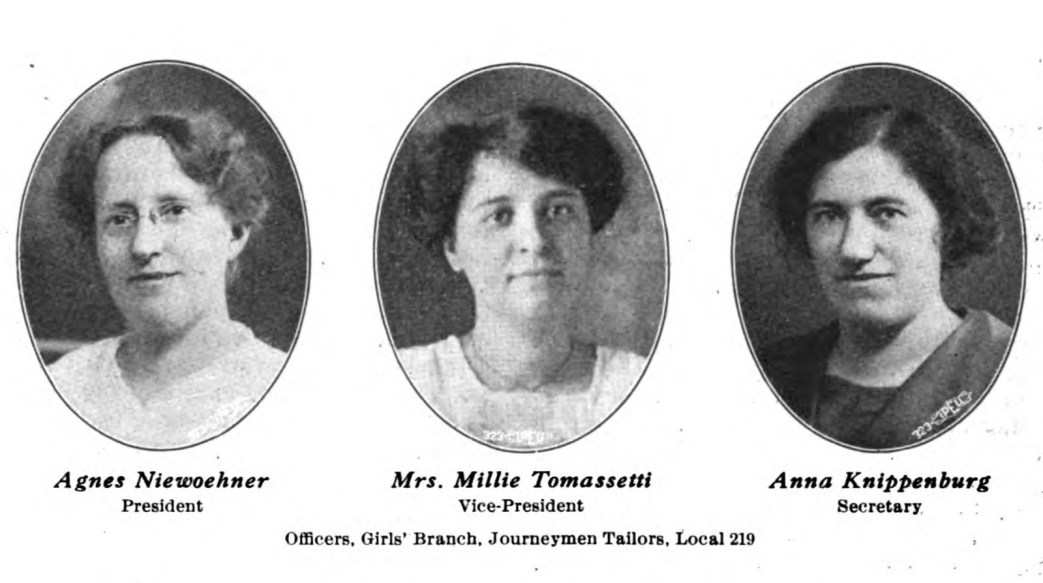
The girls are intelligent and of splendid character. They now have a flourishing branch of Local 219 of the Journeymen Tailors’ Union, officered by themselves and meeting regularly. They are pledged to work and agitate among the unorganized girls of the trade so that they too will learn the lesson of co-operation and join in the effort for more pay and better conditions. Miss Agnes Niewoehner is president, Mrs. Millie Tomassetti vice-president and Miss Anna Knippenberg the secretary. Under their leadership and with the help of other enthusiastic and willing members this girls’ branch of the Journeymen Tailors’ Union is bound to be a success. November, 1913.
Credit must be given to the women who took great interest in and assisted the girls in this strike, to Miss Edith Campbell in charge of the Schmidtlapp Fund for girls, and member of the school board; to Miss Anne Tracy in charge of Central Suffrage Headquarters, and Mrs. Edna Ohnstein, Chairman of the Central Suffrage Committee and member of the Women’s Union Label League. Several times a luncheon was given for the girls at suffrage headquarters and through other friends they were furnished with sandwiches. All this added immensely to the girls’ courage and was greatly appreciated by them. Their strike though relinquished, was not lost. They have gained organization and that in itself is assurance of better wages and conditions in the future.
The Laundry Workers
The last of the strikes, the Laundry Workers’, came about through the efforts of the girls to organize. As soon as the employers heard that a girl had joined the union she was discharged. This had the effect of bringing about the strike. The laundry worker is about the lowest paid for the hardest work of any trade. It was no wonder then that the response was good and some of the largest laundries were crippled in their work.
One laundry sent out circulars to its customers stating that they were already paying more wages than their business should pay and that outside agitators were responsible for the strike, etc.
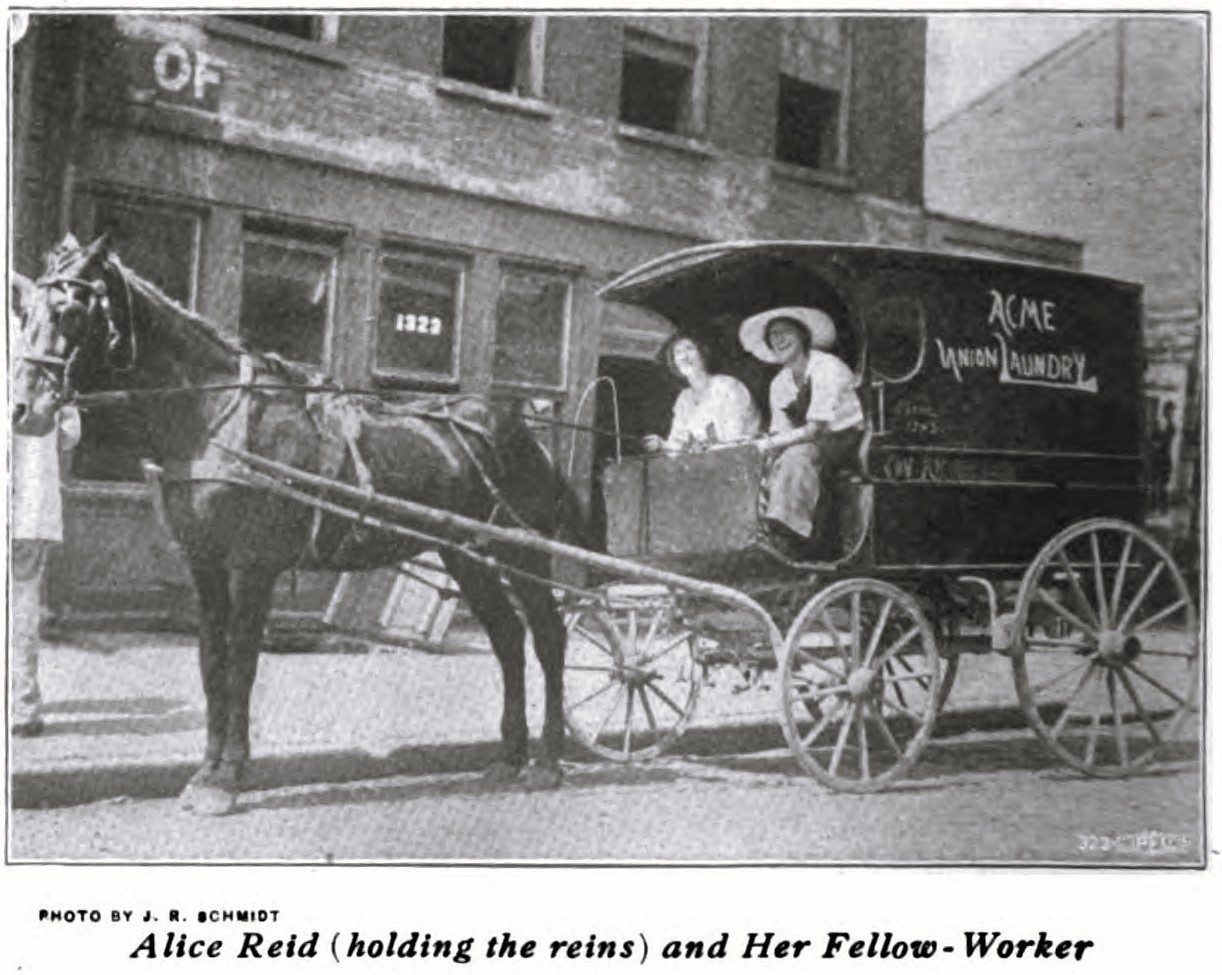
When the general strike was called two young women, Alice Reid and her friend, were forced out of their positions. They immediately applied for work in a laundry in Covington, Ky., just across the river. There was no opening in their special line but learning that the place was in need of a driver or two, they applied and were accepted, and created no little excitement on the streets by collecting and delivering laundry on a regular route.
“We realized that we had to do something to secure an income,” they said. “The union is not paying strike benefits yet and with the price of a meal ticket staring one in the face quick action is necessary for the average girl out in the world earning her own living.” They were reared among horses and consequently knew how to handle them. They also stated that the position paid from $10 to $20 a week and was better than working in a laundry at $6 and $8.
The strike is still in progress but a union laundry has been established in the city which works in two shifts of eight hours, pays the scale and has engaged quite a number of the strikers.
An Amusing Incident
An amusing incident, at least to some of us, happened at one of the Fresh Air Societies. The director of this special charity decided that strikers’ children should not be accommodated and put up a sign to that effect. Protests came from social workers and others and eventually the sign was taken down; but the director still insisted that strikers were not worthy people and therefore their children should not enjoy the privilege of the fresh air that the society furnished.
Life and Labor was the monthly journal of the Women’s Trade Union League (WTUL). The WTUL was founded by the American Federation of Labor, which it had a contentious relationship with, in 1903. Founded to encourage women to join the A.F. of L. and for the A.F. of L. to take organizing women seriously, along with labor and workplace issues, the WTUL was also instrumental in creating whatever alliance existed between the labor and suffrage movements. Begun near the peak of the WTUL’s influence in 1911, Life and Labor’s first editor was Alice Henry (1857-1943), an Australian-born feminist, journalist, and labor activists who emigrated to the United States in 1906 and became office secretary of the Women’s Trade Union League in Chicago. She later served as the WTUL’s field organizer and director of the education. Henry’s editorship was followed by Stella M. Franklin in 1915, Amy W. Fields in in 1916, and Margaret D. Robins until the closing of the journal in 1921. While never abandoning its early strike support and union organizing, the WTUL increasingly focused on regulation of workplaces and reform of labor law. The League’s close relationship with the Amalgamated Clothing Workers of America makes ‘Life and Labor’ the essential publication for students of that union, as well as for those interest in labor legislation, garment workers, suffrage, early 20th century immigrant workers, women workers, and many more topics covered and advocated by ‘Life and Labor.’
PDF of issue: https://hdl.handle.net/2027/uc1.b3859466
 Revolution's Newsstand