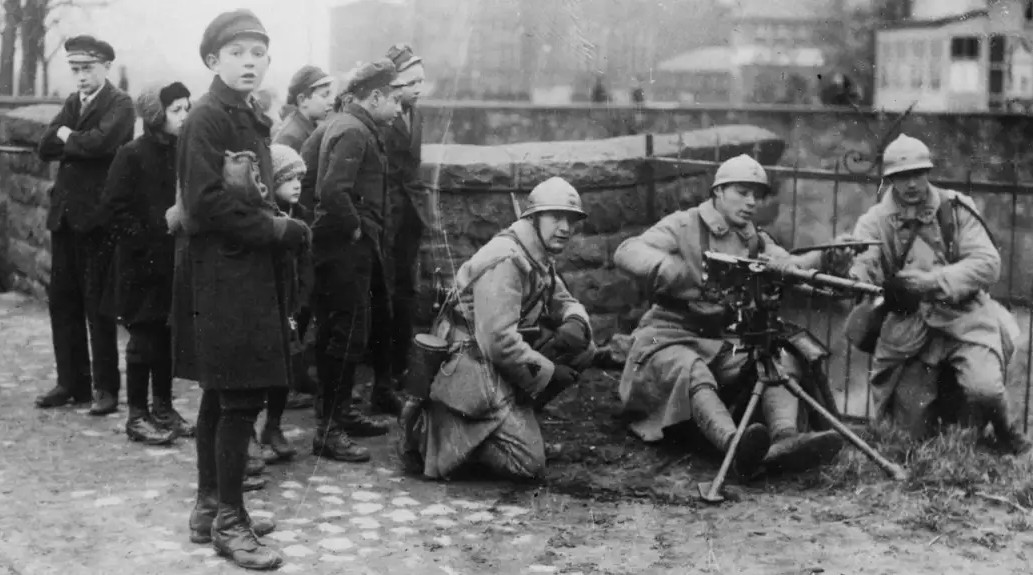
One the organizers of the Communist resistance to French imperialism’s occupation of the Ruhr speaks to its reasons and aims.
‘The “Communist Putsch” in the Ruhr’ by Franz Dahlem from International Press Correspondence. Vol. 3 No. 41. June 7, 1923.
The Ruhr area is ablaze. Starvation has driven the workers out of the workshops and factories. The wage strike spreads from town to town. Gelsenkirchen, Dortmund, Bochum, Hamborn, all are in the midst of a general strike. In Duisburg,
Düsseldorf, Hörde, Bottrop, and even in the unoccupied Hammer district, the workers have downed tools. And the struggle continues to spread.
Hunger is driving the masses to fight for their daily bread. The fall of the mark has, during the last few weeks, driven food prices up by leaps and bounds. “But the employers refuse to take this circumstance into account and grant higher wages. Wage negotiations are deliberately postponed. Deliberately, for the industrial capitalists of Rhenish-Westphalia have been anxious for a wage conflict with the Ruhr proletariat. The present situation appears to be favorable for provoking this war.
The business manager of German capital, the Cuno government, is aiming at capitulation. This means that it must break the self-defensive front on the Ruhr. But it is the proletarians who maintain the self-defensive front against Poincare in the Ruhr. The first premise for the destruction of the Ruhr front is the subjugation of the Ruhr proletariat. And this is the whole import of the great campaign of lying and slander now being carried on against the workers of Rhenish-Westphalia by German capital, its governmental organs, its newspaper hacks, and its social democratic eunuchs.
The wages strike of the Ruhr workers is declared to be a “wild strike”. The reformist trade union leaders do not countenance it, on the contrary, these servile flunkeys of the German bourgeoisie are doing their utmost to render the strike abortive. But the workers of all parties have been driven by starvation and want into this united fighting front. They have formed their strike committees in their shop steward councils.
The industrial magnates and the government believed that they could easily drown the strike movement in blood. Over the body of the fallen Ruhr proletariat they then intended to conclude the compact of capitulation with Poincaré. But the force of the mass movement has been too deep-rooted and too strong for this. The workers in Gelsenkirchen, in Bochum, and Dortmund, were not inclined to simply let themselves be shot down. They deprived the bourgeois self-defence organizations of their weapons, and forced them to take to their heels. But they did not do this until dozens of striking workers lay dead or wounded in the streets. The work of self-defence against the rabble of provocateurs sent by the capitalists was everywhere taken up by the proletarian hundredshafts (defence units), and in some towns the protection of the inhabitants has been undertaken by security guards consisting of trade union organized workers.
The German bourgeoisie foams with rage now that the Ruhr proletariat upsets its plans of treachery against the people. Its whole press, from the German Nationals to the corrupted coolies of the German Socialist Party, has been let loose. “Communist putsch” is the universal watchword. “Strike down the communists” is the meaning of the slogan. At the press conference of the German government the government councillor Salla gave the cue of “especially emphasizing the communist crimes in the events in the Ruhr”. It is only a deviation from the general line taken when the representative of the Prussian government at a later press session declared that “truth compels us to say that the communists have not participated in the events in the Ruhr. The strike movement is born of want of food and low wages. The press should endeavor to induce the employers to grant higher wages at the negotiations on Tuesday”.
But the bourgeoisie is thirsting for blood. It wants to silence the starving population in the Ruhr area by force. Instead of bread–bullets.
The German bourgeoisie declares, with brutal candour, through its organs, what it wants in the Ruhr area. The Police President of Dusseldorf this German patriot, comes whining to General Degoutte: “Give me permission to strike down the workers”. He reminds the general of the shameful assistance given by Bismarck in defeating the Paris commune.
“This occasion induces me to recall the circumstance that, at the time of the Commune rebellion, the German Commander in Chief afforded the French authorities every aid towards crushing the rising, in the most judicious manner. I am obliged to request the same in this case, if dangerous occurrences are to be avoided in the future.”
And he requests permission to employ security police against the workers.
“It is my firm conviction that, if the situation be clearly recognized, the occupying powers will derive equal advantage as the German authorities from our successful efforts, and that it is solely Bolshevism and its supporters who have interests to the contrary.”
The French generals have not turned a deaf ear to this appeal to the solidarity of the capitalist class. General Devignes has allowed the police troops to be reinforced, German fire brigades and security police have been provided with weapons by the French, in Wanne and Dortmund French occupation forces have even taken steps against the strikers. The massacre of the German proletariat can begin.
At the time of the Paris Commune, over 30,000 imprisoned proletarians were shot by the Versailles authorities. Tens of thousands perished in the gaols or in penal servitude. The German monster of law and order demands that it be aided in carrying out a similar bloody massacre among its own people. On Sunday, May 27, 1871, tens of thousands of Parisian proletarians were placed before the wall of the Federals, where the bloodhounds of the French bourgeois republic shot down the men, women, and children of the defeated Commune, while the German besieging army looked on with benevolent tolerance. At that time, on the Sunday following whitsuntide in 1871, the French bourgeoisie acted against their own countrymen just as the organs of the German government now want to act against the Ruhr workers. The motives of the French bourgeoisie at that time were the same as those of the German bourgeoisie today.
“To complete the ruin, the Prussian Shylock was there with his bond for the keep of half a million of his soldiers on French soil, his indemnity of five milliards and interest at 5 per cent. on the unpaid installments thereof. Who was to pay the bill? It was only by the violent overthrow of the Republic that the appropriators of wealth could hope to shift on to the shoulders of its producers the cost of a war which they, the appropriators, had themselves originated. Thus, the immense ruin of France spurred on these patriotic representatives of land and capital, under the very eyes and patronage of the invader, to graft upon the foreign war a civil war–a slaveholders’ rebellion.
“There stood in the way of this conspiracy one great obstacle Paris.” Marx” The Civil War in France.”
The prediction of the communists, that the capitalists of Germany and France would unite at the expense of the proletariat alter crushing it, is proving correct. All the organs of bourgeois society are now taking up the attack against the working class. The capitulation of the German government is going ahead at full speed. The Cuno government is tottering, heavy capital demands a government willing to capitulate. Heavy capital is laying down its terms. These have been formulated in a communication recently addressed by the “National Union of Industry” (“Reichsverband der Industrie”) to the German lord chancellor, as follows. Organization of state undertakings on principles of private enterprise, decontrol of home economics and foreign trade, full liberty for tariff agreements, release of industry from unproductive wage burdens, etc. Translated into proletarian language, this means: Delivery of the railways and other nationalized and state undertakings into the hands of private capital, unlimited liberty for profiteering, abolition of the eight hour day, pledging of taxes, dismissal of war-disabled, etc.
This is the situation. These are the aims for which the struggle in the Ruhr is being carried on.
The Central of the German Communist Party has issued an appeal to the German working class, drawing its attention to the dangers now brewing in the Ruhr valley, and calling upon it to arouse and take up self defence. After pointing out the bankruptcy of the impotent sabotage policy pursued by the Cuno government against the invasion of French imperialism, the appeal further draws attention to the organized provocations, which have no other object than the thrusting of the costs of the capitulation onto the working class which is now being suppressed by deeds of violence. The Central opposes its action to that of the treachery of the social democratic trade unions, and summons the working masses of Germany to take up the fight all over the country for the following slogans:
“For a labor government, which will gather together the masses for the disarmament of the Fascisti, and for the formation of armed self-defence organizations of the German working class; which will carry on the struggle for the seizure of real values and of the milliards of profits gained by the exploiters; which will unite with Soviet Russia in an offensive and defensive alliance, for the joint development of socialist economics, and for an earnest struggle against the French invasion and against subjugation by international capitalism and imperialism.”
The workers of the Ruhr area are called upon to recognize and frustrate the manoeuvres of those heavy industrial capitalists who are contemplating high treason; not to let themselves be provoked into partial struggles for the conquest of political power, but to carry on the wages fight to a victorious end, aided by a united front holding determinedly and firmly together despite the treachery of the United Social Democratic party and the bureaucracy of trade unionism.
The whole German working class must be on the alert. The cause of the whole class is at stake today in the Ruhr valley.
International Press Correspondence, widely known as”Inprecorr” was published by the Executive Committee of the Communist International (ECCI) regularly in German and English, occasionally in many other languages, beginning in 1921 and lasting in English until 1938. Inprecorr’s role was to supply translated articles to the English-speaking press of the International from the Comintern’s different sections, as well as news and statements from the ECCI. Many ‘Daily Worker’ and ‘Communist’ articles originated in Inprecorr, and it also published articles by American comrades for use in other countries. It was published at least weekly, and often thrice weekly. Inprecorr is an invaluable English-language source on the history of the Communist International and its sections.
PDF of full issue: https://www.marxists.org/history/international/comintern/inprecor/1923/v03n41[23]-jun-07-Inprecor-loc.pdf
 Revolution's Newsstand