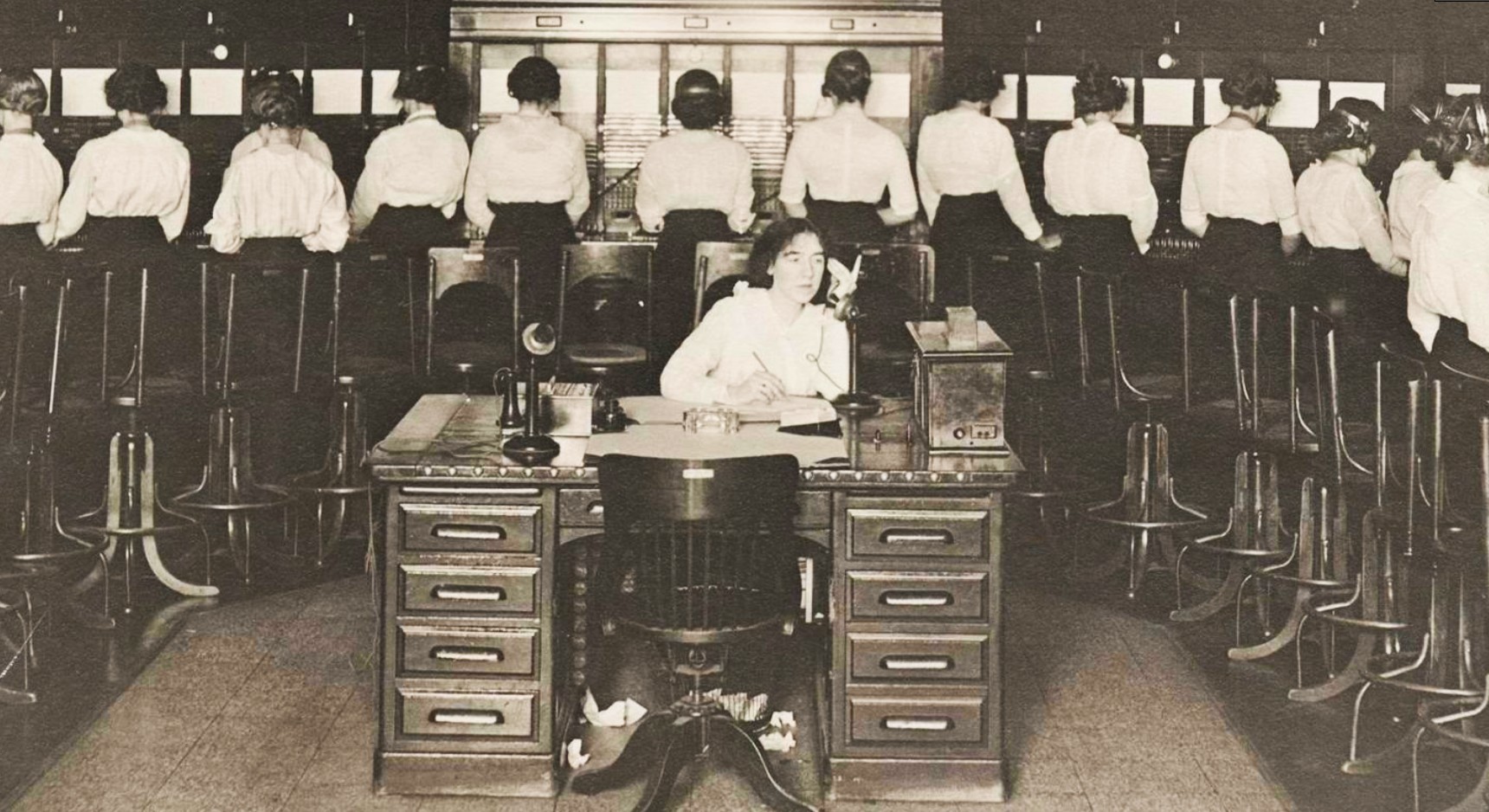
Operators for the Chicago Telephone Co. with conditions almost exactly like those of today’s call centers.
‘Hello Girls of Chicago’ by Central from Solidarity. Vol. 4 No. 5. January 25, 1913.
How the Chicago Telephone Company Sweats the Last Penny of Profit From its Slaves at the Exchange.
We have heard all sides of the telephone question from the capitalist newspapers but the workers’ side.
On applying for the job as operator a large yellow card is handed the unfortunate with the following questions:
Name.
Address.
Parents name and address.
What is business of parent or guardian?
Where worked previously?
How much of an education?
Why did you quit last job?
Are you married?
If so, how long?
Have you any children?
Are you divorced, or a widow?
When was the last time you had a physician?
For what ailment?
When were you last vaccinated?
By whom?
Will you agree to give ten days’ notice on leaving?
Has any of your family ever had paralysis, insanity or drunkenness?
Afflicted with any nervous trouble?
What diseases have you had?
The operator then attends the telephone school for three or four weeks, after which she is sent to an exchange.
From the time she enters the school up to the time she quits the only words she hears are: “You must do so and so, and burry up!” Here are a few of the musts;
Must not visit with other operators.
Must sit properly at board.
Must answer calls within eight seconds.
Must collect or return nickel within 30 seconds.
Must take down disconnects promptly.
Must use set rule of phrases.
Must obey the supervisors and chief operators.
For all this, the compensation is very poor; hardly enough to keep one out of the bread line. While at the telephone school, operators receive $5 weekly, and when sent to an exchange one begins with 11c an hour. These wages are as follows:
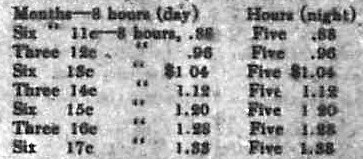
Girls working on evenings, 5 to 10, 6 to 11, or 4 to 9, never receive more than 17c an hour, but girls working eight hours in the day have a chance to get a raise of about a penny a year.
Girls working all night receive 10 1-2 hours pay at this rate, but the work is so killing that a few months of this in sufficient.
While speaking for the Chicago Telephone Co. to outsiders they write long orations about the healthy and wholesome food handed out by them to the operators. This food in reality is far from what it is represented. Only the girls who have to eat it, do so. The majority never touch it. The menu us as follows:
Monday, preserved salt beef; Tuesday, beans; Wednesday, bologna sausage; Thursday, boiled ham; Friday, spaghetti; Saturday, Campbell’s canned soup; Sunday, ham and bologna.
For dessert, an apple, cup of coffee or tea. But the coffee and tea is so cheap and badly prepared that it is enough to give an operator a nervous malady. The food is poorly cooked and disgusting to the palate.
In some part of every exchange a room, done in soft harmonious tones of brown, with velvet rugs and large book cases and shaded electric lamps is situated. While working evenings, an operator has 15 minutes relief, in which time she has to eat her lunch and visit the restroom. Working days, the operator has 15 minutes in the morning and afternoon to visit the restroom.
After resuming a board, it can not be left for any reason whatever.
One instance of this is, a girl became ill while at her board and asked to go home, but was refused. She became seriously ill while on her relief and lay down for that period. She found to her surprise that she was unable to arise and was left alone in the restroom for about one-half hour, after which they discovered her absence and telephoned downstairs to investigate the matter. After asking her if she could not resume a board, at which she refused, she was finally allowed to go home. If this had occurred after her relief she would not have been allowed to go home so easily.
Another girl in the same exchange fainted at her board from over work, and she was so violently ill that she had to be taken home in a carriage. These girls did not sit and suffer silently; they asked to go home repeatedly and were, of course, refused.
A straw boss is placed over every three or four girls, called a supervisor.
It is the duty of these supervisors to take complaints from subscribers and to watch the girls in every instance. The only words one ever hears from these supervisors are: “Hurry up! Hurry up! Slow answering there! Hurry up!”
The supervisor makes a report of every complaint received thus keeping tab on every operator’s proficiency.
Also there is what is known as the error system. A listener situated in the middle of the room, by a small electrical device, can plug in on any operator’s board and keep a record of her calls, time taken for each connection and errors made by that operator. This is called “listening.” This record is written down on paper and kept on record, as so many errors keeps the raise in wages back, and so many errors makes the operator liable to suspension. “So many errors” is the only term used. The Chicago Telephone Co. never tells how many errors, that impels this loss.
Eight seconds is the time limit for answering calls; and no matter how many she may have, if all calls are not answered in this time it is an error.
Failure to understand a subscriber’s order is an error.
Failure to collect nickel in 30 seconds is an error.
Failure to use set phrase is an error.
Failure to talk sweetly to subscribers is 25 errors.
Also there is a Chicago Telephone Benefit Association, paid for by the telephone employees, but owned by the Telephone Company. The operators, when making eleven cents an hour are charged thirty cents a week dues and these increase as wages increase.
If an operator becomes ill, she must after three days send in report of her illness doctors certificate to verify her illness to this benefit. A doctor then calls at the girl’s home to see if she is telling the truth; if so, he tells her she must have medical care, and tells her to go to a doctor. The Benefit Association doctors do not treat patients unless they are paid by the sick person, besides receiving so much a year from the Benefit Association.
Girls making 11c per hour receive 50c a day for the period of illness, and this amount is impressed in proportion to wages received. This amount does not cover doctor’s fees, to say nothing of the incidentals attendant upon a sick person.
The Chicago Telephone Co. never gives an accounting of expenses or liabilities. The money is, it is thought, deposited in the Northern Trust and Title Co. at interest, but this has never been verified by the company, and is probably used by the company. When it comes to paying sick benefits, the money is not sent so quickly, as when it comes to paying nurses to spy on the girls to see if they are collecting some small part of what they had deposited in this Association.
A new rule has been formulated, which forces a girl, on penalty of her job, to strip to the waist and submit to a physical examination by a man doctor. This rule not only applies to sick operators, but to every girl on the job.
No organization exists among the girls, and none is allowed. As soon as a girl is found talking organization she is fired.
During the recent agitation about lowering rates of telephone subscribers, the girls were assembled and told to try to influence the voters in the families to vote against this new proposition, for, as it was stated, it would take $7,000,000 annually out of the treasury of the Chicago Telephone Co.
The manager said that it would have no effect on the “salary” of the operators, except that the telephone company had been contemplating a raise in salary for their employes, but if this bill went through a raise would be out of the question.
He also stated that the telephone company was paying 8 per cent on common stock, and if this $7,000,000 was taken from the treasury a raise would be impossible.
Here is the story of the girls who do not live at home. This is the common rule among the rule:
This girl received $5 a week, out of which she paid $2.50, for her room. On account of the distance of the exchange she had to ride both ways, which amounted to 60c weekly. She did her own cooking and dressmaking, and it was heard said that the girl had not had a square meal since she worked for the Chicago Telephone Co.
“CENTRAL.”
The most widely read of I.W.W. newspapers, Solidarity was published by the Industrial Workers of the World from 1909 until 1917. First produced in New Castle, Pennsylvania, and born during the McKees Rocks strike, Solidarity later moved to Cleveland, Ohio until 1917 then spent its last months in Chicago. With a circulation of around 12,000 and a readership many times that, Solidarity was instrumental in defining the Wobbly world-view at the height of their influence in the working class. It was edited over its life by A.M. Stirton, H.A. Goff, Ben H. Williams, Ralph Chaplin who also provided much of the paper’s color, and others. Like nearly all the left press it fell victim to federal repression in 1917.
PDF of full issue: https://www.marxists.org/history/usa/pubs/solidarity-iww/1913/v04n05-w161-jan-25-1913-solidarity.pdf
 Revolution's Newsstand