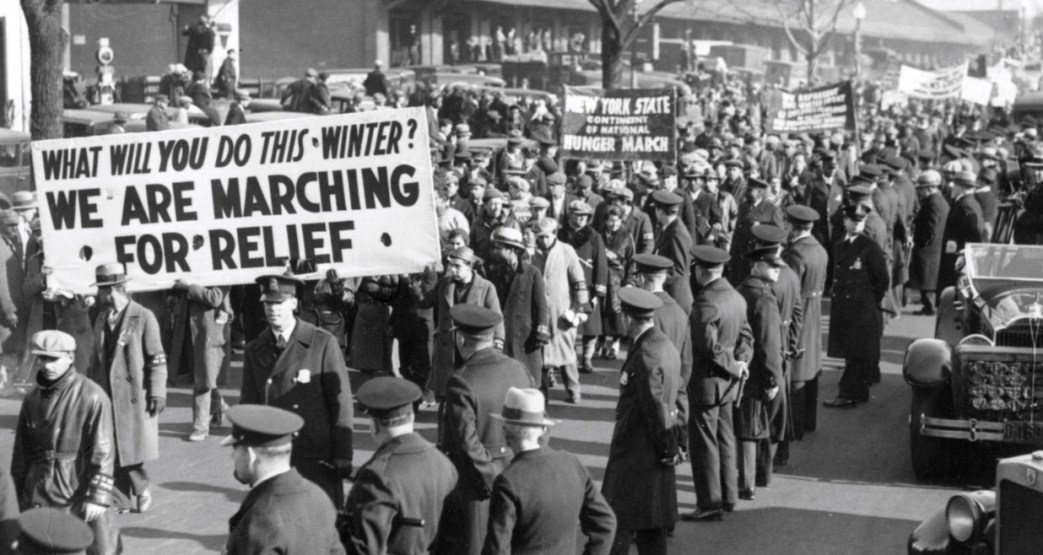
What were certainly transforming experiences for many of those involved, Amter reviews the activity and lessons of 1931’s wintertime Hunger Marches on the state capitols of New York and New Jersey to present demands for relief during the Great Depression.
‘Hunger Marches’ by Israel Amter from The Daily Worker. Vol. 8 Nos. 92 & 96. April 16 & 21, 1931.
THE hunger marches to the state capitols represent a higher stage in the development of the struggle for unemployment insurance, and therefore their results, politically and organizationally, must be closely studied.
The marches to Trenton and Albany, starting on February 28 and 25 respectively, and among the first that were organized in this country, show that the unemployed workers are ready not only to demonstrate in the cities, but to undergo hardships in the fight for unemployment insurance. They show that the unemployed workers and the employed workers too, are filled with a sense of discipline that is extraordinary. The workers on these two marches understood the political aspects of the march and the rebuff in Trenton and Albany did not surprise them.
In organizing the marches, it was clear that considerable organizational work had to be done prior to the march. The plan of march had to be carefully worked out; the route had to be selected, the stops and lay-overs be measured and fixed, and provision had to be made for food and shelter. This was done by two comrades–one for the Workers International Relief, and the other for the Trade Union Unity League. The former went along the route mapping out and making arrangements for lodging and food, while the other organized unemployed councils along the route.
The response for food and lodging for the marches both on the way to Trenton and Albany, was remarkable. In some places Workers International Relief groups were set up. In others, where there were no contacts previous to the march, and where the workers were intimidated, provision was made secretly for food at a restaurant, the workers helping to supply the money; in others, for the marchers to put up in the homes of the workers. On both marches, good unemployed councils were formed, the workers not only demonstrating in their respective cities and towns for unemployment relief, but also preparing the workers of the city for the reception of the marchers as they passed through.
The march was one succession of enthusiasm. The Albany march starting from New York City, departed from Union Square, marching up Broadway to 42nd Street, through the heart of the city. There the men boarded trucks, which were provided for the long country stretches, and then proceeded on the way to Albany. Everywhere, beginning with New York, the marchers were the recipients of cheers and ovations. Further along the road–Yonkers–where the state cossacks began to interfere, the workers of the towns were intimidated. The marchers were not allowed to get out of the trucks, once they participated in the mass meeting arranged by the Workers Ex-Servicemen’s League in Yonkers. The state troopers forced them to keep going along the road, despite the fact that they had a permit to hold meetings in several places. But what does a state trooper care about a permit? What does he care about the fact that he has no authority in a city or town, but only along the highway? He has a gun in his pocket, a long, baton in his hand, and that is the LAW!
Nevertheless, along the route, meetings were held in the cities, before factories, in the squares. Everywhere the workers greeted the marchers on their entrance to the city, accompanied them through the city, to the meeting place. Everywhere, they gathered round the marchers, asking questions, telling them about conditions in the factories of their towns, the unemployment situation, etc. At night, it was difficult to send them away, they continued to speak and ask questions.
When the marchers arrived in Albany, meeting the detachment that came from the west from Buffalo and other cities, the reception by the Albany workers was inspiring. Marching through the city with banners and placards, and accompanied by the workers of Albany, they went to the hall arranged for their organization, prior to going to the State Capitol.
The battle in the State Capitol at Albany was a brave battle. The strategy of the committee approaching the State Assembly had been worked out, and the marchers, some in the gallery of the Assembly, others in the street to hold a meeting before the capitol, were prepared. When the three spokesmen, one after the other, were denied the floor and thrown out of the capitol, the men in the gallery began the fight, demanding that their representatives be heard. This was a fight that showed that the Hunger Marchers, starved as some of them were (18 of them took sick at Yonkers, where they had the first meal, because their stomachs were not used to food), are a determined group. Although they had to deal with husky, burly state troopers with their heavy long sticks, and they, the marchers, had no weapons, they delivered blows to the cossacks, that many of them will not forget. All the fighting, as the marching, was done in an organized manner. When retreating out of the assembly chamber, the marchers reorganized their forces, marched down the stairs–and then some of the marchers, enraged, wanted to return to the assembly chamber to give the troopers another drubbing. But better counsel prevailed, and the marchers, accompanied by thousands of Albany workers, returned to the hall and held a meeting. The next day they returned to their homes in trucks, debarking at the towns from which they came as the trucks passed through, to hold meetings in these towns.
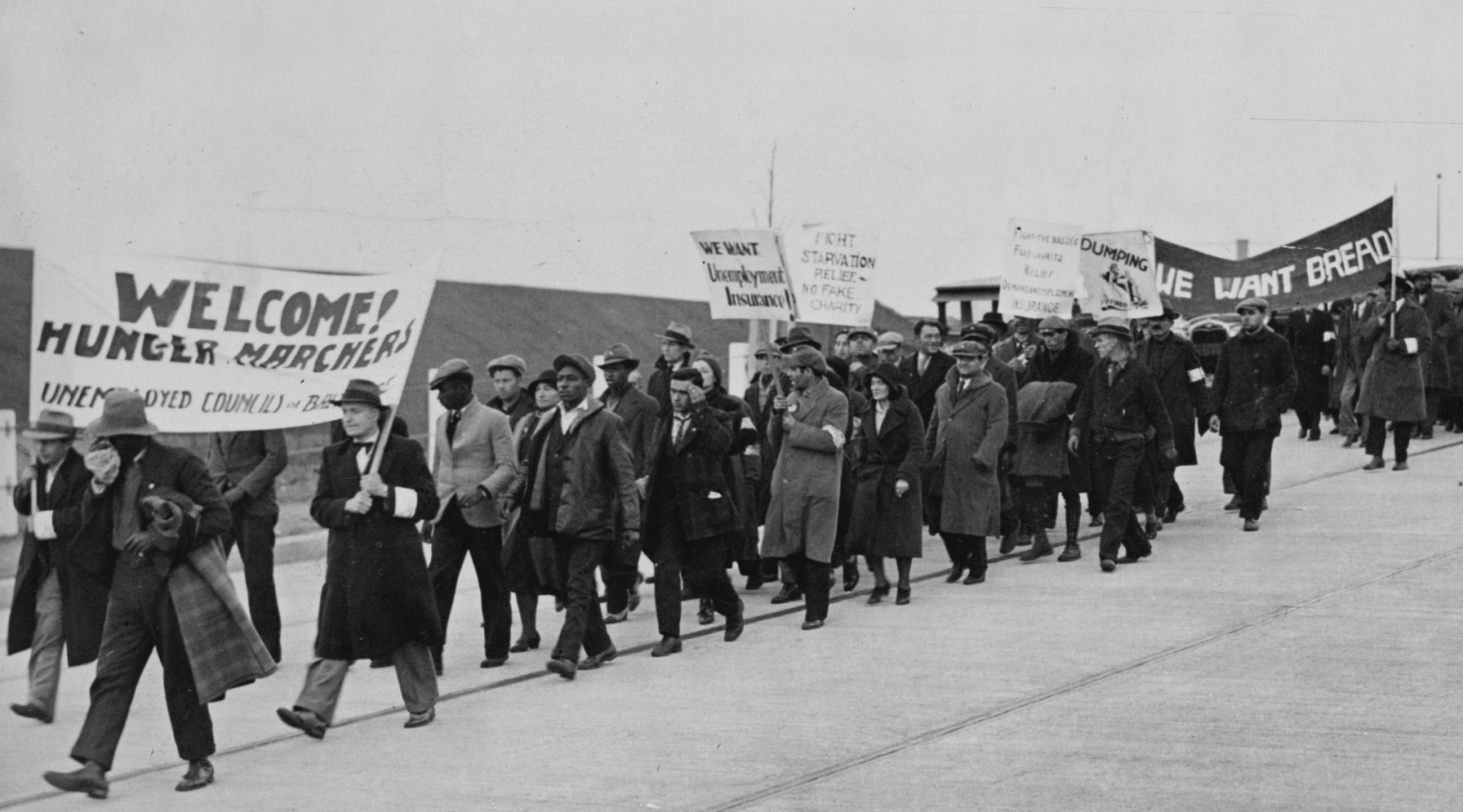
Arriving in New York City on March 4, the night of the Ruthenberg Memorial meeting, the marchers went to the meeting in disciplined ranks, and were received with an ovation. Many of them spoke and there it was announced that of the more than 180 who went from New York City on the march, 56 of the best had joined the Communist Party.
The march to Trenton was equally effective. In some of the places, Carteret, for instance, the entire town turned out for the march, and accompanied the marchers far outside the limits of the town, insisting upon meetings. Everywhere the same reception. When arriving in Trenton, a splendid group of the Trenton jobless met them and marched with them to the hall that had been prepared. Similarly to the march to Albany, the march was preceded by leaflets, announcing the coming of the marchers. Along the route, leaflets were distributed, telling the workers the aim of the march. Daily Workers and Labor Unity and literature were sold in large quantities.
At Trenton, the committee of the marchers did not succeed in getting to the floor of the Assembly, being outmaneuvered by the sly politicians, who did not dare to let the committee speak. While the committee was detained in a side room, practically under arrest, the workers demonstrated before the Capitol, remaining there for several hours.
The Hunger Marches made a tremendous impression upon the workers of the towns through which they passed. The workers clamor for organization–and it is the task of the Trade Union Unity League to organize them. The workers showed everywhere that they are ready to fight for the Workers Unemployment Insurance Bill and for immediate relief.
In our next article, we shall deal with some organizational aspects of the march.
II.
THE preparation of a Hunger March is not a simple matter. Not only have full preparations to be made for the housing and feeding the marchers along the route, depending upon donations, collections, etc., but organization of the men themselves is very important.
The men have to be carefully selected, for the distance is not short, they have to march long stretches, and, being unemployed workers, who have not had a good meal for some months, it is not a simple thing for the workers to march. The men have to be selected also from the standpoint of stability, Hotheads, boisterous men are not suitable for a march. The men have to have some discipline, though this is quickly inculcated. They have to understand something of organization, so that being given a task, they will know how to perform it without hesitation. The N.Y. marchers were carefully selected. Being composed of unemployed and employed workers (mainly the former), they were organized into companies of 20 with a captain and lieutenants of squads of 4. The captain was responsible for his men, while the eight captains were subordinate to the three leaders selected by the Trade Union Unity League.
Each man had a task. One for distribution of literature, another for defense, etc. The work went with wonderful precision. When the men stopped for a meal, the captain, through the lieutenants, knew where his men were, whether they got food, etc. When they stopped for the night the march lasted six days), the captain, through his lieutenants, knew where his men were put up. When in Albany, some of the men were battered by the cossacks and were given first aid. The captain, through his lieutenants, knew whether his missing men were locked up by the police or were in the first aid room. When meetings were held along the road the defense groups were prepared for any eventuality.
This was an embryo army, with the men learning discipline on the way. The work was facilitated by the fact that quite a number of the marchers were ex-servicemen, and this was only another march under less trying circumstances than those they had made during the world war. There was a group of Communists in the marches to Albany and Trenton and this lent stability and discipline to the marches. But it must be stated that the non-Communists showed equal discipline and promptness, thus demonstrating that there are multitudes of workers willing and able to fight, good militants who belong in the Communist Party, and only waiting for the Party members to bring them into the Party ranks.
Provision was made for the political education of the men along the route. Short talks and discussions on the role of the Trade Union Unity League and the revolutionary unions were to be held. It was almost impossible, however, to arrange the talks, for the men were tired when they arrived at a stopping place, and therefore the discussion was chiefly on the experiences on the road, which were interpreted by the marchers selected for the educational work.
Provision was made for meetings in the towns on the road to Trenton and Albany, in the squares and before factories, but not in all cases was it possible to hold the meetings, for the marchers frequently arrived late. Whenever the meetings were held, they were large and enthusiastic. On the road back. It was arranged that the marchers should report to the workers as to their experiences in Albany and Trenton, respectively, but these did not materialize.
First aid nurses accompanied the marchers, not only to assist in case of collisions with fascists and state troopers, but to take care of sick men, sore feet, etc. The only time that they Had considerable to do was in Albany. Doctors could not be obtained to start out with the marchers, but volunteers were found in all the cities.
A few incidents will indicate the reception that the workers gave the marchers. In one town on the way to Albany some of the marchers put up for the night at a Negro Community Church. A Negro woman came to the marchers with five loaves of bread. This was a splendid demonstration of solidarity, by a poor Negro woman.
At another place, an Italian, at 12 o’clock at night, knocked on the door where a number of the marchers were sleeping, woke them up and asked to do something for them. He and his son brought the men a big cauldron of spaghetti, and for a few hours there was much chatting and joking.
In New Jersey, in Cartaret, the marchers did not think that they would have any meeting. The little town seemed bare, till they came to the corner of the main street. There the entire town awaited them. A meeting was held, then the marchers set out for the next city, But the Cartaret workers and their children did not want the marchers to leave. The trucks were sent ahead, and the marchers, accompanied by the Cartaret workers, proceeded along the road. Once more the trucks were dispatched a space, but the workers and their children would not leave. The children wanted that “working man’s paper”–the Daily Worker; they wanted to learn one of the songs that the marchers sang. And this was taught them on the road to Trenton.
In Elizabeth, the marchers held a splendid meeting. The police did not like the size of the meeting and tried to interfere. The chief tried to disrupt the meeting and pull the speaker from the box. But, with one fling, he went flying out of the crowd, and the meeting went on.
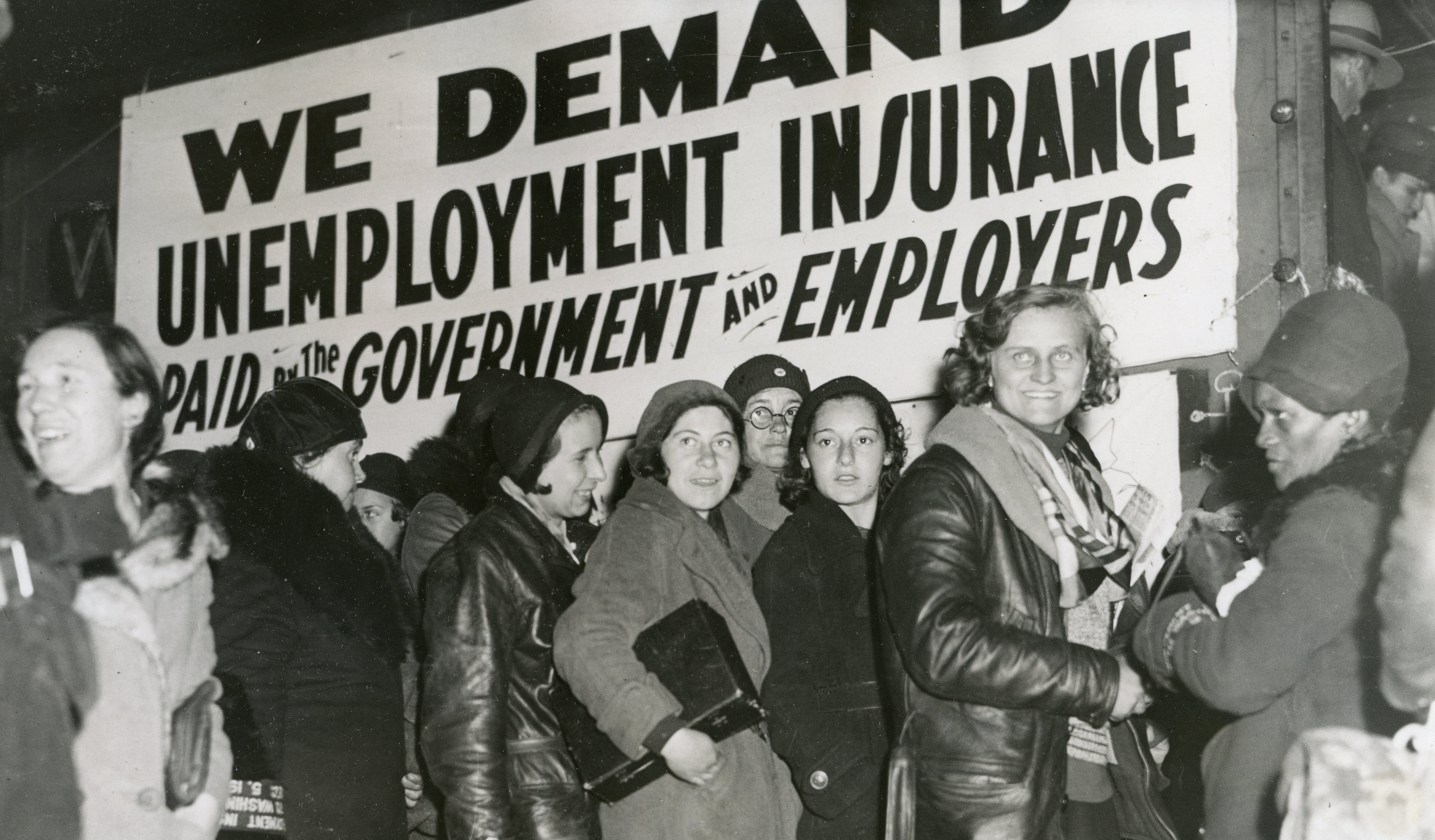
What is the significance of the Hunger Marches? They are a higher stage of the struggle for Unemployment Insurance, in that the demand is presented to the state legislature by men representing the masses of unemployed in their respective territories; they represent a method of demand by selected groups of workers; and they convince large numbers of workers of the Insincerity of the demagogues who sit in the state capitols (Roosevelt) and the capitalists determination not to grant unemployment insurance. They fill the workers with greater will to fight for Insurance, and convince them that they will get nothing but by struggle.
In Albany and in Trenton, the workers learned how representatives of the workers, especially the unemployed, are treated by “their” government. They learn that this government, which receives, with bended knee, a prostitute queen, a rake of a prince or a vicious labor-hater, does not receive the representatives of the workers, but clubs them, arrests them and prepares to meet them with machine guns. These marches have opened the eyes not only of the marchers themselves, but of the tens of thousands of workers who greeted them and listened to their speeches as they marched to the state capitols. These workers know now that only by more intense organization and struggle will they get relief and insurance. They know now that the “Reds,” the Communists and revolutionary trade unionists are not their enemies, as Fish, Green, Woll and Norman Thomas brand them, but the only ones who fight for the interests of the workers. They know now that they will get nothing by asking for it, it makes no difference how much they may be entitled to it. They will get Unemployment Insurance; they will win the right to hold meetings and to present their demands to the state legislatures only when they are properly organized and ready to fight.
The fight for Unemployment relief and insurance goes on. The marches to Albany and Trenton are now followed by marches in the other states. The workers all over the country will not stop there. Although the demand was already presented to the United States Congress, which merely adopted a bill to “study” the unemployment situation and then adjourned without even considering the Workers’ Unemployment Insurance Bill, which was presented by the National Delegation on February 10–the fight will go on. The 10,000,000 unemployed workers of this country, backed up by the employed workers, will continue the fight, by organizing firmer, better knit Unemployed Councils, by building up the revolutionary unions of the Trade Union Unity League and by launching a fight that will COMPEL the U.S. Congress and the Wall Street bosses, whom that congress represents, to grant Unemployment Insurance, whether they like it or not.
This is the task of the entire working class and the Communist Party makes it one of its most important jobs.
The Daily Worker began in 1924 and was published in New York City by the Communist Party US and its predecessor organizations. Among the most long-lasting and important left publications in US history, it had a circulation of 35,000 at its peak. The Daily Worker came from The Ohio Socialist, published by the Left Wing-dominated Socialist Party of Ohio in Cleveland from 1917 to November 1919, when it became became The Toiler, paper of the Communist Labor Party. In December 1921 the above-ground Workers Party of America merged the Toiler with the paper Workers Council to found The Worker, which became The Daily Worker beginning January 13, 1924.
PDF of full issue: https://www.marxists.org/history/usa/pubs/dailyworker/1931/v08-n092-NY-apr-16-1931-DW-LOC.pdf
PDF of issue 2: https://www.marxists.org/history/usa/pubs/dailyworker/1931/v08-n096-NY-apr-21-1931-DW-LOC.pdf
 Revolution's Newsstand