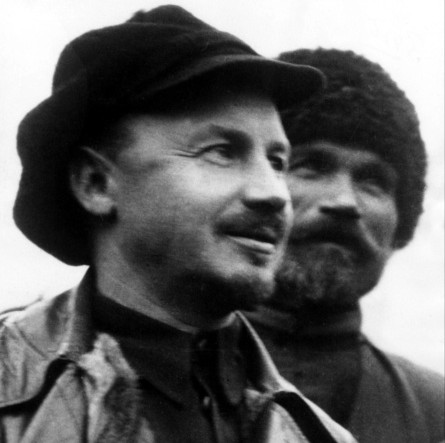
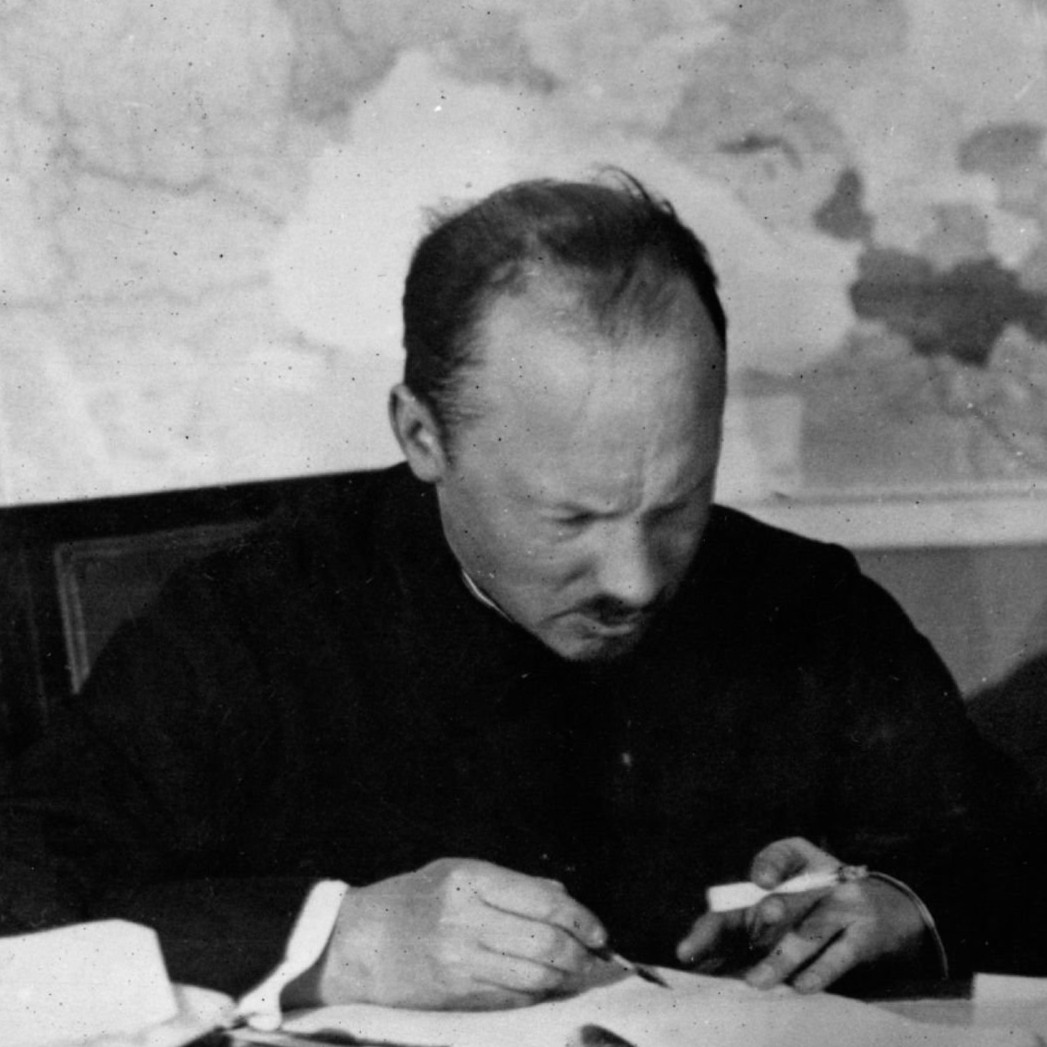
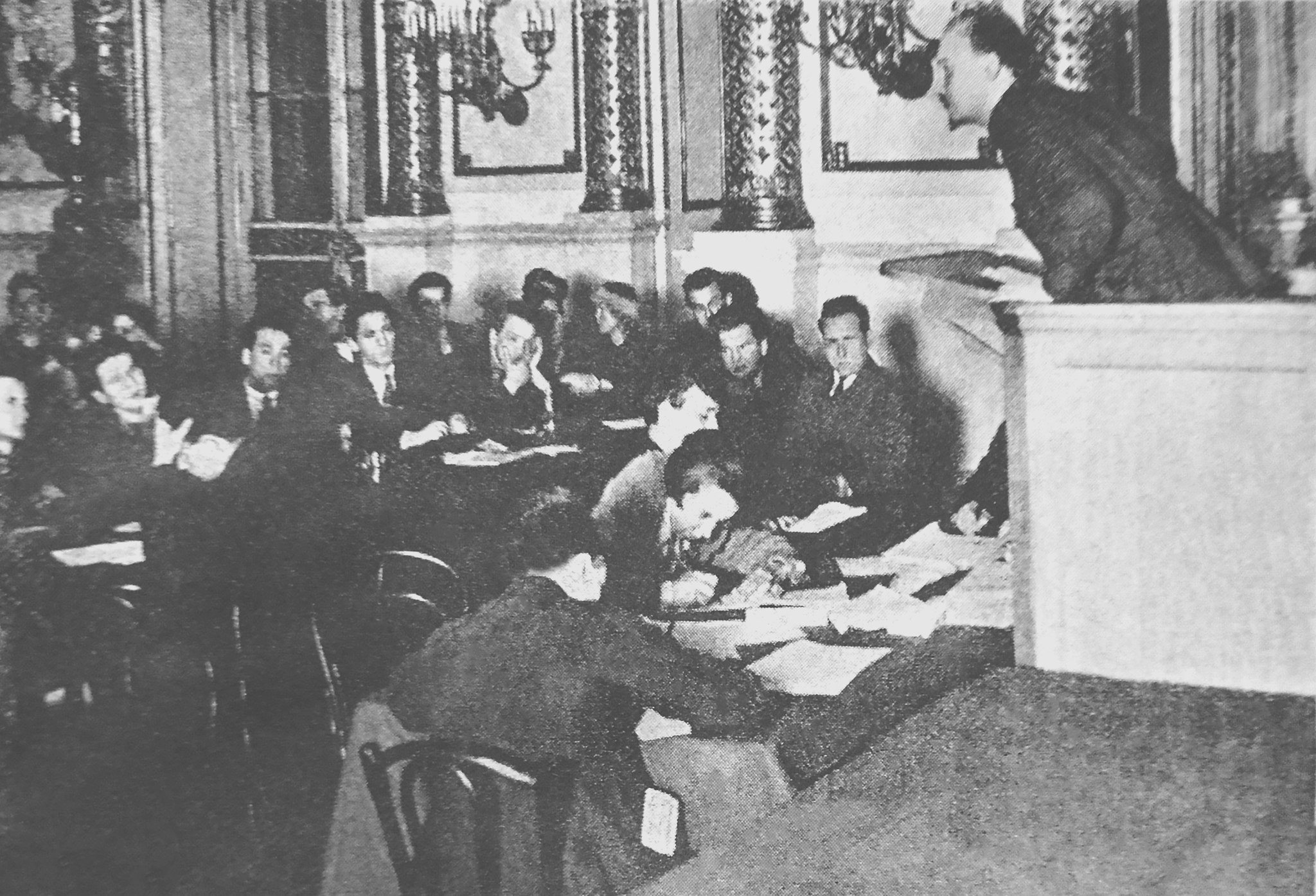
Regardless of tendency, a speech that is an intellectual feast for any Marxist. Bukharin’s major 5th World Congress intervention was, in large part, a critique of the ‘Left Communist’ positions then put forward by Karl Korsch (Comrade Boris). A subject he spent nearly the whole first decade of the revolution working on, without ever satisfactorily finishing, Bukharin, who wrote the Programme of the World Revolution in 1918 and, with Preobrazhensky, ABC of Communism in 1920, and was tasked by 1922’s 4th Comintern Congress to lead the elaboration of program for the International. A central contradiction in crafting a program was the differences in orientation and in needs between those Communists in power, and those seeking to gain it. Should be read with Thalheimer’s supplementary report.
‘The Program of the Communist International’ by Nikolai Bukharin from The Daily Worker. Vol. 2 Nos. 124, 127-129. April 12, 15-18, 1924.
COMRADES, we two reporters who appointed by Executive to deal with this question–Comrade Thalheimer and myself, have divided the work between us. Comrade Thalheimer’s report will not be a counterpart to mine, but rather a supplement to it.
Comrades, at our last congress the program question was discussed with considerable thoroughness. The most important program questions were dealt with in the reports made at that time. I will therefore not again go over the paragraphs contained in my report and in Thalheimer’s supplementary report.
Capitalist Accumulation.
Differences arose in connection with two quite different questions: first, in connection with capitalist accumulation–a purely theoretical question brought forward by Comrade Rosa Luxemburg. We have omitted this purely theoretical discussion for today, not because of our inability to discuss this question, or because we do not attach any importance to it, but because it is a question which does not lend itself to discussion in the plenum. It is of an extremely theoretical nature and therefore not suitable for the plenum of a great congress. We have decided to deal with these purely theoretical questions at separate meetings.
The second question, which gave rise to differences–the question of partial demands and transition slogans, was settled by the Fourth Congress. As there are no differences in connection with it, this question disappears from the agenda, unless some delegation or group of delegations object to this.
Thus, in today’s report I will deal only with new questions, namely with questions not discussed in former reports.
Comrade Thalheimer and myself propose (and I believe we voice the opinion of the Commission on this) that at this congress, we adopt not a final program, but rather a draft which the parties affiliated to the Communist International may discuss. This draft must be distributed to the sections for discussion in the name of the congress.
Determine Aims and Methods.
In the first place, we need the program for the ideological training of the parties belonging to the Communist International. We also need the program for its political significance, in order to determine its aims and the methods by which these aims are to be achieved. We also need the program to demonstrate and to further our unity. I must say that I do not share comrade Maslov’s scepticism with relation to the program. He published a rather good article in reply to comrade Boris’ article in “Die Internationale”–the theoretical magazine published by the German Party. But in this article, comrade Maslov expressed himself against the adoption of this program. He argues that sufficient preparatory work has not been done and that various, purely theoretical questions, are not yet solved. He proposes that only a program of action be adopted in lieu of a program I do not agree with his contention, for I think that in the various documents already adopted by the Communist International, which date from our first congress, we have sufficient material and also sufficient elucidation of the most important questions which concern the program. I also think that, with a few exceptions we are justified in saying that even the purely theoretical questions have been, on the whole, well thrashed out. I think that there is no justification for comrade Maslov’s theoretical scepticism.
Philosophy of Movement.
I come now to the question itself. As I have already said, I will deal now only with questions which are comparatively new. I presume that former reports, which were published in book form, and the discussions connected with them, are familiar to all the comrades.
The first question we have to consider is–our philosophy. Not a word has been said in the draft laid before the Fourth World Congress about the philosophy of the Communist International and of Communism in general. But since then we have gone through experiences which make it imperative for us to deal with this question. During the meeting of the Enlarged Executive we had a very heated discussion on the religious question. This of course, is a tactical question, but not merely a tactical question. These discussions on the Enlarged Executive showed us that the question of our philosophy needs elucidation. There are more subtle facts which, in a less crude form perhaps than the religious discussion indicate that there are still some dangers ahead. We notice among Communist Parties, and to a still greater extent, among social-democratic parties–especially in the German Social Democratic Party–a relapse into the old Hegelism, which we must designate as pre-Marxist and an idealistic viewpoint. This is particularly noticeable in the social democrat Cuno, especially in his works on the state, the role and functions of this state. This is linked up with a certain relapse into Lassale-ism. I cannot of course, deal here very fully with these questions, I merely want to emphasize the fact of those relapses in the ranks of the social democracy. Unfortunately, Communist Parties are not immune from such relapses into the old Hegelism, certainly in a less prominent form than in social democratic ranks, but which nevertheless reveal the same potentially harmful tendencies.
The Italian Party.
The second phenomenon is particularly noticeable in the Italian party, although probably it is not conscious of it. This ideological deviation from revolutionary Marxism could be designated as idealistic voluntarism, which is substituted for Marxist activism. We find the same deviations in the Russian Party, but in a different form, namely in the form of agnostic positivism in lieu of Marxist materialism. Some comrades base their attitude on the teachings of a revolutionary school of thot, the so-called reflexology, and go back to activism. All this may be plausible enough, but it is not revolutionary Marxism. The point is that in all this, Marxist materialism is treated, avowedly or tacitly as an obsolete viewpoint. This is a great danger, especially because bourgeois science and bourgeois philosophy and ideology are at present in a process of dissolution. This bourgeois ideology is tainted with mysticism, and therefore in a period of general disintegration and chaos can, to a certain extent, permeate proletarian circles. That is why philosophy must be given a place in the program. It must be precisely and concisely formulated. We must say that we are materialists; our viewpoint is the viewpoint of revolutionary materialist Marxism. This is a rather elastic formula but we cannot do without it if we want to proclaim our revolutionary Marxism openly and meet the perils which I described to you.
Shows Certain Dangers.
As to the second group–the economic questions, I must say that if the influence of bourgeois ideology is noticeable on the philosophical field, it is also present in our economic doctrines. I should like to propose to the congress here to discuss Comrade Boris’ article in “Die Internationale.” Not because I attach much importance to Comrade Boris’ arguments, but because his article shows us in a crude form the dangers which are ahead. It is not a question of Boris, but a question of symptomatic phenomena. For it cannot be ascribed to mere chance when a scientific organ conducted by educated people print such foolish things and such social democratic rot. Such a phenomenon shows rather that there is a certain psychological basis for such discussions. This article is a palpable proof that the bourgeoisie and the social democratic theorists have gained a footing in our camp. The article is very outspoken. Certain compliments are paid to us in it. For instance, I am described as a petty bourgeois gone mad. This is a very outspoken expression, and as I said before, the article is very outspoken indeed. Comrade Boris would like to send the entire bourgeoisie and also the petty bourgeoisie to the devil. He has no wish to make common cause with any revolutionary parties in the colonies whatever, on the plea that they are bourgeois parties. He also taboos partial socialization. He says: to the devil with any kind of socialization which is not complete socialization! He wants to socialize everything, including the waste-paper basket of “Die Internationale.” He justifies his article by saying that political economy is the be-all and the end-all. Thus, we must socialize everything, or nothing. He is much more radical than the most radical elements represented here. But under this radical cloak, we have literally a purely social democratic theory, and I fail to see how it was possible for the editors of “Die Internationale” not to notice it. This is ludicrous, and at the same time dangerous. Comrades, I will read you an extract from Comrade Boris’ article to give you an idea what we have really to contend with. One of the most important differences between the Second and Third Internationals is the conception of imperialism, the conception that a few great powers exploit the colonies, receive super-profits from these colonies and by means of them corrupt some working class sections, which provide the basis for social democratic policy. Hitherto we thot that this conception is the most important point which separates us from the Second International. This conception is a strong weapon in our hands against social democracy, and against the imperialist policy of the bourgeoisie, a strong weapon which enables us to establish a connection between Western Europe and Asia, between the industrial proletariat and the backward colonial peoples. We have in this conception a connecting link between the revolution of the industrial proletariat and colonial rebellions, which in the trend of history are nothing but component parts of the world revolutions. Against this, are directed all the attacks of the social democrats, on the theoretical as well as on the practical field.
Criticism of Program.
Now what does our super-clever Boris propose? He criticises my draft program by saying:
“What is the implication of the assertion that the bourgeoisie raised the wages of the workers at home and thus gave them an interest in the plunder? The European and American workers are exploited. The workers receive the value of their labor power, i.e., the means of existence which are necessary to maintain and reproduce their class. Hence means of existence must be sufficient to maintain the laborer as a laborer in his normal standard of living and to allow him to reproduce his kind. By fighting, the workers have been able to attain a certain standard of living. The basis for raising this standard was the development of producing power. The wages of the workers in the home countries were not raised by the bourgeoisie for the purpose of corrupting the super-profits of some sort or other. Moreover, there are no super-profits; there is only one profit, and this is created by surplus labor in production.”
“We cannot speak of super-profits from the Colonies.”
And after he has set forth our mutual stand point, he writes:
“And the Communist International is expected to elevate this class-conciliatory nonsense to its program. And the thesis covering the war and post-war period are still more absurd. For the 19th century, Bukharin was able to use Karl Marx in a mutilated form. For the beginnings of the 20th century, he used Hilferding, whom he faithfully echoed, since theoretically he is his Disciple. But he has also developed a few of his own senseless theories of state capitalism.”
Thus, the whole doctrine of super-profits is fundamentally anti-Marxist; it is absurd, it is class-conciliatory, etc. Well, I don’t know what class-conciliatory means. But first I want to make a brief remark. Comrade Boris says that this doctrine is not Marxist at all–that it is fundamentally anti-Marxist. There is no such thing as super-profits; it is impossible and impermissible to speak of the exploitation of one country by another; that is sheer nonsense. I base myself on an author who was in no way a petty-bourgeois run wild, i.e., the venerable Karl Marx. In his “Theories of Surplus Value,” Vol. 2, Part 2, Marx says: “Even a blind sow can find an acorn, and even a bourgeois economist can sometimes speak the truth.” And with reference to his famous blind sow, Marx says:
“J.B. Say, in his comments on Constanzio’s translation of Ricardo, made just one correct observation on foreign trade. Profit can also be made by cheating. One wins what the other loses. Gains and losses within a country cancel each other. But this is not the case between various countries. And even according to Ricardo’s own theory–which Say does not notice three working days of one country can be exchanged for one working day of another. Here the law of values must be essentially modified. Or, as highly-skilled, complex labor within a country bears a certain proportionate unskilled, simple labor, so the working days of one country can bear a certain proportion to the working days of another country. In such a case, the richer country exploits the poorer, although the latter may gain by the exchange. J.S. Mill developed this theory in his ‘Some Unsettled Questions, etc.’”
From this we can infer that Comrade Boris’ conceptions are somewhat more profound than those of a blind sow. But of course, that is not the decisive factor for us. The decisive factor is that we clearly see that this doctrine of super-profits of richer countries is an entirely Marxist doctrine. Marx put that down in black and white. But Marx proceeds from the hypothesis–only from this hypothesis–that there is a peaceful exchange between the countries. He does not speak of downright plunder; he does not speak of the results which must arise from the direct pressure of the state apparatus. What must be said when we also take this powerful means into consideration? The question is perfectly clear and conprehensible to any child. Only Comrade Boris believes that this doctrine is absurd.
Now for the arguments of Comrade Boris on wages. Naturally, the bourgeoisie can corrupt the working class only by means of higher wages. That is entirely correct. If, for instance, we consider the wages of the workers in the imperialist states, we observe that the workers receive their income in form of wages, but that is not the question. We must ask: Why are the wages of these workers higher than the average wage? One answer is: The wages are higher because the labor power is of a different nature, because the labor power is more highly skilled. That would be correct, but a further question is necessary: where is the basis? How did the possibility arise for these sections of the working class to transform the labor power into more highly skilled labor power? This must be answered. Of course, this question, the decisive question, did not occur to Comrade Boris. The wages of every section of the labor aristocracy conforms with its more highly skilled labor power. But why was just this labor more highly skilled? Why does this labor power belong to the highly skilled workers and not to the unskilled worker? Practically the whole working class of the capitalist state is an aristocracy as compared with the pariahs of the working class. That is the basic question. This question is answered by our doctrine, which was created by Marx and developed by Engels and Lenin and which is clearly discussed even in the program of the Russian Party. Comrade Boris absolutely overlooks this questions. And that is a return, a complete turn to the Second International. If we do not have this premise, we cannot fight against the labor aristocracy, imperialist politics, and will not be in a condition theoretically to explain all these fundamentally important phenomena. Engels, as even those who are not specially educated in Marxism know, even speaks of the bourgeois proletariat in England. This is also an absurdity from Comrade Boris’ standpoint, because he is not familiar with Marxist literature. We must ask: How is it possible that the editor of the “Die Internationale” cannot exercise a censorship? (Korsch: It was merely brought up for discussion!) Comrades, we cannot bring up every bit of piffle for discussion. That is a bit strong.
***
I COME to the second question–one of the most important.
At the beginning of the war there were bourgeois economists who actually went mad in the effort to justify the imperialist war and invented the theory that the war was a very useful thing from the standpoint of the development of productive power.
The basis was that there was a decided shifting of productive power in the metallurgical industry, in the war industry, in heavy industry. This great shift resulted in decrease of unemployment. Only very superficial “savants” failed to notice that from the standpoint of the next cycle of capitalism, all these phenomena in reality indicated a gigantic process of the destruction of productive power, of fixed capital.
Criticizes Boris.
Arising out of the enormous increase of non-productive consumption, these imbecile illusions of the bourgeois economists vanished some time after the beginning of the war. Now, several years after the beginning of the imperialist war, the courageous Boris, who of course, is in no way crazy or absurd, writes the following:
“He (Bukharin) asserts that the war led to the destruction of a tremendous mass of means of production.”
The very opposite is true.
And in another passage he says: “Neither can one talk of the destruction of productive forces by the war.”
How is this to be understood? We all know that ten million people were killed during the war, but according to the deductions of the super-wise Boris, it means “that we have an increase of living productive forces; the destroyed railways mean an increase in means of communication, while the destroyed factories and villages in Germany and Belgium signify an increase of the productive forces. This is sheer nonsense.
War Does Bring Destruction.
No sensible person can talk in this strain. One could say that the sores of the war have partly been healed. But this is not what Boris asserts; he claims that the war does not cause the destruction of productive forces. I will quote only the most glaring instances. Boris is not a bit worried by the question of productive and non-productive consumption. This question is far more important than the question of destruction, of the loss of human lives, of which I have spoken. What is the meaning of this prosperity theory? It is a repetition of the views which existed among bourgeois economists, and which were accepted by the social democrats.
With these I dealt in my first report at the Fourth World Congress. At that time I exposed the statements made by leading social democrats upon this question. For instance, one of these gentlemen goes so far as to say that capitalism has emerged even stronger from the war. Thus you see the “theoretical proportions.”
War Weakened Capitalism.
The simplest liberals, the pacifists, the clerks, and the bourgeois economists, nearly all of them see more or less the economic weakness of the capitalist world, and not one of them denies this. And then the social democrats, ostensibly Marxian, come along, and declare that capitalism has emerged even stronger from the war. It sounds almost like clamoring for a new war. An ostensible Communist chimes in with a similar statement. How can such things be taken up even as a matter for discussion, as Korsch says? If we are to take up a discussion on every bit of bourgeois nonsense (and such nonsense is produced in abundance), what would be the result? We can very well say that super-profits and extra wages are the justification of the imperialist war. If the imperialist war is such a process that in the course of it we get an increase of the productive forces, then why should we raise the alarm?
THEORY OF CRISES
Trusts Widen Crises.
The third theory is that of the crisis. We are all aware of the great controversy between us and the social democrats on the question of the crisis. We all know that the revisionists, led by Bernstein, were the first to attempt to prove that the trustification of industry, the creation of monopolist industry, tends to enable capitalism to overcome the crisis. There are different versions of this theory. In its crudest form it is represented by the pure and simple revisionists. At the time when the differences between the orthodox radicals led by Kautsky and the ultra-revisionists led by Bernstein had disappeared, Kautsky, before the drafting of the Goerlitz program, wrote that in our present theoretical discussion of the development of the capitalist system we may say quite frankly that the theory of crisis must assume “more modest dimensions.’
What does it mean? It means that according to Kautsky the capitalist world has become more harmonized in recent years. What is our view upon these things? We have dealt with this question more than once and I think we have shown that in some branches of industry the state of anarchy has been partly removed as a result of the creation of monopolies. But the creation of trusts does not prevent crises; it rather produces them in a more extended and graduated manner.
Boris goes on to make the following suggestion:
“With the development of capitalism, constant capital increases in relation to the variable capital, constant fixed capital in relation to constant circulating capital, and particularly constant fixed capital in relation to the total capital. The systematic management of production goes at the same rate.”
Then he says:
“The higher the organic composition of an industry is, the more systematic is the management of such an industry. Of course, increased systematization leads not to a slackening but an intensification of capitalist competition. Systematic management of production leads to systematic curtailment of production, which partly takes place instead of, the crisis.”
Revisionism of Boris.
This amounts to saying that the growth of productive forces signifies the growth of the organic composition of capitalism; the ever-increasing systematization in the management of production, instead of crisis, a growth of the productive forces. What does it all mean? Does all this represent a Communist theory? It is pure revisionism, and a pure social democratic theory.
There is yet another social democratic doctrine which says that the circumstances during the war and the period of revolutionary ferment are such that the revolutionary proletariat, if it wants to carry out the revolution victoriously, must constantly bear in mind the necessity for the continuity of the process of production. This is what we are told by Kautsky, Hilferding; etc. In support of their opposition of the bolshevist interpretation or revolutionary Marxism, they say that if we capture the machinery of the State, we shall lose all credits and shall be obliged to close the factories, and so on. This is certainly not the goal of our revolution.
Revolt Halts Production.
As I bluntly put it at the last Congress, the use of telegraph poles for barricades will not encourage the increase of production. Revolution, like war, entails loss of productivity thru the temporary destruction of the productive forces.
Now, Comrade Boris comes along again and reconstructs the whole doctrine of the community of production. He says: “I am going to put this in the form of a mathematical formula.” And so he does, for he transforms the transitory decline of the productive forces into an absolute process. He goes on to say that this indicates that Bukharin “is seriously of the opinion that the Communist system of production will have to start literally with nothing in the way of means of production and distribution.” What a wonderfully clever fellow he is! He himself evolves the mathematical formula, and then he accuses me of it. If for instance we were to transform Comrade Boris’ relative foolishness into absolute foolishness by means of mathematical, historical, and logical reasoning, we would also obtain the corresponding result. But we are content with having to deal with relative foolishness.
Is Socialist Theory.
What is the meaning of the thing in itself? It means nothing else than the restoration of the social democratic doctrine. For it is the best argument in the hands of the social-democracy against revolutionary methods. If we say that the revolution can be based only on the growth of the productive forces, then we get the doctrine established by Kautsky.
You see how tactfully we have established our theory. We have shown that the process of relative and temporary transition renders the destruction of the productive forces absolutely necessary. We have shown by various Marxian quotations that this transformation, these critical circumstances, serves as the basis for the revolutionary change.
The social democratic doctrine, on the contrary, asserts the impossibility of the revolution. They argue in this way: before the war the productive forces are not developed enuf for the realization of socialism; during the war the social revolution is impossible because the productive forces are partly destroyed, and after the war one must want until they develop again, so by that time a new war will come.
SOCIALIST STUPIDITY
And thus the circle of stupidity runs merrily round. The expended repro-duction of Boris’ theory represents the expanded reproduction of this theory.
See what a rich bouquet of theory we get! Negation of super profits, negation of the wage-relations of the labor aristocracy, a theory of war-time prosperity, and consequently a justification of the social-patriotic attitude during the war; whole theory about crises, the social-democratic doctrine about the continuity of the process of production.
It has quite a number of passages which sound very radical, but behind these radical words we have the foulest social democratic trash.
And it is this thing that the super-wise Boris uses for his attack against us on the national question, on the colonial question, on the question of the united front, on the question of socialization and so forth and so forth. These are sufficient to illustrate what the discussion is really about.
Why Boris Is Discussed.
I repeat, I have dealt with Comrade Boris at considerable length, not because I consider his arguments important, but in order to show that even in our own ranks there are social democratic notions, which we must combat with the utmost vigor.
If such things are written by the “Left” comrades, they are even more dangerous, because when the “Left” comrades, whose tactical and political orientation is quite proper, indulge in such foolish talk, they compromise the entire political orientation of the “Left” wing.
We cannot be swayed by sympathy, we must protest in the most emphatic manner against such irrelevance, and expose the comrades in question. Another reason why I spoke so much about Boris was because of the peculiar construction of his brain, and the crude form in which he put his theory. I would now like to touch upon another theoretical question which was omitted in our previous discussions, viz. the question of crises; not of crises as specific phenomenon of the transition period, but of crises in general. As you know, a theoretical discussion on the theory of crises is going on in Marxian circles.
Anarchy of Production.
There are two formulas which are fundamentally different (disproportionality, and under-consumption). We must have a formula which will express the contradiction between production and consumption as a component part of the anarchy of production. I will deal with this more fully on another occasion.
I believe that in our draft program we must be somewhat more cautious in formulating the process of the decay of capitalism. We already see the empirical fact that on the whole we are facing the process of capitalist decay, but within this great process we see also partial processes of regeneration.
Proceed Cautiously.
Consequently, the picture is more checkered than we have thot it to be, and the checkered nature of the process of capitalist decay should cause us to proceed more cautiously in our future formulations than we have done hitherto. For this reason we must give a somewhat more exhaustive definition and clearer description of the transition period.
Without going into long comments, I shall point out a few things. We must elaborate more clearly our ideas upon the period of the two processes, the fundamental processes of the proletarian revolution in itself does not yet constitute the world revolution, that there are also other disruptive processes which have a revolutionary sense, e.g. the national crises. Of course, if we consider these crises as isolated phenomena, they do not by any means constitute proletarian revolutions.
COLONIAL REVOLTS
It may be said, likewise, that colonial revolts, which are so numerous, do not constitute merely proletarian revolts, but that also revolts of the petty bourgeoisie and of the national-revolutionary elements of the bourgeoisie.
Taken by themselves, these secondary processes are not integral parts of the proletarian revolution. In the majority of cases they are not led by the proletariat. Objectively speaking, if these processes were entirely isolated, they would play quite a different part. But they cannot be spoken of as isolated phenomena. In the process of world history, these phenomena have direct bearing on the world revolution.
And if the proletariat gains the leadership of this process, it will lead also the other classes, because they are component parts of the world revolution. This may sound paradoxical, but it is, nevertheless, true. Comrade Boris absolutely fails to understand the subject, for he has no inkling of the objective meaning of these secondary processes.
Two Simultaneous Forms.
We should mention that during the transition period, two antagonistic forms of organization may continue to exist side by side for a long time, bourgeois and proletarian forms; proletarian forms of economy and survivals of commercial and capitalist-industrial relations, and many other incongruities of this kind; the whole picture would present a motley complexity of things.
We should make mention of the antagonistic forms of organization. We should also mention the various capitalist organizations, and the various initial stages of the socialist society that is being built up.
We should point out that after the conquest of political power, a new law of social development will operate. In the first place, development would proceed amidst the flame of revolution, and secondly, the law of social development would work concretely upon a new basis. Capitalist development is nothing but the extension of the capitalist contradictions; these contradictions will go on and lead to the collapse of the capitalist system of production, but after the capture of power by the proletariat, the law of social development will not tend in the direction of extending the contradictions, but rather in the direction of their gradual elimination. Let me give an illustration.
Road to Communism.
We have contradictions between the various forms of economy; if these contradictions were to go on increasing in acuteness, the whole order of society would collapse. But we hope that the process of competition will enable us to dispose more and more of the economic contradictory forms in an evolutionary way. And the contradictions which will exist after the conquest of political power, considered from a definite historical standpoint, will steadily diminish until they will finally vanish, and then we shall have the communist society.
Of course, conflicts of a catastrophic nature may arise, e.g. revolts of the bourgeoisie, of the large peasants and so on. Of these things I do not speak; I merely say that a certain historical period, when the proletariat shall have established his complete economic, political and cultural hegemony, the law of economic development will work differently from what it did before.
MAY FORM BLOC
We should mention further the idea that during the transition period there should be a bloc between the proletariat and some sections of the peasantry. Here I would like to make a few remarks. Even in the ranks of the Communist International there is a dangerous tendency to ignore the importance of this problem, of the relations between the proletariat and the peasantry.
Everybody knows today that we want to go hand in hand with the peasantry, but this does not mean to say that we want theoretically to wipe out the differences between the proletariat and the peasantry.
It is absolutely clear, and strategically as well as tactically necessary, that we must consider the peasantry as our allies, but this should not be misconstrued in the sense that we should transform ourselves into Workers’ and Peasants’ Parties. On the contrary, the more we retain our proletarian character, the more successful will be our policy in regard to the peasantry. In this connection we might draw a perfect parallel between our bloc and the bloc that exists among the possessing classes. For instance, there is quite a big difference between the large landowners and the industrial bourgeoisie.
Bloc Vs. Bloc.
It is true that the growth of financial capitalism and banking has enabled the large landowners to obtain their revenues in the form of dividends; nevertheless, there are still large and important differences between the bourgeoisie and the large landowners, particularly the so-called feudal or semi-feudal large landowners, not the large landowners who carry on capitalistic enterprises on the land. But in spite of these differences there is a bloc between these classes, and constant mutual support. As against this bloc, we should establish the bloc of the workers and peasants. The differences between the proletariat and the peasantry have not vanished any more than the differences between the large landowners and the capitalist bourgeoisie has vanished; but just as the whole of the ruling class supports the bourgeois bloc, so must we support, strengthen, and consolidate our policy during the whole of the transition period by this bloc between the proletariat and the peasantry.
***
NOW come to the question of the new economic policy which I consider to be the most important part of my report.

First of all a few introductory remarks. After the introduction of the new economic policy, we, the Russian Communists, and also our friends, the foreign parties, almost without any exception, had a feeling that we had acted somewhat improperly, and that we ought to apologize for the new economic policy.
New Economic Policy.
In its most subtle form, this apologist attitude consisted in our considering the new economic policy exclusively from the standpoint of political expediency, as a political concession to the petty bourgeoisie. It means that we did not think the new economic policy to be expedient and rational in itself.
This is what we thought then. Now however, we may quite conscientiously say the very opposite. The question of the new economic policy on the whole should be formulated by us in the following manner (later on I will deal with it more exhaustively): The only correct economic policy for the proletariat, the policy which insures the growth of productive forces, is the policy which we described as the “new economic policy.” War-time Communism was nothing else but a corrective of this new economic policy, the necessary corrective for the political expression of the direct class war against the bourgeoisie and the petty bourgeois elements. I believe that we should state these ideas quite clearly, and for this reason, comrades, I must ask to be excused if I shall deal with these ideas in some detail.
Class Remnants Still Left.
Comrades, the fundamental facts, the fundamental phenomenon which will confront the victorious proletariat after the conquest of political power, will be the variety of the forms of economy with which it will have to deal. In no country, not even in the most capitalistically developed, are the productive forces so highly developed as to have caused the disappearance of all the immediate strata.
No Marxist will assert that the social revolution cannot come unless every petty bourgeois, every handicraftsman, every small capitalist shall have disappeared. It would be a foolish exaggeration, of the kind contrived by our opponents to make a caricature of Marxism.
We here spoke only about the tendency of the development. None of us thought that social revolution will only come when the last peasant will have disappeared, but knew that it will come when the contradictions of the capitalist system will have produced a situation on the social chessboard which will call forth revolution thru the class interests.
Thus in all countries without exception (of course in some countries to a greater extent than in others) we shall have to deal with a great variety of economic forms. And that is the main fact. With it are connected two other main facts of economic and political life.
Classes Reflect Class Economy.
The second fact is as follows: There are as many different economic forms as there are classes or rather social strata. As long as we have small enterprises we shall have small producers, as long as there are small farms in the country side we shall have peasants and as long as we have small capitalist enterprises, we shall have small capitalists and also handicraftsmen.
Thus we see that the various economic forms correspond with the various classes or strata of society. There is another main fact connected with this, which will play an important part after the conquest of political power. If we leave this third fact out of sight and out of account, we run the risk of adopting an erroneous and even harmful policy. This third factor is as important as the above mentioned two main facts, and consists in the heterogeneity of economic motives, of economic impulses. Thus, if we have different economic forms, we also have different economic motives. The motives of the peasantry differ from these of big capitalists.
The economic motives of socialized enterprises differ from those of the big peasantry. Even the economic motives of the big peasantry differ from those of the small peasantry.
What then is the main problem of our economic policy in the face of this basic problem? This main problem could be formulated as follows: it is the problem of coordinating and subordinating firstly, economic stimuli.
Economic Hegemony Above All.
In the face of such heterogeneity, we must of course consolidate the hegemony of the ‘proletariat also on the economic field. What does this mean? It means that our socialized enterprises must have the hegemony in our economic life, and that the other economic forms, consequently, all intermediate motives, must be subordinate to this economic hegemony.
What makes the proletarian economic policy so complicated is—that it is not as clear and simple as Comrade Boris’ conception of economic policy. If, as he says, there were no differences and no variety of forms, it would be an easy matter to establish socialism. Thus, our highly esteemed opponent gets rid of the entire transition period, for this period presupposes heterogeneity of economic forms. The transition period is the period during which the most advanced economic forms squeeze out other forms by means of competition.
Now it is clear to us that the main problem consists in subordinating economic forms and classes. This is a complicated art But this is the only right way to look at the economic policy of the victorious proletariat. It is not difficult to understand why we cannot except complete socialization a la Boris. It would be a caricature.
Inkpot of Centralism.
I well remember that Trotsky once said in arguing with extreme centralists, that centralism consists in placing a big inkpot in the Red Square into which all the writers from the various parts of the Soviet Union are to dip their pens. Why is it impossible to carry out this complete socialization a la Boris? It is impossible because of the heterogeneity of the economic forms within our Soviet Union.
We are unable to carry this through for technical reasons. We have not enough organizational forces to socialize everything, even the peasant allotments. This is one of the reasons. Secondly, it is politically impossible, because, by attempting it, we would rouse the petty bourgeoisie and all the traders against the victorious proletariat. Thirdly, because to attempt to socialize everything all at once such heterogeneous enterprises would require a gigantic administrative apparatus the cost of which would be higher than that of anarchic production. This played an important part during the period of military communism. This excessively centralized form of government necessitated such a gigantic State apparatus that it consumed everything. We still feel the consequences of this disease. The problem of distribution between productive and unproductive consumption is one of the most important problems of the victorious proletariat
NEP Correct Policy.
The New Economic Policy is the only correct and true proletarian economic policy. When I speak of the only correct economic policy of the proletariat, I mean a policy based on the growth of productive forces, and a policy which encourages this growth.
When from this standpoint, we make a comparison between economic policy, new economic policy, and military communism; when we compare the two forms of this policy, we come to a full understanding of the difference between them. What was military communism? It was rational consumption of existing food stores. It seized or requisitioned from every peasant and from every locality anything that was to be had, in order to provide for the army and for the urban proletariat. At that time this was the only possible policy, the first strategical position which gave us a firm footing in the economic life of the country. We seized power In economic organization, we also partly destroyed them (this too was a good thing, it is in fact a justification of the policy of military communism). On the other hand we established rational consumption of the existing food stores. That we could not give encouragement to productive forces, is self-understood. How could we encourage agriculture, if we took away all the surplus produce What motive could the peasantry have for production? We have no economic subordination of small farms, and therefore no economic subordination of the peasant class, hence no subordination of the economic stimuli of this class—hence, from the standpoint of productive forces, we had to record not an advance, but a retreat The peasants refused to produce.
We Recognize Mistakes.
There was a great conflict between our State policy and the economic motives and impulses of these strata of the population, which made the partial existence of these economic forms impossible and roused the indignation of these classes against this policy. It is a good thing that we adopted the new policy ourselves, in making a careful survey of this matter, we recognize the economic mistakes we made and we realize what real proletarian economic policy must be like.
Apparent Radicalism of Boris.
Comrades, I should like to deal here with an argument used by Boris. His justification of the demand for complete socialization is—that every national economy is a unity, and being a unity, requires just such a policy. This sounds very radical, but in reality it is theoretical opportunism. Why? Not only is there a unity, but there is also a unity of contradictions. To a certain extent, the proletariat and the bourgeoisie is also a social unity. But there are contradictions within it, and the same may be said of all economic forms. This, in fact, is the whole problem. The bourgeoisie has coordinated these contradicting elements. We must have another kind of co-ordination. To deny this problem, one must assume that society represents an united whole, and not a unity in contradictions.
Further, if we regard the varieties of economic forms as the main phenomenon, it becomes quite clear that the most important manifestations arising out of the diversity of production are the forms of market relations. And here I think we must deal with the following prospects. In the long run as Boris says–the proletarian section of economic life, the social enterprises in industry and agriculture, will squeeze out the forms of private capitalism, the small producers, by means of competition in the markets. Formerly our idea was somewhat as follows: we have a portion of the economic life of the country; other, socially hostile, or partially socially hostile elements have the other portion, and these we shall be able to swallow up by the direct methods of state power and without market relations. In all probability, judging by empirical facts–not merely by the Russian experience, but “mutandis mutandi” by the experiences of other countries what will actually happen will be that owing to the anarchy of production, market relations will be necessary and therefore the competitive struggle between the state forms of proletarian economy, between the socialized industries and the other forms of industry. Formally, the method is the same as under the capitalist economic system The great difference lies in the fact that under the capitalist economic system, large and medium-sized industries have almost the same economic content. What was the distinction? There was no distinction in principle. But if we have varieties of economic forms after the organization of power, the economic forms are in general bound up with the socially antagonistic content of the enterprises. If the industries are in the hands of private capital, a competitive struggle against them by the large proletarian industries will take place a revolutionary struggle, a class struggle against the bourgeoisie. That prosaic thing, market competition, is nothing but a specific new form of the class struggle. On the one hand we have large industries with a proletarian content, and on the other, forms which have a different social content. This is perhaps the most important point we must grasp; since all doubts and misunderstandings, all attacks upon Nep and the present situation in Russia proceed from the fact that the comrades concerned fail to understand the entirely new forms of class struggle based upon economic competition. Formally, maters are almost the same as they were under capitalism, the producer received wages, the whole process goes on as in capitalist society. But the important thing is, that in spite of this formal identity, there exists a difference in principle. When we examine the economics of the proletarian dictatorship, we must bear in mind that the variety of economic forms is bound up with the variety of the social content of industry.
Difficulties of Economic Planning.
Here comrades I think belongs the idea of the development of economic planning. We formerly believed that we had only to determine the plan and the plan would mechanically be carried into effect. We now know that economic planning after the establishment of the dictatorship of the proletariat is difficult to carry into practice; in other words, we can only carry out economic planning to the extent that the material basis therefor exists. And this material basis for economic planning is nothing but the result of the squeezing out of backward economic forms by the superior large industries with a proletarian social content.
A certain parallel can be drawn between capitalist production in the transition period, namely, the process of the centralization of capital and the squeezing out of backward forms by market competition, the limit of which is state capitalism. The same is true with us: we have the squeezing out of backward economic forms by market competition and the centralization of industry. And the more centralization proceeds, the more is the basis for economic planning created. The limit, however, is not state capitalism, but socialism.
No Voluntary Discipline Bunk.
Here we have an entirely new conception. But I think we can safely say that only this perspective is a correct one; it is the only one which can be theoretically proved. And it is just this perspective which is the strongest weapon against every form of pessimism on this subject. The attitude: Alas! the small producer is being permitted; alas! they are permitting even the capitalists. And all the other alases, are the result of a failure to understand the phenomena. In the early stages the superiority of large industry was not so apparent, since during the process of general economic disruption it is not immediately possible to carry on large industry. The same is true of commerce, where there are machines but no demand for them, where there is no circulating capital to set the apparatus going. But as soon as competition between large industry and small industry begins, we immediately begin to perceive the extent of the superiority of large industry. The competitive capacity of large industry will therefore steadily increase. What grounds are there for pessimism? We shall certainly have crises, but these crises will disappear when we have complete economic planning. We shall in all probability have crises for many years to come, but the general line of the squeezing out of other economic forms, which do not possess a social character, is the only right one and represents the victorious prospect of our social development. The contraction between capitalist forms and social forms is a great problem, a very sinister problem. But if we grasp what I have here stated, the matter becomes quite clear. We indeed have capitalist forms, wage relations; we have money circulation instead of distribution of goods; we have banks and stock exchanges, ay, even stock exchanges, the holy of the capitalist class. We have competition and even profitmaking in our state industries. But here we can find a parallel in the military sphere. Our army is to a large extent similar to any ordinary bourgeois army. We originally believed that the structure of our army would be something quite different, there would be no compulsory discipline, but only voluntary discipline. But experience has proved that there can be no question of voluntary discipline in the literal sense of the word, although, of course we have more voluntary discipline in our army than in any other army.
The Army or the Red Army.
But various coercive measures are adopted in the army, and we cannot do without them; we even shoot deserters. This is the highest means of coercion in hands of the State. The outward structure is similar to that of the bourgeois army. But that is not the most important point. What is really the most important, is the different class character of the army. The same applies to this economic fight.
The new economic policy, which is already fairly old, has also many inherent, contradictions, not only of form and substance but also contradictions of a more serious nature, especially during the initial stage of proletarian economic policy. Our socialized enterprises–and institutions are growing, but the same must also be said of petty bourgeois enterprises. The contradiction between the rationality of our economic life represented by small capitalists and private traders is growing. Thus, we have already not only a contradiction between form and substance, but contradiction between various social forms and social forces. Naturally the class struggle on the economic field will definitely solve this question.
Possibilities of Coalition.
Just a few more words to make myself fully understood on this question. I said that we will arrive at our final socialist economic order by means of various economic struggles, in which big enterprises will be in the hands of the proletariat. But the matter is not so simple, because proletarian dictatorship is able to co-operate with the small producer under his hegemony. This is very important, especially as far as the peasantry is concerned. A situation is possible in which the proletariat and the proletarian big enterprises form a bloc with the small producers, and co-operate with them. And we must be very careful not to underestimate this question of small producers as a bulwark of private trading.
After a few explanatory remarks on war communism, we shall be able to see that the new economic policy is not a corrective of war communism, but that the new economic policy is the only expedient policy of the proletariat. War communism on the contrary appears to be a corrective of the new economic policy. But why is it a corrective? Because it is necessitated not by a rational economic policy, but by direct political struggle. In many cases there are conflicts between the view-point of economic nationality, namely between the formula of the necessity of economic policy and the necessity and expediency of direct political struggle. During the rising, for instance, we destroy material values, but we do the same when defending the fatherland. If we make war on the bourgeoisie and desire also to make a clean sweep of the petty bourgeoisie, we have only to take the necessary measures for the overthrow of the bourgeoisie: we must get into our hands the sources of its natural wealth. I told you that we took away everything from the peasants. Was this necessary? Certainly but in what sense was it necessary and expedient? It was the necessity and expediency of war. Had we acted differently, we should have lost the war. And without victory in war further development was impossible. That is why military communism was essential. I reiterate most emphatically that the expediency of direct political struggle in the economic life was also bound up with the decline of productive forces. But when this political task has been fulfilled, when our power and the dictatorship of the proletariat are firmly established, and it is only a matter of bringing the productive forces into motion and to do everything to encourage them–then a policy of military communism is no longer justified. I do not raise the question, which should precede the other. With us, the policy of war communism preceded the new economic policy. It is possible that things will be different in other countries. For instance, in a country where the bourgeoisie is easily overthrown and the proletariat is well trained and disciplined, the latter will realize the expediency and necessity of the new economic policy.
But when a blockade intervenes, requisition or partial requisition becomes necessary. On the whole, war communism will probably have to be applied in many countries to a lesser or greater extent. This will be necessary, because the bourgeoisie will be able to offer energetic resistance to the proletariat. But the important point is that all our parties should be able to distinguish between political and economic expediency and that they adapt it to the situation in their respective countries.
***
Comrades, I am coming to the end of my report. But I should like to say a few words on the agrarian question. This question was very fully discussed at our congress. We have before us Comrade Lenin’s theses and the results of the work of our various commissions. Nevertheless, I should like to say a few more words.
There is a certain tendency within our ranks, which, I think, constitute a considerable danger. On this question there was a very great difference between the Second and the Third International. It is certainly true, that the Second International paid very little attention to the agrarian and peasant question. But there is already a tendency among some of our comrades to deduce from our attitude towards the peasantry, that in agriculture, there is no difference between small and big enterprises.
These comrades contend that we need only organize the peasant parties or re-organize our own parties on a proletarian-peasant basis. In the face of this tendency, we must state here most emphatically that we adhere to the principle of big enterprises in agriculture. We believe that the development of big agricultural enterprises is the only means to increase agricultural production. But the solution of this problem is different now than in the pre-war period. Before the war, during the period of so-called healthy capitalism, our main task consisted in getting rid of all relics of feudalism, of sweeping away all obstacles which stood in our way. We asked: Does victory belong to big or small production? Contrary to the revisionists, we said: Big production is more progressive than small production.
Well, we are now in a different epoch. Our task does not consist in prognosticating the development of agriculture. Our task is to find an ally and we must adopt a different orientation to be able to break down the power of capitalism. For this purpose we are even entitled to parcel out farms at the expense of big landed property, in order to secure an ally. For this is the main point. At present, it is not a question of prognosticating if big enterprises are superior to smaller enterprises, but, of finding means to overthrow capitalism. This is our present orientation, and everything else is based on it. To win over the peasantry, we must be able to give it something, in accordance with the nature of the various countries and the social importance of the peasantry in these countries. For the high price we have to pay now for the progress of revolution, we will be compensated later, when we shall have the pre-requisites of dictatorship—the entire industry in our own hands. Then we shall be able to introduce more progressive forms of agriculture. Why? With your permission, I will make a very important but purely theoretical remark. One of the greatest contradictions in the capitalist system, especially during the last decades of capitalist methods of production, consisted in the gulf which existed between industry and agriculture. During that period we witnessed an ever-growing disproportion between the growth of productive forces in industry and the growth of productive forces in agriculture. Why? I am unable to give a detailed answer to this question. The most important phenomenon in this connection, is the appearance of a new factor, the so-called absolute-rent. Comrades will find this subject fully explained in the third volume of “Capital.” But this is an absolute fact. Thus, the obstacles in the way of technical progress, of the application of modern machinery in agriculture are connected with absolute rent in agriculture. And that is why we have disproportionate development. Agriculture was, so to speak, under the yoke of industry. We can and shall free agriculture from this yoke to the extent in which we get rid of this disproportionality of capitalist methods of production. If from the viewpoint of economic rationality, we stand to lose something by parceling the estates of big landowners, we shall be compensated, and compensated generously, through the abolition of absolute rent, through co-operation with the peasantry and the systematic intervention of socialized industries in agriculture. I think that in this connection, we must bear in mind what Lenin said in his last article. We had a special form of so-called agrarian socialism in the countryside even in the time of capitalist prosperity. This was a very peculiar ideology. It had its material basis in the growth of peasant organizations which were under the hegemony of big landowners, priests, etc. There were agricultural syndicates, co-operatives, and various other forms of organization, as in Denmark, for instance. It is on this basis that the so-called agrarian and co-operative socialism developed. All this, of course, was utopian. To believe that tendencies coming from this side would develop into Anti-Capitalist organizations, was a semi-capitalist illusion.
But comrades, the establishment of proletarian dictatorship changes the situation in this respect. The former development of all these institutions, was the only possible development in a capitalist organism and under a capitalist state power. All these institutions became part and parcel of the organism and economic body of the capitalist state. But, under proletarian dictatorship, when industries are socialized, the growth of these institutions (wherever it is possible to replace the hegemony of the big land-owners, etc., by the economic hegemony of the proletariat) means that these institutions become part and parcel of the proletarian economic body.
That is why this question has a very different aspect in the epoch of proletarian dictatorship. And this is very important.
Comrades, we believe that in accordance with the decision of the Fourth Congress, we must also have a tactical strategic section in the plan of our program. I think that we shall have to discuss this section of our program a little later, when the commission will have made some headway in its work and when the final or almost final draft will be before you. I think it will be more expedient to do this after the discussion, for I. hope that there will be a discussion. To re-capitulate my main ideas: I think that the reports presented at the Fourth Congress must be the basis of our new attitude towards this question. What is actually new is the declaration of our philosophy and the more comprehensive treatment of the new economic policy which I propose should be regarded as the economic policy of the victorious proletariat.
This is the most important part of my report, and I think that in drawing up our plan, we must elaborate these points very carefully in order to clear away any possible doubts on this subject. I am absolutely opposed to raising the question of the elaboration of the program. I think we shall do the right thing if we go from here with the approval plan which the congress shall decide should be discussed, and if we leave the final decision to the next congress.
What we need now, are definite lines for our future activity. It is not an easy proposition, but this should not alarm us. We will elaborate this program, provided that comrades show a little interest in it. Surely it cannot be that the critical capacity of the International should be centered in Boris alone. This lack of interest in theoretical questions which was always a characteristic of reformist tendencies, is a dangerous symptom. Nearly in all parties, including the Russian Party, lack of interest in theoretical questions was always a sign of opportunism. We must do our utmost to combat theoretical opportunism and skepticism. There are enough forces in the International to solve a:so theoretical problems. (Applause).
The Daily Worker began in 1924 and was published in New York City by the Communist Party US and its predecessor organizations. Among the most long-lasting and important left publications in US history, it had a circulation of 35,000 at its peak. The Daily Worker came from The Ohio Socialist, published by the Left Wing-dominated Socialist Party of Ohio in Cleveland from 1917 to November 1919, when it became became The Toiler, paper of the Communist Labor Party. In December 1921 the above-ground Workers Party of America merged the Toiler with the paper Workers Council to found The Worker, which became The Daily Worker beginning January 13, 1924.
 Revolution's Newsstand