The repression that accompanied the British General Strike of a century ago.
‘On the Road to British Fascism: Ten Days of the General Strike’ by D. Raymond Jenkins from Labor Defender. Vol. 1 No. 8. August, 1926.
Of the International Class War Prisoners’ Aid (British counterpart of I.L.D.)
THE Ten Days’ General Strike did at least one thing. It destroyed an illusion which the British working class had for long nursed so closely to its bosom that it had almost become a cankerous growth–the illusion of “democracy” and “justice.”
The class struggle, however, provides a thorough purgatory for such illusions and this particular one could not withstand the cleansing process of the general strike.
A few hours after the mining lockout had commenced (Saturday, May 1st) and in immediate precedence to the declaration by the Trades Union Congress of a general strike, the king proclaimed the country to be in a “state of emergency,” and the government at once charged the police authorities and strike breakers with almost unlimited powers–to be used against workers, of course.
Sunday saw the first signs of a campaign of petty terrorism by the Fascisti. These black-shirted hooligans toured certain quarters of London in open cars and lorries holding up and assaulting workers connected with the Labor movement. Their activities received the first check when large crowds of workers raided and smashed up the Fascisti headquarters in the West End. In this case, the Mounted Police (who had not been attracted on a single occasion by Fascist violence) charged the crowds, injured many and arrested anybody they could get hold of. After that, the Fascisti submerged themselves by enrolling as “special” constables which enabled them to continue their foul deeds under the guise operating emergency regulations. Mass pickets were provoked by these “specials” (most of them were “plus-foured” university graduates, given immunity from study and examinations) and on the least pretext baton charges were made. The following reply to a question given on June 1st in Parliament, by the home secretary is illuminating:
“The number of arrests (during the general strike) arising out of street disturbances was 453. The number of persons taken to hospital by police was 77.”
That was for the area of metropolitan London alone.
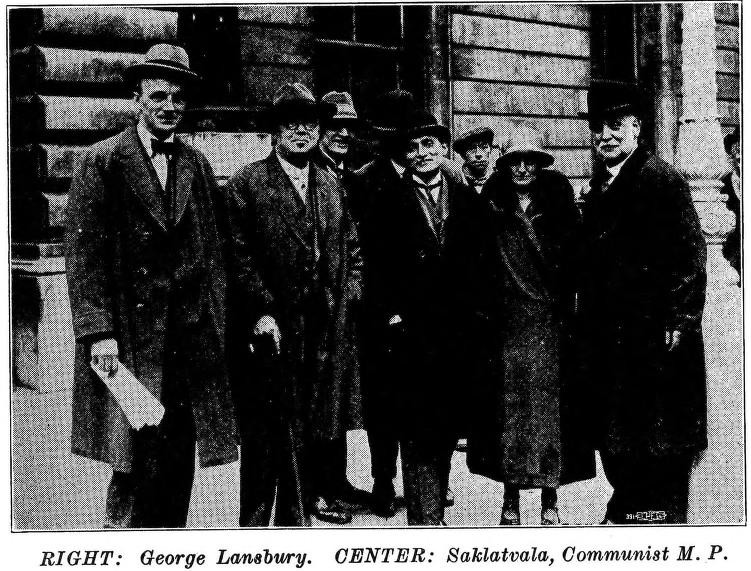
The first prominent arrest, however, was that of Saklatvala, Communist member of parliament, for a speech delivered at the London May Day demonstration. He was given two months’ imprisonment. This seems to have given the authorities an added impetus to speed up their offensive against the strikers and within a few hours of the conviction of Saklatvala, hundreds of workers charged with sedition found themselves behind prison doors with stiff sentences to undergo. The emergency regulations were as elastic as the police desired to make them, and peaceful picketing, in the eyes of the law, became an offense of common assault, damage to property, etc. The more recent laws legalizing picketing were hustled into the background and musty 19th century statutes were given daylight and used against the most active elements.
It was a repetition of what happened in the Communist trial of 1925, when 12 leaders were sent to prison by an act passed 129 years before by a government that represented 15,000 electors.
British capitalism, when faced with a direct class menace, had not time for laws that had any points of favor to the workers in them.
Between the 3rd and 12th of May, according to the home secretary (Official Parliamentary Report, June 1st) 604 arrests took place in the London metropolitan area without warrant in connection with the emergency. Proceedings were taken under various enactments including the Prevention of Crimes Amendment 1885, Metropolitan Police Act 1839, Conspiracy and Protection of Property Act 1875, Offenses against Persons Act 1861 and Malicious Damage Act 1861.
Workers were charged on the flimsiest evidence. People who had purchased copies of strike bulletins in the streets (in a natural thirst for news) were pounced upon and the next thing heard of them was that they were serving sentences ranging from one to six months. Remand and bail were refused in many cases and facilities for legal defense denied. To cite one instance. An unemployed man in Castleford was charged with writing “seditious” statements on the pavement (urging solidarity). Pen and paper to prepare his defense were refused and he was sentenced to six months’ imprisonment and a fine of £200.
Houses were raided without warrant and pre-strike and purely legal publications were taken and used as evidence against the occupants. In South Wales three miners were each given two months’ hard labor for possessing old copies of the “Workers’ Weekly.”
It was in this way that prominent leaders were arrested. Bob Stewart, secretary of the Communist Party; Marjorie Pollitt (wife of the imprisoned Communist leader), W. Lawther of the National Labor Party executive land a Durham miners’ leader, T.A. Jackson, editor of the Workers’ Weekly”; Noah Ablett, the South Wales miners’ leader and executive member, are but a few who were brought before the capitalist law courts for various “offenses.”
In Birmingham the entire strike committee (including several Labor magistrates and the editor of the “Socialist Review”) were arrested and their headquarters ransacked. In the same city all the district committee of the Communist Party was arrested. A Liverpool demonstration to demand the release of class war prisoners and attended by about 30,000 workers was banned by the police and some arrests made.
The above will be sufficient to show the way in which the capitalists waged their war during the general strike. The British ruling class, long believed to be above the use of such weapons, was shorn naked of all its sham pretentions and the workers of Britain were taught a sharp lesson in the dangers of harboring illusions.
Had the general strike continued, there is no doubt that the government would have brought other measures to bear in the struggle. The official publication of the Cabinet, “The British Gazette” (edited by Winston Churchill) gave daily repeated reports of parliamentary speeches by Tory and Liberal lawyers proclaiming the strike as illegal and pointing to the legal liabilities of its promoters (the T.U.C). An editorial paragraph, accompanying these reports, hinted that the government were considering taking action against the T.U.C. general council.
As it was, tanks, machine guns and soldiers in full kit paraded the London streets and some of the big strike centers were given the appearance of war-time military encampments. This display of force was part of the government game, and evidence was not lacking that it might be carried a stage further than that of mere display.
The workers of Britain, more solid when the strike was called off than at the beginning (J.H. Thomas admitted in the house of commons that there were more on strike on the day following the calling off than during the actual strike period) have now seen to what extent the capitalists can go and to what methods they can resort, in their struggle against a revolutionary working class, and are now preparing for the future. The International Class War Prisoners’ Aid (the English counterpart of the I.L.D.) has grown immensely since the strike. Several district committees, widely representative, have been formed spontaneously by local trades councils, councils of actions, etc. Affiliations from trades unions and Labor Parties are coming in steadily without appeal being made and new members are rapidly being enlisted.
A general strike prisoners’ fund has been opened and help is being given to many of the dependents of the class war prisoners who number 1,000 and 1,500.
A national campaign for the release of these prisoners and against the emergency powers is being arranged and demonstrations outside the various prisons will play a big part.
On May 28th, a demonstration in support of the miners and class war prisoners was held in the Albert Hall and attended by 10,000 workers. A collection among the audience realized £1,000 to be divided on a basis of one-fourth for class war prisoners and the balance to the miners’ fund.
The workers of England are rallying around the prisoners of capitalism and are building up a strong and efficient I.C.W.P A. to fight against the capitalist White Terror.
 Revolution's Newsstand