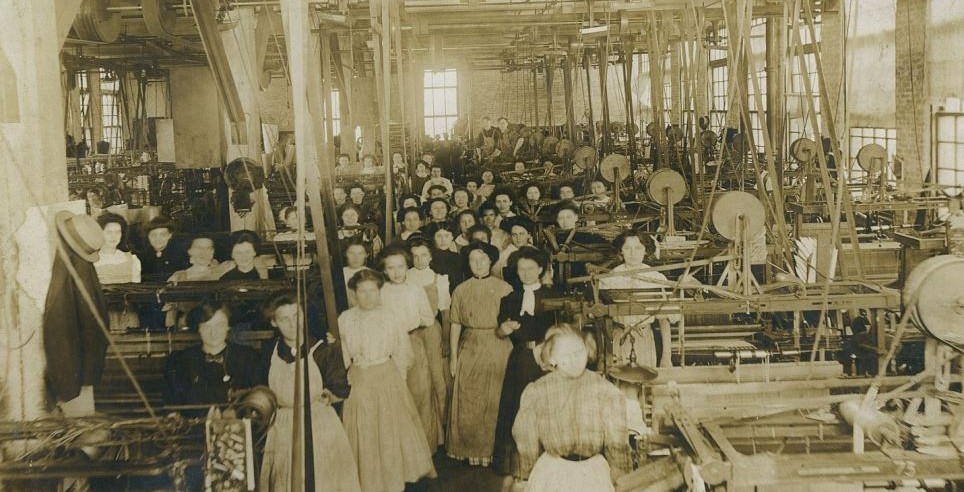
The situation of the Paterson textile workers, among the most storied and combative group of class fighters of the time, as the Uprising of ’34 of 100s of thousands of mill workers kicked off.
‘Paterson’s Dye Workers’ by Steve Foster from New Masses. Vol. 12 No. 9. August 28, 1934.
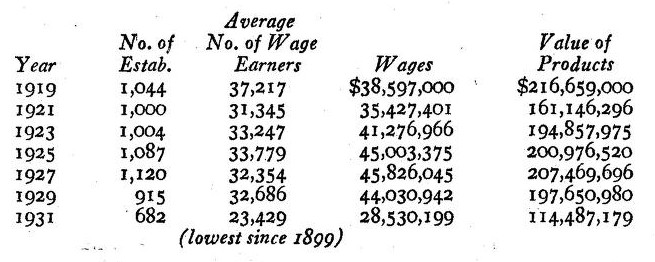
Paterson, N.J. THE forces at work in the strike of 13,000 Paterson textile workers are more complex than those agitating the Southern and New England textile areas. The main industries in Paterson are silk weaving and silk dyeing upon which the economic life of the town is, to a great extent, dependent. In the past, much of the town’s wealth grew out of the silk business because of its continual mounting wage volume; Paterson was the silk center, the birthplace of the silk industry, where 70 percent of the nation’s looms wove silk into cloth. Today, compared to a total national loomage of 133,000, Paterson has 19,000 looms or an average of 15 percent of the nation’s silk weaving looms. The population from 1920 to 1933 has increased from 135,875 to 140,000, but the average number of wage earners has decreased. In the Paterson industries as a whole, the wage volume has fallen from $45,826,045, reached in the peak year, 1927, to $28,530,199 in 1931, the final year for which statistics are available.
The Chamber of Commerce figures for the industries of Paterson are:
Strike struggles which were drawn out and bitterly fought, and the general economic crisis have added to the continued impoverishment of this textile community.
Because of the great cost of the strike conflicts, many owners of silk mills evacuated and set up shop in the South, in small Pennsylvania towns, in New England, in towns whose proletariat was unorganized and provided cheaper labor, towns that offered tax-free land and various privileges and concessions to manufacturers settling there, and towns that had never known industrial conflict.
And Paterson has been the scene of famous class battles. Its proletariat is highly politicalized and class-conscious. Again and again, in 1913, 1919, 1924, 1928, 1931 and 1933, it has gone out on the picket line, has closed shops and mills and, though it has been often betrayed by its leaders and has lost strikers, it has hungered and starved and fought courageously for its demands. Seven or eight years ago a weaver earned as much as $50 per week; today he is lucky to average $10 per week. That is reason enough why the Paterson silk workers are again out on strike. They demand a 30-hour week, with 40-hour pay, a five-day week—6 hours each day, two 30-hour shifts, abolition of the stretchout, and recognition of the union.
Public opinion in Paterson is sympathetic towards the strikers. The middle and lower middle class are dependent for its existence largely upon the wage earnings of the working-class. As a local paper editorialized: “With higher wages, the workers will be able to spend more among our merchants. They will be in a better position to continue control of their little homes and meet their various obligations. As it now stands, there are few of the silk mill employes who could have continued their payments on their homes from the wages received at the mills.”
In Paterson, where the majority of the workers were organized in the American Federation of Silk Workers, affiliated with the United Textile Workers, the National Textile Workers’ Union voted to merge with the A.F.S.W. so as to have one union, one strike, one set of strike demands and one rank and file strike committee in order to assure the success of the General Strike. This action was cheered and applauded by 15,000 textile and dye workers assembled at the Hinchcliffe Stadium meeting on Labor day.
The sentiment of the rank and file textile worker for one union, which has existed as its ideal for years, forced the leaders of the A.F.S.W. to agree to the merger. The N.T.W. won the right to seat two of its members, Luigi Valgo and Moe Brown, Communist candidate for Governor of New Jersey, on the Broad Silk Executive Board. Other demands of the N.T.W. were adopted by the Executive Board of the A.F.S.W., but were referred for final adoption to the general membership of the union.
However, Eli Keller, general manager of the local branch of the A.F.S.W., the Associated Silk Workers, has refused to recognize the right of Moe Brown to a seat on the Executive Board and, because he fears removal from office, he has issued through the Joint Board, consisting of the paid officials of the union, the order that no membership meeting would take place until after the strike. By this means he controls the situation. There is no elected rank and file strike committee. The strike committee can only recommend a possible course of action to the Joint Board. The Joint Board does not issue orders of its own, with an eye to the local situation, but receives and accepts orders from the National Strike Committee, headed by Francis J. Gorman, at its Washington headquarters.
Among the strikers, although there is no organized opposition, there is resentment against Keller’s methods of conducting the strike. Very few mass meetings are held and mass-picketing rarely takes place. Telegrams are exchanged with the National Strike Committee. Committees are sent back and forth to and from Washington. There is anger and dissatisfaction at the almost criminal negligence of the Strike Committee which has done nothing to strike the vitally strategic silk dyeing plants, though the dye workers are anxious and willing to come out in support of the National Textile Strike.
A move toward extending the strike on the part of the strike committee would inspirit the silk strikers towards militant action, assure the success of the textile strike in Paterson and substantially aid the nation-wide textile walkout.
A strike of dyers in Paterson would bring out 20,000 dye workers in the Passaic Valley area. Seventy-five percent of the silk goods production of the nation is dyed and printed in the Paterson district. A strike in the silk dyeing plants would practically cripple the whole silk and rayon industry in the Passaic Valley and the metropolitan area, and it would insure the success of the Paterson strike.
But Mr. Keller seems to be interested in preserving the “family” mills (small dyeing and printing plants) from such disaster.
The owners of these mills, organized in the Institute of Printers and Dyers, and similar associations, have raised a great hullabaloo in the local press concerning the obligations of the unions to abide by a contract which requires that Paterson dye mills can be called out on strike solely when 40 percent of the nation’s dye houses quit. The manufacturers themselves, it is well-known, have been regularly breaking the contract.
To abide by the contract and then call a strike of dye workers after the expiration of the agreement on October 24, 1934, would serve to isolate the dye workers and minimize their chances of achieving their demands.
One of the reasons why the 1933 textile strike in Paterson was broken was because the Southern mills were able to send their products to the Paterson dye plants to be printed and dyed.
If the dyers quit their jobs, they strike in unity with 500,000 other textile workers and they have that much support. Their chances for winning their demands are so much greater.
In this crucial situation the National Textile Workers’ Union has taken the initiative and offered to merge with the United Textile Workers’ Union. The N.T.W. has a §0 percent influence among the workers in the United Piece Dye plant in Lodi, New Jersey, on the outskirts of Paterson. The United Piece Dye, one of the largest dye plants in the area, has two mills in Paterson, whose workers belong to the U.T.W. The. N.T.W. members at Lodi have voted to strike and are awaiting a strike call. If the Lodi workers quit work they may start a walkout that will spread throughout the New Jersey area.
As this is written there has been no official response from the United Textile Workers’ Union to the offer to merge and form one strike committee, one picket line, and to maintain unity in the struggle for the demands of the workers. The dye workers under the U.T.W. leadership are anxious to strike and await a signal from their leaders. Their leaders are doing little in preparation for conducting such a strike. But there is constant pressure from below which may force the leaders into action. The Silk and Dye Worker, organ of the American Federation of Silk Workers, published in its September 7th issue the headline “Dyers to Strike Monday.” Monday, September 10th, dawned and the strike of dyers did not materialize. Meanwhile Mr. Keller and his associates twiddle their thumbs and await a telegram from Washington, which may order the dye workers to walk out on strike.
The New Masses was the continuation of Workers Monthly which began publishing in 1924 as a merger of the ‘Liberator’, the Trade Union Educational League magazine ‘Labor Herald’, and Friends of Soviet Russia’s monthly ‘Soviet Russia Pictorial’ as an explicitly Communist Party publication, but drawing in a wide range of contributors and sympathizers. In 1927 Workers Monthly ceased and The New Masses began. A major left cultural magazine of the late 1920s to early 1940s, the early editors of The New Masses included Hugo Gellert, John F. Sloan, Max Eastman, Mike Gold, and Joseph Freeman. Writers included William Carlos Williams, Theodore Dreiser, John Dos Passos, Upton Sinclair, Richard Wright, Ralph Ellison, Dorothy Parker, Dorothy Day, John Breecher, Langston Hughes, Eugene O’Neill, Rex Stout and Ernest Hemingway, Artists included Hugo Gellert, Stuart Davis, Boardman Robinson, Wanda Gag, William Gropper and Otto Soglow. Over time, the New Masses became narrower politically and more journalistic in its tone.
PDF of full issue: https://www.marxists.org/history/usa/pubs/new-masses/1934/v12n09-aug-28-1934-NM.pdf
 Revolution's Newsstand