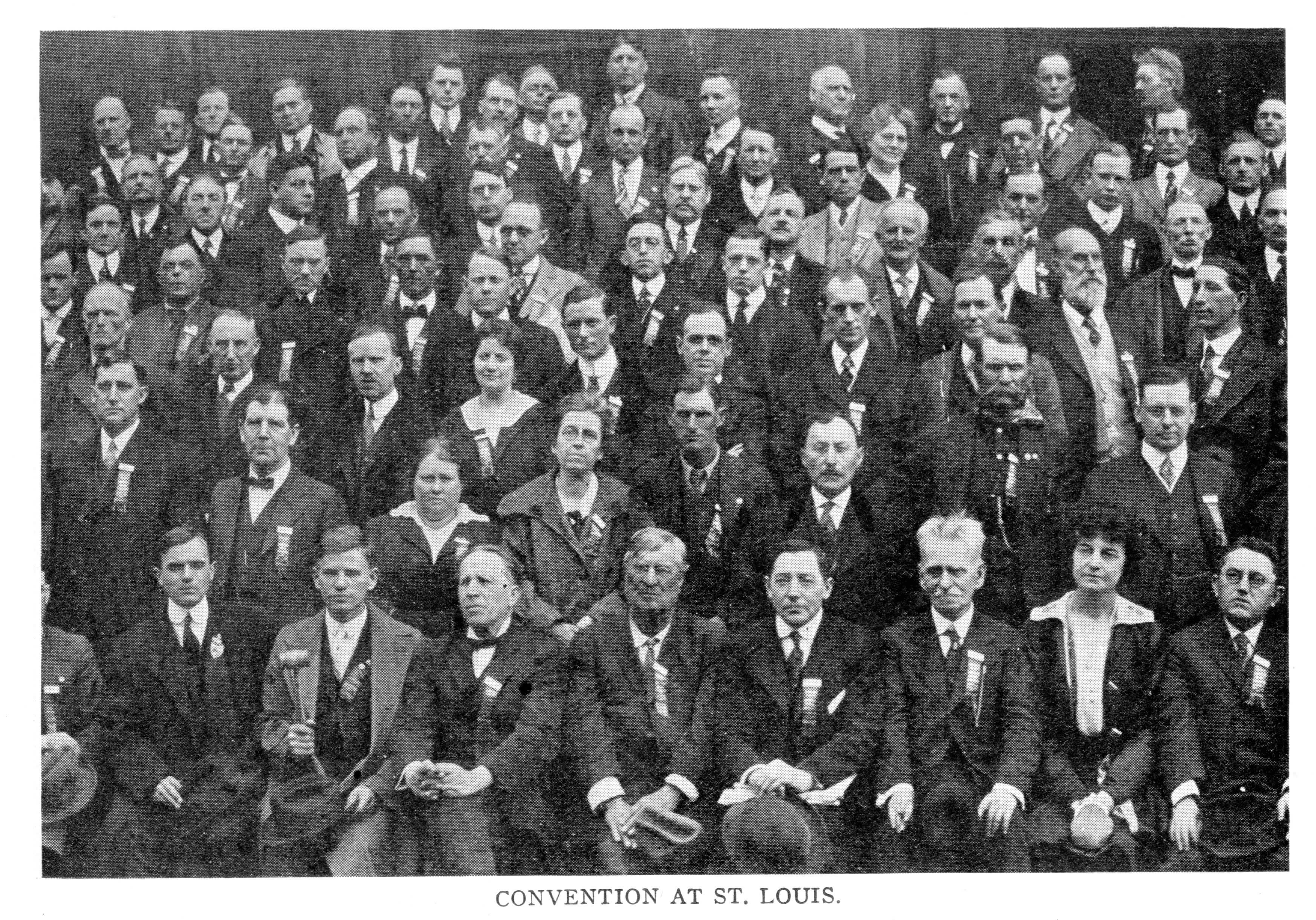
Boudin looks back on the year from the Socialist Party’s historic anti-war congress in St. Louis and sees only chaos. The week-long April, 1917 Emergency Conference in St. Louis met to discuss the Socialist Party’s attitude to US involvement in World War One. A culmination, rather than the beginning of a debate, the first day saw nominations for the fifteen-person Committee on War and Militarism to draft the Party’s position. While the fight with the pro-war Right is well known, there were three positions; the broad anti-war Majority, the Right, and the self-declared Left. From the 200 voting delegates as well as representatives of eight Language Federations, elected were Boudin, of New York along with Kate Sadler of Washington and Walter Dillon of New Mexico representing the Left. The Majority was represented by Kate Richards O’Hare, Missouri; Morris Hillquit, Algernon Lee, New York; Patrick Quinlan, New Jersey; C.E. Ruthenberg and Frank Midney, Ohio; Dan Hogan, Arkansas; Job Harriman, California; Victor L. Berger, Wisconsin; Maynard Shipley, Maryland; Walter Dillon, and George Speiss, Connecticut. Finally Vermont’s John Spargo, for the pro-war Right. The Majority report drafted by Morris Hillquit, Charles E. Ruthenberg, and Algernon Lee, at least rhetorically, asserted a strong anti-war and internationalist position and united broad swathes of a Party moving leftward. John Spargo was the voice for the isolated pro-War minority in the Party already heading for the doors, while Louis B. Boudin presented a Left Wing minority report. Though close to the Majority on many issues, Boudin insisted that the Party recognize the conflict as integral to imperialist capitalism, with the “revolutionary working class…the only social force either willing or capable” of stopping the war, defending democracy and guaranteeing national self-determination. 140 delegates, including many future Communists, voted for the majority report, 31 for Boudin’s report, with Spargo almost completely isolated receiving only 5 votes. Some additions from Boudin’s wing would make it into the final document from the Committee going to the national membership for a referendum as the pro-war Right doubled down and demanded one more try to move the overwhelmingly anti-war Party. With votes returned that July the Majority Report passed 22,345 to 2,752; the pro-war Right was routed and split to found their own short-lived National Party.
‘St. Louis–One Year After’ by Louis B. Boudin from Class Struggle. Vol. 2 No.3. May-June, 1918.
There is only one word in the English language which can adequately describe the state of mind of the Socialist Party with respect to the war on the anniversary of the St. Louis Convention. That word is: Chaos.
Formally the St. Louis resolution still remains unrepealed. But to a large section of the party membership it has long since ceased to be a rule of action. Just how large that section is it is impossible to say, since the party bureaucracy insists on not permitting the party to express itself either by way of a referendum or a congress of delegates specially accredited by the membership to discuss the subject and reach a decision. All that we can say therefore with assurance is that that section is both large and influential. On the other hand it would not be safe to say that the majority of the party membership has given up its opposition to the war, since some of the leaders who have a genius for discovering where the majority stands are still on the fence.
In the meantime confusion reigns supreme.
In New York the Socialist delegation in the Board of Aldermen of the Metropolis vote for Liberty Bonds, under the leadership of the principal author of the St. Louis Resolution; while in Wisconsin, Victor Berger, one of the principal leaders of the party and one of its three delegates to the prospective International Socialist Peace Congress, runs for office on a program demanding the withdrawal of our troops from France.
The New York Call publishes a statement of Allan L. Benson, the Socialist Party’s presidential candidate in the last presidential election, expressing the hope that Berger would be defeated, while the Milwaukee Leader assures us that Morris Hillquit, the National Chairman and International Secretary of the Socialist Party, telegraphed emphatically denying any criticism of Berger’s platform, and expressing the conviction that Berger’s election would be “a triumph for international Socialism.”
Perhaps the best illustration of the confusion reigning within the party, and the attempts made by the politicians to straddle the issue, is furnished by the New York “Conference on the Party’s attitude towards war,” which ended in an utter fiasco after trying for six weeks to get somewhere. Early in March the N.Y. State Executive Committee of the Socialist Party called a Conference to consider the question of the Party’s attitude towards the war in view of recent developments. The conference, which consisted of the members of the State Executive Committee, the Executive Committees of the Locals within Greater New York, the Socialist Assemblymen and Aldermen from New York City and other Socialist functionaries met on March 15th, and after an evening’s discussion elected a Committee of Twelve to draft resolutions and report the same to the Conference.
The Committee of Twelve labored hard for a month, and finally reported a set of resolutions drawn up by the authors of the St. Louis Resolution and agreed to by a majority of the Twelve. The Conference discussed these resolutions and a substitute reported by a minority of the Twelve, at an extremely stormy session (held on April 18th) defeated the substitute, but refused to adopt the majority resolutions, sending the whole matter back to the Committee for further consideration. The Committee thereupon refused to consider the matter any further and “referred” it to the State Convention which is to meet on June 29th-30th.
The outstanding features of the work of this Conference, aside from its failure to agree on anything, is the consistent refusal of the swamp, led by the politicians, to take definite position one way or another on clear-cut issues.
In the Committee of Twelve, the present writer attempted to force the issue of the “Withdraw from Europe” agitation made acute by Berger’s recent campaign, by offering the following resolution:
“In view of the present international situation, we deem all demands for a withdrawal by the United States of its armed forces from Europe at the present time as not in consonance with the principles of international Socialism or the policies of the internationally minded working class, nor with the spirit and intent of the resolutions adopted by the Socialist Party of this country at its Emergency Convention held at St. Louis in April, 1917, and we, therefore, strongly deprecate the same.”
This resolution was voted down. Instead, the Committee adopted the following, under the circumstances utterly meaningless, statement:
“The aim of the Socialist movement is not a partial or temporary peace, nor one maintained through armed power. What we desire is a universal peace, rendered secure by the removal, in the largest possible measure, of the causes which lead to war.”
An attempt was also made in the Committee to force an unequivocal expression of attitude on the war generally, by the introduction of a resolution re-affirming the St. Louis resolution. This resolution, too, was defeated; and the following declaration was adopted instead: “The Socialists of the United States, while maintaining their attitude of steadfast opposition to war, must bend all their efforts in war as in peace to secure needed political and economic reforms for the workers”; followed by some more verbiage of the same inoffensive and meaningless sort.
The advocate of the unequivocal re-affirmation of the St. Louis Resolution thereupon attempted to “put teeth” into the “while” clause by moving to insert the article “the” before the word “war,” so as to bring the declaration into some relation to the present “emergency,” but his attempt failed, the Committee preferring to talk of war generally, rather than of the present war.
In reporting for the majority of the Committee of Twelve, Mr. Hillquit stated that its resolution was intended to reaffirm the St. Louis Resolution “by implication.” But at the same time he offered an amendment which deprived the Committee’s resolution of the last vestige of resemblance to the St. Louis Resolution which it was supposed to “impliedly” re-affirm. As amended by him the passage quoted above read:
“The Socialists of the United States, while maintaining their attitude of steadfast opposition to war among nations as an instrument of social progress, must bend all their efforts,” etc. A statement to which the most rabid pro-war man could hardly take exception.
Needless to say that such a policy of evasion and equivocation can only end disastrously for the party. It must be stopped at once, an unequivocal attitude taken, and a frank and clear statement of our position made. Even a wrong position is better than a policy of equivocation.
We, therefore, heartily endorse the demand made by Eugene V. Debs for a National Convention of delegates duly elected and accredited by the party membership to discuss the situation, with a view of meeting it fairly and squarely, and without dodging any of the momentous issues which these stirring times are pressing upon our attention.
PDF of full issue: https://www.marxists.org/history/usa/pubs/class-struggle/v2n3may-jun1918.pdf
 Revolution's Newsstand