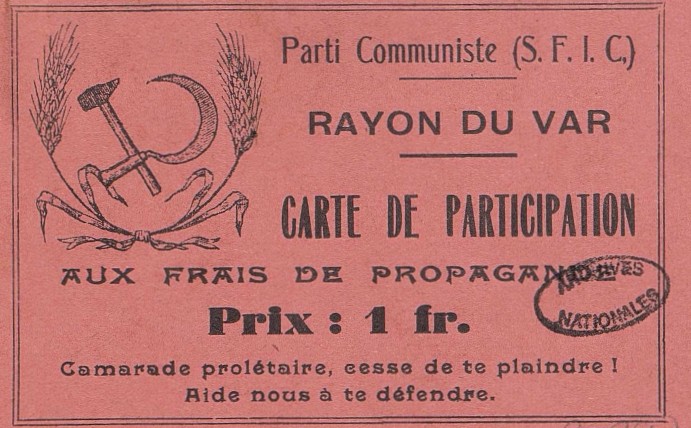
A primer from the Comintern’s position on the battles in the French Communist Party as the Center and Left unite to oust the Right at its 1922 Paris Congress.
‘The French Communist Party and its Paris Congress’ by Franz Dahlem from International Press Correspondence. Vol. 2 No. 95. November 3, 1922.
The convention of the Communist Party of France was held last week (15th to 19th October) in Paris. The task set to the conference was the solution of the acute crisis under which our French brother party has been suffering during the past year. This task has not been carried out with entire success. On the contrary: Five days of heated debate only served to heighten the crisis to the acutest possible degree, to show differences of opinion with a clearness that left nothing to be desired. Moments of dead silence were followed by storms of passion, when the speakers plumbed the utmost depths of their differences, and attacked antagonistic opinions and their representatives openly and without regard for persons, forcing those attacked to give immediate reply. It is perhaps the first time that delegates from every part of France have seen their party as it really is. Until this congress the totality of the French party has never been fully conscious what it means to be a section of the Third International. For the first time the delegates heard severe judgments, out of the mouths of representatives of the International itself, on the role played by their own party. The debates of this Parisian Congress have roused the C.P.F. to its innermost depths. The party feels that it must break with its autonomism, that it has to learn, and to carry out: an iron and international discipline.
The Roots of the Present Crisis.
Two years ago, at the party conference at Tours, the majority of the old Social Democratic Party of France joined the Third International. The defeated minority left the conference and reconstituted itself, acting in the same manner as the minority at the conference of the German Independent Social Democratic Party in Halle. Renaude, Blum, and Longuet, were joined by a number of intellectuals, journalists, and lawyers. These were almost without exception deputies of the Chamber. Thousands of municipal councillors, mayors, etc. took sides with the dissenters.
Despite this, the young Communist Party started life heavily laden with the traditions of the old French Socialism. Its ranks were filled with contradictory elements, held together by a common enthusiasm for the Russian Revolution. The Communistic core, represented by the Committee for the Third International, possessed in itself no unity. It succeeded in setting the Party on the road of the Third International through its work since the congress at Strassburg (1919). But when the executive demanded the dissolution of this committee after Tours, it disappeared in the mass of other elements without having exercised any decisive influence on the Party.
The C.I. itself, realizing the difficulties under which the French section was developing, exercised particular caution in France. The reservations made by the old majority in the Socialist Party, grouped around Frossard and Cachin, against the 21 conditions, were accepted. The C.P.F. thus maintained a certain autonomy. In consideration of the peculiar situation of the French trade union movement, the C.I. made the concession not to interfere with the autonomy of the French trade unions.
This policy, relinquishing as it did strict adherence to the 21 conditions, resulted in the appearance at Tours of a number of elements, belonging to the French section of the C.I., but possessing political views deviating in important points from those of the International, and incapable of ever submitting to strict international discipline. Verfeuil, for instance, who had left the conference hall at Tours with the dissenters, was called back into the session by Frossard amidst the applause of the delegates.
Thus the autonomists, a part of the Second International, remained in the C.P.F.
Another element which remained were the representatives of a trade union tendency, maintaining the principle that economics are solely the sphere of the trade unions, and that the political party has no right to interfere in trade union activities. Finally, there remained pacifist elements, Wilsonians, driven into the Socialist ranks by the horrors and terrors of war and comprehending little of the changing conditions of the proletarian class war. These elements made use of their position in the Party solely for the purpose of agitating against any exercise of force, against all militarism.
When the victorious forward march of the proletarian revolution began to slacken its pace, when the proletarian government of Russia expended the whole of its energy in struggling against its enemies at home and abroad, and against the famine catastrophe, when the German Social Democracy shamefully betrayed and sold the German revolution into the hands of the bourgeoisie, and thus enabled a fresh wave of reaction to sweep over Europe while the wave of revolution ebbed, then, all these elements were no longer carried away by the elan and enthusiasm of the masses. They had their posts in the Party and press, and now hung like leaden weights, hindering the further development of the Party towards the Third International. When the latter made concessions at Tours, it was only with the design of giving its French section time to develop. This initial sabotage on the part of the Right elements, aroused the opposition of the Communistic nucleus, which, though weak, had already formed a group around the Bulletin Communiste. Boris Souvarine in particular, in his capacity as representative of the C.P.F. in the executive, sent from Moscow many severe and even biting criticisms of the party leaders. The crisis in the C.P.F. had begun.
The crisis broke out openly for the first time at last year’s party conference at Marseilles. The majority of the delegates let Souvraine fall with obvious ostentation, failing to re-elect him to the new Central Committee. Upon this, four leading members of the left wing solidarized with him, and resigned their posts in the Central Committee. The executive declared this to be a false step, and proposed that the French section should reinstate these four comrades; this was done by the French Central Committee, but with a very slight majority.
This did not however stem the crisis. Verfeuil, Fabre, Méric, that is, the autonomists and pacifists, continued their former course of action, as did also Mayoux and Lafond, who continued to maintain that the Party should not interfere in trade union matters. The attacks of these elements against the Communist International itself became more and more frequent. The most fundamental principles of the C.I. were questioned and brought up for renewed discussion; the schism of Tours was regretted, and the attempt made to create an atmosphere of enmity against the “Moscow Dictatorship”.
The Question of the United Front Tactics.
Fresh difficulties arose after the III. World Congress, when the C.P.F. was confronted with the question of applying the new tactics of the International. The Party was divided into two new camps. In one camp was the great majority of the Party, without comprehension for these new tactics, and deeming them extremely dangerous; in the other, a small minority possessing an international outlook, capable of seeing beyond the frontiers of their own country, and seeing in the new tactics of the Executive the sole means of winning the working masses for Communism on a basis adapted to the international situation of the class war. We are well aware how difficult it was, even for the German Party, to adjust itself to the new tactics after the Third World Congress. The C.P.F. definitely refused to apply these tactics in France.
The chief reasons for this resistance are as follows: The French proletariat is dominated by a deep distrust of the political party as such, and of all “politicians.” It has happened too often that the masses in France have looked on while the leaders of the Socialist Party have gone over into camp of the bourgeoisie. The names of Millerand and Viviani suffice. During the war Guesdes, Thomas, and Sembat ratified the policy of war, and became coalition ministers. These elements were eliminated from the party at Tours, and the desire is to have nothing more to do with them. The united front tactics, misunderstood, intentionally misrepresented and garbled by their opponents, met with an opposition which was the more unanimous that the introduction of these tactics was regarded as an attempt to approach the dissenters once more, and even to restore organizatory connection with them There is no doubt that after Tours the C.P.F. comprised a part of the best elements of the French proletariat, and gained the confidence of wide masses of workers. And now the Party has been anxiously endeavouring to prove that it is something more than an electoral club, than a refuge for lawyers and journalists, a spring board for future ministers. The united front, under suspicion of being an enormous electoral strategem, was rejected for this reason also.
After this the “French question” appeared more and more frequently at the sessions of the Executive. The French comrades were able to formulate their standpoint precisely in Moscow. They were, however, opposed by every section of the C.I. The totality of the International demanded that the French section carry out the resolutions of the Executive, not only with regard to combatting the right elements within the Party, but also as regards the application of the united front tactics. When Fabre and Verfeuil rebelled openly, the delegates of the C.P.F. in Moscow declared that the Party would exclude them from its ranks, Frossard, Cachin, and Daniel Renoult undertook, at a meeting of the Enlarged Executive, to make a beginning at last with the united front tactics.
But on returning to France, these comrades did nothing whatever to put a stop to Fabre’s proceedings. The Executive itself was obliged to effect Fabre’s exclusion. In the question of the united front Daniel Renoult organized further resistance, while Frossard kept his word, and submitted to the Moscow resolutions on this question.
The Tendencies in the CPF.
It would go beyond the scope of an article to go into all the details of the various factors–especially the attitude of the Party towards the trade unions–which brought about five different currents in the CPF.
The extreme Right with Verfeuil and his friends, who rebelled openly, and for whom there can be no room in a Communist Party.
The group of the Right gathered around Daniel Renoult and Duret, and carrying on a systematic opposition to the tactics of the united front and against the trade union tactics of the C.I. In many cases these marched side by side with the outermost right; so for instance, they organized the violent attack against article 9 of the International Statutes, by the help of which Fabre had been excluded, and demanded its revision. According to their phraseology, they are advocates of “revolutionary action”, but their “action” during the past year has consisted in paralyzing the Party.
The Centre gathered around Frossard and Cachin, men balancing between the various tendencies, unable to decide between Right and Left, and thus remaining in a passive condition rendering them responsible for the latent crisis during the past year. This Centre forms the majority of the Central Committee. Its most prominent representatives hold the leading positions in the Party; Frossard is General Secretary, Cachin, editor of the Humanité. In the completely decentralized organization there is no trace whatever of initiative towards those who have always marched in the line of the International, the central organ passes over or evades the questions of the greatest importance for the French proletariat, “theses being the business of the trade unions”.
The Left, followers of Souvarine and Treint, consist of those who have always marched in the line of the International, who during the last few months have concentrated their powers, not only in Paris, but all over the country, and who will form the real heart of the Party. These are the comrades who have led the struggle for a political and trade union united front. It is thanks to them that the most powerful organization, the Seine Federation, has escaped the clutches of the Anarcho-Syndicalist Federation, and has been able to take its place, in the front ranks of the International. They are still in the minority, but it is their policy that the congress just held has agreed to adopt, and has already adopted by its acceptance of the theses on tactical and trade union questions.
The extreme Left can scarcely be said to exist any longer; its confused and decentralized system of organization having worked out its own decay in the Seine Federation. Its representatives are Heine and Lavergne.
The four first tendencies were represented in the Comité Directeur. Under these circumstances it was impossible to get consistent leadership, a Frossard (Centre), sought to gather all these contradictory elements under one policy,–a vain attempt. The Left attacked sharply. The demands of the Executive, that the international resolutions be carried out, became more and more pressing. “I was torn between antithetical ideas and antithetical policies. I was no longer certain even of myself”. This was Frossard’s declaration on the 3rd day of the Paris Congress.
The Agreement between Centre and Left.
In order to put an end to this situation, the executive suggested that Centre and Left come to an agreement under which the Party would be conducted under joint leadership. This agreement was made. The resolutions submitted by the Left, referring to the general policy and to the united front, were accepted without friction, and were submitted to the conference as Frossard-Souvarine motions. The Left was obliged to withdraw its trade union resolution, as a manoeuvre of the Renoult group resulted in a declaration from the leaders of the CGTU. that the acceptance of this resolution would signify war between them and the Party. The Left was thus forced into a compromise; a trade union resolution combining all the votes of the old Central Committee was patched up.
It was to be assumed with a fair degree of certainty that the great majority of delegates would advocate the Frossard-Souvarine resolutions. It was certain that no representative of the Right would have a seat in the new Central Committee. The solution of the latent party crisis was generally expected from the Paris Congress. This was the state of affairs shortly before the Congress opened.
Centre and Left were united on the Frossard-Souvarine resolutions. Both fractions had defended these resolutions against those of the Renoult fraction. It was a matter of certainty that the overwhelming majority of the Party would gather round the Frossard-Souvarine resolutions.
At this point, the Humanité published a declaration of the Centre, obviously directed against the Left. This declaration objected to the classification of the Party into a number of fractions although the existence of these fractions is a fact that even the Executive acknowledged in its letter to the Congress. Anyone reading the declaration was bound to receive the impression that the differences that caused the crisis were not matters of principle, but of a personal character. The publication of this remarkable declaration threw the membership into renewed confusion. Besides this, Marcel Cachin, one of the chief leaders of the Centre, wrote an article making reservations against the common resolutions. Paul Louis, another comrade holding a leading post in the Centre, failed to give the resolutions full support. The Left was induced to publish a counter-declaration, in which it demanded an explanation from the Centre, as to the object of its declaration. Comrades Souvarine and Treint wrote articles in which they declared openly that for them mutual work was only possible with comrades remaining faithful to the common resolutions, and defending these without reservation. This was the commencement of the Cachin conflict. Then Renoult attempted to drive a wedge into the Centre. All the members of this fraction received circulars requesting them to decide whether they were prepared to see the representatives of the Renoult group excluded from the new leadership and let comrade Cachin fall. This strategy enabled Renoult to divert the important question of the reorganization of the Party, and of the necessity of cooperation between Left and Right, from a pure matter of principle to a mere personal “Cachin case”. The Right elements in the Centre gained the upper hand.
Conflicts over Choice of Leaders.
The Left had drawn up the resolutions with regard to the general policy and the united front, and had submitted these to the Centre. They had been accepted without difficulty by the Centre, and countersigned by Frossard. The policy of the Left, fought for since the Marseilles Congress, had won the day.
Despite this, differences arose as soon as the two fractions began to negotiate respecting the choice of the leaders who were to take up the most important party functions. Last year the majority of the Central Committee were Centrists. On them alone fell the responsibility for the crisis in the Party, for the differences arising between the French section and the International. Its vacillation and hesitation had prevented the non-Communist and sabotaging elements from being excluded. They were responsible for the failure of the Party to carry out the resolutions of the Executive on the united front.
It was therefore more than natural, that the Left, now that its policy had been finally adopted, should insist upon receiving sufficient leading posts to ensure that this policy would be actually carried out. Since Tours, experience had shown often that it does not suffice for party congresses to deciare in favor of the policy of the Communist International, if this policy is afterwards not carried out by the men at the head of the party.
Frossard wished to resign. The Left, acting in agreement with the Executive, held it to be absolutely necessary that Frossard retain his position. He is one of the strongest powers in the French Party, who has always succeeded in mastering the most difficult situations, and has proved himself, fully equal to cope with the duties undertaken by him at the Enlarged Executive Session in June. Frossard was therefore to remain General Secretary of the Party. The Left, acting on the principle of parity in the distribution of leading functions, claimed the leading post on the Humanité. It demanded that the position of director of the Humanité be done away with, as the paper was to be politically conducted by the political office in the future. The chief editor of the central organ, responsible to this political office, was thus to be one of the comrades of the Left.
A similar arrangement exists in the German, the Russian, and the Italian parties. It is the sole arrangement possible in the Communist Party. The central organ is not something which differs from the Party itself. The policy of the paper cannot and must not be other than the expression of the policy of the Central Committee of the Party.
The Centre declared this proposition to be unacceptable. To them it was an attack against the person of Marcel Cachin, up to now director of the Humanité.
As the two fractions could not come to an understanding on this point, the delegation of the Executive proposed perfect parity between the two fractions in all leading posts, that is equality, in the Central Committee, in the political bureau, Frossard as General Secretary, a member of the Left Assistant Secretary, Cachin and a member of the Left as directors of the Humanité.
The Left declared itself in agreement with this proposition of the Executive. The representatives of the Centre reserved decision until their fraction conferred.
This was as far as the negotiations between the two fractions had gone by the third day of the congress. We have gone into these preliminaries into detail, as this is the critical point of the whole Paris Congress. The first two days had passed quietly. The organization and press reports had been debated, and the discussion on the general policy of the past year had begun. Comrades Henri Sellier and Marie Mayoux, confronted by impending exclusion, had done their utmost to poison the Party conference by repeated interventions. The representative of the Italian section had criticized the French section severely, and had awakened in the delegates the consciousness that they had a great deal of work before them before they could hope to form a fighting section of the Third International.
Breach of the Agreement by the Centre; Refusal of the Arrangement proposed by the Executive.
On the third day, Ker mounted the tribune. The Centre had resolved to attempt a trial of strength. The fraction meeting had decided to decline the arrangement proposed by the delegation of the Executive, and to bring the question of the occupation of leading posts before the congress, which, in its sovereignty, was to decide. Ker supported this with arguments calculated to give every delegate the impression that the Party crisis consisted solely in a race on the part of the Left for leading positions, and of a personal attack on Cachin. He declared that the breach with the Left was already complete, and that the congress would have to decide whether the French party had or had not the right to choose the men who were to be placed at the head of its organizations.
The fat was now in the fire. The situation was poisoned, the delegates were thrown into a state of the wildest excitement. In this situation, and to wipe out the reproach of pursuing a personal policy, a declaration was made by Souvarine, spokesman of the Left, to the effect that, after the attitude adopted by the Centre, the Left proffered to abstain from being represented at all in the leadership of the Party.
Scarcely any more interest was felt in the actual congress debates. Comrade Manouilsky rose to speak amidst the unanimous enthusiasm of the whole congress. He demonstrated with the utmost clearness that the attitude of the Centre had created a second Leghorn in France. He retailed the history of the French Party since Tours, and told the French delegates a number of truths such as they had never yet heard from the lips of a representative of the Executive. He placed himself without reservation on the side of the Left, and declared that without their capable assistance it would be impossible to form a Communist section with actual fighting powers.
On the fourth day, the central point of the debates was formed by the speeches of Frossard and Souvarine. As Souvarine made comrade Frossard responsible for the party crisis, the latter explained his policy during the past year with the utmost candour. He declared that for two years he had been divided between his faithfulness to the International and the interests of the Party, and that he was continually striving to combine these. When confronted by certain decisions of the International, which he held to be impossible of execution, he had adopted the policy of trying to gain time, so as not to harm the Party. In the course of the past year the situation had however changed, so that he could now keep the promises which he had made in June at Moscow, and undertake to carry out the line of tactics of the International even in France. He declared himself prepared to continue this policy. He expressed himself in full agreement with Ker, and declared that the Centre was willing to assume the full leadership. After Frossard, comrade Dahlem rose to speak for the German party. He also told the French delegates candidly what the International thought of their party, and emphasized the great responsibility borne by the CPF. in the international proletarian struggle.
The decision was reached at the last session of the congress, which lasted all night until noon of the following day. The Left had brought in a motion in favor of temporary acceptance, until the IV. World Congress, of the proposition made by the delegates of the Executive. Cachin, for the Centre, submitted a list of 24 members of the Centre for seats in the Central Committee. When it was put to a vote, the result was as follows: Centre motion: 1698 votes; Left motion: 1516 votes; 814 abstaining.
After this, Vaillant-Couterier read a resolution of the delegation of the EC., addressed to the Left, and containing the words: “Faced by a French Leghorn, the International demands of the Left that they enter the Central Committee on a basis of equality, and that they accept every position with which the congress entrusts them.” Having thus acceded to the will of the International, and after having obtained the agreement of your fraction to the step, you may declare that you reserve the right to appeal against the situation so created at the IV. World Congress.”
A short interruption of the congress followed. Ker and Maranne, in the name of the left wing of the Centre, were now willing that Centre and Left should come to an agreement on this basis. The majority of the Centre decided, however, to hold to their original motion. Cachin declared this to the congress, upon which the Left made the counter-declaration that they would now abstain from voting all questions, and would appeal to the Fourth Congress. Thereupon the 24 members of the Centre were elected by mandate, without voting, as it was merely a question of a temporary measure until the IV. World Congress.
Results of the Congress.
The Paris Conference has thus been unable to solve the crisis completely. The French question will occupy the IV. World Congress. We are firmly convinced that at this congress the crisis will be successfully met. The Paris Congress itself signifies a great step forward. The Party has excluded the elements assembled around Verfeuil, as well as those of the Mayoux faction, and has thus shown that there is to be no more tolerance of sabotage on the part of anti-Communistic and undisciplined elements. Further, the overwhelming majority of the congress has adopted the policy of the Left, by accepting the resolutions on the general policy, on the united front tactics, and on the trade union question. It is imperative that the comrades of the Left now see to it that this policy is really carried out, and that they assist in the leadership. The numerous resignations of comrades of the Left from leading party positions are perfectly incomprehensible to us. This resignation tactic is perfectly futile, and our comrades of the Left must permit us to tell them this in all friendliness. Temperamental demonstrations do not further the cause. The duty of the Left is to place all available power at the service of the Party. The proportion of the groups represented in the congress show that all over France, not only in the Federation of the Seine, but in every province, there exist good elements ready and willing to create a strictly disciplined Communist Party. The whole International will help them in this work. Long live the Communist Party of France!
International Press Correspondence, widely known as”Inprecorr” was published by the Executive Committee of the Communist International (ECCI) regularly in German and English, occasionally in many other languages, beginning in 1921 and lasting in English until 1938. Inprecorr’s role was to supply translated articles to the English-speaking press of the International from the Comintern’s different sections, as well as news and statements from the ECCI. Many ‘Daily Worker’ and ‘Communist’ articles originated in Inprecorr, and it also published articles by American comrades for use in other countries. It was published at least weekly, and often thrice weekly. Inprecorr is an invaluable English-language source on the history of the Communist International and its sections.
PDF of full issue: https://www.marxists.org/history/international/comintern/inprecor/1922/v02n095-nov-03-1922-inprecor.pdf
 Revolution's Newsstand