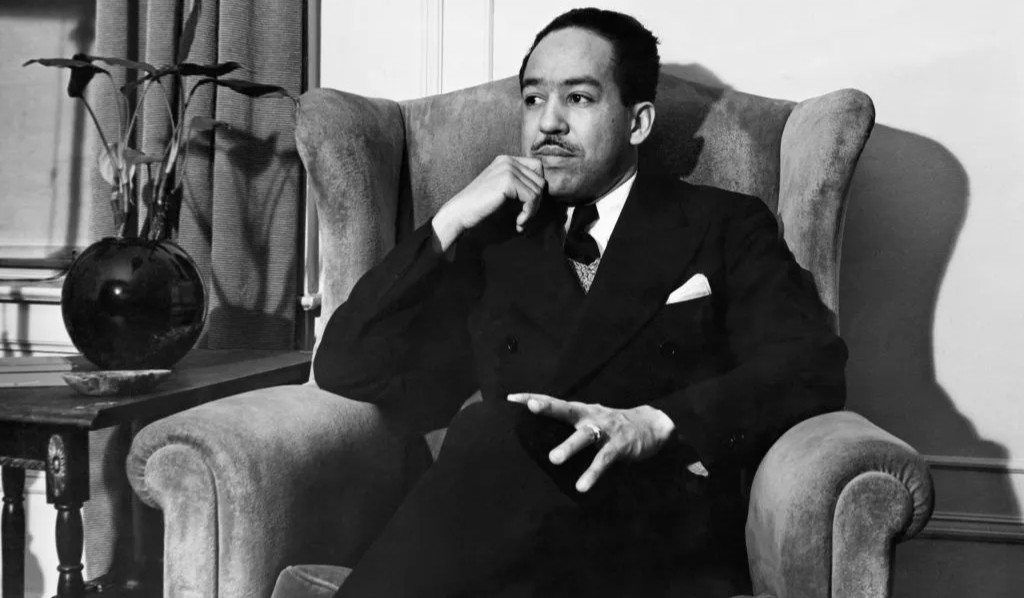
Inspired by a visit to a village on the Niger Delta during what would be a defining experience of his young life. In 1923 a 21-year-old Langston Hughes, adrift after dropping out of Columbia, got a job on the crew of the S.S. Malone traveling to West Africa and eventually to Europe.
‘Burutu Moon: An Evening in an African Village’ by Langston Hughes from The Crisis. Vol. 30 No. 2. June, 1925.
LIFE is a ripe fruit too delicious for the taste of man: the full moon hangs low over Burutu.
We walk through the quiet streets of the great native-town, my comrade and I. There are no pavements, no arc-lights. Only the wide grassy streets, the thatched huts and the near, low-hung moon. Dark figures with naked shoulders, a single cloth about their bodies and bare feet, pass us often, their foot-steps making no sounds on the grassy road, their voices soft like the light of the orange-gold moon. Through the open doors of some of the houses, fires gleam. Women move about preparing food. Peace is everywhere. In the clearing great mango trees cast purple shadows across the path. There is no wind. Only the moon, peace and the moon.
“How still it is,” I said to Pey.
“Yes, how still,” Pey replied, “but bye and bye they make Ju-ju.”
“Tonight? Where?” I cried excited. “I want to go.”
Pey shook his head, but pointed toward t e edge of the town where the wall of the forest began. “Christian man no bother with Ju-ju,” Pey said. “Omali dance no good for Christian man.”
“But I want to see it,” I insisted.
“No, him too awful” Pey cried. “White man never go see Ju-ju. Him hurt you! Him too awful! White man never go.”
“But I’m not a white man,” I objected. “I’ll…”
“You no black man, neither,” said Pey simply. So I gave up going to the Ju-ju.
We were invited to the house of Nagary, the trader. It was a little larger than the other houses. There were two or three small rooms. We sat down on the floor in the first room, the moon-light streaming through the door-way. A large, green parrot slept on a wooden ring hung from the ceiling.
Nagary was an old Mohammedan in voluminous, long robes. He must have been a large, strong man in his youth. There was a lingering nobleness in his dark, old face and proud carriage Nagary called his wife. She came, a pretty, brown woman, young, much younger than Nagary. Her own body was wrapped in a dull red cloth of rich fiber. She spoke no English, but she smiled. Nagary sent her for two candles. Nagary sent her for the only chair, which she offered to me. Nagary sent her for three heavy boxes which she placed before him. Nagary opened the boxes. Then he showed us beaten brass from up the Niger; statuettes that skilled hands had made; fiber cloth woven by women in far-off villages; the skins of jungle animals and the soft white feathers of birds found in the dangerous forests of “the bush”.
Nagary opened the third box with a rusty key. It contained a fortune in ivory. Great, heavy bracelets for women when they marry; solid ivory tusks, smooth and milk-white; little figures and tiny panels, intricately carved; and one great white tusk circled with monkeys and coiled snakes. Nagary did not ask me to buy any of these things. He seemed satisfied with my surprise and wonder. He told me of his trips up the river to Wari and down to Lagos. He gave me a great spray of feathers. When I left, he said, with outstretched hands, “God be with you”.
When we came out the moon had risen in the sky. It was not so large now, but it was brighter, much brighter. I had never seen a moon so bright.
We turned into a narrow street. There there was a bit of animation. Men were walking up and down. “This is where the whores stay,” said Pey. And even here the oldest profession flourished. The women of the night stood before low doors with oiled hair and henna-dyed nails. In the golden light, they were like dark flowers offering their beauty to the moon. With slender bodies wrapped in bright cloths, they waited for lovers. They said no word to those who passed. They stood still, waiting.
In front of one hut three white young sailors were bargaining with an old woman. Behind her, frightened and ashamed, stood a girl of fifteen, a virgin. The price was four pounds. The sailors argued for a cheaper rate. They hadn’t that much money.
We crossed the dry bed of a creek. In the distance we heard the drums of Omali, the Ju-ju. Their measured beating came across the swamp-lands at the edge of the forest. Tonight the natives danced to their strange Gods.
We turned back towards the docks and followed the river road. Hundreds of tiny house-boats lay rocking at their moorings, each with its lantern on a slender pole. The long, flat, paddle-wheel steamers of the Niger were anchored in mid-stream. The river flowed quietly under the moon.
We came to the docks where the great ships from the white man’s land rested,—an American boat, a Belgian tramp, an English steamer. Tall, black, sinister ships, high above the water. “Their men,” say the natives, “their white strong men come to take our oil and ivory, our ebony and mahogany, to buy our women and bribe our chiefs…”
I climbed the straight ladder to the deck of my ship. Far off, at the edge of the clearing, over against the forest, I heard the drums of Omali, the Ju-ju. Above, the moon was like a gold-ripe fruit in heaven, a gold-ripe fruit too sweet for the taste of man.
The Crisis A Record of the Darker Races was founded by W. E. B. Du Bois in 1910 as the magazine of the newly formed National Association for the Advancement of Colored People. By the end of the decade circulation had reached 100,000. The Crisis’s hosted writers such as William Stanley Braithwaite, Charles Chesnutt, Countee Cullen, Alice Dunbar-Nelson, Angelina W. Grimke, Langston Hughes, Georgia Douglas Johnson, James Weldon Johnson, Alain Locke, Arthur Schomburg, Jean Toomer, and Walter White.
PDF of full issue: https://archive.org/download/sim_crisis_1925-06_30_2/sim_crisis_1925-06_30_2.pdf
 Revolution's Newsstand