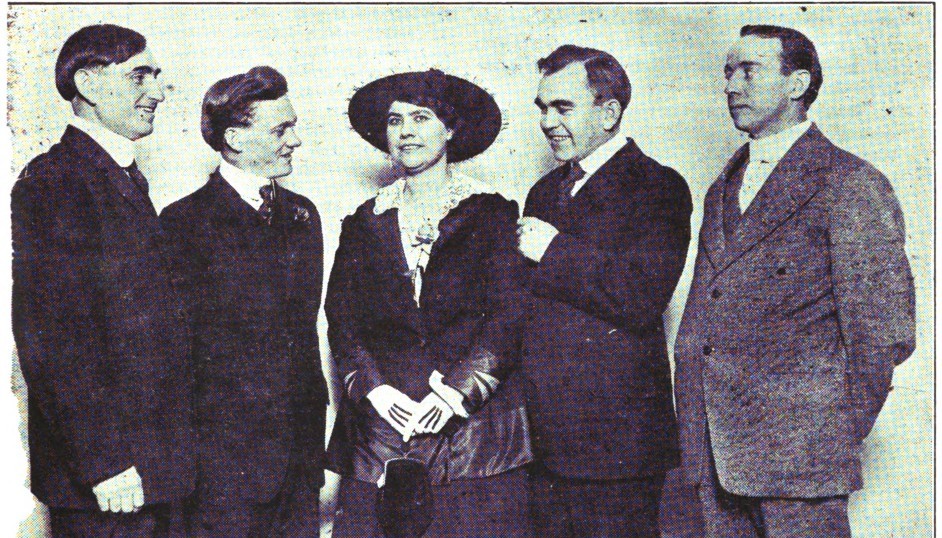
Robert Minor reports from the courtroom as Tom Mooney is sentenced to die in the frame-up trials of he, his wife Rena, and their his comrades from the 1916 Preparedness Day Bombing in San Francisco. His sentenced commuted to life in 1918, Mooney would spend 22 years in Federal prison before his pardon in 1939.
‘In the Shadow of the Gallows’ by Robert Minor from The Blast (San Francisco). Vol. 2 No. 2. February 15, 1917.
A NERVOUS, pale-faced crowd of Tom Mooney’s friends hastened back to the courtroom after a quick meal in coffee houses, whilst the jury was dining in charge of the bailiff and guarding the secret of Mooney’s fate. The dimly lighted room was soon filled with faces full of question and of pallor, offset here and there by the cynical smiles of detectives.
A bailiff whose heart seems still to reside with him despite his profession, showed a visage upon which was written tragedy. “Where’s the judge? There will be a verdict in ten minutes. Get the lawyers, quick!” The tensest hour I have ever known, filled by a thousand sobs from Rena Mooney’s sister, trembling efforts of Annie Mooney to smile, and the low unconscious moaning of “Mother” Mooney, displaced the expected ten-minute wait.
The courtroom is different from its usual appearance at night. It seems puzzlingly unofficial. For one thing, an assistant district attorney’s wife was not there, laughing at a man’s plea for his life.
Assistant Prosecutor Brennan came in waddling, contented, eager. He sat in a juryman’s chair, miscellaneous attaches gathering around him. District Attorney Fickert entered grinning. Assistant District Attorney Cunha seated himself and called a giant plainclothes man, whom he carefully placed between himself and the defendant’s friends. The big “bull” completely covered Cunha’s little body from sight. By these signs, hope was given farewell. Rumors of the worst sort flew from whisperer to whisperer. We lied to “Mother” Mooney. Some one sent a new and conclusive word across the room.
The coarse, metallic laugh of Jim Brennan, lolling back in the juror’s chair, broke the semi-quiet. Then we knew that Tom Mooney was slated to die. Cunha looked coyly from behind his big policeman, toward “Mother” Mooney who rocked back and forth in her place, moaning, moaning with her eyes closed.
The Judge was fetched.
The jury came in. William V. MacNevin, real estate man, held the verdict in his hand. He was foreman; I wondered why.
“We, the jury, find the defendant–find Thomas J. Mooney, the defendant in the above mentioned cau–where do I begin to read?–find the defendant guilty of murder in the first degree.” His fumbling hands could hardly hold the shaking paper. Mr. MacNevin, real estate man, looked at the Judge, and the Judge didn’t look very happy or triumphant; and then MacNevin looked at the crowd and changed his eyes quickly to the face of Cunha.
“Guilty?” I think every friend in the room asked himself, “guilty?” Isn’t it possible that he said “not guilty?” Didn’t we miss the word “not”?
Annie Mooney screamed. “Mother” Mooney’s moaning changed to a shriek that seemed to come from a thousand mothers’ hearts. Mrs. Weinberg arose, stood for a moment dumb, then fell without a sound upon the floor.
Above the confusion rose the bellow of Fickert: “Get ’em out o’ here!” They dragged “Mother” Mooney out by the arms, and Annie and Mrs. Weinberg were carried out.
There was but one calm man in the room. It was Tom Mooney. Standing erect, he looked for a moment at William MacNevin, real estate man, and then Tom smiled and turned about. “Don’t cry, Sis, it’s all right. Don’t cry, Mother.” The handcuffs closed about his wrists and Tom disappeared through the door that leads to–
The “bulls” were driving the crowd out. The bulls were happy, triumphant. “Get them out of here,” shouted Fickert, with clenched fists and a grin. Suddenly he found himself facing Rena Mooney’s sister. She looked at him. Fickert turned away and for the moment stopped his grinning. The “bulls” didn’t even hesitate to lay hands upon the lawyers of the defense. It was their day, and they always have resented Mooney’s having a defense.
The newspaper men stopped their interviewing of ex-jurymen for a moment while the wail of Annie Mooney echoed through the corridors and died out as she was carried through the door below.
“Puff!” of a flashlight; William V. MacNevin, real estate man, is having his picture taken, standing just right, as the newspaper photographer instructed him, with the paper in his hand upon which was written “We, the jury–” The last of them filed out. The courtroom was still, scraps of paper on the floor, an upset chair, and an overturned cuspidor, in the dim light.
The next day many compliments were given. We heard some of them about the saloons in Real Estate Row. “Good boy, Mac, you done your duty. We’ll get you back on the Real Estate Board”! The remarks were addressed to William V. MacNevin, real estate man. Later Mr. MacNevin replied to a question (the question being unheard), “Well, I don’t know as I will make as much money out of it, anyway, as I lost by serving on the jury.”
So was Tom Mooney condemned to die, “hanged by the neck until dead.”
The means used to this purpose have not been limited by anything but the bounds of the imagination of the tools of the “Frame-Up System.” When once the “slimy mind of Private Detective Martin Swanson” decided upon this opportunity to destroy the enemies of Swanson’s masters, there was nothing too vile to be used to that end. The heat from the fire of the bomb had hardly cooled from the concrete pavement before sledgehammer and crowbar were put to work to manufacture an artificial “scene of the explosion” to be photographed by the police as fake evidence. This happened within a few minutes of the time that Swanson was put to work on the case, and the place was in charge of the famous “Frame-Up Steve” Bunner when the sledgehammer work was done.
The Frame-Up System gets witnesses exactly as a stage manager recruits a stock company–by simply hiring them. It was with an offer of $5,000 that Swanson tried four times during the week preceding this explosion to get Arthur Silkwood, Billings and then Weinberg to sell Mooney into his hands for alleged streetcar strike activity. So were witnesses recruited with which to convict Billings for the bomb crime, as Billings had refused to sell Mooney; and thus also is to be kept Swanson’s promise to revenge himself upon Weinberg for refusing to sell Mooney.
Seventeen thousand dollars were offered as a reward for evidence against “the perpetrators of the bomb crime.” A beautiful collection of: one prostitute, her mother, one convict, one drug victim, one live-by-his-wits private detective out of a job, and two women of unenviable standing–was brought to the “Stock Company” to play the death play against Billings. Billings was duly convicted upon the words of this crew, although each contradicted the others, and it was proven that at least one of them was testifying for cash in hand. The criminal records of these persons were successfully concealed until after the conviction of Billings.
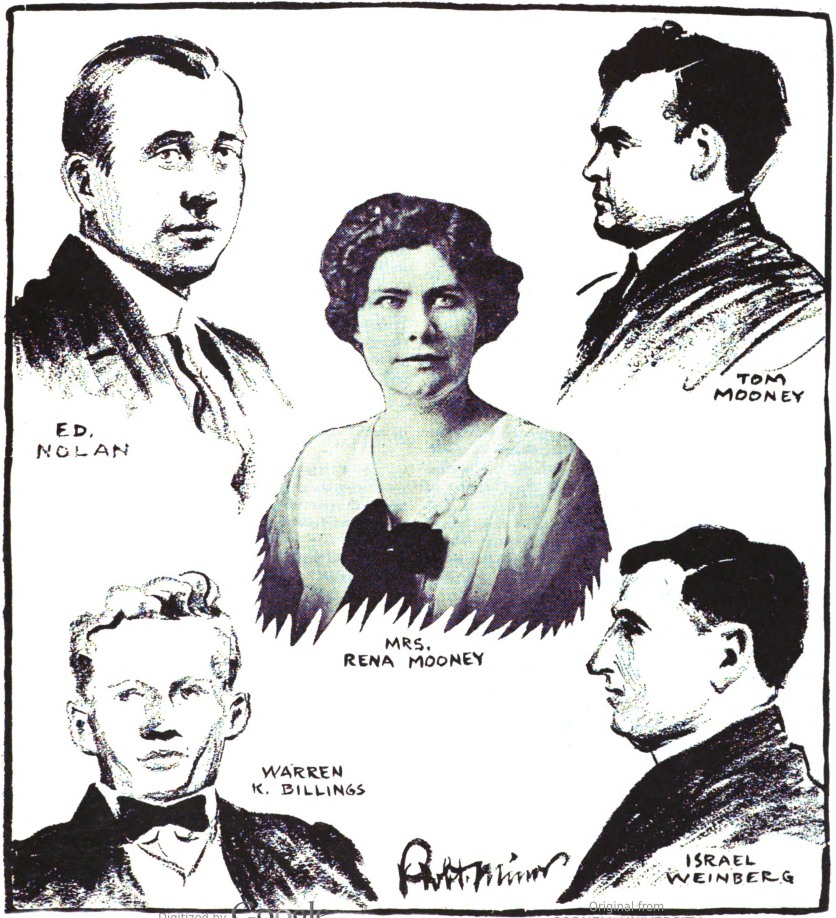
As soon as the characters of the State’s witnesses against Billings were fully ascertained, several of them were dropped and a new set was procured for the trial of Mooney. On and on they go, with a new set of perjurers for each of the five victims.
Estelle Smith, once indicted for murder, arrested in a bawdy house in Los Angeles, and notoriously lacking in veracity, was discarded as a witness, after convicting Billings and then having her reputation uncovered. Her mother, Mrs. Allie Kidwell, was discharged from her witness job even before the Billings trial, because the defense found a letter written by her telling how she was to receive as a reward for her testimony the pardon of her husband in Folsom penitentiary. It is not known whether her brother, who is in San Quentin, was also to be released or not.
John Crowley, who served to convict Billings by swearing that he saw the boy, a block away from the scene of crime, refuse to take his hat off when the band played the “Star Spangled Banner”–John Crowley was dropped as a witness because the defense had turned up the fact that he was an ex-convict for having given the syphilis to a seventeen year old girl, and that he was out on parole from another conviction for stealing a watch at the time he testified.
Louis Rominger was fired from his job as a witness against Mooney because, since he testified in the Billings case, the defense had published its proof that he had first declared Billings not to be the man he had seen, and that later he changed his statements upon the importunity of an assistant district attorney and of his fellow witness and friend, Estelle Smith.
Mrs. Mellie Edeau and her daughter Sadie were not discharged from their positions as witnesses, but merely given new lines to speak upon the stage that is called the witness stand. Each one suddenly remembered a lot of new things, Sadie explaining that she had not at first told the detectives because they had called “so near church time” that she hadn’t time enough to tell it all. Her mother, however, assured the court that she had “told an elder of her church” all about it, and that “she didn’t want no blood money.”
John McDonald, the star witness of the Billings case, was kept on the job for the hanging of Mooney. Before being allowed to “go east on the cushions with plenty of change in his pockets,” as he had explained to his friends, however, John had to change his story in two respects. For the defense had discovered that the district attorney had defrauded them in the Billings case by the suppression of photographs of Tom Mooney on the roof of his home at the very moment that John, the cocaine-sniffer, saw him a mile and a quarter away at the scene of crime. The prosecution had been ordered to turn these photographs over to the defense, but they had served their case and convicted Billings by fading the photographs out until the time could not be discerned on the street clocks showing in the pictures. Before Mooney came to trial, the defense discovered that fraud and forced the police to allow the great hand-writing expert, Theodore Kytka, to make enlargements from the films. These enlargements showed that Mooney was on the roof of his home at two minutes to two o’clock, one minute past two, three minutes past two, and four minutes past two. So John McDonald changed his testimony in the Mooney case, blandly denying what he had said in the Billings trial and placing the time that he said he saw Mooney, at sixteen minutes earlier.
When the defense announced the deciphering of the time on the street clock as one minute past two, the prosecutors published the statement that they had a witness to swear that Mooney entered his home at two o’clock. And we don’t doubt that this witness would have appeared on the stand, had not the prosecution discovered later that the defense had also made out the time on the other picture as 1:58. So the two o’clock witness was dropped.
John McDonald had sworn in the first trial that Mooney and Billings both left the scene by “crossing the street through the parade” on foot, going each in a different direction. The discovery of the aforesaid clocks, however, did not leave sufficient time for Mooney and his wife to travel from the crime scene to their home on foot, so this time John McDonald swore that he did not see them “cross the street through the parade,” but lost sight of them on the near side of the street, together. Thereupon appears Frank C. Oxman, “worthy of credence,” as the district attorney shouted, because he was “worth a million dollars, a wealthy cattleman from Oregon.” The story of Oxman is not fully known at present, but rumor has it that a prominent keeper of redlight cafes turned him over to Fickert to use as a witness to hang Mooney. We do know this much: that that cafe-keeper was in need of Fickert’s favor at the time, for the Rev. Paul Smith’s vice crusade was on. And the resort-keeper got the favor, too, for his resorts have not been closed, as have nearly all others.
“Frame-Up Steve” Bunner it was who went to Oregon after the cattleman-witness. That in itself was suspicious; but what can you prove? Oxman blandly took the stand and supplied EVERY MISSING LINK IN THE STATE’S CASE. He swore that he saw all four of the defendants (except Nolan, whom the prosecution wants to let out as sop to Labor Unions) at the scene of the crime. Perfection itself falls short of the testimony given by Oxman. He assured everyone that he was a “country gentleman,” and that he loved his wife and was rich. Under cross-examination he pulled from his pocket a telegraph envelope on which was written the number of Israel Weinberg’s jitney bus! He had even taken the number of the automobile, “thinking those fellows had stolen the suitcase.” Hardly ever has so dramatic a scene been witnessed as that when Oxman pulled from his pocket this damning bit of “proof.” Hope fled from the room and the vision of five bloody nooses took its place.
Tom “Mooney was condemned to death upon the word of Frank C. Oxman. No matter that John McDonald had contradicted Oxman; no matter that Oxman lied in saying that Captain Matheson was not in uniform, and Captain Matheson said that he was; no matter that it was impossible for a jitney bus to go down Market street at the time that the parade was in motion, and in violation of every police regulation; and no matter that Tom Mooney was known to every policeman on the street, as the recent streetcar strike leader, and would have been stopped for that fact alone.
Nor did it matter that the defense proved by photographs and the evidence of a City Supervisor, a police chauffeur, a reporter for the Oakland Tribune, another for the Chronicle, and a newspaper photographer, that it was they themselves who went down Market street at that time seated in the automobile exactly as Oxman described the Mooney party. No matter that Supervisor Andrew J. Gallagher answered the description of “a fat-faced man” that Oxman gave of Mooney; Spangler, the Tribune reporter, being wonderfully like Billings and exactly his size; and the police chauffeur is amazingly like Weinberg! No matter that it was proven by photographs that no other automobile was at that corner, during any of the time mentioned by Oxman, except that official car driven by the police chauffeur! No matter anything, for the Chamber of Commerce jury, a business man’s jury, wanted but an excuse to hang the “agitator.”
Tom Mooney stands condemned to death on the word of Frank C. Oxman, who appeared to be drunk on the witness stand. It is a choice in San Francisco between the professional jury of hungry two-dollar-a-day graft-seekers and the jury chosen from the Chamber of Commerce and business element.
This is the Frame-Up System!
By switching witnesses, putting on a new set as fast as the old are found out; by “planting” evidence! A retarding coil from a telephone switchboard was “planted” at the scene two days after the crime and offered as an exhibit of a “dry-cell battery!” Just as catalogs from the Hercules Power Co., “planted” in Mooney’s studio when Martin Swanson searched it in Mooney’s absence, were shown to the jury and then quickly withdrawn when Mr. Cockran made his attack upon the Swanson frame-up. Just as Oxman was aided to identify Mooney by being shown the number of his cell on the roster of prisoners, looked at Mooney locked alone in his cell, and then “identified” him by the number of his cell. In this same way the Edeau women, the Smith woman, the Kidwell woman, McDonald the cocaine-sniffer, and all the rest, “dentified” all of the prisoners by having them pointed out to them, and even introduced to them by name so that they could identify them and earn the reward money.
Twenty-five witnesses and seven photographs proved that Mooney was not at the scene of the crime. But the jury believed Oxman, the “home-loving cattleman”; and Mooney was condemned to drop through the death trap at the end of a tarred rope.
And Fickert, the same prosecutor who had laughed in old “Mother” Mooney’s face upon the death sentence of her son, took advantage of the blow of the conviction to announce in the next morning’s papers that a tremendous conspiracy of “anarchistic criminals” all through the United States was soon to be proven and the anarchists rounded up and hanged. Frank C. Oxman had done his work well. The resort-keeper is running at full blast, and William V. MacNevin, real estate man, is to be given back his place on the Real Estate Board for his services as foreman of the jury.
Then suddenly the frame-up of the Oxman testimony was exposed!
Mrs. R.E. Le Posee, wife of a shoe clerk, happened to remember Frank C. Oxman. He had come into a dry goods store where Mrs. Le Posee worked in Portland, Oregon–had come in with a woman to buy a dress, and the woman had whispered to Mrs. Le Posee that she had a “live one,” and to bring out something worth while. Later Mrs. Le Posee happened to be in a cafe in company with her husband and to have seen the “home-loving cattleman” makes signals to a female entertainer by holding up “five fingers twice.”
The pitiful fact, the desperate situation in which a labor man is placed in trying to defend himself, is illustrated by the fear that Mrs. Le Posee had that her husband would lose his job if she dared to tell the truth. (See in this issue the letter of a policeman engaged in the frame-up, who cannot tell, because he would lose his job.) Mrs. Le Posee was in the courtroom when Oxman testified. She had seen him a mile away at exactly the time that Oxman was supposed to be identifying the Mooney party at the scene of the crime. Mrs. Le Posee had a long, hard struggle with her conscience before she came forward, but her husband happened to have an honest, employer who promised that Le Posee would not lose his job for his wife’s telling the truth. And so it seems, and so we hope, that Tom Mooney’s life is to be saved from the Frame-Up System by this new discovery.
But now we hear that the police are besieging the little woman in her home, threatening her there and threatening her husband at his place of employment.
Is there any depth to which they will not stoop? To hire witnesses, buy witnesses, trade red-light favors for the testimony of cafe drunks!
“It isn’t your bloody noose about my neck that hurts,” said Tom Mooney. “It’s the knowledge that men can be so base.” So we hope for a new trial for Mooney. Surely Judge Griffin, who has had the courage to defy some of the most disreputable acts of the prosecution, will have the courage now to grant Tom Mooney another trial. And you, Labor, must keep your shoulder to the wheel, support this fight now, and we may yet win.
Tom Mooney says: “There is just one place to which we can look for any aid, and that is the united efforts of Organized Labor. John Lawson, one of the biggest labor men in Colorado, was headed for the gallows, as I now am, because he dared raise his voice in behalf of the toilers. He is a free man today and he owes that freedom to Organized Labor. That alone saved him, and that alone can help us.”
Alexander Berkman’s incendiary-titled ‘The Blast’ began after Berkman left New York City, and his editorial position with Emma Goldman’s ‘Mother Earth’ he had held since his release from prion in 1906, to organize the ‘Anti-Militarist League’ and anarchists circles across the country in opposition to the war and associated repression. Published semi-monthly in San Francisco, California, beginning in January, 1916 with the first issue carrying a cover legendary cartoonist Robert Minor and this statement: ‘Before a garden can bloom, the weeds must be uprooted. Nothing is therefore more important than to destroy. Nothing more necessary and difficult…To destroy the Old and the False is the most vital work. We emphasize it: to blast the bulwarks of slavery and oppression is of primal necessity. It is the beginning of really lasting construction.’ Twenty-nine issues were published, with special attention paid to the war, political prisoners, and the labor movement in California. Berkman was arrested in June, 1917 for encouraging resistance to the draft and The Blast, like so many radical journals of the time, fell to Federal repression. Berkman spent two years in Atlanta Federal Prison before being deported to Russia in 1919.
PDF of full issue: https://hdl.handle.net/2027/coo.31924007352614?urlappend=%3Bseq=175%3Bownerid=13510798903357346-181
 Revolution's Newsstand