Abdullah Safdar (I believe) on the background of and reaction to the growth of communalism in British-controlled India as the movement for independence developed.
‘Hindu-Mussulman Strife’ by Safdar from The Communist International. Vol. 4 No. 5. March 30, 1927.
HINDU-MUSSULMAN antagonisms are a great obstacle to the organised struggle of the Indian nationalist movement. This movement has been experiencing a decline since the end of 1922. In 1920 and 1921 it was a serious menace to British imperialism in India. For the first time in the history of the country the movement became a real mass movement. In some places it broke out into open rebellion, in the form of a conflict between the poor peasants and the city workers on the one hand and-the authorities on the other. Naturally, at that time neither the government nor the Indian nationalists could devote themselves to stirring up Hindu-Mussulman strife. The movement was so powerful that they were filled with consternation. However, the Liberal leaders of the Indian National Congress got scared at the dimensions and character the movement was assuming and gave the signal for retreat. The notorious Bardoli resolution says: “(1) The Executive Committee deplores the inhuman conduct of the mob at Chauri-Chara, which brutally killed the police officers and senselessly burned down the police stations. (2) In view of the fact that mass civil disobedience always gives rise to violence, which shows that the country is not yet prepared for the methods of passive resistance, the Executive Committee of the Congress orders that mass civil disobedience shall cease and instructs the local committees of the Congress to advise the farmers to pay the land taxes and all other government taxes and cease all aggressive action…(6) The Executive Committee instructs the Congress and its branches to inform the peasantry that a refusal to pay rent to the landowners is a violation of the decisions of the Congress and causes harm to the vital interests of the country. (7) The Executive assures the landowners that the Congress movement does not in the least threaten their lawful rights, and the committee desires that in all cases where “the peasantry put forward any claims a way of settlement may be found through the medium of mutual agreement and arbitration.”
Defending the Landlords
This resolution indicates that the leading body of the national movement at a critical moment considered it its duty to defend the interests, not of the masses whom it was supposed to lead, but of the landlords and the capitalists. Owing to betrayal by the bourgeois leadership, the revolution suffered defeat. Gandhi, the celebrated leader of the Indian national movement, at the time when it was at its height, declared: “Everything is born in order to serve God—the Brahmins by their knowledge, the Kshatri by their strength, the Waisim by their commercial abilities and the Shudra by their physical labour.”
A way out from the cul-de-sac in which the Indian national revolutionary movement found itself after 1922 was found by organising the Swaraj Party. The decline of the Swaraj Party, however, was strikingly demonstrated at the last Indian National Congress, at which the Swarajists held a dominant position. Through the mouth of Gandhi it was declared that the aim of the national revolutionary movement was Swaraj—Home Rule on a Dominion basis—and that the Congress and the Swaraj Party did not aim at complete independence of India from the British Empire. Even with regard to its tactics, which distinguished the Party from all avowedly bourgeois parties, the chairman of the Indian National Congress declared that the policy of non-cooperation with the government was not an absolute nor an immutable policy.
The Calcutta Fighting
This implies that the Indian nationalists are prepared to co-operate with the British in the present AngloIndian government, and this practical programme is the inevitable consequence of the economic co-operation between British and Indian capitalists in the exploitation of the Indian masses. Under these conditions, Hindu-Mussulman antagonisms inevitably had to assume extremely acute forms.
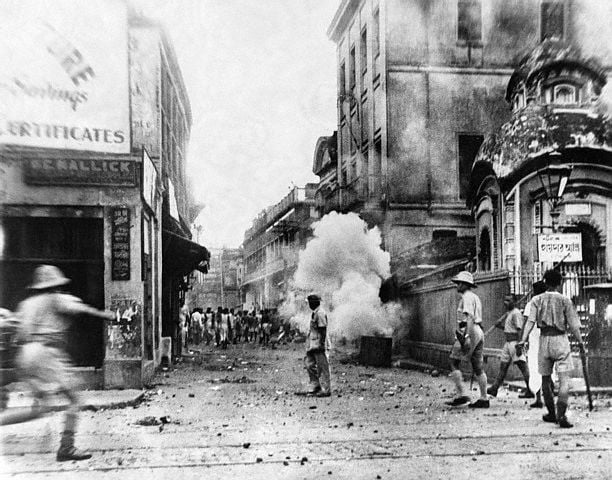
The main feature of political life in India during recent years, and particularly during the past year, 1s the break-up of the Swarajist Party and the growing Hindu-Mussulman strife. From all the large cities in India news comes of men being killed and wounded in riots. These conflicts reached their culminating point in Calcutta, where open war broke out between the Hindus and the Mohammedans. The fighting lasted throughout the whole of April and assumed a very fierce character. The combatants employed all sorts of weapons, including stones, bamboo sticks, rifles, revolvers and even bombs. Over 100 were killed and a thousand seriously wounded in these conflicts.
It is not surprising that the whole of India is closely watching these rivalries between the Hindus and the Mussulmen, who together represent 90 per cent. of the population of the country. The Hindus number 217 millions, or 6S per cent., while the Mohammedans are 63 millions or 22 per cent. of the population. The intensity of the hostility between these two religious denominations can be judged from the reports in the newspapers. At the time of the Calcutta riots a Mohammedan organisation issued a leaflet which contained the following:
Incitement to Massacre
“Mussulmen beware! Since last evening the Hindus have been attacking Mussulmen. The Hindus have killed hundreds of Mussulmen, their homes have been burned down and their shops plundered. Mussulmen must not stand by idly and peacefully; every single Mussulman life must be paid for with 100 Hindu lives. Wherever a Hindu city dweller or peasant is found he must be killed on the spot. Massacre the Hindus as far as lies in your power!”
The present relations between the Hindus and the Mussulmen is having a serious effect upon the national movement. Owing to the development of this religious antagonism, which is the result of the deliberate policy of the British, a special political school of communalism has arisen. Communalism maintains that the Indian people can and should act along the line of common national and religious views. On the basis of this principle special organisations have sprung up both among the Hindus and the Mussulmen. The principal aim of the Mussulman League and the new Indian Mussulman Party is to protect the interests of their co-religionists as against the interests of the Hindus.
The interests of the latter are protected by a no less powerful and reactionary organisation, the Hindusakaba, and in these organisations even more or less revolutionary nationalists are converted into agents for inflaming the religious prejudices of the masses. A deplorable consequence of this is the split in the national movement in India; even one section of the workers is being hounded against the other.
The British imperialists declare that this strife exists in the country because India does not represent a single nation. Sir John Strachey, the ex-Governor of the United Provinces, once declared that the most important problem that has to be studied in India is that there is not, and never has been, a united nation having, according to European ideas, anything in the nature of physical, political, social and religious unity. There is no Indian nation, no Indian people about which we hear so much. (“India,” by Sir John Strachey.) From this the conclusion is drawn that India must have a neutral foreign government which shall restrain the country from automatic collapse. The “Times” frankly declares that the Calcutta riots are one more proof of the practical impossibility of giving India “Swaraj,” and that those who demand Home Rule for India do not understand the Hindu-Mussulman problem, although that problem is of first-class importance.
Economic Causes
As a matter of fact, the primary cause of the Hindu-Mussulman strife is not that it is impossible to unite all the nationalities populating India into a united and independent State. The real cause of this strife lies in the economic conditions of the Hindus and Mussulmen respectively. The Mussulman bourgeoisie represents the most conservative section of the Indian bourgeoisie. While the Hindu bourgeoisie, added by the National Congress, was fighting British imperialism in defence of its interests from the end of the last century, the Mussulman bourgeoisie, as such, had then not yet arisen. It is not surprising that at that time the Mussulman League was established as a counter-balance to the National Congress. This League was an organisation of Mohammedan landowners, who represented the social bulwark of British rule in India. The whole activity of the League consisted in combating the National Congress, the majority of the members of which were Hindus. Naturally, the Mussulman landlords found it to their advantage to give this struggle a religious character.
At the present time one of the factors in Hindu-Mussulman strife is the competition between Mussulman merchant capitalism and the more developed industrial commercial capital of the Hindus. This is indicated by the fact that the majority of those who took part in the Calcutta riots were Hindu and Mussulman merchants. The attacks of the Mussulmen were directed largely against the Hindu merchants. The situation becomes more complicated from the fact that in some provinces the peasants are Mohammedans and the landlords are Hindus, while in other provinces the position is just the reverse.
The Moplah Rising
The Moplah rising on the Malabar coast was purely peasant in character, both in its aims and those who took part in it. As, however, the landlords in this district are Hindus they described the revolt of the peasants as a Mussulman attack upon the Hindus. This they did in the hope that they would obtain the help of other Hindus, including peasants.
A similar state of affairs prevails in Bengal, the centre of Hindu-Mussulman strife. Here, too, the strife is not religious but social, and is a problem of first-class importance. In Bengal the majority of the Mohammedans are peasants, the landlords are in the main Hindus; the exploitation of the peasants by the landlords has assumed terrible dimensions. If to this is added the exploitation of the peasants by usurers who are also Hindus, it will be clear that the conditions of the peasantry are absolutely intolerable. Nearly 45 per cent. of the peasants are almost constantly in debt to the usurers, who extort interest amounting sometimes to 75 per cent. per annum. Moreover, we must bear in mind the heavy burden of taxation and the extreme shortage of land from which the peasants suffer. The Bengal peasant on the average possesses about three acres of land.
From this it will be clear what measures the Hindu peasant must take in order to emancipate himself from his present slavery. First, the abolition of British imperialism which extorts excessive taxes and fosters Indian feudalism. Secondly, the confiscation of the land from the Hindu feudal landlords. The discontent of the peasantry, however, found expression in quite a different direction. The Mohammedan bourgeoisie of India has taken advantage and continues to take advantage of the discontent of the peasants in order to increase their political and economic influence. The Mohammedans occupy 45 per cent. of the seats in legislative and civil bodies. They preach to the peasantry that they must support them in holding these seats, on the ground that they, the bourgeoisie, will protect the interests of whole Mussulman population of India.
Divide and Rule
This brings us to the policy of the British Government which is based on the principle of “divide and rule.” Were it not for the system of separate representation for Mussulmen and Hindus in the various legislative bodies, the fight of the Mussulmen to obtain 45 per cent. of the seats would not be so acute. The reactionary Mussulmen leaders would not be tempted by soft jobs, and undoubtedly they would cease to preach the sacred ideas of Islam. The British imperialists, however, foresaw that such a system would be of great advantage to them, and it was on these grounds that they introduced the reforms, which from 1909 to the present day have been directed towards creating a privileged position for the Mohammedans. The British have carried out this system in the most cunning manner. The privileged position of the Mohammedans inevitably gives rise to strife between the Hindus and the Mohammedans. A definite number of the seats on legislative bodies are allocated to the Mohammedans “in view of their special position.” On the surface the British appear to defend the numerically weak Mussulman communities, but as a matter of fact they sow discord and rouse a Hindu-Mussulman conflict.
The British imperialists stick at nothing in order to maintain their rule in India. At the present time when India is advancing by great strides towards industrialisation, and consequently the division of society into various castes is dying out and religious prejudices are disappearing, the British are exerting every effort to set one religious denomination against the other, for this purpose they set up their special electoral systems.
As Lenin wrote in his article, “Progressive Asia and Backward Europe,” when speaking of the imperialist bourgeoisie: “The dying bourgeoisie is combining with the obsolete and dying forces in order to preserve tottering wage slavery.” It is precisely the obsolete and dying religious and caste divisions in Indian society that the British are trying to preserve by creating a privileged position for the Mohammedans. The British imperialists by their experience in Ireland know how it is possible to utilise national minorities for the purpose of strengthening and prolonging their rule. In India these national minorities are the Mohammedans. It has long been known that the British were most active in the establishment of the Mussulman League, the fundamental purpose of which is to combat Indian nationalism. The present system of creating “special” Mussulman interests is a continuation of the policy of “divide and rule.”
Strengthening the Bureaucrats
We saw an example of this mutual strife during the elections to the Indian “parliament.” The “Bombay Chronicle,” of 25/1/26, was quite right when it declared that there is not a single patriotic Hindu who is not pained by the sight of internecine strife carried on under the guise of an election campaign. This strife demoralises and paralyses the forces working for the emancipation of India. This state of affairs is a source of strength and of rejoicing for the bureaucracy.
The policy of setting one denomination against the other is being continued. There is not the slightest doubt that the Calcutta riots were a result of the provocation of the British Government. Immediately after the riots broke out the British Government began to spread the legend that the Hindu-Mussulman strife and the Calcutta riots in particular show that India would not be able to govern herself if the British were to leave. Moreover, the British press asserted that the Calcutta riots were caused by the fact that the masses of the Indians were dismayed by the prospect of the further limitation of British authority in India. The very impatience revealed by the British authorities in proclaiming to the whole world that India was not ready for Home Rule exposed their real desire.
At the time of the Calcutta riots the city, which usually seethes with commercial life, was a scene of desolation. All the shops were closed. With the exception of a casual vehicle carrying some sower of panic, not a sign of life was seen on the streets, apart of course from the military and police patrols. In the European part of the city, life went on as if nothing were happening. The life of the Europeans represented the very opposite of that of the Hindus and Mussulmen. This the “Times” had to admit when it wrote: “Calcutta always represented a city of contrasts, and these contrasts were never so glaring as during the Hindu-Mussulman riots.”
After the provocative role played by the British Government in the Calcutta events had become evident, the latter tried to throw the blame upon alleged agents of Soviet Russia. The editor of an important organ of British imperialism in India wrote: “On April 22, a person of authority asked me in all seriousness whether there was any truth in the story that the rioters had been bribed by Soviet agents in order to discredit the Government. I could not persuade my interlocutor that this was not the case. If indeed Soviet money has been distributed in Calcutta, then who received it? Or perhaps there were Bolshevik agents in both camps? Mussulman and Hindu leaders say that there are heads and organisations which foster the fanaticism of the masses. This is the common opinion concerning the twofold deception of Moscow which supplies both parties with money.”—(“Capital,” April 22, 1926).
British Action
Here is another example of how Hindu-Mussulman strife is encouraged, and how the Mussulman community is exploited by the British Government. During the Mussulman festival in Delhi, during which a cow has to be sacrificed, the Hindu Mayor of the city prohibited the Mohammedan procession from passing through the streets in which Hindus lived in order to avoid trouble. But a British official intervened and told the Mohammedans that they could pass through any street they desired. This British official himself solemnly marched at the head of the procession, and thus heroically “defended” the Mussulman faith from attacks of the Hindus.
This British official succeeded in achieving his object. A Mussulman daily, which up till then had been attacking the British Government, came out with a report under screaming headlines to the effect that “the Hindu Mayor had prohibited our procession, but a British official on the contrary permitted the procession to take place and even marched at the head of it.” This will make it clear by what methods the British carry out their policy of setting Mohammedans against Hindus and Hindus against Mohammedans.
The last reason, but by no means the least in importance, for Hindu-Mussulman strife is the wrong policy conducted by the Indian Nationalist Movement on this question. The attempts of the nationalists to smooth out these differences produce the very opposite results from those desired. The social revolution alone can bring about a complete solution of the Hindu-Mussulman problem.
As we have pointed out already, the root of these disagreements lies in the present-day social relations of India. This means that only a progressively developed India, i.e., an India freed from all religious prejudices and caste privileges, can ensure both communities against a repetition of Hindu-Mussulman strife. Hence in order to remove the disagreement it is necessary that the interests of the combined toiling masses of the Hindu and Mussulman communities should serve as the basis for the national-revolutionary struggle. Instead of doing this the Indian nationalists tried all the time to foster and strengthen religious traditions and prejudices, and on the strength of this bring about a compromise between various groups and call it community.
The Hindu nationalist call: “Back to the old days,” and the call of the Indian Mussulmen: “Back to the Khalifat,” express this tendency of accentuating religious prejudices. This cannot but foster sectarian moods among Hindus and Mussulmen, and these moods inevitably find expression in increased strife between the two denominations. It is absurd to expect that agreement can be reached on this basis.
Even the most revolutionary organisation in India, the Swaraj Party, failed to solve this problem. Its attempt to reach an agreement by the proposal to share posts between Hindus and Mussulmen in the Nationalist India of the future is an attempt to smooth out antagonisms on the basis of group distinctions. This will not solve the problem; on the contrary, it will make the antagonisms between the two national religious groups in India more acute.
How Nationalism Grew
The history of Indian nationalism may be divided into three periods. In the first period, Indian nationalists adopted the Western ideology. All that was Indian was rejected, all that was European was to serve as something worthy of imitation.
The second period of development of Indian nationalism marked a reaction against the capitulation of Indian nationalism to European culture. In order to combat capitalist culture, a high type of proletarian culture was required, but traces of the proletariat in India could only be discovered with the aid of a microscope at that time. In the same way as the Russian Narodniki (Populists), in their fight against Tsarism, based their revolutionary theories on pre-capitalist forms of economy (the “mir” or commune) so the Indian nationalists at that time turned to the feudal and medieval system, its superstitions and prejudices. Out of the decaying relics of religious and metaphysical views, on the ruins of the village communes and out of the relics of the departed glory of a by-gone civilisation they tried to realise the golden dream of an Indian culture, which was to serve as their ideal and guiding star.
The present period of development of the national-revolutionary movement in India brings with it the chance to solve the Hindu-Mussulman problem. The modern Indian big bourgeoisie is allied with, British imperialism. The driving forces of the revolution to-day are the proletariat, the peasantry and the petty bourgeoisie (the artisans, small traders and the petty bourgeois intelligentsia). The economic conditions of these classes are becoming worse and worse, for the compromise between British and Indian capital is based upon intensified exploitation of these classes. The struggle of the latter against imperialism therefore is an historically necessary struggle. In this struggle the proletariat will assume the leadership. This means that the basis of a national struggle will become wider. This will lead to the dying out of group and religious distinctions, for common problems will take supreme place above all others. We see therefore that the solution of the Hindu-Mussulman problem is a function of the social struggle of the workers and peasants.
Through the Class Struggle
From what has been said it follows that the only way Hindu-Mussulman strife can be abolished in India is through the class struggle and the elimination of the survivals of religious ideals in the country. It is the duty of true revolutionaries to introduce, develop and strengthen the conscious elements in this struggle. The Indian Nationalists however, fail to understand the necessity for such work. More than that even, they look expectantly to the government in the hope that they will take measures to prevent the spread of this strife in India.
In their opinion the British Government represents the only ray of hope amidst the gloom that now overshadows India. The “Indian Review,” in a leading article dealing with the Hindu-Mussulman question, points out that the situation is not as gloomy as it may appear at first sight. There are forces which will bring about mutual harmony between Hindus and Mussulmen. These forces are a source of rejoicing for they are invincible. It would be as well to bear that in mind at the present time when the cult of separatism is in its ascendancy. First place among those who are striving to weaken communal differences and restore communal harmony must, in the opinion of the “Indian Review,” belong to Lord Irwin!
The character of the “neutrality” of the British with regard to the caste system in India is very well known. The British and Indian manufacturers artificially maintain the existence of the caste system. On the other hand, however, the factory system and capitalist exploitation of the rural districts are destroying the feudal forms of social life. The spectre of the class struggle is beginning to haunt India. Hindu-Mussulman strife is partly an expression of the class struggle.
Workers and Peasants
Reports in the newspapers show that in the majority of conflicts in Bengal the Mohammedans were the attacking party. The Indian Nationalists fail to understand why it is that the Mohammedans and not the Hindus are the attacking party. This is due to the fact that in the majority the Mohammedans are subject to the Hindus. In Bengal go per cent. of the capitalist employers are Hindus.
This grain of fact is worth more than a bushel of argument. It clearly shows that the Hindu-Mussulman strife is an expression of the spirit of irreconcilable protest on the part of the workers and peasants against their present conditions of life. Our task is to free these masses from the dirty rags of religious and caste distinctions hampering the development of the class struggle. This alone will free India from a recrudescence of Hindu-Mussulman strife.
The ECCI published the magazine ‘Communist International’ edited by Zinoviev and Karl Radek from 1919 until 1926 irregularly in German, French, Russian, and English. Restarting in 1927 until 1934. Unlike, Inprecorr, CI contained long-form articles by the leading figures of the International as well as proceedings, statements, and notices of the Comintern. No complete run of Communist International is available in English. Both were largely published outside of Soviet territory, with Communist International printed in London, to facilitate distribution and both were major contributors to the Communist press in the U.S. Communist International and Inprecorr are an invaluable English-language source on the history of the Communist International and its sections.
PDF of full issue: https://www.marxists.org/history/international/comintern/ci/vol-4/v04-n05-mar-30-1927-CI-grn-riaz.pdf
 Revolution's Newsstand