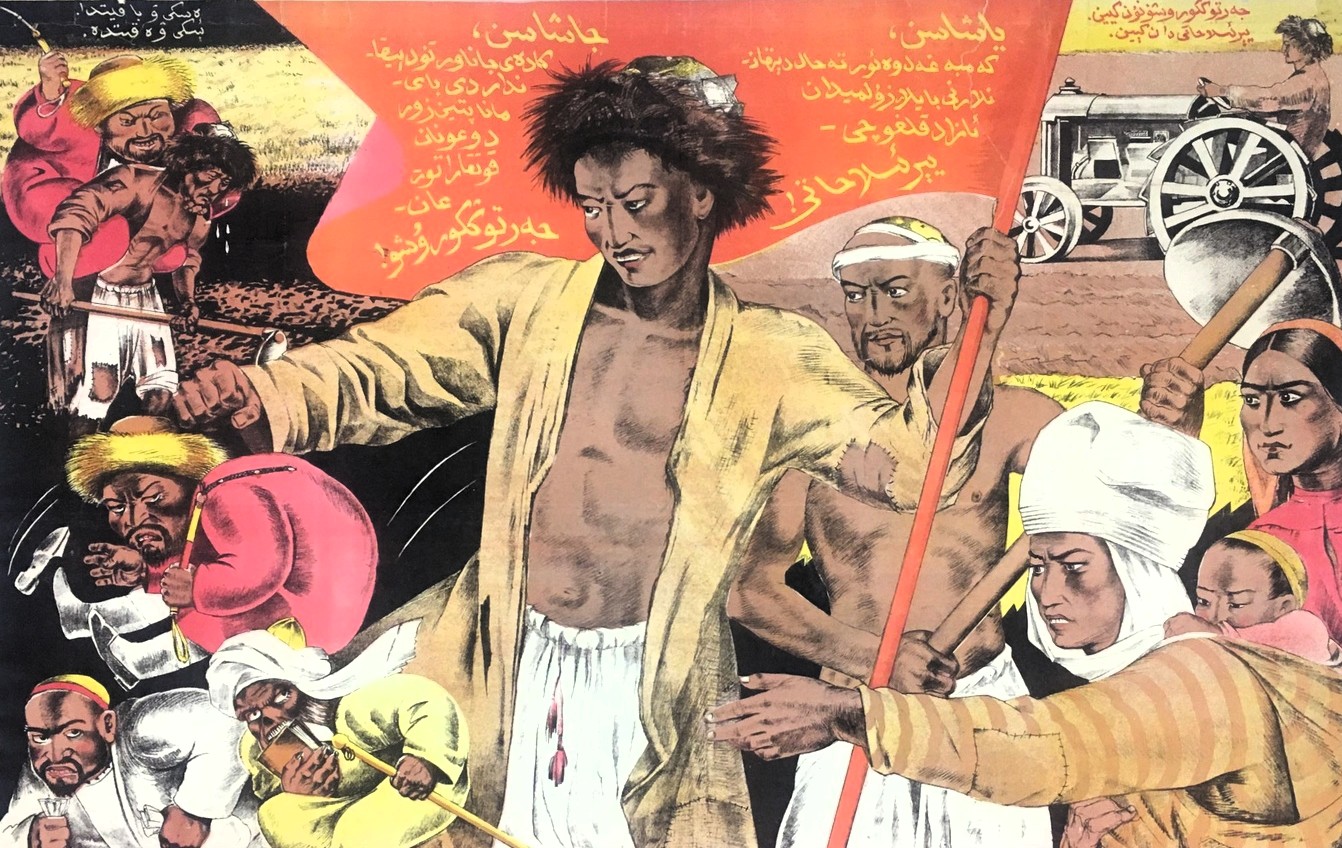
Soviet state policy towards imperialism and the oppressed and colonial world was a new departure. Harrison contrasts the treatment meted out by the Imperial state to the colonial world with Soviet relations to those same states and the national policy of the newly-formed U.S.S.R.
‘Soviet Russia and Oppressed Nationalities’ by Harrison George from The Daily Worker Magazine. Vol. 2 No. 192. November 1, 1924.
Out of the peculiarly complex struggles going on all over the world three major conflicts stand out, according to G. Chicherin, commissar for foreign affairs in the Soviet Union. These are–first, the world-wide struggle between capital and labor; second, the antagonisms between the great powers, and, third, the increasing struggle between the mother “robber” countries and their colonies.
These are often intertwined. It may be said that the greatest conflicts between capitalist powers arise, during this period of historical decline of capitalism, over the struggle for colonies. The great powers seek not only to snatch from each other the prize of colonial plunder, but to crush and subjugate each other. Germany, we see, has become a colony of, first, the entente, which, in turn, has been subjugated to the suave but arrogant imperialism of America thru the Dawes’ plan. Germany definitely enters the list of oppressed nationalities.
But, laying aside the enslavement of Germany and its political consequences, we see that the position of the colonial oppressed peoples are of tremendous importance, particularly as a strategic position in the class struggle of the proletariat against the forces of imperialist capitalism.
The Great Slave Empires.
The nine colony-holding countries, England, France, the United States, Spain, Italy, Japan, Belgium, Portugal and Holland, hold in colonial lands five times their own area, and, with their own total population of 320,657,000, hold as colonial slaves no less than 560,200,000 people. Britain has a colonial population eight and a half times her home population, while France exploits a colonial population of 16,600,000 more than the population of France itself.
The Balkans and the Near East are imperialist satrapies. The continent of Asia (leaving out Soviet territory) has been a bound and blind victim of the vultures of the Occident. Africa from end to end, from “Cape to Cairo” is a vast slave pen. With whiskey and opium, the bible and the repeating rifle, the black and brown and yellow millions carry the burden of imperialist exploitation, of industry seeking raw material and cheap labor, of traders seeking markets, of diplomats looking for oil and man power, of bankers seeking export of capital, of all of these seeking super-profits from subject nationalities in excess of the profit rate in domestic production.
The program of the Communists is comparatively simple. The solution of exploitation, of misery and oppression can be shortly stated, even if the accomplishment is long in reaching. It is, in one word–“revolution.” But before elaborating upon it, a view, or a review, is necessary of the methods of imperialist capitalism in the oppression of what are called “backward peoples.”
The favorite weapon of imperialism is plain brute force. It does, of course, moralize in the home country and before the world. It is always “advancing civilization, developing the country, building good roads (a favorite pursuit of General Wood), stopping the slave traffic, (in the name of wage slavery), forwarding Christianity (and the opium trade) and liberating oppressed races (from other ‘liberators’).”
The Missionaries of Imperialism.
The American imperialists have their peculiar method. Kalinin, president of the Soviet Union, speaking last year in Eastern Siberia, upon the expulsion by the red army from that region of all invading armies, including the American, mentioned the saintly imperialism of American interventionists. “Not without reason,” he said, “did American capitalism appear as in the highest degree religious, bringing into the occupied territory the bible, with America’s own preachers, including Baptists and Methodists.”
“What led Americans to do all this? The only reason is the following: Thru these preachers America established her first advance posts, thru which she will in the future exert influence and develop her commercial business. America takes this line not only with us, but in China. American capital in China has developed a whole series of institutions making easier the obtaining of profit by American capital, chambers of commerce, missionaries’ organizations and so on. To outside appearances these serve the Chinese populace, but at bottom they follow economic interests.”
Marx Versus the Gospel.
The chief counter-action against this sanctified imperialism, has been and is the program of proletarian revolution. I recall that one of the best laughs I got while in Leavenworth, was upon reading the accounts, told in the manner of horrified bourgeois, of how the American missionary force in China, had raised a huge fund in America to finance free, wide-spread distribution of the bible printed in Chinese. After millions had been printed and hundreds of thousands distributed, it was discovered that the “heathen Chinee” printers had se religiously inserted in the middle of the holy book, the entire Communist Manifesto, bound in and printed in the same type as the gospel!
Again, in the last few days, American imperialism with its Nazarene face, has received a slap by the Shinto-Buddhist Japan, who, in the contest between its own satrap, Chang Tso-Lin and the American-British hireling Wu Pei Fu, checkmated western imperialists by calmly bribing a “Christian general” to mutiny against Wu and seize the central Peking government.
The policy of the Soviet Union toward the oppressed nations is well-illustrated in this same country of China. Since the 1911 revolution when the nation was dismembered by the imperialists, China as a unified nation has not existed. She has been the sport and victim of quarrelling imperialists. The Russian revolution removed the ominous czarist threat, but so firmly had the western imperialists gotten the various Chinese rulers in their clutches, that none would recognize China’s only friend–Soviet Russia. Some even did the bidding of the imperialists and sent Chinese troops into Siberia and gave the Chinese Eastern railway over to the white guard Russians.
China and the Soviets.
But the power of the red army soon swept all interventionists into the sea. The magnanimous treatment of Mongolia and the Soviets’ offer to renounce all the czarist concessions and extra-territorial rights, so hated by the Chinese, as well as foregoing the Boxer indemnity, was a tremendous pressure. China, even the servile Tsao Kun, established in Peking by the power of Standard Oil, finally recognized the Soviet Union.
Particularly in South China, where the revolutionary workers and the native intelligentsia have organized with the peasants into the powerful nationalist revolutionary party, the Kuomintang, controlling the Canton government of Sun Yat Sen, is the Soviet Union looked upon with fervid hope as the Great Deliverer.
The anniversary of the bolshevik revolution is a public holiday in South China, and upon the death of Lenín great ceremonials in which the whole populace, with the exception of the Chinese merchant fascisti organized by Britain, took part.
Trotsky’s Lesson for the Orient.
The policy of the Soviet Union is well expressed in the answer of Trotsky to the message sent him by the Oriental Society for Struggle Against Imperialism, which said in part:
“True to the will of the founder, the Union of Soviet Republics will altogether and entirely remain on the side of the oppressed against the oppressors. By their opprobrious work of violence the imperialists are driving the Chinese people to hate every foreigner and everything foreign.
“It is, however, the task of Chinese revolutionists, in order to guard the Chinese people from chauvinism, to teach it to distinguish in every capitalistic nation between two fundamental classes the imperialistic bourgeoisie and the revolutionary proletariat. It is only in union with the workers of the world that the Chinese democracy will repel the new imperialist onslaught on the national independence of the Chinese people.”
Leaving China, let us see how the peoples of the Near East are treated. Let us take their own versions of how they “civilize backward nations,” and analyze them.
Palestine Grabbed for “Sentiment.”
Albert Montefiore Hyamson, controller of labor in the government of Palestine says that, while the issue between British and Turkish arms was still uncertain in that land, the Zionist leaders “especially those who happened to be in England” and who were “not slow in seeing possibilities” opened negotiations with the British government, with the result that by a declaration of Lord Balfour in November, 1917, a practical protectorate was established by Great Britain over Palestine. The motives, says Hyamson coyly, “Were complex. Prominent among them were the sentimental and religious interests in the return of the Jews to Palestine. Another motive doubtless (very probable, indeed–H.G.) was the desire for the security of the imperial communications with India and Australia.”
His excellency, the controller of labor, goes on to say how native Arab agitation against this state of affairs grew, and he observes this was increased by, of course, “a wrong interpretation” of the “promise of Arab independence made by the British government in 1915. Affairs became worse until anti-Jewish outbreaks occurred in which many Jews were killed at Jerusalem on Easter, 1920.” The British, doubtless out of pure sympathy with the Jews and not at all influenced by solicitude for “imperial communications” hastened to declare a military rule under Sir Herbert Samuel, and “the riot was suppressed and punishment meted out.”
The Arabs began a non-co-operation movement somewhat flavored with riots. But the league of nations in September, 1923, formally allotted Palestine as a “mandate” to the British crown and covered the whole mass of duplicity and imperialism with an odor of international sanctity. The armed forces of Britain still rule by force over the preponderant Arab population. The bible and the Talmud are in alliance protecting “imperial communications with India,” and doubtlessly, some undeveloped oil fields.
British Bandits in Persia.
In Persia, says Brigadier General Sir Percy Sykes, who was (some of the time) a peace-loving consul general, and sometimes a leader of marauding bands of British mercenaries euphemistically called the “South Persian Rifles,” “The policy of Great Britain was and is to maintain the independence of Persia, which has served so long as a valuable buffer between the Indian empire and Russia.” He adds as a mere afterthought that the merchants of London and Bombay were deeply interested in Persian trade, and that “the oil resources of Persia are her greatest assets.”
Sir Percy did his best to grab these things for England, and even to lay hands upon the Soviet oil fields of Baku. Of course, he found good moral grounds for this. He says that “The collapse of Russia constituted a serious blow to the Indian empire.” Besides, the infernal Germans were trying to get Baku first. A brigand crew of mercenaries politely termed a “British Military Mission” dashed across 700 miles of supposedly neutral Persian ground, united with the counter-revolutionary white guard Cossacks and seized Baku.
The Red Army Smokes Them Out.
These bands were, of course, later put out, together with both Germans and Turks, by the red any of real liberation. But imperialist Germany and Britain continued to use Persia as a bone to quarrel over. The native Persians rose against both and drove back Sir Percy and his “South Persian Rifles.” The interest of England in these looting bands of white guards, may well be seen by Sir Percy’s own admission that if his forces had been completely routed, “There would have been a rising in the Punjab, which was seething with sedition. As it was, this did not take place until the following year when the war had been won.” And, then, we may add, with no democratic pretenses to sustain, the machine guns of the British military suppressed the Indians with barbarous massacres at Amristar, and other points.
At the end of the war, England attempted to use her victory by reducing Persia to a vassal state. She attempted to subsidize Persia to form a white guard base against Soviet Russia, offering to finance a “Persian” army of counter-revolutionary sacks. But the Soviet policy of real friendship, the surrender of various concessions forced on Persia by the czar, caused a popular uprising against England and the Persian parliament was forced to denounce this scheme.
The treatment of the people of Irak, an artificially created nation at the door of Persia, with a “king” who is as servile to British imperialism as Ramsay MacDonald, is well known. Even under the alleged “labor government” the natives who rebel against the satrapy, are massacred–men, women and children indiscriminately, by airplane bombs of the British army. So sickening has been these massacres that the soldiers of the air force protested to the “labor” government at the butchery, but were ordered by these “pacifist” members of the Second International to proceed.
The Ruthless Treatment of India.
The fight of the Communists to bring a real liberation to the oppressed nationalities may be seen clearly in the case of India. We see first the steel-shod feet of England crushing the lives of teeming millions. Without India the British empire would not last a day. For good reason does England send her best bloodhounds and “firmest” statesman to service in India.
One of these, Sir Thomas W. Holderness, tells us in his smug imperialist way of the recent years’ relations between India and what he calmly assumes is “the paramount power.” He speaks of the “gracious proclamation” of King Edward, of the “notable vice-royalty” of Lord Curzon, of the “courage and tenacity” of Lord Morley and Lord Minte against the “misguided zealots” who answered oppression with tyrannicide, of the “demonstrations of loyalty” upon the visits of the royal family in 1911, strangely followed by “deep-seated anarchy” and attempts to assassinate Lord Hardinge.
“Educated” and the “Malcontents”
A new tone comes into Sir Thomas’ voice when he discusses the relations of the Indian people and the “para mount power” during and after the war. Subtly, he praises the “military races,” the “territorial aristocracy” and the “educated classes” who “in many touching ways” demonstrated their loyalty to “the throne.” He adds in the way of ecstatic philosophy, “the personal relation which kingship embodies is of magic power still in the East.” True, he asserts, that some Sikhs, “indoctrinated with revolutionary principles,” some “malcontents in the Indian army” and so on, did not fully appreciate the blessings of the “paramount power.” “But,” he added, “a vigilant government, armed with sharpened powers” successfully dealt with them.
The war began a great upheaval, in spite of the “touching” demonstrations of loyalty by the “educated classes.” India sent-sometimes by plain conscription, and usually with virtual compulsion or purchase, 800,000 combatants and 400,000 non-combatant army laborers to France. India, always with her millions on the edge of famine, was drained of food. Prices rose for the masses while the “ruling princes and territorial magnates” lashed them off to fight for the white overlord and the manufacturers and trade “reaped substantial fortunes.” It was necessary that “British freedom” should protect itself with repressive laws, and the Rowlatt bill passed by Lord Chelmsford was meant “for dealing with revolutionary crime.” The native capitalists were quick to turn the rage of the masses against the English rule in order to force from Britain their own swaraj or self-government, meaning their right to oppress the Indian masses without sharing the loot with English imperialism. Mahatma Ghandi appeared as the bourgeois-pacifist type, seeking to oppose to British arms the “soul force” of the Indian masses, preaching non-resistance, the boycott and historical reversion to the spinning wheel against the “satanic government” of England.
The Slave Pen Called Africa.
There remains the great slave-pen, Africa. In Tunis, Algiers and Morocco, the natives are made into serfs after their lands are seized by the French. In the towns the natives fight with the dogs for garbage cans, in famine years they die by the road-sides. In west and equatorial Africa a system of “hostages” prevails, old people, women and children are imprisoned in vile barracks to insure the enslaved male workers from running away. If one escapes, the dependents are put to death, and continually they are starved, beaten and treated worse than animals. The unspeakable “civilization” France has given to Africa is vividly pictured in that wonderful book by the French colonial, Rene Maran, entitled, “Batouala.” It may be noted that France plans for an army of 660,000 black soldiers to enforce “law and order” at home and in the colonies.
Does the Civil Liberties Union know that no Negro can leave South Africa legally? He must smuggle himself out as a stowaway to escape from the slave pens run by MacDonald’s “socialist” government. There, 6,000,000 blacks are bossed by 1,500,000 of whites. In the gold mines of the Rand 230,000 black miners toil under 27,000 white overseers.
Oppressed Racial Minorities.
There are, of course, the problems of the oppressed races within nations, such as the Negroes of America, and the various peoples annexed by grace of the Versailles Treaty. But there is not space here to treat of them, though they are highly important and though they, too, turn toward Moscow as to the dawn. The story has been told them of the real freedom brought the obscurest and most backward races under the Soviet Union. How unheard of races under the Arctic circle have now schools and their language taught from printed letters for the first time and that, “in the forming of the central organs of the Soviet Union, all national republics, without exception, be guaranteed equal rights and positions, and that all the needs of the nationalities be satisfied.” Such was the motion passed by the Twelfth Congress of the Russian Communist Party, which administers the Soviet Union.
PDF of full issue: https://www.marxists.org/history/usa/pubs/dailyworker/1924/v02a-n192-supplement-nov-01-1924-DW-LOC.pdf
 Revolution's Newsstand