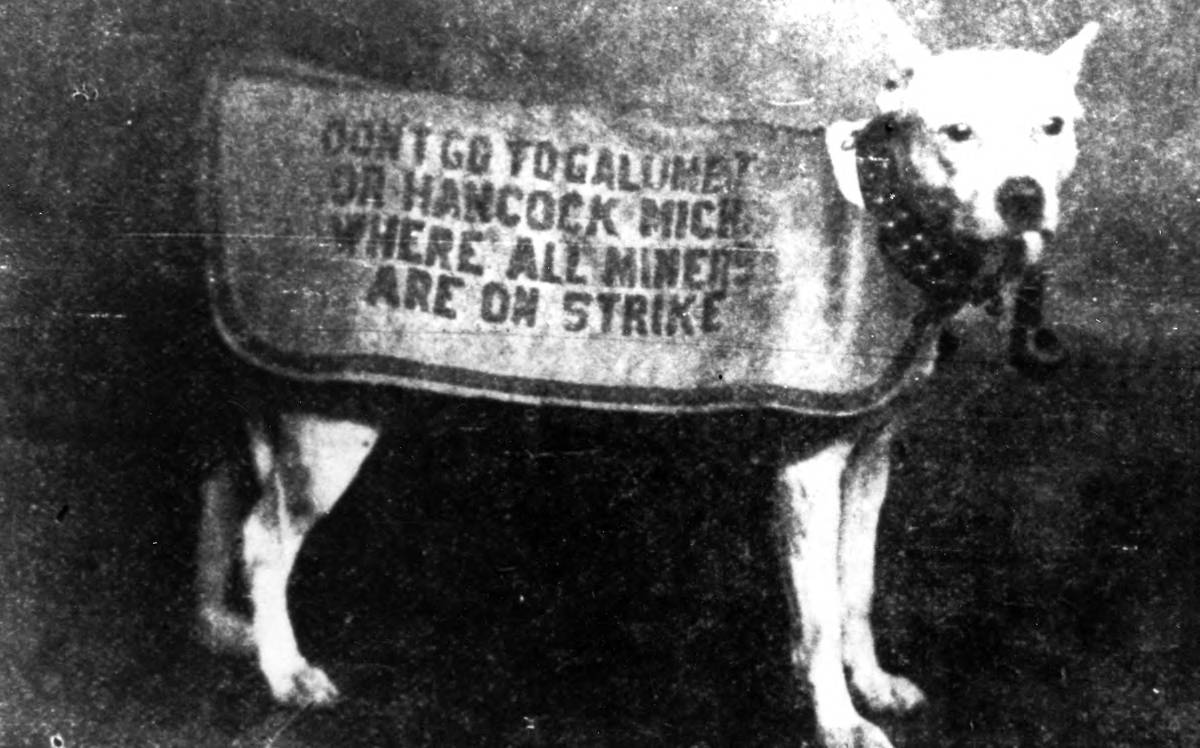
A look at the background of one of the great strikes of the 1910s–that of largely Finnish copper miners in Michigan’s Upper Peninsula.
‘The Copper Miners Strike’ by T.F.G. Dougherty from Solidarity. Vol. 4 No. 32. August 16, 1913.
(Special to Solidarity) Grand Rapids, Mich., Aug. 8. The greatest strike and lockout ever known in Michigan is now on in the upper peninsula of this state, where 15,000 mine workers are on strike and locked out from the mining properties of the Calumet and Hecla, Tomarack, Osceola, Wolverine, Centennial, Mahawk, Ahmeek, Champion, Baltic, Quincy, Isle Royal, Superior, Franklin, Lasalle, and various other smaller mines. The Calumet and Hecla is one of the largest copper mines in the world, exploiting 5,000 slaves, and is said to control all the mines in the Calumet territory, a large area. Not only that, but almost everything in the copper country is either directly owned or controlled by this great labor-skinning company. For years and years the mine workers have been mercilessly skinned by the various companies operating in the rich copper Country of the Calumet region, which is located in Houghton county and includes such towns as Hancock, Red Jacket, and Rainesdale. Apparently these workers could not be organized. They were not eligible for membership in the U.M.W. of A., being metaliferous miners, and the then militant W.F. of M. seemingly was too busy with its battles in the west to attempt to organize in the upper peninsula of Michigan. Also must be noted the fact that the Calumet and Hecla corporation has been able for many years to chloroform its slaves and others by the “benevolent feudalism” it so zealously practiced. It furnished water and electric lights, schools and hospitals, old age pension funds (of which they “generously permitted” the workers to pay part) and “cheap” house rents and many other “humanitarian” tricks which had the effect of lulling the slaves to sleep and brought forth loud and prolonged praise from mealy mouthed sky pilots, hypocritical “reformers,” the prostitutes of capitalist press, the readers and all the other parasites who are supported out of the proceeds of the robbery of the workers.
But with all this, the Socialist Party, due to the importations of large numbers of Finns into the copper region, began to get a foothold and the upper peninsula of recent years has been the stronghold of the S.P. It was in this region, at Hancock, that the red revolutionary “Wage Slave” was published by that good old rebel, A.M. Stirton, and it was mainly through Stirton that the W.F. of M. began its work in the copper region.
The Calumet and Hecla, if all that is said by the mine workers is true–this mighty corporation could well afford the “gratuities” and “benevolences” it so “generously” showered on its slaves. For, be it known, the capitalists and their retainers to the contrary, these workers were paid about $2.50 a day on an average (some a little more, others a great deal less) and were worked from ten to thirteen hours a day, and the conditions under which they worked are said to be of the worst, and besides this many other extortions were practiced them by the kind-hearted managers of the mines. The manager of the C. & H. claims the men only worked eight hours a day, received on an average of $3.25 per day and the conditions under which they worked “ideal” (they were, for the company). James McNaughton, manager of the C. & H., receives, it is said. $120,000 per year, and his salary and that of all other high paid officials, is used in striking the average for the men who work in and about the mines.
The W.F. of M. began to get a foothold a couple of years ago and had a hard time of it, as the workers were fired as fast as their connection with the union was discovered. McNaughton, the great, established a spy system in the mines and every word and act of the men was reported to the czar of the copper country. The W.F. of M. kept at it and finally presented their demands to the mine managers and these demands were flatly refused. On July 23 the W.F. of M. ordered the strike, and the managers responded by locking out all the mine workers; 15,000 miners were on strike and locked out. The demands of the W.F. of M are recognition of the union (said to be the principal demand), a minimum wage of $3 per day, an eight-hour day and abolition of the one-man drill.
On July 24, twenty-four hours after the strike and lockout was in effect, the sheriff of Houghton county sent a call to Gov. Ferris for 2,000 state troops, and on July 25 the national guard of Michigan was on its way to the scene of the strike. The sheriff was hacked up in his call for help by the chairman of the county Democratic committee, although the prosecutor of the county declared there was no necessity for the troops. It is also stated that Gov. Ferris, prior to the call for troops, had instructed the adjutant general to have the troops ready in “case of emergency” In view of the fact that the call came less than 24 hours after the strike and lockout, it looks as though this Democratic governor, who by many (including members of the S.P.) is looked upon and referred to as a socialist, had his eat well attuned to the voice of his master. Had the miners left workers in the mines to operate the pumps and keep the mines from flooding, it is doubtful if the troops would have been called for or sent. But the workers, it is declared, stated they would not permit the pumps to be operated, and, as one correspondent, in referring to the C. & H. mine, said, this valuable property must not be permitted to be ruined–and there ye are. Governor Ferris said there must be no destruction of property, and the refusal of the miners to permit the pumps to be operated, was destruction, of property, and so the militia, composed of workingmen who have no property are sent to guard the masters’ property and shoot down their fellow workers if necessary. And in the militia are many “union” men and the sons of “union” men. One of the electrical workers, out on strike in this city, has gone to the copper country with the militia, as have many furniture workers who were on strike here a few years ago.
The mine managers say they did not call for the militia; that the sheriff did. The mine managers say they do not intend to put scabs at work, but want all their men back to work the same as before. The mine managers say that all they ask is that their property be protected, and it is up to the authorities to do this. They also say emphatically, that they will not recognize, or have any dealings in any way with the W.F. of M. They will deal with their men as individuals only, and the W.F. of M. officials say that the W.F. of M. must be recognized by the mine managers.
It is announced that the retail traders would not extend credit to the miners, but would demand cash for all goods. Also that wholesalers would do business on a cash basis only. This undoubtedly emanated from the mine managers. The mine workers must be defeated; that is the edict. Everything possible is being done to have martial law declared; thus there will be a repetition of Colorado, Idaho and West Virginia.
Three hundred workers, whom the capitalist correspondents call the non-union association of workers, representing 12 different nationalities, are reported to have held a meeting, formulated demands, in which recognition of the union was waived, sought a conference with Czar McNaughton and informed him they were ready to return to work at once, but Jamesy backed water.
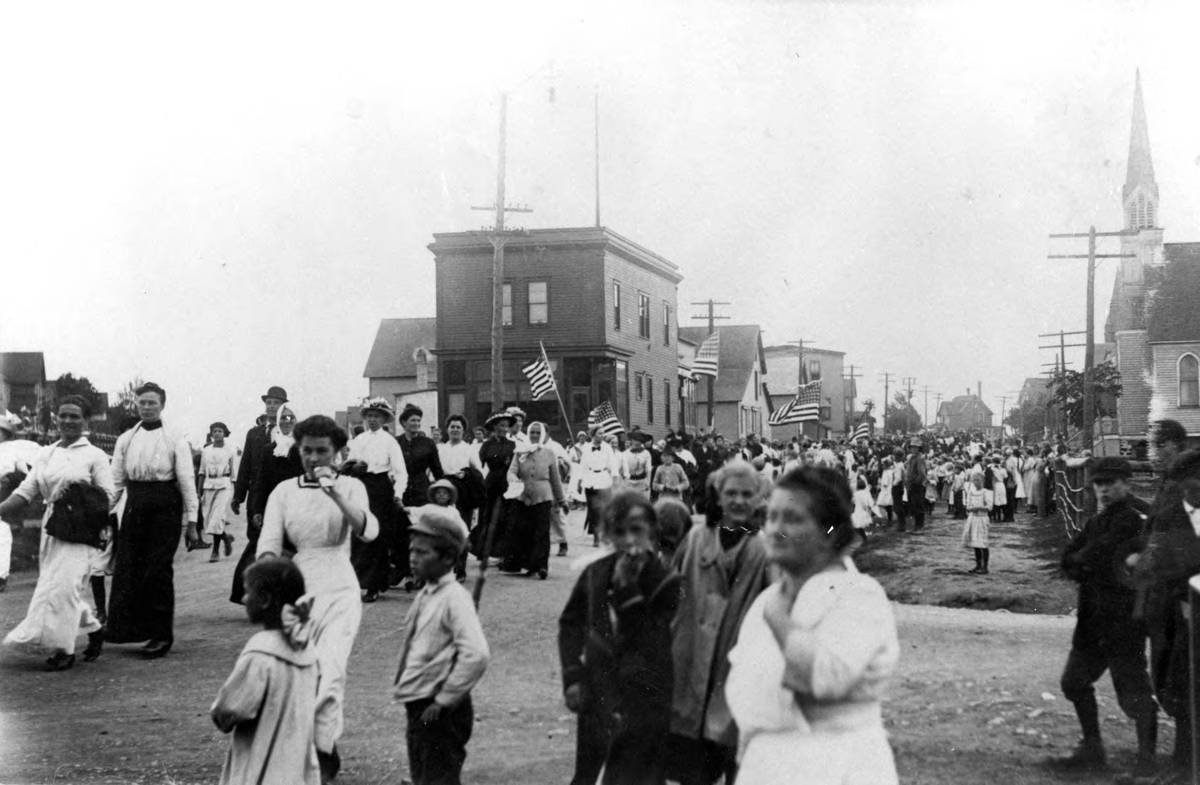
The fact that the mine managers are not anxious about starting up work in the mines, coupled with the other fact that there is said to be a surplus of millions of pounds of copper on hand, makes it look as though the W.F. of M. had unconsciously played into the hands of the mine owners by calling the strike at this time; a shutdown for any length of time will enable the companies to dispose of this surplus stock at increased prices, while the good taxpayers of this state are paying $12,500 per day to protect property which is largely owned by “foreign” capitalists.
The capitalist newspapers have been filled with sickening slush about the militia, who are termed “the boys” and “our boys.” All sorts of sensational and sentimental bull is printed about these ignorant workers who are imbued with religion and patriotism and are trained to do the murderous work of the capitalist class, the most cowardly ruling class in the history of society since economic classes were developed. This ruling class is too cowardly to fight for itself. So it takes its fighters from the subject class and through its “intellectual” prostitutes develops these workers with a fit psychology in the interests of the rulers, perverts their ideals, keeps them ignorant and superstitious, imbues them with false sentiments of “god and country” and sends them forth to murder, if necessary, their own fathers, mothers, brothers) and sisters all in the interest of the capitalist class and its god–PROFIT. Every day the capitalist papers have been filled with hair-raising falsehoods about what the miners had done or were going to do. Conversations were exaggerated: “plots” were discovered and “rumors” were rife and plentiful. Several decidedly fishy stories were sent out of attempts to blow up mines, houses and stores, which were only frustrated by the timely discovery and bravery of the militia, but to date the only fatality was caused by a horse stepping on a member of the militia, who probably didn’t know enough to get out of the intelligent animal’s way. No doubt the horse was ashamed of the company he was in.
The stories of the “brave” militia, thoroughly armed with the latest war equipment, going up against unarmed and defenseless workers, the majority i of whom speak little or no English, makes the capitalists in other parts of the state who must pay the fiddler, think they are getting the worth of their money and that the militia is a good investment. It also tends to overawe other workers and impels them to look on the militia with fear and respect: and yet these “brave” militiamen are so wrought up that every shadow is transformed into an armed and desperate striker and they fire their rifles on the slightest pretext. If the truth were known, diarrhea is undoubtedly quite prevalent among “our brave” boys.
Claude Taylor, president of the Michigan State Federation of Labor, visited the copper country, and stated there was no need for the militia; that miners cannot help but win the strike, and that the A.F. of L. is standing back of the miners. Yes, and the trains which took the soldiers, thugs and gunmen to the copper country were operated by “union” men, some of whom are affiliated with the A. F. of L. and, as stated elsewhere, many “union” men and the sons of “union” meh are members of the state militia. One big union of workers, and the “brave” militia would have to walk to the copper country.
T.F.G. DOUGHERTY.
The most widely read of I.W.W. newspapers, Solidarity was published by the Industrial Workers of the World from 1909 until 1917. First produced in New Castle, Pennsylvania, and born during the McKees Rocks strike, Solidarity later moved to Cleveland, Ohio until 1917 then spent its last months in Chicago. With a circulation of around 12,000 and a readership many times that, Solidarity was instrumental in defining the Wobbly world-view at the height of their influence in the working class. It was edited over its life by A.M. Stirton, H.A. Goff, Ben H. Williams, Ralph Chaplin who also provided much of the paper’s color, and others. Like nearly all the left press it fell victim to federal repression in 1917.
PDF of full issue: https://www.marxists.org/history/usa/pubs/solidarity-iww/1913/v04n32-w188-aug-16-1913-solidarity.pdf
 Revolution's Newsstand